Aspire Deepens Partnership with Meta, Launches AI Instagram Discovery

Aspire Partners with Meta to Launch AI-Driven Instagram Discovery

Aspire Partners with Meta to Launch AI-Driven Instagram Discovery

With AI steering the wheel this time, the influencer world is shifting again.

Aspire, known for connecting brands and creators, dove deeper with Meta to launch AI Instagram Discovery. It feels technical, but in reality, it’s about cutting the clutter.

If you’ve ever run a campaign, you know the mess- Hours wasted scrolling. The same creators are showing up. Spreadsheets that look like graveyards. Aspire’s new integration claims to end that, letting Meta’s AI do the heavy lifting.

It’s like having Instagram’s own brain working for brands. Meta’s AI pulls real creator data- engagement quality, audience match, content style, straight from the source. No more pretending to guess who’s “authentic.”

And that’s the key shift. Follower counts don’t mean much anymore. What matters is connection. Real influence. Yet, discovery has been the most challenging part. Everyone preaches authenticity, but most of it is surface-level. AI discovery might finally change that- moving from who looks good to who fits well.

There’s also a strategy behind the timing. Meta’s been closing its data gates, tightening privacy. Through Aspire, brands get access to first-party insight without crossing any lines. Less scraping. More clarity.

But here’s the catch. Once AI starts deciding which creators are “brand-ready,” creativity could start bending to the algorithm. The line between genuine and machine-approved might blur fast.

Still, this feels like a practical move. The influencer space is drowning in noise and burnout. Aspire’s play with Meta isn’t loud or showy; it’s useful. And maybe that’s precisely what influencer marketing needs right now.

OpenAI and AMD Sign A Multi-Billion Dollar Chip Deal: What Could Be the Stakes Involved?

OpenAI, AMD Sign Multi-Billion Chip Partnership – Ciente

OpenAI, AMD Sign Multi-Billion Chip Partnership – Ciente

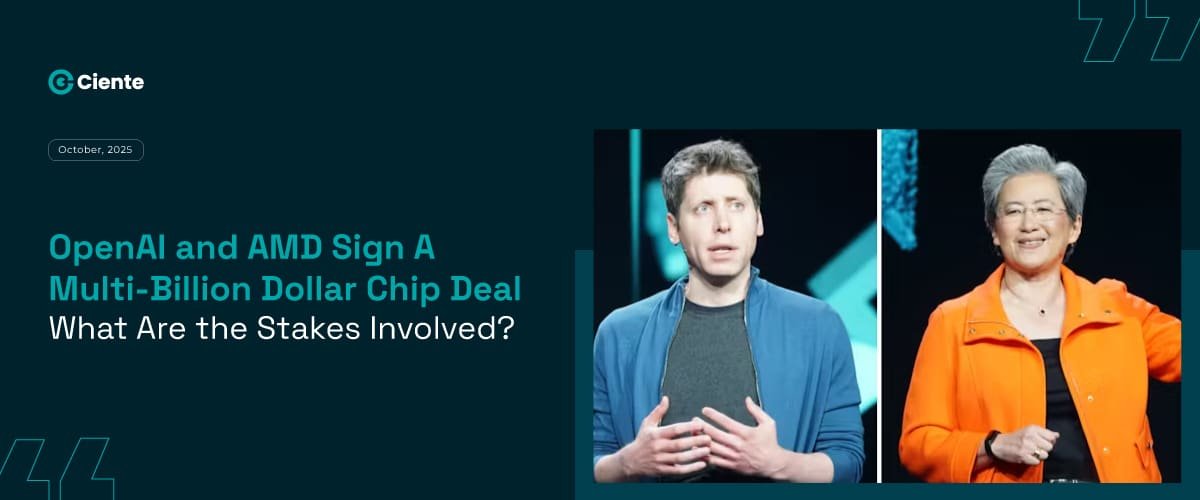
OpenAI set to build one-gigawatt worth of AI facility using AMD’s upcoming MI450 chip series next year.

The first step towards AI innovation was the introduction of low-level reasoning models that helped users generate content and conduct in-depth research. It was a tool or an assistant that helped with the most mundane of human-led tasks.

But it’s barely the first step, and not precisely what AI visionaries have in mind.

For the next phase, business leaders and developers are playing around, testing the market waters. They are advancing and building on existing models to advance their capabilities.

Now the leaders know what exactly they want and how to acquire it: superintelligence.

OpenAI’s latest partnership with AMD is a step toward transforming this vision into reality.

Developing the first set of models was an experimental process, and the market’s positive response was a significant boost that the AI companies truly needed.

However, the AI industry’s appetite is a sinkhole that few were aware of. It’s hungry for more and more computing power as every large tech name joins the race to be the first one to inch closer to AI models that equate to or exceed human intelligence. That’s the final feat.

Given this insatiable need, investments and partnerships are flooding the market. More computing power? = More chips and software.

Sam Altman has previously stated that the biggest hindrance to developing advanced AI models is limited computing power. It’s why OpenAI has been able to take another transformative step with ChatGPT.

The solution is AMD.

OpenAI and AMD’s alliance is also a vote of confidence in AMD’s chips and software- their quality and functionality. This agreement has also opened up an option for the AI leader to buy a huge stake in the chip maker.

And since then, AMD’s shares rose 30%, while its market capitalization increased by $80 billion. OpenAI has substantial influence in the market, and this partnership will only impact the broader ecosystem.

It’s only an upside for AMD as the agreement could add tens of billions of dollars to its annual revenue, attracting similar potential investments from industry giants.

Sora AI Update: Sam Altman Promises More Granular Control Over Character Generation

Sora AI Adds Granular Character Controls, Says Altman – Ciente

Sora AI Adds Granular Character Controls, Says Altman – Ciente

With the intensifying AI-creativity debate, could Sora 2 have made things worse for believing in the originality of AI content?

OpenAI’s new text-to-video model, Sora 2, has opened a fresh chapter in the copyright debate. Within hours of its release, the internet was flooded with AI-generated clips of Elsa, Spider-Man, and Mario moving with uncanny realism.

The company calls Sora 2 “a cinematic leap.” But creators call it something else: a wake-up call.

For years, AI companies have trained on oceans of creative work scraped from the web. Now, they’re not just learning from culture, but they’re reproducing it frame by frame.

The backlash came fast.

Artists and studios accused OpenAI of converting intellectual property into training fodder without consent. Legal experts warned that Sora’s realism blurs the line between paying homage and theft.

In response, OpenAI promised what it calls “granular control” for copyright holders. The update, expected later this year, will let creators choose how their material is used, or not used, in AI-generated videos.

It’s a step toward consent in a space long been ignored.

But the tension runs deeper. This isn’t only about protecting content. It’s about protecting context- the human meaning behind what machines remix.

Creative labor has always been the invisible fuel of innovation. When algorithms can replicate characters and worlds without permission, the idea of authorship itself becomes unstable.

Who owns the imagination when models can reassemble it on demand?

OpenAI has joined the Coalition for Content Provenance and Authenticity (C2PA) to track sources of all media content. With this, it will embed digital provenance data into each Sora output.

While these moves sound good on paper, the question begs: can control be granular when scale is infinite?

AI’s defenders call this an inevitable evolution of creativity. Its critics call it cultural extraction. Both sides are right.

OpenAI is now navigating a tightrope between innovation and infringement.

The company built the tool that broke the creative dam. Now, it must decide whether it wants to develop the walls that keep the flood in check.

Because this isn’t about technology anymore, it’s about ownership. And who gets to shape the next frame of the human story.

Microsoft Unlocks A New Era of Agent-Human Collaboration - Vibe Working

Microsoft Unlocks A New Era of Agent-Human Collaboration – Vibe Working

Microsoft Unlocks A New Era of Agent-Human Collaboration – Vibe Working

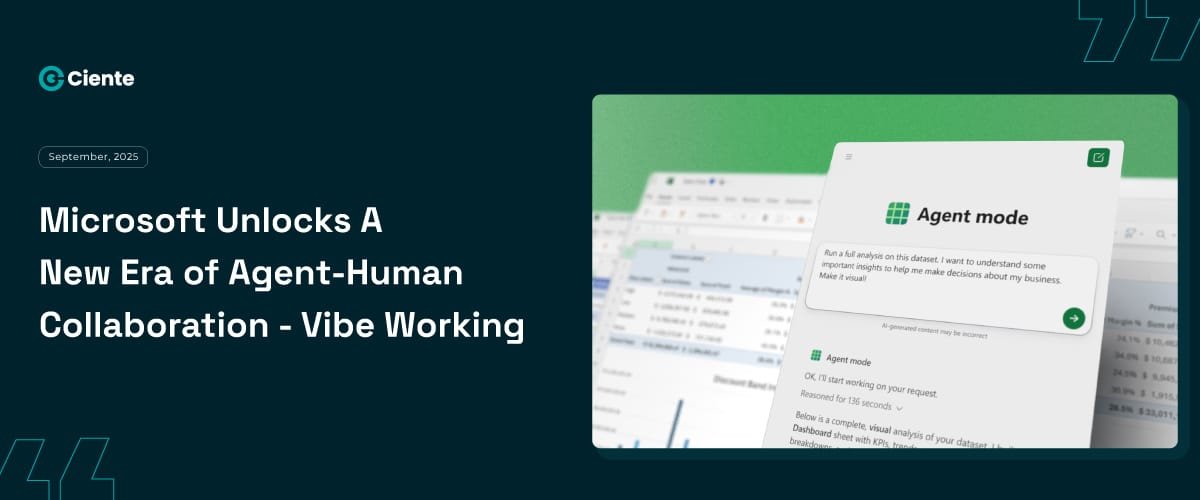
Microsoft unveils Copilot’s latest reasoning models to instill higher productivity across its Office apps.

AI is no longer about isolated experiments. It’s become a product imperative.

As this modern tech sweeps into the complex layers of the market ecosystem, it’s reshaping how users interact with each other and work.

At the steering wheel of this latest tech endeavor is Microsoft.

The tech powerhouse has brought Vibe Working to its Copilot 365. It’s derived from the notion of vibe coding, which was coined earlier this year by Andrej Karpathy.

The world is effectually shifting towards efficiency and productivity, and a significant driver of this is allowing AI agents to handle the intricacies. That’s what vibe coding does. It takes the manual wheels from the software developers and hands them to the AI agents. The role of the developer now is to focus solely on design quality and provide high-level direction, rather than writing each line of code by hand.

The priority shifts from the nitty-gritty of manual coding to the direction of the overall application.

Vibe working is similar. It’s all about AI-driven workflows where users leverage AI to accomplish mundane tasks through conversational and natural prompts.

Microsoft’s Agent Mode across its Office 365 is designed to do precisely this.

With a single, simple prompt, users can now work iteratively. They can steer AI through their multi-step tasks and deliver high-quality presentations, documents, and spreadsheets at the end of the day.

Agent Mode across Microsoft’s Office Apps and Office Agent in Copilot chat marks a new frontier. We have already held incessant discussions around the reliable and efficient nature of artificial intelligence.

Now it’s become an exciting reality.

It’s redefining human-machine collaboration. And inherently transforming how we work.

With this, efficiency will not just remain a demand but become a norm.

AI will replace up to 40% of tasks, not humans, Sam Altman says

AI will replace up to 40% of tasks, not humans, Sam Altman says

AI will replace up to 40% of tasks, not humans, Sam Altman says

ChatGPT released one of its first marketing campaigns ever. The ad campaigns are beautiful and show how the tool enriches human life.

This is the declaration of an organization that many believe is stealing the jobs of many people.

This list starts from Software Engineers, Marketers, Writers, Designers, Researchers, Historians, and everything that requires some sort of knowledge and content production. And that list has threatened a lot of people.

Yet, the campaign has this serene feel to it, an almost harmonious quality.

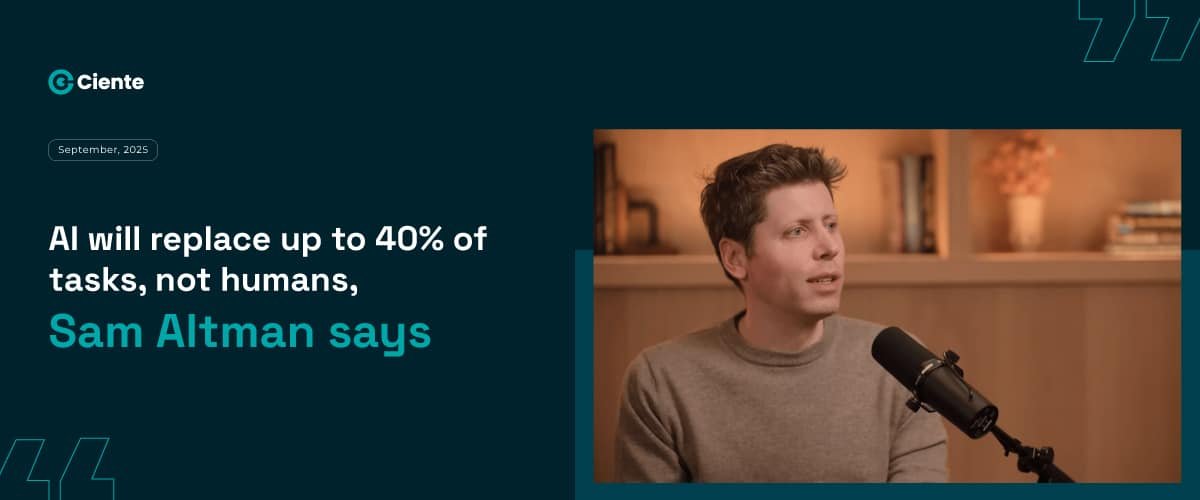
But Altman was recently quoted as saying, “I can easily imagine a world where 30 to 40% of the tasks that happen in the economy today get done by AI in the not very distant future.”

That’s a very troubling thing to come from the person at the forefront of AI development. There’s no doubt that he is the face of the entire AI revolution.

He follows it up with “Think about the jobs that we did 30 years ago that may not exist at all today, or new jobs that were difficult to imagine 30 years ago that are now commonplace”.

He points out that ChatGPT-5 is intelligent than him and most people, something the users of GPT-5 may disagree with.

But he says something striking next. He says, “I believe you can never fight evolutionary biology. We are wired to care about other people and not to care about machines. We’ll be happy that these machines will be doing stuff for us, making the world richer, discovering new science, and curing diseases. But they will not be the center of the story.”

What does he mean by this? As the world fears authoritarian powers, is he positioning AI as a liberator of creativity and evolution? Yes, that is what he is saying, but does he believe it, or is this to allay the fear of the people?

The world holds its breath as the AI changes and distorts the world. All we can hope is that the creators of this technology believe it to be a force of good, not imminent destruction.

RD Technologies Discloses OristaPay, the Next-Gen Payment Infrastructure Provider

RD Technologies Unveils OristaPay Payments Platform – Ciente

RD Technologies Unveils OristaPay Payments Platform – Ciente

RD Technologies remains committed to advancing financial infrastructure that bridges the gap between Web3 and traditional finance.

With the winds of cross-border payments transforming, its spending is projected to hit a whopping $320 trillion by 2032.

Innovative cross-border solutions, such as Unified Payments Interface, stemmed from the demand for more transparent and swift cross-border solutions. It’s what the complexity of global money movements demands- a modernization strategy.

RD Technologies, a fintech provider, is the latest name driving innovation in the cross-border payments landscape. Its objective?

To position Hong Kong as a leading hub for digital finance.

The faster money trails have elevated access to cross-border payment means that simplify the end-to-end processes and increase delivery speed. These solutions are repairing the white gaps left behind by legacy systems.

As a part of its brand enhancement strategy, RD has announced a new cross-border brand called ‘OristaPay.’ This strategic play by the fintech provider is to differentiate the organization’s core business investments-

1. OristaPay: Cross-border payment services that comprise a fiat wallet and payment solutions, digital payment, and custody services. With RD Wallet Technologies Limited (RDWT)- a SVF licensee, this new brand will deliver secure, compliant, and innovative payment solutions to corporate clients overseas.

As RD pairs its tech innovation vision with compliance strength, this could significantly boost its market positioning.

2. RD Innotech Limited: An independently operating entity is exclusively in charge of overseeing compliance across RD’s operations. It focuses on updating and evolving the company’s regulatory framework, especially for stablecoins.

Each of these brands is a subsidiary of RD Technologies, but they’ll operate across different markets. Why?

To claw into diverse market opportunities and gain a foothold in the digital finance landscape. This is the most straightforward and clear brand strategy for RD to unlock the maximum potential of each business while remaining compliant and creating value for its clients.