Brand Governance: Removing Inconsistencies for Better Messaging
Brand inconsistencies turn marketing spend into a budget sinkhole. Coherence has become more imperative than uniformity. Brand governance ensures exactly this.
Brands are expectations and associations that customers live through their experiences at multiple touchpoints. It’s basically the trust architecture.
This is why a sturdy brand identity is associated with high recall and recognition. The power is no joke. As the source of value creation, brands are the very essence of your business, and not merely a marketing problem.
It’s a business-wide thing.
Every deliverable is co-created across B2B. There’s a significant amount of to-and-fro between client expectations and brand promises. And what is truly governed is tone, knowledge IP, expertise, and how humans deliver value.
This is why, for B2B, brand governance is relatively challenging but crucial.
Brand Governance: Control or Curation?
What is brand governance, in the traditional sense?
Brand governance deploys a set of models, processes, and tools to ensure creative consistency and integrity across a brand’s assets.
What truly is brand governance? This is the misunderstanding that most organizations grapple with.
It previously meant control over creation. Control over the incorrect use of the logo. The wrong color. Off-tone messages. And non-creative teams delving into something they don’t understand.
Brand experts ruling over a brand with iron fists, controlling the use of assets, approving every project, and enforcing guidelines across every team.
It boiled down to uniformity- brand strength derived from consistency. Brand governance was a broadcast technique: one message, one center, and many receivers.
This traditional world of brand governance has been discarded.
The new world of brand management demands a generative and adaptive system.
There are a plethora of marketing channels and AI-generated content. Marketing has expanded and become hyper-targeted, with local teams across continents and personalized audience communications.
Will uniformity alone solve the consistency problem?
There’s no one-way top-down control on brand consistency. When brands share ownership with external agency partners on a global and local level, things get more intense.
A modern brand framework can offer more agility in how partners experiment with design and messaging components today. There’s no policing anymore. It’s enabling.
But with an added ingredient-
The actual objective today is coherence.
But coherence and cohesion aren’t derived from control. It requires clarity, intentional curation, and feedback loops.
A framework that allows teams to evolve brands intelligently, without straying too far off from their identity.
If control is all about “This isn’t allowed change,” then coherence is “Any change must trace back to who we actually are- the core brand values.“
So, what is brand governance truly?
Brand Governance can be reiterated as an operating framework. One that ensures that all brand experiences are compounded towards brand equity and not fragmented.
This maintains meaning across different conditions of scale and speed, taking into account the local cultural, lingual, legal, and business nuances.
Brand Governance Ensures that Everything You Publish is On-Brand.
Your brand is a confused and fragmented entity without brand governance.
Consistency in your brand identity ensures that your brand and its offerings are easily recognized. And this directly links to your brand equity.
A Case Study
Think of a large multinational.
It has siloed marketing teams operating across three different regions- North America, Asia, and Europe. Now, all of the teams implement three different brand campaigns:
The North American team opts for a dark blue, black, and silver palette. They aim for a modern and edgy appeal with the tagline- “disruptive innovation.” And the copy is quite jargon-heavy.
The Asia team wishes to showcase stability and trust. They choose a simple gold and blue palette, and focus on the messaging- “long-term and reliable partnership.”
The Europe team targets a very value-conscious market. They select orange and blue for all their social media campaigns, zeroing in on “cost-efficiency and speed” as their messaging.
A good brand helps you keep top of mind of consumers and makes you stand out in today’s crowded market. And a strong one ensures your customers feel closely connected to the brand’s mission.
But this only comes into fruition when your customers receive a cohesive brand experience.
Now, imagine there’s a CMO based in Japan who came across your partner-focused Asian ad and decides to research your brand. Their visit to your global website defaults to the North American jargon-heavy messaging. It’s disruptive. And when they visit your social media platform, they see a vibrant social feed.
Imagine each market segment receives a different core message. How do your potential buyers understand who you are?
This doesn’t show that the multinational is a diverse company. It instead posits that the company doesn’t know what it stands for. An innovator? A budget solution? Or a reliable partner?
There’s no unified narrative. No brand governance framework. This way, the company’s potential value is lost. It kills their experience and erodes trust.
The brand equity, rather than amplifying, is rapidly diluted.
Brand Governance’s Role Here?
Imposes the same set of guidelines to maintain tone of voice, messaging themes, color palette, and logo usage.
Requires that the core value and visual elements are adapted region-wise, and not fundamentally changed. This preserves the brand’s immediate recognizability.
Necessitates centralizing assets to ensure all global and local teams use consistent and approved messaging elements.
Ensures every touchpoint builds on the same building blocks of trust and meaning. It guarantees that there’s a single, strong brand image, not a fractured one.
Establishes a simple chain of command for reviewing and approving all comms strategies before launch- to establish coherence.
Defines an overarching core brand messaging and company mission. Regional teams can tailor the way they deliver this message, not tweaking the essential message.
Brand governance doesn’t work like Big Brother. It offers structure, accountability, and brand discipline, like a silent support system.
The ‘Speed vs. Governance’ Pain Point
Global B2B brands that operate in numerous local markets and multiple channel partners must contextually adapt.
It’s not only about language challenges, but also about legal and business ones. From regulatory nuances to relationship norms, every facet is offered precedence.
Does this always lead to an “off-branding”? Not quite.
It’s basically contextually aligned translations of the single brand value. Your US team might push for insight-first and assertive messaging, but the Japanese one would opt for humility
The way your value is delivered matters if the crux remains the same.
However, juggling between the different tones and voices can result in conflicts. Distinct channel partners in local markets use various tools and software to make edits for the ground they’re operating across.
What if there’s no structure to this process? There’s creative freedom, yet no uniformity- plurality without any cohesion.
But what if the system’s too rigid? Forced uniformity at the cost of resonance.
These muddy waters will make brand governance a board-level mandate.
Why Brand Governance is Significant in 2025 and Beyond
Buyers are opting for alignment and belief before they even perceive the solutions, as marketing becomes more relational. If each market territory perceives your brand differently, this belief will fracture. The content ecosystem will lose its grounding- proposals rewritten, locally edited case studies, and templated thought leadership content.
It isn’t disorganization. It’s knowledge entropy.
You prioritize content creation velocity. But does it codify what your brand actually stands for?
If not, brand building converts to brand dilution. Your brand’s voice is eroded, and authority is scarce because everyone is busy reinventing “how” it should speak. The derived insights that should contribute towards equity end up as fragments that make no sense.
AI tools have amplified this sprawl. Brands can generate human-sounding content that bypasses their core brand frameworks. What the marketers haven’t realized is that while it’s building momentum, it’s killing their voice.
In 2025 and beyond, brand governance isn’t a rulebook.
Have we forgotten the strong demand for dynamism and agility? Ridigity is killing momentum, and speed is killing clarity.
We must not only understand everything brand-related as a living system, but as an adaptive one. It’s about curating adaptive brand integrity.
Brand governance isn’t control. It’s momentum and coherence.
“You have to be more present with local content in real-time with digital; that wasn’t the case before.” – Global Marketing Director at Heineken.
Memorability isn’t created by chance. The campaigns that stick in people’s minds is the one that has been crafted by a single creed: empathy.
When was the last time you saw a marketing campaign and actually remembered it?
Not the ones you scrolled past. Not the ones you skipped. The ones that made you stop and think about them later. Maybe even mention them to someone else.
Drawing a blank? You’re not alone.
Most campaigns die the second they’re seen. They follow a formula: attention grab, product insertion, call-to-action, hope for conversions. Repeat until the budget dies or someone gets a promotion.
But campaigns that stick? They ignore the formula entirely.
In an industry suffocating under content, AI slop, and everyone following the same “best practices,” breaking the mold isn’t some creative luxury. It’s how you survive.
Memorable Isn’t Viral
Viral is a lottery ticket. Everyone buys one, almost nobody wins, and the ones who do can’t explain how to do it again. Viral happens by accident most of the time.
Memorable is different. Memorable is built on purpose.
A campaign becomes memorable when it connects to something real. An emotion you forgot you had. A truth you’ve been ignoring. A way of seeing things you hadn’t considered. The campaigns we remember aren’t the loudest ones.
They’re the ones that made us feel.
Apple’s “Think Different” didn’t sell computers. Dove’s “Real Beauty” didn’t sell soap. Slack made email the villain before showing you their product.
They sold perspectives. Ways of thinking.
That’s where campaigns fall apart. Teams get so obsessed with features, benefits, and conversion rates that they forget to give people a reason to remember. They optimize for algorithms, not humans. They test every drop of personality out until nothing’s left.
What Actually Makes Campaigns Stick
Your brain doesn’t file away marketing messages in neat folders. It doesn’t sort by industry or product category.
It files by feeling.
Did something make you laugh? Make you uncomfortable? Confirm what you already believed? Challenge it?
B2B marketing, especially, is scared of feelings. Decision-makers want spreadsheets and ROI projections, not emotions. And sure, those matter when someone’s evaluating vendors. But the first time someone hears about your brand? When they’re just becoming aware you exist?
That’s when feelings matter most.
Monday.com could’ve made boring project management ads. Feature screenshots, pricing tiers, integration lists. Instead, they focused on the chaos of work. The feeling of juggling too much. Dropping the ball. They made you feel the problem before they offered a solution.
That sticks.
Simple Without Being Stupid
Simple and simplistic aren’t the same thing.
Simple means you took something complex and found its core. Simplistic means you dumbed it down because you don’t trust people to keep up.
The campaigns that last are simple on the surface. One idea, clearly communicated. But dig deeper, and there are layers. Meaning that it rewards attention.
Mailchimp ran “Did You Mean Mailchimp?” – wordplay on the surface. But actually a commentary on brand awareness, how people search, and why switching vendors feels hard. Simple to see, smart underneath.
Most campaigns try to cram everything in. Every feature, benefit, and use case. Worried that focusing on one thing means missing potential customers.
So they reach nobody.
Memorable campaigns pick one thing. Say it perfectly instead of saying ten things, okay.
Looking Different Matters
Most campaigns are identical.
Same stock photos. Same colors. Same headlines. Then marketers act confused when nothing lands.
Scroll LinkedIn for five minutes. Count how many posts look exactly alike. Same carousel format, same corporate voice, same “insights” nobody asked for. It’s wallpaper.
Being distinctive isn’t about being weird because you can. It’s about owning an angle only you can claim. Doing something that makes people pause because they genuinely haven’t seen it before.
Liquid Death sells water. They could’ve talked about purity or hydration or saving the planet. Instead, they packaged it like an energy drink and marketed it like a metal band. Not everyone’s going to like it. But people remember it.
Wrong question: will everyone like this?
Right question: Will anyone remember this?
Stories Beat Announcements
We’re built for stories. Been telling them since language existed. Stories have setup, conflict, and resolution. Structure. Stories stick in memory.
Those are notifications. People dismiss notifications.
A memorable campaign takes you somewhere. Even if it’s just thirty seconds. There’s setup, tension, payoff. And the customer plays the hero – your product doesn’t.
Shopify doesn’t promote its platform. They tell stories about people who risked something, built from scratch, and went against conventional wisdom. Shopify is just the tool that made the story possible.
Most campaigns position the product as the hero. Memorable ones make the customer the hero.
Why Teams Can’t Pull This Off
Too Many Voices in the Room
Decision-by-committee murders creativity. When everyone needs approval, you get the safest possible option. Boring. Forgettable.
Memorable work needs someone willing to make a call. Someone who trusts the creative team to take risks. Leaders who know the difference between “I personally don’t like this” and “this won’t work.”
Most places default to risk aversion. Safer to ship something bland that nobody criticizes than something bold that might bomb.
Except bland campaigns bomb too. They do it quietly.
Chasing Short-Term Numbers
Data matters. But optimize everything for instant conversions, and you kill any chance of being memorable.
Why? Memorable campaigns pay off slowly. They build brand value over months and years. Create associations that compound. But if you’re only watching this month’s conversion rate, you’ll never approve anything without guaranteed immediate returns.
The most memorable campaigns often show weak early metrics. They’re brand investments, not performance plays. In marketing’s current obsession with attribution and instant ROI, that’s nearly impossible to sell.
Templates Killed Creativity
We’ve turned creativity into an assembly line.
Templates for everything. LinkedIn posts, emails, ads, and landing pages. Because templates sort of work, teams keep using them. But templates are fundamentally not distinctive.
You can’t template memorable. You can template efficiently. You can template consistently. Memorable campaigns break templates.
How Do Businesses Craft Memorable Campaigns?
Find Insight Before Ideas
Most brainstorms open with “What campaign should we run?”
Start wrong, end wrong.
Begin with insight. What non-obvious truth exists about your audience, your market, your product? What do you understand that competitors miss? What tension sits there unacknowledged?
Strong campaigns begin with sharp insights, then figure out creative expression. Weak campaigns start with out-of-the-box concepts and retrofit insights afterward.
Spend most of your time finding the insight. Creative follows.
Have an Opinion
Memorable campaigns take positions. Make statements. They don’t try to please everyone because trying to please everyone means connecting with nobody.
What does your brand actually believe? What are you against? What would you refuse to do even if it costs customers?
That’s your position. That’s what gets remembered.
Patagonia built its brand on strong positions. Telling people not to buy their products. Suing presidents. Donating the entire company to climate work. Conventional? No. Memorable? Obviously.
You don’t need that level of extremism. But you need to stand for something beyond “purchase our product.”
The Elevator Test
Can someone explain your campaign to a colleague in one sentence?
If it needs context or explanation or a deck, it’s not memorable. Memorable campaigns pass the elevator test. Simple enough to repeat, interesting enough that people want to.
“It’s the one where they…” should be enough.
Make People Part of It
The most memorable campaigns don’t broadcast to people. They bring people in.
Ask a question that matters. Create something people want to share or remix. Start conversations instead of making announcements.
The Ice Bucket Challenge wasn’t memorable because the ALS Association had massive budgets or genius creatives. It was memorable because it turned watching into doing. People weren’t the audience; they were participants.
You probably won’t launch the next Ice Bucket Challenge. But you can make campaigns more participatory. Invite people in instead of shouting at them.
What Nobody Wants to Hear
Most campaigns shouldn’t try to be memorable.
Not every product launch needs cultural impact. Not every email needs buzz. Sometimes you need conversions, pipeline, and quarterly numbers to hit.
That’s real. That’s marketing.
But if every single campaign optimizes for immediate performance, if nothing builds long-term value, if you never risk anything creative… you’re teaching your audience to forget you exist.
You become background noise.
Strong marketing strategies balance both. Campaigns hitting immediate goals and campaigns building lasting brand value. Campaigns that convert and campaigns that connect.
The mistake is treating them as the same thing.
What This Means Tomorrow
You’re in your next planning meeting. Product launching, budget allocated, stakeholders waiting.
How do you push for memorable without looking naive?
Start small. Don’t bet everything on one risky concept. But push one campaign to be braver. Test one creative piece that breaks the template. Try one message with an actual position.
When it works – when people remember it, talk about it, when results compound over time – you’ve earned permission to try again.
The organizations winning in the coming years won’t be the ones with the biggest budgets or fanciest tools.
They’ll be the ones people actually remember.
Because in a world of infinite content, limited attention, and rising skepticism, being memorable isn’t optional.
It’s everything.
Memorability is Strategy, Not Luck
Most of this advice isn’t new. It’s old. The principles that made advertising work before programmatic existed, before marketing automation, before AI.
Human insight. Creative courage. Willingness to say something worth remembering.
We traded memorability for metrics somewhere and optimized creative messaging to the death. A/B testing ourselves into mediocrity.
Getting back isn’t complicated. Just requires remembering what marketing was meant to be.
Not an interruption. Not manipulation. Not noise.
Connection.
Make something memorable. Or keep blending into feeds.
Ad Tech is redefining several age-old marketing techniques and providing businesses with better tools to reach their customers. How can organizations take advantage of it?
Today, digital innovation is transforming the way most businesses and industry sectors operate. For marketers, data is the new oil. Data collection and analysis will be the foundation of all future services and business models by 2030.
Despite this, 76% of marketers do not use data in their online marketing and targeting, even though businesses are continually collecting information about their customers. The failure of marketers and advertisers to fully utilize ad technology represents a significant waste of potential.
Ad Tech aims to change that. As the digital advertising business is undergoing a significant phase of development as a result of the rising amount of time customers spend on digital media, it is an excellent way of strengthening communication with clients.
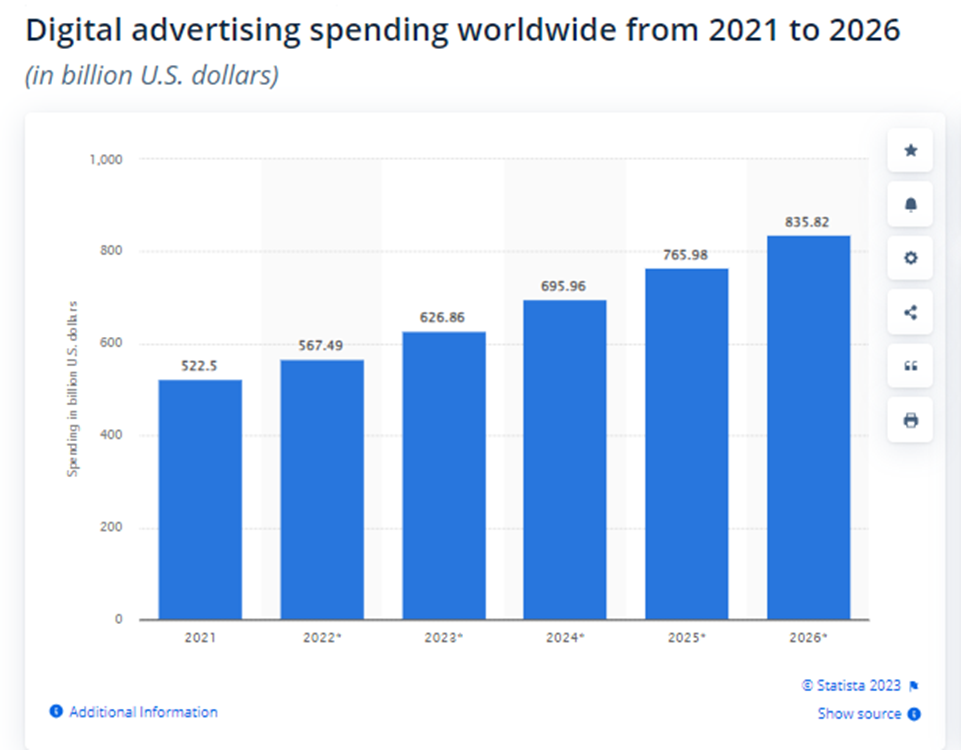
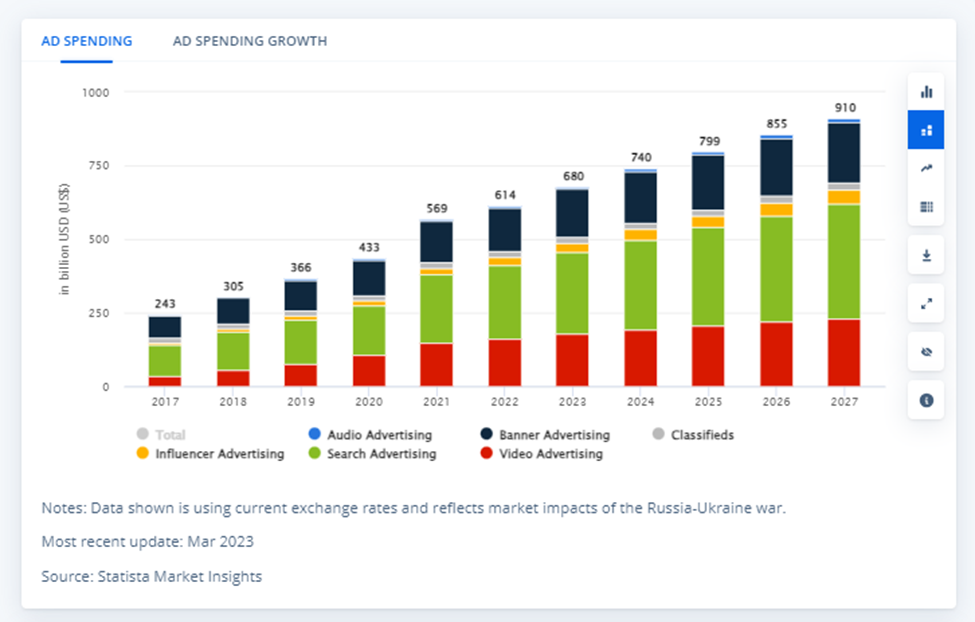
Statista predicts that global digital ad spending would surpass $645 billion by 2025. Marketers can use Ad Tech to target consumers, offer relevant ads, optimize profitability, and improve the efficiency of an ad campaign. This guide describes what is AdTech, what it entails, and how it may benefit organizations. Dive right in!
What is the meaning of AdTech?
Ad tech, or advertising technology, refers to the software and tools that assist agencies and businesses in targeting, delivering, and analyzing their digital technological advertising efforts.
AdTech strives to develop data-driven marketing tactics that are personalized to the preferences of the target audience.
What AdTech does:
In the context of b2b demand generation, Ad Tech solutions allow you to see the big picture of your campaign and maximize its effectiveness. It simplifies the increasingly complicated procedures of purchasing and selling online ads, allowing organizations to maximize their ROI by making the most of their budget.
It is a collection of tools and platforms that marketers and advertising firms can utilize to maximize the effectiveness of their ad operations. Effective advertising campaigns leverage it to gather relevant data and present the most suitable advertisements to their audiences.
GlobalData, a renowned data and analytics company, predicts will expand from $438 billion in 2021 to $1 trillion in 2030.
Key AdTech Components:
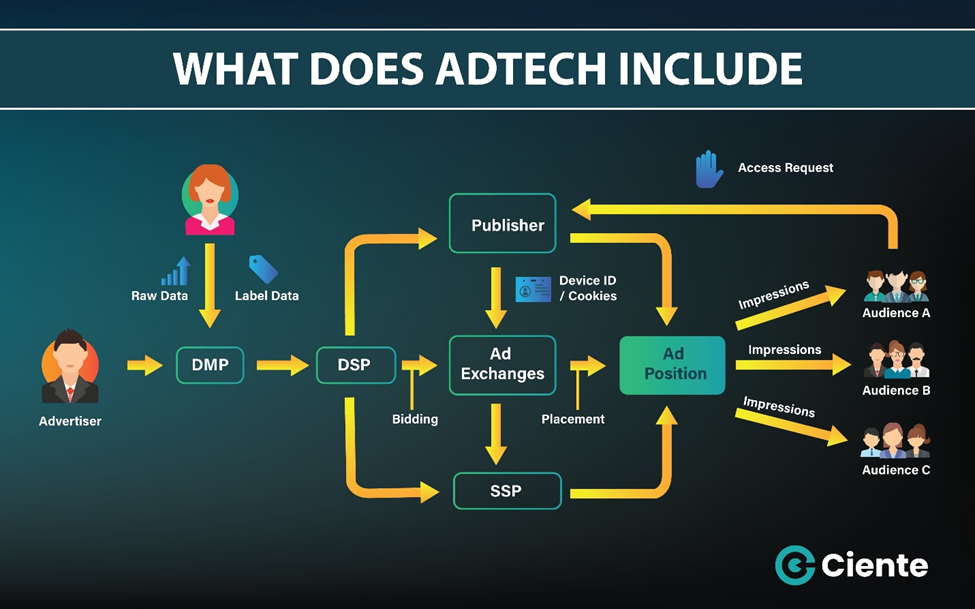
Ad tech refers to a variety of technologies that help marketers, and media agencies, operate effective advertising campaigns. It includes the following:
Advertisers have to purchase advertising space from media companies. Media-related businesses require a location to market their unsold inventory.
Demand Side Platform –
Advertisers can use demand-side platforms (DSPs) to place offers on open advertising slots on a per-impression basis.
Supply Side Platform (SSPs)
Supply-side platforms enable vendors to add their inventory on a variety of platforms in an efficient and automated way.
Ad Exchange
(the centralized point that streamlines the purchasing procedure)
When a brand wants to purchase or sell advertising space, it goes to an ad exchange, which acts as a marketplace for DSPs and SSPs. Ad exchanges enable programmatic ad buying and selling with real-time bidding. An ad exchange can provide any type of ad space, from textual content to video advertising.
Ad server technology
(a repository of creatives for advertisements created with specific software)
Aside from the big players (DSP, SSP), another force in the advertising business is ad server technology, which is an inventory of creatives for tech ad that use certain software to post ads on websites whenever needed.
The advertising provided is filtered by publishers and advertisers based on the intended audience, ad type, and demographic factors. Ad servers additionally keep track of how frequently an ad is shown to a specific user.
Why is AdTech important for Businesses
Let us see 10 ways in which AdTech empowers businesses in the digital age.
1. Highly Targeted Advertising
Adtech platforms use advanced algorithms to analyze a wealth of user data (demographics, interests, online behavior, purchase history, etc.). This allows businesses to target their ads precisely to the individuals most likely to convert into customers. It’s the difference between showing ads for baby products to everyone versus primarily to expectant and new parents.
2. Omnichannel Reach
Adtech enables businesses to reach consumers wherever they are online – websites, social media, mobile apps, video platforms and more. This ensures consistent messaging and creates seamless touchpoints with potential customers throughout their digital journey.
3. Real-Time Optimization
Adtech platforms provide real-time data on how ads are performing. If a particular ad or format isn’t getting results, businesses can adjust it or replace it immediately. This dynamic optimization helps maximize the effectiveness of advertising spend.
4. Enhanced Measurability
Unlike traditional advertising, adtech provides granular data on impressions, clicks, conversions, cost-per-acquisition, and numerous other KPIs. This allows businesses to quantify the success of their campaigns, understand what works (and what doesn’t), and refine strategies based on real evidence.
5. Increased Efficiency and Automation
Adtech automates tasks like ad buying, bidding, placement, and optimization. This saves businesses valuable time and human resources that can then be focused on higher-level strategy and creative ad development.
6. Creative Flexibility
Adtech supports rich ad formats like videos, interactive elements, dynamic ads (customized based on user data), and personalized messaging. This diversity can enhance engagement and make ads more memorable compared to traditional, static displays.
7. Improved Brand Building
Targeted and consistent brand messaging across various platforms through adtech solidifies brand recognition and awareness in the minds of consumers. This contributes to increased brand recall and trust.
8. Competitive Advantage
Early adopters of innovative adtech tools often gain an edge over competitors who are still relying on traditional advertising approaches. This advantage can manifest in several ways, like lower customer acquisition costs.
9. Global Market Reach
Adtech lets businesses easily target audiences across borders and time zones. This is invaluable for companies looking to expand into new international markets or tap into niche demographics worldwide. Explore Cross-Border Payments.
10. Data-Driven Marketing
The rich data and analytics provided by adtech empowers businesses to make strategic marketing choices rooted in performance insights. This leads to a higher return on investment (ROI) compared to a non-data-driven approach.
Example of AdTech in Action
What’s a better example of AdTech in action than diving into the largest single-day sales event across the globe- Amazon Prime Day?
Last year, the global ad spend rose, with a whopping $14.2 billion in revenue from Prime Day. And the total number of items sold? 200 million, more than any Prime Day event since its introduction.
This day isn’t about making flash sales, but developing a full-funnel strategy, from build-up to follow-ups. And all of this demands a thoroughly orchestrated campaign.
This is where AdTech occupies the center stage- it’s the hero of the show.
Amazon’s ad strategy is powered by data-driven optimization. It’s a prerequisite due to the traffic volume and dynamic nature of campaigns. The shopper are laser-focused on deals and make decisions rapidly to avoid missing out on their favorite products.
This demands a strategic use of Amazon’s AdTech tools.
How?
Showcase their topmost products.
Launching campaigns through Sponsored Products facilitates vendors to showcase their high-performing and discounted items. Then, these vendors review product performance in real-time and adjust the bids during an influx of high traffic, the peak hours.
Building brand awareness
Sponsored Brands allows vendors to present multiple products along with the brand’s customer headline and logo. It helps build awareness about the products, where the pricing could appeal to the shopper, and also introduces a new brand to them. And fosters product discovery and multiple product sales.
Expanding audience reach
Sponsored brands help vendors place their product ads across locations beyond the top of search. You may ask, What does it do?
Well, Amazon has introduced a new “New-to-Brand Shoppers” audience segment.
To reach new audiences who aren’t aware of them, advertisers can use new campaign bid adjustments. This’ll help vendors reach and even engage shoppers who haven’t purchased from them in the past twelve months.
Driving relevant traffic
Amazon’s tools offer a distinct feature of theme targeting.
It’s a dynamic, model-based framework that simplifies campaign development and elevates its performance.
And this approach is where Amazon’s shopping insights and ML capabilities come into play. The targeting groups bundle and consistently optimize keywords using this technology, according to what you want to optimize for, brand or landing pages.
This ascertains that the ads are shown to the relevant audience segments.
Optimizing bidding rules and ad budgeting
Amazon entails an option for schedule-based budgeting and schedule-based bidding.
Schedule-based bidding can help vendors gauge the most out of activity peaks. They can schedule bids when the shopping activity hits a peak according to different times, days, and dates. It helps regulate campaign performance during a high-traffic event such as Prime Day.
Next is schedule-based budgeting.
This allows advertisers and sellers to automatically adjust and adapt the budgets based on the time, day, and date. It’s more likely to help you spend strategically rather than opting for manual guesswork.
This is just one of the most popular examples of website ads- of AdTech in action.
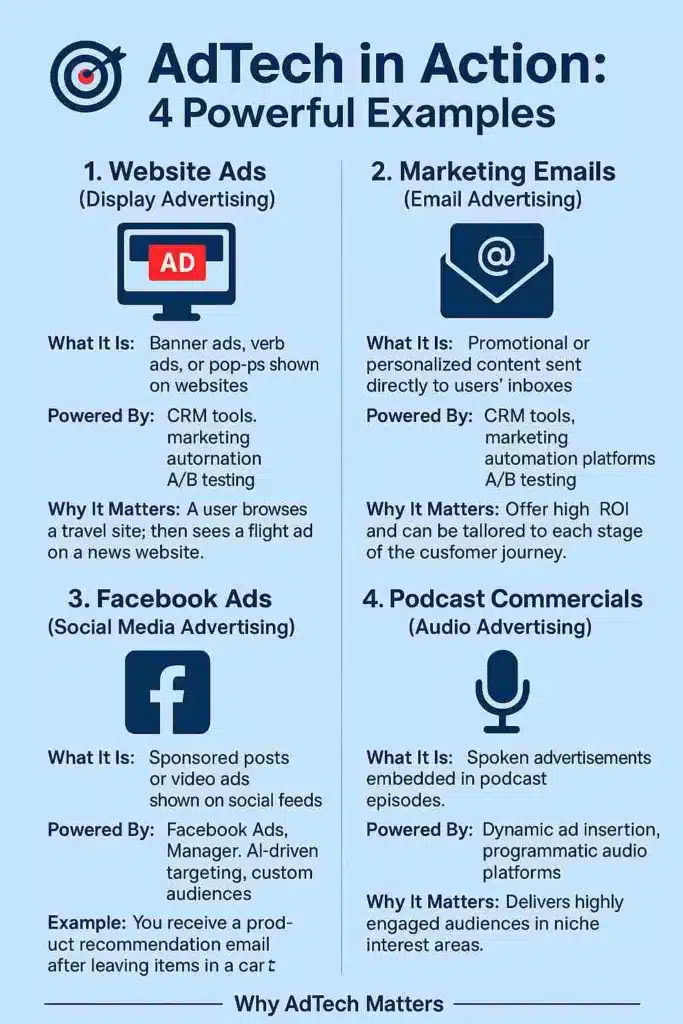
Other examples of AdTech in action comprise:
Promotional and personalized ads are sent through email.
Video ads or sponsored posts on social media platforms such as Facebook.
Until recently, the advertising industry had stayed unchanged for decades. Today, how advertisers put advertisements, how they pay for them, and the actual appearance of the advertisements themselves have all changed dramatically.
The goal, however, is always the same: to reach a specific consumer market and attract their attention. There are numerous options for agencies to differentiate themselves in the age of ad tech.
Ad tech data variety enables more detailed and appropriate targeting. To get the best possible results out of every ad campaign, it is also necessary to rely on reputable ad tech solutions and platforms.
The demand for effectiveness and scale in the domain of thousands of interactions on the internet drove the creation of ad tech. One significant benefit for organizations and their customers is an increase in client encounters. Brands can now integrate across all advertising channels using ad tech.
The purchasing and selling of advertising spaces still take place in an online marketplace, but the introduction of digital advertising has added complexity to the process. Cross-platform consistency makes sure that marketers contact people frequently and effectively.
To manage real-time buying and selling at scale, automated platforms like DSPs and SSPs are required. Furthermore, ad tech and martech solutions are becoming increasingly linked to helping brands and/or companies reach their advertising and marketing objectives. Many ad tech companies provide programmatic advertising services.
Global ad tech spending is anticipated to reach $150 billion by 2023. To put it another way, it’s here to stay. Using ad tech data, agencies may dig down and target just those who are most likely to convert, while ignoring those who aren’t.
The 3 Best AdTech Companies
Modern AdTech companies are revolutionizing the landscape, helping marketers manage campaigns effortlessly. And fine-tune their ad placement for maximum visibility.
For brands to reach the relevant audience segments has become imperative.
But only the AdTech companies with the correct understanding of what’ll drive brands to their campaign goals are going to come out on top.
Actually, there are AdTech companies that are efficient at this- helping brands realize their ad goals and reach their audience on time.
Let’s take a look.
1. Adobe Advertising Cloud
Adobe has expanded far beyond its creative roots to become a force in AdTech.
Adobe Advertising Cloud offers a unified platform for media planning, buying, and performance optimization. What sets Adobe apart is its ability to integrate first-party and third-party data with creative tools, allowing marketers to not only place ads but also adapt them in real-time.
Adobe’s strength lies in personalization.
Through AI-powered insights from Adobe Sensei, campaigns are tailored dynamically to audiences based on browsing behavior, purchase history, or contextual relevance. For enterprise marketers managing campaigns across multiple channels, Adobe offers a command center.
By combining creativity with programmatic muscle, Adobe has positioned itself as an AdTech partner for brands that want control, scale, and storytelling all in one.
2. Criteo
Criteo built its reputation as a retargeting powerhouse, but today it has evolved into much more than that.
Its Commerce Media Platform connects advertisers directly with commerce data, enabling highly granular targeting that goes beyond guesswork.
Criteo’s strength lies in its scale: it taps into shopping intent data from thousands of marketplaces and publishers.
For brands, this means visibility not only in broad campaigns but also at the exact decision-making moments that drive conversions. Whether it’s reminding someone of an abandoned cart or showcasing complementary products, Criteo makes precision its currency.
What makes Criteo unique is its ability to merge ad inventory with commerce-driven insights. This transforms campaigns from awareness-driven pushes into shoppable, outcome-focused experiences.
In a digital economy obsessed with measurable results, Criteo has carved out a reputation as a specialist in performance-driven advertising.
3. Amazon’s Ad Server
When Amazon entered the AdTech landscape, it changed the rules of the game.
Its Amazon Ad Server (formerly Sizmek) allows brands to orchestrate campaigns across channels while leveraging the immense power of Amazon’s data ecosystem. The draw here is access: few companies can rival Amazon’s direct line into consumer purchase behavior.
The Amazon Ad Server is more than just a delivery engine.
It provides cross-channel attribution, dynamic creative optimization, and a detailed view of how campaigns drive both awareness and sales.
For brands that sell on Amazon, it closes the loop between ad spend and actual revenue. For those outside the marketplace, it still provides unrivaled insights into consumer journeys.
What differentiates Amazon is scale combined with intent. While other platforms know what people click, Amazon knows what people buy.
That data transforms advertising from speculative targeting into commerce-driven precision.
What are the challenges of Adtech in 2025?
Demonstrating ROI
B2B marketing requires a focus on long-term value and pipeline development. Attributing conversions to specific ad interactions in a complex B2B sales cycle becomes crucial. AdTech needs to evolve beyond basic metrics like click-through rates (CTRs) and provide B2B marketers with tools to understand the impact of campaigns on pipeline growth and revenue generation.
Data Silos and Integration
Organizations often have data scattered across various platforms like CRMs, marketing automation tools, and web analytics. Integrating this data and creating a holistic view of customer behaviour poses a significant challenge. AdTech platforms need to prioritize seamless data integration and offer solutions that facilitate a unified customer view for effective campaign targeting and optimization.
Budget Constraints and Cost Efficiency
B2B companies often have tighter marketing budgets compared to B2C counterparts. AdTech solutions need to be cost-effective and provide clear value propositions that translate into measurable business impact.
This includes features that optimize campaign performance, minimize wasted spend, and allow for scaling your digital campaigns effectively.
Adapting to Privacy Regulations
B2B marketers also need to navigate the complexities of data privacy regulations like GDPR and CCPA. AdTech platforms must ensure compliance with these regulations while still providing B2B marketers with the tools needed for targeted outreach and personalized engagement.
Reaching the Right Audience
Buyers are exposed to an abundance of marketing messages across various digital channels. Crafting compelling content and utilizing creative ad formats that resonate with relevant audiences is crucial to capture attention and drive engagement.
Vendor Consolidation and Limited Choice
The AdTech landscape is seeing significant consolidation, with larger players acquiring smaller companies. This can lead to limited choice for buyers and potentially restrict access to specialized solutions that cater to specific industry needs.
Ensuring Data Security and Ethical Practices
Marketers entrust AdTech partners with valuable customer data. Building trust and maintaining transparency in data handling practices is crucial, especially in light of increasing privacy concerns.
Adapting to Changing B2B Buyer Journeys
B2B buyer behavior is constantly evolving. AdTech solutions need to adapt to changing trends and provide B2B marketers with tools to understand buyer journeys, personalize communication at different touchpoints, and address evolving buying preferences.
How to overcome Adtech challenges?
Invest in First-Party Data and Identity Solutions:
Leverage customer relationship management (CRM) data, website visitor behaviour, and other permission-based sources to build rich audience profiles.
Explore privacy-compliant identity solutions like contextual targeting and contextual authentication to reach desired audiences without relying on third-party cookies.
Embrace Advanced Measurement and Attribution Models:
Utilize multi-touch attribution models that account for the complex customer journey across different programmatic advertising channels and touchpoints.
Look for AdTech solutions that offer in-depth campaign reporting and analytics, including insights into pipeline progression, lead generation metrics, and revenue attribution.
Prioritize Data Integration and Platform Consolidation:
Choose an AdTech platform that integrates seamlessly with your existing marketing technology stack, reducing data silos and streamlining workflows.
Consider consolidating your AdTech vendors whenever possible to simplify campaign management, gain better data visibility, and potentially negotiate more favorable pricing.
Focus on Creativity and Engaging Content Strategies:
Move beyond traditional google ads and experiment with creative ad formats like interactive content, native advertising, and video storytelling to capture B2B buyer attention.
Personalize content based on audience segments and buyer personas to deliver relevant and engaging messages that resonate with specific B2B customer needs.
Prioritize Transparency and Responsible Data Practices:
Partner with AdTech providers who prioritize data security, user experience, user privacy, and ethical data practices.
Clearly communicate your data privacy policies to customers and ensure compliance with relevant regulations.
What is the best Adtech platform for 2025?
In the dynamic world of digital advertising technology, navigating the complex landscape of Ad Tech platforms can be a daunting task. However, understanding the specific strengths and weaknesses of key players can empower you to make informed decisions for your advertising needs.
Here, we delve into the top 3 Ad Tech platforms, each catering to distinct requirements within the ad tech ecosystem:
Nexd
Features:
Creative management platform (CMP) for building interactive programmatic creatives.
Utilizes WebGL and GPU technology to create smaller file size ads, promoting sustainability.
Offers over 30 interactive ad layouts, including gamified ads, 3D experiences, and virtual reality ads.
Integrates with well-known DSPs for seamless ad serving across various platforms.
Pros:
Creates highly engaging and interactive ad formats.
Reduces energy consumption with smaller file sizes.
Offers a wide range of creative templates and functionalities.
Integrates seamlessly with other ad tech tools.
Cons:
May require additional design expertise for advanced creative development.
Focuses primarily on display advertising, might not be suitable for all campaign types.
Pricing information might not be readily available publicly.
Target audience:
Agencies and brands looking to create high-impact, interactive ad experiences.
Advertisers focused on brand awareness and audience engagement.
As third-party cookies become increasingly obsolete, brands are placing greater emphasis on collecting and utilizing their own customer data.
This includes information gathered from website visits, app usage, loyalty programs, and other direct interactions. By building a robust first-party data strategy, brands can gain valuable insights into their audience preferences and tailor their advertising programmatic campaigns accordingly.
Artificial intelligence (AI) continues to revolutionize adtech:
AI is playing an increasingly important role in various aspects of adtech, including:
Audience targeting: AI algorithms can analyze vast amounts of data to identify and target specific audience segments with greater precision.
Ad creative optimization: AI can be used to dynamically generate and personalize ad creatives in real-time, ensuring that each user sees the most relevant and engaging ad.
Campaign performance optimization: AI can continuously monitor and analyze campaign performance, automatically making adjustments to optimize results.
Video advertising reigns supreme:
Video remains the most engaging and effective technology for advertising format, and its popularity is expected to continue to grow in 2025. This is being driven by several factors, including:
Improved video ad formats: Interactive video ads, shoppable video ads, and other innovative formats are providing brands with new ways to capture attention and drive conversions.
Advanced video measurement: Advertisers are now able to measure the true impact of their video campaigns, including metrics such as engagement, brand lift, and purchase intent.
Data clean rooms become the new normal:
Data clean rooms are secure environments where brand advertisers with publishers can collaborate and share data without compromising user privacy. This allows for more effective audience targeting and marketing campaign measurement in a cookieless world.
Focus on ethical and transparent advertising:
Consumers are increasingly demanding transparency and accountability from brands, and this is reflected in the growing emphasis on ethical and responsible advertising practices. This includes practices like:
Avoiding misleading or deceptive advertising: Advertisers need to ensure that their claims are truthful and not misleading consumers.
Respecting user privacy: Brands need to be transparent about how they collect and use user data, and they need to obtain explicit consent from users before using their data for advertising purposes.
Promoting diversity and inclusion: Advertisers need to ensure that their online advertising campaigns are diverse and inclusive, representing a wide range of people and perspectives.
Wrapping Up
The advertising landscape is constantly evolving, offering advertisers new opportunities to reach their target demographic. Marketing executives face numerous obstacles as they struggle for consumers’ attention. AdTech ecosystem holds immense promise for advertisers to enhance profits and boost ad campaign efficiency. While creative and engaging material is still required, AdTech allows advertisers to more accurately assess the effectiveness of an advertising initiative and make adjustments as needed. It also assists advertising in targeting individuals and generating better leads. If your company is not yet utilizing advertising technologies, there is no time more appropriate than now to get started with the best advertising agency.
FAQs
What is an example of AdTech?
A few examples of AdTech include software and technologies that help with data management, ad exchanges, ad forecasting, and ad management software. These technologies allow brands to quickly produce personalized ads while spending less time and money on each targeted campaign.
What is header bidding in AdTech?
Header bidding, also called pre-bidding or advanced bidding, is a process that enables publishers to collect multiple bids simultaneously from different demand sources. These demands are not limited to their ad server but also come from various servers across all of their ad inventory before a sale occurs.
What is the future of AdTech?
The future of AdTech is filled with both opportunities and challenges. By leveraging AI/ML technologies with the right set of software, data, and strategies, the possibilities are endless. These tools can understand customer behavior in real time and automatically make changes as needed.
What are the new technologies for advertising?
Programmatic advertising has innovated various tech to target user at different time. For example, the latest technologies like CTV, DOOH are reaching out to the customers even when they are not interacting with mobile or tablets.
Audio advertising is also a perfect way to target users when they are not active on digital displays but are just listing songs.
The difference between adtech and martech
AdTech is like the flashy billboard of the digital world. It’s all about grabbing attention out there—think ads on Instagram, Google search results, or that weirdly specific banner ad for shoes you looked at once.
AdTech tools (like programmatic ads or TikTok’s ad platform) use data to target strangers at scale, shouting, “Hey, you might like this!” It’s the first date: quick, broad, and focused on making a spark. Metrics here are straightforward—clicks, views, conversions. But once someone clicks, AdTech waves goodbye.
MarTech, on the other hand, is the cozy coffee shop where relationships deepen. It’s the tech that helps you keep people around after they’ve noticed you. Tools like email platforms (Mailchimp), CRM systems (HubSpot), or loyalty apps quietly work behind the scenes to say, “Remember that thing you liked? Here’s more.”
MarTech nurtures leads, personalizes experiences, and turns one-time buyers into regulars. It’s less about shouting and more about listening—using data like purchase history or website behavior to build trust.
The big difference? AdTech is the megaphone for finding new people. MarTech is the glue that keeps them loyal.
But they’re better together: Imagine a coffee shop using Instagram ads (AdTech) to lure you in, then sending a personalized discount email (MarTech) once you’ve visited. One finds the crowd; the other makes them feel like family. Both? Essential for winning hearts and wallets.
Conversion-Centred Design: Intentional Designing that Converts
The missing framework for conversion-centric design outlines more than just visual cues- intent mapping. Is it neglecting intent that landing pages fail?
Designs help put problems into context. And offers better alternatives for handling them- offering diversity to one-dimensional thinking. That’s basically the overall psychology behind design: tangibility.
Great designs stem from a myriad of POVs. It’s all about embracing the chaos.
Good design is about experimenting and playing around, such that the process of making the right one always feels subjective. Whether you know the rules or not, it boils down to creating a design that translates thoughts into actions.
Isn’t this the crux of design’s role across marketing?
From Google to Microsoft, these market leaders are a standing proof. It’s not as if they knew which logo they would choose from day one, or the color that could become a part of their identity.
They experimented. They had their fair share of trial and error. And finally found out what sticks.
This has always been the better approach- the experimentation followed the basic principles of design, and honestly, that’s why it just worked (like Facebook’s blue-colored logo).
Conversion-centric design is all about this.
Before we dive into what conversion-centric design is, let’s get into what it’s not.
Conversion-Centric Design Isn’t All About Design.
There’s severe confusion here. And it’s about because marketers approach conversion-centric design with a very narrow vision.
Every resource that you encounter on this topic guides you towards just one thing- they teach you what to do.
Create focus. Use whitespace. Deploy urgency. Include directional cues.
It’s the same mantra repeated a hundred times over.
The traditional wisdom presumes conversion-centric design as a checklist. You apply these principles, and the conversion will follow.
But this is precisely where marketers falter.
These principles aren’t the problem. It’s the thinking behind executing them-
Landing pages don’t fail because of a lack of white space or wrong CTA placement. But when marketers inherently misunderstand what conversion-centric design truly means.
So, What is Conversion-Centric Design Then?
From the very words of the one who coined it- Oli Gardner, the co-founder of Unbounce, conversion-centric design is,
“Conversion-Centered Design is the original framework for creating high-converting campaigns. It’s time for the next evolution of landing page design.”
But the term “conversion-centric design” itself is misleading.
It implies that design, i.e., the visual arrangement, color theory, and button placement, are all central to conversions.
This is too limited.
Designs don’t drive conversions, but the clarity of the visitor’s intent aligns with the depth of desire.
So, basically, design is merely a vessel.
The frameworks obsess over attention ratios and button colors while neglecting the fundamental truth: Your design decisions must stem from understanding the “why” someone arrived on your landing page in the first place.
Let’s make a comparison.
Two landing pages are identical in every aspect. The layout remains the same, with matching CTA placements and the same color scheme. But while the first converts at 18%, the other does so at 2%.
What’s the disconnect?
The page with the 2% conversion rate relies on guesswork, whereas the other one understands the visitor’s intent to the bone.
This is precisely what standard playbooks miss.
Conversion-centric design begins even before you open your design tool. It starts with speculating and studying the visitor’s state of mind at the moment they land on your page.
This is intent-mapping.
Fundamental Blocks of Conversion-Centric Design
What They’re and What They Should Be
1. The Misleading Universal Principles
Traditional frameworks present principles as universal truths. Employ contrast, use encapsulation, and create urgency.
But the priority of these collapses the context into irrelevance.
For example, take scarcity and urgency. Every guide suggests them. Each landing page has something along the lines of- “Limited Time Offer” or “Only 10 seats left.”
The psychology behind this is sound- humans are loss-averse.
But urgency and scarcity only work when there’s existing intent.
Visitor intent should take precedence.
If a user is actively comparing solutions and vendors, urgency will help accelerate their buying decisions. But if they’re in the awareness stage?
The user barely has an understanding of their problem. Urgency will only create pressure without persuasion. And this then triggers abandonment.
The same applies to each facet of the “Conversion-centric Design Principles,” from social proof and testimonials to other proven tactics. They might work in the very beginning, until they don’t.
Whether they work or don’t is based on where the visitor is in their buyer’s journey.
When marketers apply these principles uniformly across landing pages, it’s lazy thinking masked as best practice. That’s not how you convert users.
2. The Wrong Focus on Fundamentally Flawed Landing Pages
Most conversion optimization frameworks focus on micro-tweaks to very intrinsically flawed landing pages.
You’re testing button colors. But you aren’t studying whether visitors even grasp what your brand is offering. You’re bust adjusting form fields when you haven’t even validated the offer behind the form.
The traditional framework treats visitors as numbers- as conversion machines.
Input the correct design elements ⇒ Output high conversion rates.
But this way, users aren’t responding to your design. They’re only responding to whether your offer solves a pain point they actually have.
This is when even a sure-shot method such as A/B testing yields marginal improvements. Your team is busy optimizing the wrong variable.
A purpose-driven optimization asks the right questions:
Does your landing page match the actual intent of your traffic source?
Does your brand offer a solution to the specific pain point your visitors are expecting?
Will your articulated value resonate with the visitors’ current state of awareness?
These determine whether your conversion rates start at 10% or 1%.
Design optimization could push you from 10% to 12%, but no amount of color theory will rescue a landing page that misunderstands its audience.
3. Where’s the Intent?
Traditional frameworks assume a linear buyer’s journey-
Visitors arrive ⇒ Sees your page ⇒ Takes action.
This assumption is flawed. The modern visitor doesn’t just land on your page in a vacuum, but arrives with:
particular pain points
pre-held beliefs
diverse emotional states
varying levels of market understanding
different levels of decision-making authority
Your conversion-centric design should consider these variables, and not through personalization engines. There should be strategic clarity about who this particular landing page is for.
What most landing pages do is- they attempt to be everything for everyone. They comprise multiple value propositions and appeal to different market segments. But amidst all of this, the core message gets buried beneath several layers of features.
This is the opposite of conversion-centric design.
Conversion-centric design demands specificity- one page, one audience, one intent, and a single goal.
But it’s not because other audiences don’t matter. It’s because trying to convert everyone converts no one.
4. Maybe it’s the Focus That’s Lacking
Focus is the first principle of conversion-centric design.
From removing navigation to eliminating distractions, you maintain a 1:1 attention ratio. But this understanding is still incomplete.
The attention ratio isn’t about the links on your page, but cognitive load. The mental effort is necessary to highlight what you want your visitors to do and why they should do it.
The thing is, you can have a landing page with zero navigation links and panes, and still overwhelm them with:
jargon-infused copy
unclear value propositions
benefits that don’t align with their pain points
solutions that require too many mental calculations
However, the actual focus isn’t also visual minimalism. It’s all about the clarity of purpose- every component on your page should answer one of the three questions from a visitor’s perspective:
What is this?
Why should I care?
What happens if I do this?
So, if a component doesn’t answer any of the three questions, it’s merely creating cognitive overload. And this is irrespective of how neat your visual hierarchy is.
Design That Actually Matters: The Essential Conversion-Centric Design Framework
You come down to the design when you’ve aligned everything else properly-
Your offer solves an actual business challenge.
Marketing messages articulate value in concise terms.
The page addresses their current knowledge level.
There’s no unnecessary friction from the process.
Only after these does design optimization become more sturdy. Because you amplify messages that resonate with your values, rather than acting as a compensation for a weak foundation.
This is where CTA colors matter, white space becomes strategic, and directional cues guide rather than manipulate. And when urgency speeds decision-making, it does not create anxiety.
The traditional frameworks have always gotten the sequence backwards.
Design is taught, and strategy is implied.
But conversion-centric design is strategy-first, and design is the execution.
The Reiterated Conversion-Centric Design Framework
If the conventional seven principles prove insufficient, what framework should marketers actually use?
Begin with intent mapping. Before touching any design element, answer:
1. Intent Clarity
Why is a user landing on this page?
What problem do they want to solve?
What alternatives have they considered?
2. Awareness Level
Do they know they have a problem?
Do they understand what kind of solution they need?
Are they comparing specific vendors?
3. Decision Context
What objections do they need addressed?
What proof do they need to believe your claims?
What friction exists between consideration and conversion?
4. Outcome Visualization
Can they clearly picture what happens after conversion?
Do they understand the transformation your solution provides?
Have you articulated the cost of inaction?
Only after mapping these elements should you consider which design principles support your conversion goals.
The principles aren’t universal. They’re contextual tools to elevate your conversion strategy.
Conversion-Centric Design Eliminates Resistance by Citing Conversion As the Obvious Choice.
The traditional approach underlines conversion-centric design as a persuasion tactic. But it’s a framework to amplify clarity in your brand offerings.
You don’t get pushed, and neither do you coerce your audience into listening to you. But actually align yourself better with conversion-centric design.
It’s a strategic way of rethinking the relationship between page design and visitor intent.
Although the standard playbook remains useful, it’s incomplete. It’s all about techniques without context, and principles without purpose. It assumes that visitors are the same, and all landing pages serve the same functions.
This is why landing pages developed according to ‘best practices’ still convert poorly.
Before considering directional cues, white space, and colors, ask yourself: Does your page resonate with the visitor’s intent?
No amount of tweaking can rescue your conversion rate from a nosedive.
The playbooks teach you what to do, but now it’s time to understand why.
It’s simple- conversion-centric design should amplify the already compelling message.
Smarter Lead Generation with AI Agents: Turning Data into Qualified Opportunities
If any marketing function will improve with AI. It is lead gen. The opportunity there is vast and here’s what you can do to use it properly.
AI is used to eliminate low value opportunities, rank high value opportunities, and focus on the most valuable opportunities through a combination of analyzing customer data, intent prediction, and customization of outreach. By leveraging AI to generate leads, the companies will save time, increase conversions, and decrease expenses converting raw data into qualified opportunities, which will lead to real growth.
Generating leads has been one of the main components of business development. However, in the digital first generation, manual approaches fail to generate enough leads to keep the sales team busy, and most leads are not of the quality to qualify. This is where the AI Agents of Lead Generation are leaving a game changing impact. They are turning raw data into qualified opportunities that result in real revenue, by automating, being intelligent, and personalizing.
What Are AI Agents for Lead Generation?
Lead Generation AI Agents are smart autonomous applications that integrate machine learning (ML), natural language processing (NLP) and predictive analytics to simplify and streamline the sales funnel. Unlike traditional tools that can never learn or adapt to the behavior of buyers and can only automate repetitive tasks, these agents have the ability to learn based on the information, adapt and make decisions in real time.
The fundamental applications of AI agents are:
1. Data Collections Analysis : Pull data all time out of CRMs, emails, social sites, and web interactions to create a 360 Degree prospect.
2. Audience Segmentation : The potential leads are identified and delivered campaigns to the right audience, basing on demographics, behavioral and intent indicators.
3. Predictive Lead Scoring and Qualification : Predictive scoring models can be used to rank leads by purchase readiness to ensure that sales teams focus on high value leads.
4. One on One Outreach : Deliver emails, messages, and recommendations depending on the details of the prospect and their position in the buyer journey.
5. Live Interaction : Implement chat bots or virtual assistants, which can reply in real time, gather data and send follow ups without the involvement of a human.
In broader terms, AI in lead generation transforms simple marketing data in opportunities to sell, bridging marketing effort and helpful sales data. These agents do not simply automate but they think, predict and customize and the result is that businesses can scale lead generation with accuracy and efficiency.
AI Agents vs. Traditional Lead Generation Tools
Aspect
TraditionalTools
AIAgentsforLeadGeneration
Data Handling
Manual or rule based; limited scope
Automated, real time data collection across multiple platforms
LeadQualification
Basic filters; often volume over quality
Predictive lead scoring ensures focus on high intent prospects
Personalization
Generic, one size fits all messaging
Contextaware, tailored outreach at scale
Response Speed
Delayed follow ups, dependent on team availability
24/7 engagement via chatbots and AI sales assistants
Scalability
Requires more manpower to handle growth
Easily scales without increasing headcount
Decision Making
Based on static rules
Adaptive, data driven, and continuously improving
Why Businesses Need AI in Lead Generation
The contemporary customer experience evolved radically. Customers do their research, compare options, and demand personal interactions long before they speak to a sales rep.
This has posed a challenge to businesses because the old way of lead generation may lead to wastage of time, low conversion rate, and lost opportunities.
This is where AI in lead generation comes in to make a difference:
Accuracy Over Volume : AI based lead generation systems do not saturate sales teams with unqualified leads, but rather filter leads by analyzing demographics, behavioral and engagement history to weed out unsuitable matches. This is done to make sure that only the high potentials go into the sales pipeline.
Increased Speed of Conversion : AI can convert purchase intent sooner than human measures by identifying digital signals (emails, web traffic or social media). This enables businesses to be quick and take the prospects through the funnel in a shorter time.
Availability 24/7 : Customers are not 9 to 5 workers. Through the assistance of AI chatbots and virtual sales assistants, companies will be able to respond immediately to the questions, gather the leads during every hour, and ensure that the prospect is not bored by the process.
Cost Efficiency : Automation of repetitive activities such as lead scoring, follow up emails and initial qualification decreases the workload of sales teams. This not only reduces acquisition costs, but it also releases human reps to concentrate on developing relationships and making sales.
One to One Nurturing : AI is more than automation in that it can provide personalized outreach on the basis of buyer preferences and stage within the buyer journey. As an example, one lead can get a product demo invitation, and another one can be invited to a case study, both being provided at the correct moment to increase the conversion rates.
Continuous Improvement : In contrast to the fixed systems, AI agents are improved with each interaction. With time they optimize lead scoring model, targeting and outreach plans, making a campaign smarter and smarter.
According to Salesforce’s Top AI Agent Statistics for 2025, 83% of sales teams using AI report revenue growth in the past year, compared to 66% for those without AI.
In simple terms, adopting AI in lead generation helps businesses do more than just generate contacts it enables them to generate qualified opportunities with AI that translate directly into revenue growth.
From Data to Qualified Opportunities with AI
All businesses have a lot of data: website traffic, email opens, social interactions, webinar registration, CRM databases, etc. The problem is that all this data is not actionable. Sales teams that do not have the right tools may be smothered in numbers without the knowledge of which prospects are actually willing to make a purchase. This is where AI lead generation agents will be invaluable, combining raw data into qualified opportunities that sales teams can feel comfortable taking action on using AI.
Here’s how it works:
1. Predictive Analytics : AI agents examine historical data on customers and present buyer indicators to determine patterns of conversion. One instance is the number of visits to a price page or white paper downloads which can reflect high intent when repeated. This also assists business in forecasting the most probable individual and the most probable time of conversion.
2. Lead Scoring Models : Unlike using generic rules (job title or company size), AI driven lead scoring assigns dynamic value to each lead based on a variety of factors behavior, firmographics, engagement history and even sentiment based on communications. This will make sure that sales reps work on the most sales ready prospects.
3. Hyper Personalized Nurturing : AI will allow the extent of personalization at scale. It will be able to promote the appropriate follow up step, such as a case study, product demonstration, or chatbot conversation, depending on the location of each lead in the buyer journey. This creates confidence and fastens the conversion process.
4. CRM Integration : AI agents do not operate alone. They also perfectly integrate with CRMs such as Salesforce or HubSpot to update lead scores, record interactions and directly push qualified opportunities into the sales pipeline. This brings about one source of truth and does away with manual data entry.
Real World Applications of AI Sales Agents
Already, AI sales agents are delivering quantifiable outcomes to businesses in different industries:
1. B2B SaaS Companies: AI is used to sort and prioritize the accounts with the highest purchase intent out of the hundreds of demo requests due to their size, historical activity,
and behavioral patterns rather than the sales team manually sorting requests. As an illustration, AI can indicate a prospect that has been browsing pricing pages repeatedly and those who responded to email marketing, providing sales reps with a high speed signal to follow up.
2.E commerce Brands: Chatbots now can do more than respond to frequently asked questions. They lead the shoppers in real time, suggest products based on the browsing history, and lead even after a working day. As an example, a client leaving a cart could get an immediate chatbot message with an offer in the form of a discount or recommending similar products so that they remain active and increase the number of sales.
3.Financial Services Firms: AI data tools can be used to predict high value clients by processing enormous amounts of data. Predictive models are used in place of the generic outreach to identify individuals who are likely to require services such as investment planning or insurance. This is a focused strategy that is time saving, low in acquisition, and lifetime clients.
The measurable impact? AI efficiency and personalization improve the lives of companies through increased rates of close, shortened sales periods, lower acquisition expenses, and enduring customer relationships.
Future of AI Powered Lead Generation
The future of AI in terms of lead generation will grow exponentially compared to the capabilities that it has to date:
Autonomous Negotiation:
The future AI sales representatives will have the ability to chat in real time with potential customers and address their objections, explain product features, and even make promotions, leaving the human reps to focus on making complicated deals
End to End Meeting Scheduling
AI will integrate with calendars and suggest ideal meeting hours, instead of the back and forth email exchange, and book meetings with the decision makers immediately.
Hyper Personalized Product Advice and Recommendations
In addition to qualifying leads, the AI agents will be able to provide product suggestions that are highly personalized by features and pricing model to best align with each customer.
Cross Channel Consistency:
Future AI will be able to roam freely across email, social, chat, and voice, guaranteeing prospects a consistent and personalized touch on all points of contact.
Those businesses that are forward thinking and embracing such tools today place themselves at a competitive advantage tomorrow. AI will not only facilitate the generation of leads, but it will also turn the sales agents into real digital co workers, who can perform routine assignments but also increase the human creative power and strategy.
Conclusion
AI agents cease to be a futuristic concept since they are currently reinventing how businesses attract, qualify and convert leads today. They can use Agentic automation and intelligence to convert raw data in large volumes into viable opportunities, so that sales groups can work hard where it counts. Predictive analytics and real time engagement to hyper personalized nurturing, AI powered lead generation allows companies to scale smarter, close deals faster, and stronger customer relationships.
Since buyer expectations are still increasing, businesses that adopt AI powered lead generation will not just stay at the same level but achieve a strong competitive advantage in their industries. Basically, the transformation is not about substituting human sales forces it is also about enabling them with smart digital collaborators that open the door to greater efficiencies, accuracy and expansion.
Behavioral Marketing: What Are Your Customers Thinking?
As value-driven experience becomes table stakes for consumers, behavioral marketing will prove to be the go-to strategy to deliver what customers truly want.
The traditional economic theory positions us, humans, as rational beings.
When it comes to making high-stakes purchases, we come forth as rational actors who operate on logic. We make choices that add to our utility. It’s the traditional economic theory- the ‘rational man hypothesis.’
Wouldn’t it be wonderful if decision-making were this neat?
It isn’t how consumers, or human beings, in general, actually function.
Human behavior is based on specific deviations from logic-driven processes. These, according to Dan Ariely, are predictable irrational cues. From a bird’s-eye view, the choices appear illogical, but if you lay them down and then study them, there are visible patterns.
These patterns won’t make sense to another party, but to consumers, every step makes perfect sense. And follows a personal linearity.
This is what behavioral marketing leans into.
What is Behavioral Marketing?
Concisely, behavioral marketing is a significant segment of marketing psychology. And a modern framework, even though this is what marketing has been truly operating on since the olden days.
In other terms, HubSpot defines behavioral marketing as
“Behavioral marketing is the method by which companies target audiences based on their behavior, interests, intentions, geolocation, and other metrics…By finely segmenting audiences based on specific behaviors or user profiles, organizations can provide relevant content and offers rather than sending general messages.”
Behavioral marketing is how your mobile phones know which product you were searching for on Google. And then gives you ads that recommend the same products. It used to be eerie- users would doubt how their phones knew precisely what they were thinking of.
That’s what this marketing framework is all about- the science of customer listening.
How else do you think brands promise personalization?
It’s all about applying the basics of behavioral marketing. You are spotlighting patterns and trends in how customers behave and interact with information across devices and platforms.
The Need for Behavioral Marketing
This marketing methodology taps into the gaps left by the traditional playbook. It systematically assumes several things, such as the symmetry of decision-making.
But the truth is that there’s no symmetry to consumer decision-making. The post-pandemic market is extremely disconnected from what it used to be.
The relationship between customer sentiments and spending is untethered.
Their thought patterns rarely align with their behavior patterns. The state of consumers is fragmented. Even as buyers remain vigilant about inflation and skyrocketing prices, they made very surprising trade-offs. While they trade down in some areas, they splurge in others.
Let alone B2C, even B2B marketers cannot assume a one-dimensional buying process. First and foremost, consumers aren’t privy to the brand information that marketers entail. They see what’s right before their eyes.
It’s impossible to paint an accurate picture of the bottom line with half-baked information. There are AI tools and software that can put together different data points into a clear pie chart, but is that the whole picture?
And honestly, this whole picture lacks a vital human attribute: the tendency to be impacted by transient emotions (a trait that compulsive buying is born out of).
It begs the question- is behavioral marketing only about discerning patterns from datasets?
Not quite.
Principles of Behavioral Marketing: The Science Behind
Multiple actors influence how consumers perceive and make brand choices. The choices might not be linear, but they are predictable.
Loss Aversion
Strategic decision-making depends on avoiding loss rather than making gains. According to statistics, the “torment of loss is twice as strong as any equivalent gains.”
It’s what buyers value more, especially during high-value B2B purchases- risk (loss) avoidance.
Most marketing messages delve into this, and those are the ones that actually work. Stakeholders don’t want to hear how your solution will add to their tech stack, even though the revenue impact comes later in the conversation.
What sets the primary stage is how you can solve pain points and challenges in the business. This strategy is more proactive. Companies are inherently scared of losing market share or reputation. To avoid any negative impact, they shy away from partnerships and passion projects.
Marketing can use this bias to its benefit.
Rather than spotlighting the risks, you can underline the benefits and create a sense of gain that can mitigate the buyer’s loss.
From limited-time offers to trial periods, these marketing models leverage this principle.
And the logic? Once the buyer grows used to a product, not opting for it again feels like a downgrade. When paired with a sense of scarcity (“limited”) and urgency (“only for this period”), it helps marketers ramp up the decision-making process.
Framing
How a piece of information or an offer is presented influences their decision-making processes. The entire risk aversion and potential gains conversation builds upon framing, i.e., how do you frame your messages and questions?
There is a fundamental need for a reference point around which your entire messages and brand storytelling revolve.
A perceived value can be acted upon differently, depending on how it’s framed- as a gain or a loss. This principle builds on the psychological discomfort of facing a loss as opposed to making a gain.
Think about this.
There are evidently better service providers out there, mostly in terms of monetary deals. But businesses still hesitate to make a shift. It’s about the potential loss.
Most pricing strategies follow this. The emphasis on why something works 90% of the time is better than highlighting the 10% failure rate.
Focusing on how you frame value through your marketing messages highlights the strengths of your brand over its weaknesses.
Anchoring
It’s a human tendency to believe the very first piece of information you come across. This information is an anchor or reference point that influences how we perceive the rest of the narrative.
Do you remember the iPad launch presentation?
Steve Jobs’ knack for marketing storytelling had created more buzz than the product itself.
Why?
Because Jobs plays into the consumer psychology. This marked the iPad’s price reveal as one of the most dramatic reveals of all time. The pundits had thought it to be around $1000 or more, while Steve Jobs began his presentation with the reference point of $999.
This is what the audience hooked onto. And when Jobs revealed (at the end) the actual price was to be $499, it suddenly looked attractive.
It all boiled down to the anchoring bias. The initial high price served as an anchor, making the final price look more appealing.
To remind the market that Apple isn’t the only innovative device maker, it often positions itself parallel to Apple (of course, without explicitly mentioning it!). In some of its ads, Samsung actively highlights the features Apple lacks to promote its own products with features predating its rival’s.
These principles are the fundamental blocks of behavioral marketing. And the examples are living proof that diving into the qualitative, ” the why,” works.
However, a good marketing strategy requires a structure. You cannot adopt principles and duplicate them across your messages.
Quantitative + Qualitative Framework for a Balanced Behavioral Marketing Strategy
To develop a marketing plan that actually influences your target audience, you first segregate who precisely you’re targeting. Irrespective of the marketing model, precision and contextual relevance always hold precedence.
And for your behavioral marketing to make the utmost sense, you get to the very crux-
Behavioral Segmentation.
With this function, you don’t merely segment the audience based on demographic and firmographic data, but also through their behavior patterns, interests, and preferences.
This way, you’re dividing your Total Addressable Market (TAM) into customer groups based on their previous purchases, browsing data, and choices made. It also leverages their everyday search trends and spending habits to outline insights into what exactly the buyers are searching for.
These customers have a myriad of options- the market is quite a vast arena. And with the added complexity of multiple touchpoints, personalized marketing strategies have become imperative.
Behavioral segmentation will help your team craft messages that not only resonate but are also relevant to the audience segment. This means no single message will be sent to accounts with different intent levels, from cold to hot.
This approach facilitates micro-personalization such that no buyer account feels unseen or unheard.
Behavioral Marketing Example: Amazon
An exemplary behavioral marketing example is Amazon.
Amazon leverages behavioral marketing principles to offer its users personalized product suggestions. It bases the marketing model on real-time user data as well as purchasing history.
For example, if you’re searching for a mobile phone, you’ll receive notifications regarding it. Or it’ll offer you discounted (better) deals on different phones, with the same features, the next time you visit.
From “Keep shopping” to “Pick up where you left off,” Amazon tracks behavioral cues to the bone, such as the amount of time a user spends hovering on a product and what they add to the cart.
There’s so much to behavioral marketing than merely personalized product suggestions. Dynamic ads, push notifications, loyalty programs, in-app messaging, email marketing, and retargeting are all behavioral marketing examples.
It has become a mundane modern marketing model. And savvy marketers have come to rely on it-
Vamped customer experience (personalization and precise targeting) ⇒ elevated satisfaction levels ⇒ increase in retention rates and higher conversion rates.
Behavioral marketing is marketing’s crystal ball.
Several experts and veterans believe that old marketing techniques are dead. But we say that it’s merely undergoing a much-needed evolution.
Behavioral marketing is driving this next phase.
Previously, being customer-first felt like an exception. But today, it has become the norm. With data at their fingertips, businesses have opted for and made behavioral analysis of their prospects a crucial step in their overall framework.
They grasp the vitality of a customer-first, value-driven approach. And modern marketers have made it a reality. From Facebook’s dynamic ads and Spotify’s Wrapped to Amazon and Netflix, the marketplace is undergoing a drastic revolution towards what matters to the customers.
A marketing strategy that balances both qualitative and quantitative insights.
One that bridges the gap between customer sentiments and their actual behavior.