Brandig

Top 10 Marketing Automation Tools for 2026

Top 10 Marketing Automation Tools for 2026

B2B companies are swiftly adopting marketing automation for its array of benefits. But how do you decide which tool is ideal for your brand?

As more and more people come together online to interact with content and each other, marketing automation is being pushed to the forefront. Automation is no longer a buzzword.

Your users spend most of their time online. With increased web presence and interactions, they expect better, personalized engagement.

And the most effective way to serve that is through marketing automation tools.

Marketing automation rules the marketing domain, simplifying everything from social media ads to email campaigns, scheduling, and publishing content. It’s etched into every business component, from strategy to execution.

What are Marketing Automation Tools?

Some business operations are repetitive and mundane. They require less of our thinking processes and more of us to be efficient. This is where marketing automation comes in. These tools and software automate such tasks across the overall marketing strategy.

From lead generation to email marketing, these tools oversee every taxing process. And there are countless automation tools to level up your marketing strategy.

But not every tool is the right one for your brand.

Its compatibility depends on several factors- business goals, sought-after features, and available resources. So, to help your business make the right decision, we’ve compiled a list of the best marketing automation tools in the market right now.

Key Benefits of Marketing Automation

Let’s glance at the different benefits of integrating marketing automation tools to scale your marketing operations.

Increase prospect funnel

Lead generation is an essential step in marketing automation, involving several steps. Automating leaves more time to focus on the overall marketing strategy and nurture leads. More prospects means more customers.

With this software, you can get detailed insights into consumer behavior patterns through tracking methods like following a user’s path through site visits.

Personalizing the buyer’s journey

77% of buyers prefer tailored content targeted at every stage of their research. With marketing automation tools, you can streamline the process of creating target-specific content and schedule them for a timely launch. It also helps you to extract data from the content you generate, giving a clear picture of customer engagement.

How are your social media channels performing? Is your website getting frequent visits?

Marketing automation software helps get answers to such questions relevant to your content marketing strategy.

Big data for better decisions

Although big data is gaining importance, not all businesses know how to use it to their advantage.

With marketing automation, you can seamlessly embrace big data, acquiring valuable information at scale. These tools are the best solution for measuring campaign performance and predicting consumer behavior.

You get a comprehensive overview of prospects with ease.

Sales & Marketing Alignment

It’s not surprising that integrating sales and marketing teams can seem like being on the edge. But it’s a crucial component of successful marketing.

With the increasing innovations being introduced, the buying cycle also transforms. It emphasizes the need for sales and marketing teams to grow closer, fostering efficient collaboration.

In case these departments are not aligned, it can impact process quality and outcomes of deliverables.

The bottom line? Marketing automation can improve your brand’s lead quality.

Criteria for Selecting the Best Marketing Automation Tool

Here’s a list of key factors to help chose best marketing automation software.

Automation capabilities

Most tools automate at least two channels: emails, ads, and social media. You can check the automation capability, ranking, and workflow.

Integration

Nitpick whether it helps with content management, customer relationship management, pipeline management, etc. Ensure that it aligns with the tasks you would like to automate. The marketing automation software that integrates with these tools ensures a smooth workflow.

Price to value

The price of these platforms ranges from free to high costs. When you research this feature, you will be able to perform a value comparison of the various options out there.

Reporting & Analytics

An efficient marketing tool must have the feature of reports and analysis. The top platforms offer reports that can help you apply metrics and visualize data for future strategy.

Best Marketing Automation Tools: Ciente’s Top 10 Picks

Let’s walk through the best tools for scaling up your marketing operation.

1. ActiveCampaign

automation

ActiveCampaign is the most flexible and comprehensive marketing automation platform. Its flexible functionality is its strongest point, along with its impressive deliverability.

With this platform, you can integrate all automated processes with manual ones. It’s based on the concept of adding features, such as notification emails, empowering marketing and sales teams, and not replacing them. ActiveCampaign collates email marketing, automation, sales automation, and CRM tools in a single channel.

This comprehensive platform is ideal for managing customer relationships and driving brand growth.

2. Sender

Sender marketing automation tool funnel example

Sender is an all-in-one marketing automation tool for businesses of all sizes. It’s an affordable tool, particularly for helping with email and SMS marketing automation. This software is your perfect go-to for expanding your business without exceeding your budget.

Whether you wish to scale or build your list, Sender serves as your go-to.

Sender provides a series of features, such as intelligent automation, segmented lists, and a pop-up builder. You can also design dynamic features into your workflows such that they pop out. With this, you can grow your subscriber lists, increase customer engagement, and accelerate the ROI cycle.

But unlike traditional marketing automation tools, Sender doesn’t just help you curate and edit your campaigns. It serves as the number 1 WordPress plugin for your brand newsletter. Designing a newsletter is now a breeze with its drop-down system-

Choose from a free template diverse library to build a newsletter that can convert in a single click.

3. Omnisend

Omnisend marketing automation campaigns

Omnisend offers excellent support, and its overall functionality is what distinguishes Omnisend from other marketing automation tools.

It serves as an efficient tool for beginners and experts, as it comes along with learning resources. In the off chance that your team doesn’t know how to use it, there’s a free app just for you to master this platform.

Additionally, it’s one of the only marketing automation tools whose free plan actually entails a myriad of features- ones that are accessible only through premium plans on other platforms.

When you choose Omnisend, you can easily add multiple channels, such as emails, push notifications, and social media, to the same automation software. It’s flexible, allowing you to launch an immersive customer experience by delivering messages automatically through their preferred channels.

Omnisend’s pre-built workflow categories span the entire customer journey. It is intuitive enough not to hassle users with confusing features and drop-down options.

4. Adobe Marketo Engage

image 25

Source: Marketo

Marketo, founded in 2006, was later acquired by Adobe and integrated into its enterprise marketing cloud. First, a marketing software automation company; it’s now one of the most popular marketing automation tools.

Powered by AI, this platform works for any channel and engagement. It operates as a central hub for all your marketing functions, and also seamlessly connects sales to operations. This promotes alignment between the two teams, driving a predictable pipeline and revenue.

And the most fascinating factor?

It works at all stages of the marketing funnel- automated nurturing to multi-step campaign execution. It is compatible with all operational tasks, from digital advertising to social media management.

The flexibility Marketo offers makes it a perfect choice for large-scale marketing operations.

5. HubSpot

hubspot marketing automation workflow

A popular marketing automation tool, HubSpot’s focus on inbound marketing makes it stand out among other platforms. It offers the additional benefits of CRM, Sales, and Service Hubs, allowing teams to work in synergy across different departments.

With HubSpot, you can showcase your brand expertise on different channels. It enables you to launch campaigns designed to succeed by streamlining marketing activities. You can access several benefits, from leveraging the power of chatbots and email triggers to increasing audience reach.

Hubspot offers data-driven insights that promote the optimization of your overall marketing plan.

6. Pardot

image 26

Source: Salesforce Pardot

It is a perfect choice if you are looking to manage account-based marketing.Salesforce’s marketing automation tool is built on long-term trust and value.

Integrating Pardot with Salesforce fosters a seamless alignment between sales and marketing. So much so that your campaign goals effectively rest on positioning your offering as the solution, not the product. Pardot builds that bridge between the two teams to never let the ball of opportunities drop.

Additionally, it’s also a robust tool to help brands get more high-value leads, accelerate the sales pipeline, and get insight into overall marketing performance. And simplifies market segmentation and categorizes customers into groups.

You can find a variety of templates for emails, landing pages, and forms on this platform. And you can leverage multiple drag-and-drop builders across visual editors to find the right template for your audience.

Pardot also offers real-time alerts on prospect activity to inform you when the account is close to a purchase. And then your team can get down to responding proactively through existing marketing content that can be shared with just one click.

7. Customer.io

Customer.io marketing automation dashboard

This marketing automation software works well with various channels. When you select this, you can customize messages along with automation. It helps brands adhere to customer-centricism while automating operations.

You can automate multiple channels, such as email, SMS, push notifications, and apps. One of the features that stand out is its A/B testing capabilities, allowing you to test up to eight variations of a newsletter. The detailed analysis gives you an idea about what’s working and what isn’t.

Another highlighting feature of this platform is its prompt customer support.

With Customer.io, you can take email marketing to the next level, knowing that the right content delivers at the right time.

8. Orrto

image 7

Ortto is worth choosing due to its extensive user activity tracking and reporting. Among the premium automation solutions, its interface can be described as whimsical and colorful. And extremely user-friendly.

The vibrant interface adds to its overall appeal, and its workflow builder comes with a revision history. If you make an error, you can easily restore the previous version.

Additionally, Ortto also offers an effective reporting/analytics feature. And this is its most impressive component. Why? You can nearly track every behavior of each user by keeping tabs on email open rates, reactions, and subscriptions. There are 60 preset activities, and you can add more custom ones.

But there’s more. This feature offers 10 different ways for you to visualize this data. You are presented with user data in the way that suits you best.

Each workflow is extensively detailed. You can zero in on the most specific touchpoint to get a more granular picture of a customer’s journey- where they drop off and why.

Further, syncing your ortto account with Zapier elevates its capabilities to automate your marketing workflow. You don’t just sync data across, but orchestrate how this data flows across your operations.

In simple terms? ortto builds a marketing ecosystem that works seamlessly with your other marketing functions.

9. Brevo

Bravo’s marketing automation workflow dashboard

Brevo offers you the bang for the buck- that’s how good it is.

Even on a free plan, your team can automate emails, WhatsApp, and SMS, a mix of both traditional and modern channels. And its workflow builder entails a plethora of options as well. Whether it’s A/B splits or delays, webhooks or CRM updates, you’ll find the basic features on the platform.

And the best part about this marketing automation tool is that it is free! With this, you can automate more than four channels. And it offers more than a marketing workflow- Brevo is also a CRM and meeting scheduling platform. This all-in-one tool benefits users by providing a toolkit to enhance customer relationship management.

Bravo’s AI integration makes it easy for you to craft impactful email subject lines and manage email marketing.

10. Mailchimp

mailchimp automation funnel

The marketing tool has expanded from an email marketing tool to a well-established automation solution. You can go for this to deliver robust and user-friendly email automation. It is integrated with several features to promote the prospects funnel and customer retention.

This is the ideal fit for your business if you have established customer reach and have a lead-nurturing strategy in place. Its customizable templates are a highlighting feature.

Mailchimp is integrated with audience segmentation and A/B testing, helping brands launch segment-specific campaigns aligning with customer pain points.

Free Marketing Automation Tools for Small Businesses

The top free marketing automation tools for small businesses include:

  • ActiveCampaign
  • HubSpot Marketing Hub
  • ortto
  • Adobe Marketo Engage
  • Intuit Mailchimp All-in-One Marketing Platform

But as these have been mentioned in our overall list of the market’s top marketing automation tools, we’re going to include a few honorary mentions for small businesses-

Braze

Braze is all about lasting and trust-driven connections.

This top-performing customer engagement tool helps marketers collect all types of customer data from any channel or source. Using this, your team can interact with customers through a single platform in real-time across multiple touchpoints.

And with ample space left for creativity.

image 5

Source: Braze

One of the most popular aspects of Brave for clients is its ability to empower all teams, from the initial planning stages to the final execution of all campaigns. The platform is simple to use and quite intuitive to navigate. One can build audiences, pull code blocks, and preview test devices to avoid any breaks.

Brave is easy to get started with and convenient, with ample customization features.

Dotdigital

One of the best features of Dotdigital is its ease of use. The company consistently tweaks its UI/UX design to ensure users can intuitively navigate the tool.

Dotdigital is built for a simple and positive user experience with numerous features to help elevate your marketing comms. It all depends on your business needs and how you utilize and adapt the features into your campaigns.

image 3

Source: Dotdigital

You can easily segment your audiences and use the straightforward drag-and-drop options to send out emails. It’s a breeze for businesses looking to create email templates and automate their emails on a single platform.

But that’s not all. Dotdigital proactively takes care of its customers’ end-to-end journey. Their customer support is one of the best in the market. Especially for timely response and issue resolution.

Constant Contact Advanced Automation

Constant Contact’s Advanced Automation is all about merging efficiency with growth and productivity. If you’re busy with frivolous, repetitive tasks, when do you focus on the actual creative strategies- ones that actually bring growth to your business?

This is what Constant Contact helps with.

It helps you send compelling and authentic marketing messages straight to your target audience’s inboxes. And ascertains that you reach them at the right place and time.

image 4

Source: Constant Contact

Each feature of Constant Contact is built to deepen relationships with customers, from email and SMS to e-commerce. Engage with your audience where they are- orchestrate entirely personalized campaigns with just a few clicks.

The best thing about Constant Contact is that users can set up automated emails and organize contact lists without feeling overwhelmed. This has facilitated smoother comms for Constant Contact’s clients with their customers-

Enabling them to stay informed in a meaningful way by saving tons of time through automation and existing templates.

AI in Marketing Automation Tools: The Future

Marketing automation has always been a rule-based system. But when paired with AI, it can take modern marketing to the next level. As functionalities transform, marketing automation has evolved into being more adaptive and agile.

This is why over 90% of marketing professionals have integrated AI into their framework- to automate and personalize customer journeys efficiently.

How does artificial intelligence do this precisely?

1. Predictive Analytics

Deriving insights from a heap of customer data to discern their past behaviors and outline a pattern. These patterns then help you segregate customers into different segments and outline personalized offers or predict buying times.

With this, targeting becomes extremely in-depth, and your message reaches them at the right moment and channel. Especially, ones with the maximum chance of conversion.

2. Hyper-Personalized Content

Gen AI models, such as ChatGPT, have left a substantial impression on the marketing world. With businesses seeking out diverse content formats at scale, AI has become the go-to. You can curate content that adapts in real-time and personalizes depending on audience sentiments.

Even with advances in image creation and editing, such as Nano Banana, marketers can now create targeted ads, product demos, and videos. Meanwhile, platforms such as Adobe Creative Cloud can design graphics from clear, simple text prompts.

3. Conversational AI

Customer service has always been “the” industry pain point. Customers seemed to have difficulty getting their problem resolved or even getting through in the first place. AI is actively changing that.

AI has made customer support more proactive and efficient. It’s about meeting customers where they are, even when they are done with their purchase. It’s not just about integrating an AI agent but about maintaining a balance between human touch and machine efficiency.

With this, modern tech is adding efficiency to marketing comms and freeing up marketers to do what they do best- orchestrate stories.

4. Campaign Performance Optimization

It’s become imperative for marketers to measure their campaign’s performance. How else do they justify the marketing spend? And when the ROI doesn’t match that? It can lead to budget cuts.

But tracking each little elevation across the entire campaign can be a laborious process. AI-driven marketing automation tools not only track KPIs but also make tweaks in real-time. You receive real-time feedback and actionable insights as the campaign progresses.

Some AI-driven software also optimizes campaigns based on your brand KPIs.

Wrapping it up

Businesses must deal with various time-bound processes, each requiring precision and efficiency. But companies often struggle with managing these routine tasks.

Marketing automation is your go-to solution for streamlining workflow operations.

Selecting the best tools is crucial for effectively launching marketing strategies and enhancing customer experience. You can leverage the features of these platforms to propel a well-designed marketing plan. Identifying the distinct requirements of your brand will help you select the relevant marketing automation software.

With the right tools, you can transform data-driven insights into impeccable execution on a large scale.


Answer Engine Optimization: Or what is happening to search?

Answer Engine Optimization: Or what is happening to search?

Answer Engine Optimization: Or what is happening to search?

Whatever conversation AI is a part of seems like a platitude. AEO or Answer Engine Optimization has become a part of this.

Mostly, it’s people talking about how to hack your way there, and spoilers, it basically mentions.

So if the question you are looking for is:

How do I rank on LLMs and AEO?

The answer is clear: You get mentioned multiple times by different pages. You create a list for the service you’re selling and distribute that content across domains. The most recent mentions win!

  1. You must be mentioned on multiple content pieces multiple times, i.e., Reddit, LinkedIn, websites, Substack, Medium, etc.
  2. The content must be recent; the freshness directly impacts ranking scores.

And if your organization is home to actors that don’t deliver on their promise, but you do! Well, that’s a clear advantage.

If you think this idea has no merit, there is active research by SparkToro in this field.

That’s it.

Mentions.

So this is for all of you who came here looking for that specific answer. If you think it sounds like hacking. It is hacking. And the argument is that if AI models are unethical to begin with, hacking them is not that bad.

Plus, brands do need visibility to survive. So take your chance. There are other methods, of course. But this is the one that has emerged as a known one. For now, it’s the only one most people know.

Moving to the second part, let’s probe into something that will stagger us for time to come…maybe.

What is happening to search?

Are answer engines the future of search?

Don’t you find it a bit annoying that AI machines or algorithms choose what you should look at?

And they do it better than you could ever do! After all, who is going to sort out what’s good and what isn’t- most social media websites do it for us.

Instagram shows you content that hooks, YouTube is an endless feed of information and knowledge, and LinkedIn is the business opportunity right around the corner.

And Google? It’s a search. It is the grand library. The biggest marketplace in human history. From it, everything else branches. There are, on average, 5 trillion searches on Google annually.

That’s a lot.

But LLMs will change that. And if it won’t be ChatGPT, Google’s own AI overview and the AI mode might. Why do organizations push this so aggressively?

Haven’t they thought that AI might not be suited to search, or do they want to promote bad habits like not reaching the depth of an argument?

Perhaps neither of these; they feel AI is the natural evolution of computing. A superhuman way of thinking.

But for now it isn’t. It’s in its nascent stage, prone to mistakes and hallucinations. And easy manipulations.

The real question is: are AI engine searches better than algorithmic ones?

  1. What is the goal of organizations, and what role does knowledge play here?

That is the question everyone must try to answer. It seems, increasingly, we play to the demands of the market- revenue, the driving force of commerce, has become less about dispersion and mobility of wealth and more about hoarding it in the hands of shareholders.

Digression aside, we cannot ignore the fact that socio-economic factors play a huge role in decision-making.

If answer engines provide more revenue, future or present, then they will become a mainstay. If they aren’t, then there’s a chance they will be replaced with something monetizable.

What do the Answer Engines offer?

LLMs are unique; you get to have a conversation and probe into the truth of your matter deeply. Whether these are technical questions, philosophical, or knowledge-based, they help people reach a conclusion through dialogue.

Something that blogs and other content cannot do- how can you talk to this piece? It may generate ideas for self-reflection, but it cannot talk back to you. It will remain static.

LLMs bypass this and engage. Quite naturally. Yes, people love passive consumption, but this is the perfect mix of passive and active.

Active enough that people will have to think, and adequately passive that some answers will be fed to you directly without thought.

But there is depth.

However, you may cite MIT’s research and say AI makes people stupid. But that’s with every tool in the world- can we state the internet made books obsolete? No. But it gave us new ways to work with.

Do AI and, by extension, the answer engine do the same? Not just integrations, mind you. But a new and radical way of working- a collaboration that requires pattern-making.

Answer Engines Change Knowledge

How do you apply knowledge? Maybe you’re a software programmer or a mechanical engineer, working with robots and code- somewhat concrete philosophies.

But what about marketing leaders and salespeople or CEOs- how do you recognize the patterns inside your own knowledge and use it to make a decision?

This requires pattern recognition and practice. However, what if the AI gave you the answer based on the knowledge it’s fed, and it’s right 100% of the time? What would that mean for the retention of knowledge and its use?

That is the crux of all questions. But it assumes-

  1. The data fed is accurate
  2. The answer is accurate
  3. It knows the context

Are the AI machines of today capable of this, and will they be tomorrow?

That depends on the person operating it. For example, let’s look at the stock market.

Why do stock values change? It is based on the perception of the market. On the opinions of the people investing in the given company.

And they can be wrong. Now, imagine an answer machine that can accurately predict where to invest. And it’s right.

You use it again, and it’s right again. You’re a millionaire now. You do it again. Multi-millionaire. You do it again, and this time invest all of it to become a billionaire. And lose it all. The machine was right just 99% of the time.

Whom do you blame? It’s the person who made the bets.

This is the inherent problem everyone will face: what to trust?

How can businesses leverage answer engines and LLMs for growth?

This question is misleading. Sorry.

For employees, managers, and founders reading this, here’s a strategy. But not the one you’re thinking.

Businesses, especially the medium and smaller ones, are facing difficulties selling. And everyone’s asking: is this a marketing problem? Must we invest in advertisements, SEO, and content?

Of course, you should, but there’s a deeper problem in the market. The buyers have lost trust in your processes. They have come to believe you are after their revenue.

But, you’re asking, what does that have to do with AEO and LLMs?

Everything.

It’s the knowledge that your teams are using to create their processes and ideas. However, AI and its implications have disrupted that. Organizations are chasing an unknown technology (one that is changing 24/7) at the cost of knowledge flow, which happens internally.

Instead of listening to the sales team’s valid concern, a leader may choose to listen to an LLM’s answer or pair with an agency that uses malpractice to rank, ending in catastrophe. Here, too, the question is of trust.

But we put trust in data. Yet it’s not data that brings revenue; it is other businesses and people. And that bridge can only be overcome when they are heard. And their voice is heard through the people working on the ground.

This is something Google hasn’t been able to replace either. It has become a metric of trust, yes. But not the entire picture.

The entire picture starts when they work with you and realize that you have made empty promises that you cannot keep. They will understand that what you were after was not solving a problem but getting money out of the deal with subpar work.

And AI will fuel this- marketing messages already sound the same. And OpenAI, the pioneers of this system, are not trying to create an answer machine but an evolution of the Operating System. One that does everything by mere commands.

As a business, you can and maybe even should hack these systems. But there is a blind spot that organizations overlook- the knowledge shared and cultivated by internal teams. And they matter, especially when an organization is growing.

A leader without this sensitivity won’t adapt to what’s coming next.

The next generation of knowledge will come from a lived experience and experimentation. And that requires some risk, we know, that’s not an easy thing to digest when real bills have to be paid. But AI has shifted knowledge-work to trust-based and experiment-based work.

Leaders must lean into this instead of trying to create an LLM clone and hack the AEO process.

Total Addressable Market (TAM): Determine Your Business's Viability

Total Addressable Market (TAM): Determine Your Business’s Viability

Total Addressable Market (TAM): Determine Your Business’s Viability

TAM is a dream- what if the entire world buys our solutions? But this thinking doesn’t sway investors. If chasing this high doesn’t lead to sustainable growth, what does?

“How big is this thing going to be?”

It’s the very first question every startup must face. And one that a lot of them skip out on.

They draw on ideas and business strategies, but the market size remains in question. Although it’s evident that they aren’t selling to the whole market, the markets they’re catering to are either too saturated, too microscopic, or don’t exist at all.

Existing data states that 70% of startups fail because they haven’t understood their market size. And this is why they’re missing out on a myriad of opportunities.

Your “amazing” product will fail to create an impact if you treat Total Addressable Market (TAM) as just a number in your pitch deck.

What exactly is Total Addressable Market (TAM)?

The generic definition of TAM is,

“A metric popularly leveraged by startups, entrepreneurs, and investors to evaluate the potential size of a market for a new product or service. It’s intended to represent the total potential demand for a product or service within a given market.”

Total Addressable Market is a mainstay in every startup’s pitch deck, presented as the potential revenue opportunity the company is pursuing. It’s the primary filter for investors, and demands that you present a hue, quantifiable market size that’s ripe for taking.

But investors aren’t swayed by this, given the current market conditions. What’s in large existing markets? It has become a blind spot- this is the main problem VCs now have with TAM.

Zeroing in Only on the Total Addressable Market Comes With Limitations.

Focusing on such massive markets is distracting businesses from actual opportunities- the creation of new markets.

Across this arena, TAM is negligible, barely attracting attention. It’s great for existing and well-defined markets, but for new or disruptive product categories, it’s a fluke.

The “top-down” approach to TAM analysis is taking the punch. It has come to be known as the unreliable pitch deck theater by the market.

What is the “Top-Down” TAM assessment approach?

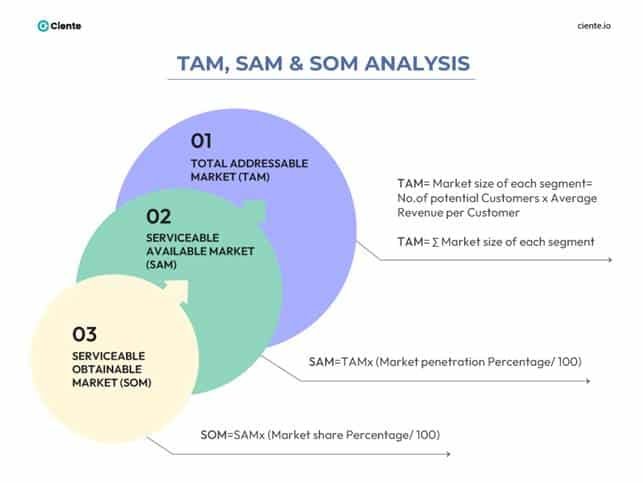
The top-down approach starts at TAM- the total addressable market, i.e., the overall market size.

Then, they progressively narrow it down to the potential market size for the business or the eventual market share.

This comprises the target market segments for the business’s offerings out of the entire market (Serviceable Available Market, or SAM). And then you dive in even deeper, i.e., the percentage of market size that can be realistically obtained and serviced to (Serviceable Obtainable Market, or SOM).

  • TAM = the whole 10-inch pizza.
  • SAM = the slices you can eat.
  • SOM = the slices you’ll actually end up eating.
image

The calculations are often subjective and presumptuous. These numbers are based on industry reports, various macroeconomic factors, and market research data.

This makes the traditional TAM calculation a significant hurdle for business leaders.

These numbers could end up over-inflated. Focusing on a chunk of the market doesn’t automatically generate more opportunities. And the glimpse into a company’s vast potential (or the upper limit) that TAM offers is misleading.

Limitations of the traditional “top-down” TAM analyses

The traditional TAM framework is inherently unsuitable for creating new markets. In recent times, it has driven investor skepticism and led to startups undermining their true potential. And investors might easily end up passing over the company, missing out on the company’s potential within new markets that could be created.

VCs now want believable numbers that align with your product strategy, GTM framework, and final objectives. Only focusing on TAM introduces too many limitations-

1. “For truly innovative products, the market is not a fixed entity to be captured, but a dynamic one to be created.” In simple terms? Disruptive offerings create their own demand (see Uber, Apple, and Microsoft).

2. TAM is often a farce, a large number on paper to make a company look good. Do the presented numbers actually link to the business’s analytical and real-world capabilities?

Imagine a client you’re working with asserts that their TAM is around $60 billion. They’re convinced. But the number is quite ambitious and should be credible. So, their SOM turns out to be $600 million. This 100x overenthusiasm can put a hitch in the client’s business strategies and growth planning.

3. Top-down TAM analysis put together by a third-party source reeks of laziness and lacks credibility. Just because everyone around the world uses phones doesn’t mean all of them will purchase an iPhone. It’s become a norm for third-party providers to tie up existing categories to reflect a large number. But what do those pre-packed figures really demonstrate?

4. The market is extremely heterogeneous- with distinct buying behaviors, needs, preferences, and myriad variations of the same offerings. TAM or the overall market size is a subjective number that represents the potential demand for a company’s offerings. But with the market fragmented and chopped into segments, this number doesn’t consider the challenges of penetrating these segments.

For a cloud solution, there might be individual as well as enterprise buyers. This demands majorly distinct sales, marketing, and distribution approaches.

5. TAM is too static a number for the dynamic market of the 21st century. The market transformation cycles have elevated from a 10-year-long pace to just 2-3 years. It’s due to the increased flow of information, tech disruptions, the adaptive nature of business models, and dynamic customer preferences. And these factors are what should impact TAM, but its rigidity doesn’t have the room to consider these fluctuations.

“I hear these TAMs – we are attacking a $30B TAM. OK, that’s great. But where did that number come from? The single largest company that exists in what you define as your category is a $2 billion company. So, where is the other $28B? Where are these numbers coming from? And then you have to unpack it- is it software? Is it software services or something else? They are packing it in so it looks gargantuan. But you look at every precedent company and nothing is over $2B.”

Tony Kim, BlackRock‘s Head of Investments.

The problem here is that the analytical capabilities of the traditional TAM framework are lacking.

What’s the solution here?

You lean on alternative methodologies to calculate TAM- ones that dive into the specifics to gauge the accurate market size.

TAM Analysis: Alternative Approaches to the Top-Down

A. The Bottom-Up Framework

TAM analysis with a bottom-up approach is more granular and specific. And it’s data-driven, which is why it’s a market-favorite. This framework is also often used when industry reports and broader market data aren’t available, i.e, the market (third-party) data is limited.

So, you convert existing zero-party and first-party data to analyze your current market size and potential.

You leverage existing audience data, such as offering pricing and usage, to calculate the TAM.

It helps you put the customers first. Rather than relying on a third party’s data analysis, you conduct your own market research in the arena where you know you can play best.

The process?

  • Define your ideal customer profile (ICP).
  • Count how many companies actually fit into your ICP.
  • Outline the average contract value (how much they’d pay you annually) for each account.
  • Multiply to calculate your total potential revenue, or TAM.

Example:

You’re targeting businesses in Singapore with overall 200-500 employees for your HR and payroll tech.

  • Number of companies in that range? – 10,000
  • Average contract value? – $3000
  • Your TAM? – 10,000*$3000 = $30 million.

All the calculations are based on actual customer and company data, and not assumptions.

With the bottom-up approach, you can negate the one dilemma that existed above- of pre-packed segments. And you can now explain to potential investors why you chose specific segments over others.

B. The Value Theory

Value theory asks, “What’s this worth?” i.e., highlights the economic value of your venture.

And mostly significant for startups with disruptive offerings.

You aren’t looking at existing markets. You are demonstrating your own worth to create a new segment driven by the value you offer. This means you’re solving an expansive market pain point that doesn’t have an established market size yet.

Value theory for TAM kickstarts investor discussions and offers market validation- what is the potential of your offering?

The process?

  • Outline a particular business challenge.
  • Measure how much this pain point can cost companies.
  • Quantify your offering’s value creation, i.e., how much of that cost can you eliminate.
  • Calculate the value of market share you can capture = total market value.

Example:

Data entry errors cost companies $750 per employee per year.

Your startup has developed a solution that can reduce the problem by 50%.

  • Target => 5000 companies, each with 200 employees.
  • What’s it costing a company? => $750*200 = $150k.
  • Total cost of the problem for the market ⇒ $750*5000*200 = $750 million.
  • How can your solution eradicate? ⇒ $750 million*0.50 = $375 million (Your TAM).

The Bottom Line- Adopt a Multi-Structural TAM Analysis Framework.

By changing the approach to TAM analysis, you aren’t eliminating the entire process but evolving it.

You must pivot to a TAM analysis framework that offers a more precise and accurate assessment of your company’s market potential. By solely sticking to the traditional method, you are limiting your understanding of your own company and its impact.

It can offer you high estimates and paint a sunny picture. But at the end of the day, it’s clouded by assumptions and doesn’t align with real-world market complexities.

A sustainable business model demands a change from this inflated TAM calculation.

Instead, opt for a multi-structural framework- one that considers diverse scenarios. And spotlights both the upsides and downsides of your market opportunities.

Alternative approaches help draw a realistic picture of a company’s market potential than depending on hearsay. Investors and founders alike can gauge its potential impact and ROI.

And highlight where you may stand in the market-

Will the market drive you, or will your offering end up driving the market?

12 Key Demand Generation Metrics Every Marketer Should Know

12 Demand Generation Metrics & KPIs to Measure Your Marketing’s Success

12 Demand Generation Metrics & KPIs to Measure Your Marketing’s Success

Data-driven decisions are vital for successful marketing campaigns. Do you have the right demand generation metrics to ensure your efforts hit the mark?

Demand generation is essential for B2B success. In 2024, the imperative to align with the evolving B2B demand generation becomes more pronounced. These constantly evolving times demand transformation and a deep understanding of the emerging trends and innovative strategies to generate demand and build meaningful relationships with our target audience.

The complexities of demand generation in 2024 necessitate a fresh perspective, blending traditional approaches with cutting-edge methodologies. But demand generation can be challenging – everyone has a unique way to achieve their goals, and the one-size-fits-all approach does not work anymore.

Yet, having some basic demand generation metrics in your map could guide you in the right direction and help you attain your goals faster.

12 Demand Generation Metrics for 2024

MQLs

If you haven’t incorporated MQL tracking into your strategy yet, now is the time to do so. They serve as a crucial Key Performance Indicator (KPI) to measure your progress toward achieving your company’s revenue objectives.

An MQL refers to an individual you identify as highly likely to convert into a sale. While they may not be ready to make an immediate purchase, they are aware of your brand and solution, express a need for it, and are open to learning more. MQLs are individuals who are receptive to additional marketing efforts and nurturing.

Identifying MQLs requires a keen eye and insightful data analysis. Several telltale signs indicate a prospect’s growing interest in your offerings:

  • Targeted Page Visits: Clicks on crucial website sections like product pages or pricing plans reveal a focus on potential solutions.
  • Time Invested: Extended website browsing suggests deeper engagement and a desire to learn more.
  • Frequent Visits: Repeated visits within a set timeframe showcase a sustained interest in your brand.
  • Content Consumption: Signing up for newsletters, downloading guides, or attending webinars signifies a willingness to receive further information.

These actions collectively point toward a prospect’s:

  • Engagement: They’re actively interacting with your brand.
  • Problem Awareness: They recognize a need that your solution addresses.
  • Nurturing Preference: They seek additional resources before committing to a purchase.

By recognizing these signals, you can effectively identify MQLs and tailor your marketing efforts to nurture them further toward becoming valuable customers.

SQLs and SALs

Finding potential customers ready to buy is crucial for any business. Two key metrics, SQLs (Sales Qualified Leads) and SALs (Sales Accepted Leads) help assess the effectiveness of your efforts in attracting these individuals.

Sales Qualified Leads (SQLs)

Ready for Sales Engagement: An SQL is a potential customer identified by your sales team as prepared to receive sales information and potentially make a purchase. These are often called “hot leads.”

Data-Driven Qualification: SQLs are determined using specific criteria, often based on data gathered through various sources. Examples include:

  • Frequent visits to product pricing pages.
  • Direct contact attempts with the sales team.
  • Trying a free trial version of your product.
  • Adding items to a shopping cart but not finalizing the purchase.
  • Using specific keywords during interactions with your chatbot.

Sales Accepted Leads (SALs)

Similar to SQLs, SALs represent potential customers acknowledged by the sales team. However, the key difference lies in how they are identified:

Manual Assessment: SALs involve a more qualitative approach, typically assessed through manual evaluation by the sales team.

Teamwork: This evaluation often involves a salesperson directly interacting with the lead, such as through a call, to determine their suitability for:

  • Immediate sales engagement.
  • Additional nurturing as a potential customer.
  • Disqualification due to not meeting the criteria.

Both SQLs and SALs are valuable tools for gauging the interest in your product and the overall health of your sales pipeline. They provide insights into how close potential customers are to becoming paying clients.

Cost Per Acquisition

The Cost per Acquisition or Customer Acquisition Cost(CAC) is a crucial metric that provides valuable insights into the effectiveness of your demand generation strategy. While adhering to demand generation best practices does not guarantee immediate sales, the number of customers acquired and the associated costs are key indicators of your strategy’s success.

It’s important to note that CAC differs from Cost per Lead (CPL). CPL focuses on potential buyers, whereas CAC assesses the expenses related to customers who make a purchase.

For instance, if you generate ten sales with a monthly profit of $9 per sale, but customers only stay for one month, and your marketing costs amount to $100 per customer, it signals a lack of sustainability and profitability in your business model.

Monitoring CAC can help you determine the amount of investment required to acquire each customer. It prompts you to consider the money you spend on acquiring customers and their return on investment in terms of Customer Lifetime Value (CLTV). By measuring CAC, you can gain insights into the demand your product has generated or failed to generate, providing a valuable indicator of your business’s health and potential for growth.

Activations & Signups

Two critical metrics for assessing the effectiveness of demand generation are activations and signups. The number of people who register for your product, whether through paid subscriptions or freemium versions, is a significant indicator of demand. Simultaneously, tracking how many users are actively engaging with your product provides insights into user adoption.

These demand generation metrics indicate the success of your marketing team and lead generation campaigns at the top of the funnel. They reflect the team’s ability to generate informed demand for your product and contribute to the overall growth of your business.

CLV

Monitoring Customer Lifetime Value (CLTV) is a crucial aspect of demand generation analysis. It emphasizes the average value of customers over their lifetime rather than individual cases. An upward trend in CLTV indicates the effectiveness of demand generation efforts, showcasing a deeper impact beyond basic engagement. It’s vital to differentiate between generating general demand and fostering informed demand.

CLTV serves as a pivotal gauge because simply creating demand is inadequate if it doesn’t result in tangible outcomes like sales or referrals. If demand-generation activities fail to contribute to an increase in CLTV or other key metrics, it’s essential to reassess strategies. Pursuing demand solely for superficial metrics is unsustainable. If the generated demand doesn’t lead to long-term customer value, adjustments in approach are necessary.

Payback Period

The payback period is a critical metric to monitor in demand generation. It signifies the duration required to recoup the upfront costs incurred in acquiring a paid user. Ensuring that demand generation expenses sustain profitability or maintain positive figures while focusing on user growth is crucial. Essentially, the payback period ensures that initial costs and marketing endeavors yield returns for the business over time. Sustaining profitability while focusing on user growth is paramount, ensuring that demand-generation efforts yield positive returns over time.

Days in Status

“Days in status” is a crucial metric in evaluating lead progression within the marketing cycle. This metric measures the duration a lead remains in a specific status before advancing to the next stage, such as from Marketing Qualified Lead to Sales Qualified Lead or from MQL to customer. Unlike customer acquisition cost, which is typically assessed later in the process, “days in status” provides insights into the efficiency of demand generation efforts at different stages of the pipeline. By dividing the acquisition cost per day by a specific status, this metric offers valuable insights into the impact of the budget on the pipeline, highlighting the contribution of demand generation efforts to the overall process. The objective is to strike a balance between efficiency and speed without rushing individuals through stages they are not prepared for.

Marketing Sourced Pipeline

Marketing sourced pipeline is a critical measure of success for demand generation teams. This metric reflects the close rate per channel and serves as a primary indicator of amplified demand in the market. By tracking demo requests on the website, demand generation teams can measure the effectiveness and cost of various channels, allowing them to allocate resources to channels that yield the highest return on investment. Increasing demo requests indicate a growing demand for the product with sales intent, guiding strategic decisions in resource allocation.

Average Deal Size

In demand generation strategy, monitoring the average deal size obtained from each tactic is essential for evaluating progress. This metric provides insights into the effectiveness of different channels in generating larger and more impactful deals. By associating specific channels with the most deals and the largest deals, businesses can make informed decisions about resource allocation. For instance, if SEO efforts consistently lead to larger contracts compared to PPC, it prompts considerations on where to prioritize time and budget within the demand generation strategy.

Contribution to Total Revenue

Monitoring the contribution of demand generation efforts to total revenue enables businesses to evaluate the commercial effectiveness of their marketing strategies. This metric justifies marketing expenditure and guides strategic decisions in resource allocation. A substantial contribution to total revenue indicates the success of marketing strategies in driving business growth and profitability.

Brand Sentiment

Brand sentiment is an essential metric that measures how the audience perceives a brand. Positive brand sentiment fuels demand and nurtures customer loyalty. By consistently monitoring brand sentiment, businesses can identify areas for improvement and take proactive steps to enhance their brand’s image in the eyes of the audience.

Content Performance

Content performance metrics, including shares, comments, likes, and impressions, provide insights into the engagement levels of content. This data shapes the content strategy, enabling businesses to craft compelling and impactful content that resonates with the target audience. Evaluating content performance guides strategic decisions in content creation and distribution, ensuring alignment with audience preferences and interests.

Key Demand Generations Strategies for 2024

Account-Based Marketing (ABM):

Account-based marketing (ABM), a prominent B2B demand generation strategy, can be helpful for laser-focused targeting. The focus remains on targeting specific high-value accounts and tailoring marketing efforts to cater to their unique needs and preferences. A successful ABM strategy is all about personalizing content, engaging key decision-makers, and ensuring seamless alignment between marketing and sales efforts.

Content Marketing and Thought Leadership:

Generating demand through quality content remains a crucial aspect for businesses. By creating informative blog posts, ebooks, whitepapers, and videos, companies can establish themselves as thought leaders in their respective industries. This strategic approach not only helps in attracting but also nurturing quality leads, further strengthening the role of content marketing in demand generation.

Personalization and Customer Segmentation:

Personalization emerges as a critical factor in the success of demand generation. Leveraging customer data and marketing automation tools empower businesses to deliver tailored experiences and targeted messages to diverse customer segments. This enhances engagement and contributes to higher conversion rates, emphasizing the integral role of personalization in demand generation success.

Social Media Marketing:

Social media platforms remain formidable tools for demand generation in 2024. Utilizing platforms such as LinkedIn, Twitter, and Facebook enables businesses to expand their reach, actively engage with prospects, and promote valuable content. Social media marketing continues to be a key strategy for generating demand, fostering brand awareness, and facilitating meaningful interactions with the target audience.

Data-Driven Decision Making:

In 2024, data analytics will play a vital role in demand generation. By using insights obtained from customer data, businesses can gain a deeper understanding of customer behavior, preferences, and concerns. This understanding helps them make informed decisions, streamline campaigns, and achieve better results. The integration of data-driven decision-making processes further cements the effectiveness of demand-generation strategies in today’s rapidly evolving business landscape.

How do you measure demand generation?

But to use these metrics, there must be certain measures to weigh these against. These measures are qualitative and quantitative.

For example, MQLS- how do you measure their effectiveness? Either it can be the number of MQLs you get vs converted or the number of conversations you have had.

The logic is simple, to build on the metrics.

Qualitative Measure

These are the ones that help your brand become a brand- and makes it memorable. Quality dictates the outcome of your demand generation activities.

But demand only, which is ideally the top-of-the-funnel activities. And as such, you should measure demand by: –

  1. The number of conversations your brand generates
  2. Brand mentions and buzz on social media
  3. Reception to advertising and impact- for B2C, this is if your buyers are buying post ad-click. And for B2B, it’s the type of conversations your brand has with its potential buyers.

Qualitative measurement is always a bit abstract and requires acute awareness of your goals, your needs and the sentiment of your market.

Sentiment

Perhaps the most vital measure is sentiment. NPS is a good starting point but it shouldn’t be your only measure to track. As your brand grows, and it should once you get customers- you need to engage and understand what the think of you or IF they think of you.

That if is vital because if there is no sentiment, there is no brand. It’s non-existent.

Sentiment is the lynchpin of your demand gen campaigns. And it can be measured by direct interactions, social media conversations, and engagement.

Relationship Building

The second qualitative measure is the relationships you have built. These are easy, do your emails get replies or is there a particular part of your campaign that speaks to your audience?

This can be measured by increase in google searches- track impressions and brand searches on GSC or mentions by LLMs, which directly corelate to the amount of times you are mentioned in a given space.

For example, you ask, which are the best lead gen organizations? And the LLM says something along the lines of: –

“Sure, here’s a list: –

  1. Ciente
  2. Sales Road
  3. Martal
  4. Cience
  5. Belkins

With these lead generation companies, you cannot go wrong. Let me know if I can give you information on what they do.”

Something like this.

These are underutilized, especially since search is becoming more personal and about staying visible in a noisy world.

Visibility

This is probably the first measure that will show you whether demand generation has worked in your favour. Are you searchable?

  • Do you rank?
  • Does your social media show engagement- including comments and or replies to email?
  • Are there conversations your brand can engage in?

This is the qualitative aspect of demand generation and metrics must be measured against them.

Quantitative

The industry is somewhat moving away from the quantitative. But they aren’t gone completely.

Data and numbers, especially conversion rates give definitive proof of whether a campaign has worked. But there is a drawback in the quantitative approach. It is not future-proof as it provides number very relevant to the running campaign.

It’s proof that the current demand gen campaign worked but not why it worked exactly. An advantage that the qualitative measurement will provide. This approach entails: –

  1. CAC: CLV ratio
  2. Revenue based on campaign cost
  3. Bottom-line

This is perfect for CMOs and marketing directors because they can take these measures and take it to the CFO and CEO as definitive proof of their creative and scientific endeavors.

Conclusion

The future of B2B demand generation demands agility and innovation. Effective strategies blend traditional wisdom with modern tech, helping businesses to thrive in a dynamic market.

Moving forward, businesses must not just meet current needs but anticipate and shape future requirements. Gone are the days of simply reacting to market whims. Today’s B2B landscape demands a proactive approach. Businesses are shifting gears, transforming from passive observers to influential forces shaping the industry.

This strategic overhaul involves three key elements: staying abreast of industry trends, using technology effectively, and building strong customer relationships.

In essence, it’s a call to action for businesses to lose their reactive stance and seize the reins. By taking a proactive approach, they can ace their goals, ensuring their continued relevance and success.

FAQ

What are the six steps in the demand generation process?

The demand generation process has a funnel of its own. Although it operates primarily on TOFU, there are stages to this process.

They can be broken down into 6 steps or stages: –

  1. Awareness
  2. Lead Nurturing and Education
  3. Data-based marketing optimization
  4. Campaign Pivots
  5. Segmentation
  6. Retargeting

What do demand generation metrics mean?

They’re supposed to measure how effectively marketing creates and converts interest into revenue.
But half the time, they’re just signals of activity, not impact.

Are MQLs and SQLs still relevant?

Only if both sales and marketing agree on what they represent.
Otherwise, they’re vanity checkpoints — numbers that make dashboards look busy but don’t tell you anything about intent or movement in real accounts.

What about pipeline metrics?

Pipeline should show momentum.
If it’s just showing volume, it’s missing the point.
True demand generation is about velocity — how fast real opportunities mature, not how many forms were filled.

So what’s the metric that matters most?

Revenue influenced and accelerated.
If your campaigns don’t connect to those, you’re measuring noise. Everyone wants a simple number for a complex process.
But demand gen is closer to orchestration than output

Programmatic Advertising Platforms: The Best Picks

Programmatic Advertising Platforms: The Best Picks for 2025

Programmatic Advertising Platforms: The Best Picks for 2025

When planning to invest in programmatic advertising, the first thing to figure out is an efficient platform to partner with. This article will help you make that choice.

Programmatic advertising allows leaders to implement media purchases and retarget customers using automated tools. Choosing the right platforms simplifies launching efficient ad campaigns, highlighting a brand’s offerings, and garnering more customers.

The various features and advantages of programmatic advertising make it a popular channel for marketers. As technologies emerge, brands must incorporate these media channels to boost ROI.

Studies indicate that in 2025, its strategic integration can contribute to an unprecedented growth of around $271 billion in ad spending in the United States alone. You can combine it with top-notch ad templates and ad inventory to improve user experience.

More about B2B Programmatic Advertising

Programmatic advertising has two main players: an advertiser and a publisher. The advertiser shows ads to the target audience, whereas the publisher uses the ad space to display them. In contrast to display ads, programmatic ads can be bought or placed on platforms using the software. The purpose is to increase a brand’s distribution and scale at a higher budget.

With programmatic advertising, brands can give digital advertisers the benefit of the doubt for buying and selling ad inventory from publishers. You can leverage these platforms to buy the ad space of choice, manage ad campaigns, and optimize them using data.

There are six critical components involved in programmatic advertising’s automated process:

Demand-Side Platform (DSP)

DSP is an automated buying platform that is fitting for purchasing digital ad inventory. It allows you to buy ad space in exchange for advertisements at a pre-determined cost. When you launch ads with DSP, you can target audiences based on location, age, and online presence.

Supply-Side Platform (SSP)

This tool is perfect for including an ad inventory in an ad exchange. Typically, SSP can be managed before the onset of programmatic bidding.

Ad Exchange

An ad exchange is like the trading floor where actual bidding occurs. After an inventory is available, the ad space can be sold to the highest bidder. This process resembles an auction setting— the only difference is that it takes place through algorithms.

Real-Time bidding (RTB)

RTB offers clarity about what the target audience is seeking and how much they are willing to invest to reach them.

Private Marketplace (PMP)

Also known as a private exchange, it gives ad publishers more control while choosing what’s best suited to purchase their ad space. Publishers will provide inventory to a handful of advertisers.

Programmatic Direct

This ad platform allows publishers to sign one-on-one deals with advertisers beforehand. The pre-planning helps gather impressions at a guaranteed price. However, the actual process of publishing ads to the target audience happens through an automated system.

What Goes into Programmatic Advertising?

This process involves six steps:

Step 1: When customers visit a website displaying a programmatic ad, the site first shares client details with an ad exchange.

Step 2: The ad exchange then assesses user data. This detail is shared with advertisers in real-time. All this is followed by the initiation of an auction.

Step 3: With the help of DSPs, advertisers review the information, evaluate the value of serving their ads, and then place a bid accordingly.

Step 4: After the bidding process is completed, the ad exchange selects the best bid, and the winning advertiser gets the ad space.

Step 5: Soon after, the selected ad gets uploaded to the user’s webpage.

Step 6: Once an ad has been published, you can evaluate its performance using metrics like clicks, impressions, and conversions.

Want to read more about programmatic advertising? Please refer to some of our other blogs on this topic. (link)

Benefits of Using Programmatic Advertising Platforms

Why must you leverage diverse programmatic ad platforms? The answer is quite straightforward. It’s an informed and smart strategy. And an integral component of intelligent decision-making.

However, this isn’t all there is to leveraging different programmatic ad platforms.

They add an edge to your ad campaigns, elevating their visibility and reach. And this is why shifting from traditional digital marketing methods to programmatic ones is imperative to maximizing your ROAS.

What can optimized and automated ads actually do for your business?

1. Offers real-time data insight.

Tweaking and optimizing ad campaigns in real-time is a modern ad demand. While AI and automation have made it possible, few marketers usually understand their benefits.

Imagine being able to analyze PPC data after a whole day of running ads on the Google Ad Network? You can draw parallels between the huge volumes of real-time user data. It becomes much easier to draw insights at the very moment when users are interacting with your ads.

Your team receives insight into what’s working and what’s not. The data is presented, not in numbers, but in pie charts, metrics, and graphs using Google Analytics (or other integrated analytics software).

After which, these programmatic ad platforms allow you to make real-time adjustments. And the result? Elevated efficiency and speed. You no longer have to wait for the collated data at the end of the ad campaign and wonder if you can improve upon it next time.

2. Instills transparency into the reviewing and buying processes.

The truth is that you can’t improve upon what you can’t see or measure.

Programmatic ad platforms have elevated the visibility into ad campaigns, removing a significant amount of the black box. The most crucial one is an insight into automated ad buying and selling, especially in real-time.

Traditional advertising never offered advertisers or publishers so much information in the ad process. Behind the curtains, it’s never easy to understand where the disconnect could be. Think of billboard ads in a busy area, such as Times Square. You know the reach is enormous, but what are the exact numbers? Is your reach moving beyond vanity metrics?

Running an ad across the Google Ad Network is substantially different. You don’t just track impressions, but other value metrics that’ll help marketers make better decisions regarding ad spend.

3. Improves audience reach and targeting on multiple intricate levels.

Oftentimes, reach is misunderstood. It’s not a vanity metric, but a proof of your brand’s faring. This way, it’s directly linked to your business’s growth.

Programmatic media buying solves this curious case of audience reach for you.

Programmatic ad platforms are the chosen way to reach the maximum number of audience segments. And ascertaining that the ad hits the target just right. It fulfills the entire purpose of an ad, making people see it.

And with multiple networks and exchanges, the potential reach is quite significant. This is why most modern brands are opting for programmatic ad platforms. You don’t even have to concern yourself with your display ads or how to monitor and adjust them. These platforms help you consolidate and unify your running ads from a single location.

You can curate customized ads for different geographies to appeal to the local market and elevate conversions. From informed targeting to cross-device reach, these platforms do it all, emerging as a top-notch solution to traditional adtech limitations.

4. Scales campaigns for flexible resource allocation.

Scaling is a gemstone for businesses to remain competitive. But it’s not without its own risks and inefficiencies. How do you scale campaigns quickly and still ensure all the goals are achieved?

Programmatic ad platforms facilitate scaling depending on how much is invested in the campaigns. This makes programmatic an efficient solution for both large enterprises and small businesses.

For example, Google Ads ensures scalability by allocating average daily campaign budgets. Then it looks over when to best use the budget on a day-to-day basis. The amount spent substantially depends on the campaign’s potential ROI. This means that an advertiser can opt for the programmatic ad platform to reallocate a chunk of the budget during customer peak times.

The ad platforms ensure that advertisers can capitalize on opportune moments and increase effectiveness. And the most vital thing to note here is that the scalability that programmatic ads deliver is really agile. Your team can scrunch or increase the budget according to your campaign directives.

5. Improves your access to a rich media mix and enhances the creatives’ quality.

Programmatic ad platforms help choose the right media mix that suits your campaign best. It hosts a plethora of ad formats and channels to reach your audience in the most engaging way possible, from video ads to audio and connected TV.

This diversification adds edge to your campaign, retaining freshness in your campaigns. You can rotate between ad formats and experiment with multiple creatives at multiple touchpoints.

But always ensure that the content isn’t generic or static. Instill creativity across all assets to establish a direct understanding and empathetic communication line to your target audience. Leverage content that ties to the viewers’ pain points and offers value in return.

Don’t just invite your audience to look at your ad. But engage with it, and truly grasp what your brand can do for them. Creating more personalized creative assets might do the trick. And if it’s shareable? Your creatives add more bargain points to your ad campaigns.

This is what programmatic ad platforms afford advertisers- not just the technical structure, but also creative enhancement.

Choosing the Best Programmatic Advertising Platforms in 2025

Don’t just follow market trends or base your selection on the coattails of the market leaders. Given that programmatic is highly technical, you must opt for the best one- one that actually aligns with your business requirements.

The right platform will help you zero in on your campaign goals, factor in the funnel stages, and segregate audience data smartly.

Every brand entails a USP and unique customer journeys; the programmatic ad platforms you finally opt for must consider these aspects to enhance your activation strategy.

But choosing one isn’t as straightforward as you might think.

Let’s see which ones are making all the noise in the market currently.

Best Programmatic Advertising Platforms for Your Business

With several efficient ad platforms within the market, it can seem like a real challenge to decide which would be ideal for your brand.

We’ve prepared a list of top picks to help you integrate the leading programmatic advertising channels.

1. Publift

Publift is a Google Certified Publishing Partner specializing in ad tech, startup strategy, and optimization. Their high-quality custom solutions and customer service have earned them a high reputation.

Publift easily provides access to features like premium demand sources, real-time bidding optimization, and data-driven yield management. It’s a perfect choice for driving a significant increase in publisher revenue.

Publift is ideal for brands looking to deliver structured reporting and analytics to track ad campaign performance. The core objective is to push informed decision-making with these ads and optimize them.

2. Google Ad Manager

As a leading programmatic advertising platform, Google Ad Manager allows brands to target large publishers, thus generating traffic and revenue. Its equipped tools make ad optimization a smooth process.

Google Ad Manager’s ad exchange platform contains automated optimization and dynamic allocation. Features like this enable companies to modify campaigns based on performance indicators such as cost per action or click rate.

3. Adobe Advertising Cloud

One of the highlights of this platform is that you get the combined benefits of both Adobe Marketing Cloud and Adobe Analytics Cloud. This offers flexibility, supporting various programmatic ads across channels, such as display, video, social media, and so on.

You have an all-in-one platform that enables you to reach an audience through different ad formats. And it’s user-friendly, streamlining ad campaigns plus having the right tools for optimizing performance. You receive holistic information on customer behavior and preferences.

Adobe Advertising Cloud’s real-time analytics will help adjust bids and budgets, amplifying the ROI cycle.

4. Trade Desk

The features of Trade Desk can improve audience targeting and streamline omnichannel marketing. You can access RTB, private marketplaces, budget management, and more using the same tool.

What’s more, it exposes you to a data marketplace that gives advertisers access to high-quality data to enhance targeting efficiency. This platform enables brands to reach the right audience using the right message at the perfect time.

5. Xandr

Xandr is a Microsoft-owned platform that helps brands streamline the buying and selling of digital advertising. What makes it stand out is that it is very adaptable. Xandr’s striking blend of automated tech, data, and identity solutions makes it an asset for brands wanting to engage their target audience.

The differentiating feature of Xandr is its efficient audience analysis tool, providing insights into customer interests and preferences. Brands can use these details to customize ad campaigns to connect with customers and accelerate the sales pipeline.

6. PubMatic

PubMatic offers you the seller’s perspective. Brands can choose from an array of solutions that it offers, ensuring ad quality and monetizing the ad space. It also allows you to access a private marketplace, analytics tools, and tools to manage ad fraud.

Businesses can use the media buyer console plan in PubMatic to manage campaigns across multiple channels. The best feature of this platform is its scalability, making it accessible across various budget options.

7. MediaMath

Launched in 2007, MediaMath is an established platform integrated with cutting-edge programmatic buying technology.

The Gartner Magic Quadrant for Ad Tech listed it as a leading platform. MediaMath’s combination of catchy video and first-party data provides a complete end-to-end solution that promotes simple yet efficient omnichannel advertising.

This programmatic advertising platform is an ideal choice for omnichannel campaigns across mobile, display, video, and audio.

8. Criteo

Criteo is a genius at retargeting.

How often have we noticed users browsing through a website, or adding products to a cart, and then abandoning it? Criteo is an expert at delivering relevant and personalized ads that encourage these visitors to re-engage and complete their purchase.

It uses a hybrid approach, leveraging both audience data and algorithms, to track behavior and drive out data-driven, accurate insights. This way, their ad targeting strategy remains dynamic and contextual.

And in today’s landscape of ad fraud and lack of data security, Criteo moves away from deceptive incentives that encourage third-party clicks. This is what makes this platform the most accessible platform for publishers with mid-level website traffic.

9. AdPushUp

AdPushUp is known for its user-friendly interface. Started in 2014, this is a revenue optimization platform for website owners and online publishers. It facilitates publishers and advertisers to experiment with their creative assets by applying A/B testing.

It isn’t merely about publishing ads and generating revenue, but also about enhancing the overall campaign. AdPushUp fosters an environment of testing and choosing the ad configurations that work best for their brand.

Its standout feature isn’t this flexibility to experiment, but its capability to integrate with popular ad networks. This increases publishers’ access to ad demand sources and helps them make informed monetization frameworks.

Choosing the Right Programmatic Ad Platform is All About Choosing Brand Safety.

Brand positioning remains significant in marketing, irrespective of a company’s size or year of establishment. The boom in technology demands a strong digital image. But for that to happen, brands must be available on the correct channels in front of the right audience. Embracing this change with open arms will do wonders for your brand.

Programmatic platforms will help elevate your digital advertising efforts. So, it’s crucial to understand what these platforms offer and choose the best fit.

Outbound Sales Playbook: A failing strategy or a misused tool?

Outbound Sales Playbook: A failing strategy or a misused tool?

Outbound Sales Playbook: A failing strategy or a misused tool?

Are playbooks really working for your sales team? The data is anecdotal and confusing. Perhaps it’s time for a new perspective to arise.

Sales is frenetic.

There’s energy everywhere, and the conversations are hypnotic to a certain degree. No wonder the outbound sales playbook plays such a pivotal role in the conversation, because like sports, sales is nothing short of an enchanting game. (And the stakes are at their highest.)

It’s like a game of American Football, a mirror of war. Because after all, sales is a battle of human wills.

“Here’s what we have. Can you buy it? You need it and here’s why.”

Then the buyer plays their own game to win- whatever winning might be for them.

But for sellers, it is relatively simple: to get the sale. So it would be natural to think of strategies and playbooks because they exist in football and other strategy games. There’s always the right first move.

And these playbooks sell for what? $1200-1300 a piece?

How many of these playbooks have worked in your favor? Surely, the answer depends on organization to organization. But that’s too ambiguous.

The popular theory is that playbooks do work, and the reason for that is simple: the sales leaders and reps who use these playbooks are already good at their jobs, and the playbook introduces new ideas for them to work with.

Caught between ‘the old playbooks are dead and the new playbook is in loop’, let’s talk about a simple idea.

What if you could escape this loop? No, not matrix style, but by observing where you stand in your own context.

What is a sales playbook?

This small section is for those who need a formal introduction.

A sales playbook is a set of strategies, buyer pain points, personas, and possible scenarios encountered by SDRs on call.

The playbook helps the sales rep navigate the uncertainty that the buyers may throw at them. The playbook has everything they would need to deal with the buyers and their objections.

Yes, it is a document. Ideally, a living document- one that changes shape as it grows.

But there is a problem with this. Playbooks are notorious for being shelved and never being used. Or they are too complex for teams to use- there is just too much there, and very few insights that can be used.

Why do businesses get playbooks wrong?

There is growing skepticism around playbooks. First, they are expensive to buy and time-consuming to create.

Second, these playbooks don’t offer much. Even though teams report a 30-40% increase in efficiency, these numbers are anecdotal and don’t offer a complete view. There are as many teams that say the playbook doesn’t work and is an expensive piece of content that remains on the shelf.

Or it isn’t used by their SDRs because there’s just a lot to unpack there. And of course, what else could it be?

There’s a vast disconnect between the playbooks and the players- sales is a dynamic game where buyer sentiment changes, and unlike football, there’s no real way to monitor it in real time.

This is what playbook creators and adopters falter- they think the buyer might give them real-time updates before a relationship can be established.

The outbound sales playbook is not what you imagined.

Of course, you want your sales team to be successful with as few resources as possible. Ideally, the math is simple: down go the costs and up go the profits.

And efficient communication with the prospects is part of this arithmetic. In as few calls, emails, and touchpoints as possible. After all, the CAC: CLTV ratio must be in balance. If CAC rises and CLV falls, that’s a huge problem.

But the traditional playbooks don’t look at this: they are focused on the quantity of the calls and extracting as much information out of the prospect as necessary. And the new playbooks are too marketing-centric.

It’s a conundrum. And the conundrum conveniently hides a crucial fact: sales is complex.

Sales Playbooks, new and old, don’t acknowledge complexity.

Does anyone believe sales are easy? Although it cannot be categorized as difficult, it is complex. There are a lot of moving parts involved- there’s the committee and the buying list.

These two elements make it difficult for sales reps to connect with their prospects. And the buyers are feeling this effect- they believe most of their sales calls are transactional. And they are irritated by it.

Think of all the calls you get with the same script, doesn’t it feel like a waste of your time?

Who would you rather listen to: the person who wants to solve your problem and understand it, or the person who is reading a script that someone else has created for them?

That’s the problem with these playbooks: they try to codify dynamic human behavior by assuming each segment will behave the same across events.

When has this happened? Never. And this thinking boxes the SDRs into a repetitive pattern, dulling their conversational instincts, something that a sales rep always needs to sharpen.

These playbooks, with their overreliance on data, reduce the prospect to a bunch of past-based predictions.

Does your organization need an outbound sales playbook?

That brings us to a vital question: must you invest in a playbook?

Let me give you a few likely scenarios: –

  1. It will increase efficiency
  2. It will eat dust in your SDR’s corners
  3. It will be removed from reality.

Option C is the most likely one. Why? Because buyer behaviors change rapidly.

Think of this, one prospect whom you have cold-called, accepts to sit for your demo. Your engineers and sales director are ready to explain everything, and the prospect never shows. And when you send an email to them, they say: –

“Hey, I am not going to sit for any call. What is this about anyway? I don’t remember any call.”

Down goes all the plays. The playbook didn’t account for the fact that nurturing is a vital component. Or the indifference of the buyer.

Yet it should have. But that’s when complexities arise. Think of all the ifs, buts, and if-else scenarios your SDRs will have to deal with. Can a single document capture all of that?

Even the blueprint of this framework and playbook might be too complex. But there needs to be a north star- something to guide the generation of SDRs. With more empathy, active listening, and that frenzy that makes sales so addictive.

How to create a sales playbook?

This part is a bit misleading on our part. To create a sales playbook, you could capture every best practice in history and fuse it with your organization’s context.

But that won’t do much if you think the playbook is the gospel and ask your team to follow it to the T.

They will fail.

The previous sections are clear. Outbound requires a deep understanding of the prospects, and that can happen on a call. Yet the pitches that SDRs give are so disconnected from the person- no wonder they aren’t responding positively.

But hey, that’s okay. In B2B, it’s the quantity that matters. Call 1000s and close 2, you have more than enough to run your ship.

Who cares about quality anyway?

But the market is always looking for a vendor that they can trust explicitly. And those 2 buyers that you got are about to churn for someone with better processes than you.

And this is where you have an answer: the process.

So the real question is: how to create a sales process?

The sales playbook, with its complexity, can actually be managed if we think of it in terms of systems and processes.

The guiding principles behind these processes must be: –

  1. Consultancy on overselling
  2. Identifying leverage through conversation
  3. Approaching sales with a multi-thread strategy
  4. Nurturing

If you look closely, all playbooks actually tell you to do this, but complicate it in a branch of conversations. Your prospects’ engagement in going to be based on what they think of the SDR, anyway.

Why not give the prospects time to breathe and connect with the person they will talk to?

This is the crux of the sales process. Yes, some of your playbook will help onboard new SDRs. But if an organization wants to grow, it has to make sure its employees grow with it.

It’s altruism based on mutual growth.

However, these processes require honesty that is lost in most B2B transactions.

Many sales leaders and consultants advise on playing on strengths and weaknesses because every organization has its inherent strengths.

A start-up can pivot quickly and take risks.

While mid-sized organizations build on trust.

And enterprises have resources.

There’s a lot of talent to go around, but companies falter when they don’t align their sales process to their organization’s context. I.e.: –

  1. The problem they are solving
  2. Their headcount
  3. Their resources and availability.

Often, this is why some organizations, even large ones, make promises and don’t do better on them. In a bid to survive and gain, they lose trust.

The playbook is a relic of the past.