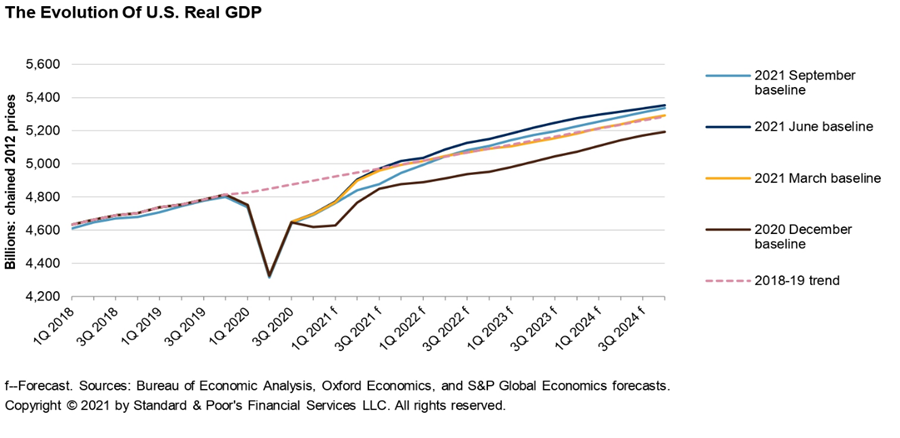
The US economy, a speculative topic for leading economists, witnessed the recent surge in GDP and has bolstered the faith of millions of citizens.
In defiance of the prediction of leading financial analysts about recession, the US economy, powered by the GDP, flourished to 4.9% in the last quarter (July to September). The world’s biggest economy owes its promising financial upsurge to propelling factors and is successfully holding off prospects of a downturn. This fast-paced growth marks the highest rise since the last quarter of 2021. We delve into the contributing factors and break them down to gauge how economies prosper or fail in the economic landscape.
Gross Domestic Product rises from 2.1% to 4.9%
GDP rose by about 133% this quarter from 2.1% in the previous quarter (April through June).
Gross Domestic Product (GDP) can be formulated as the cumulation of consumption, investments, government spending, and the net export of a country.
GDP = C + I + G + (X – M)
Implying:
private consumption + gross private investment + government investment/ government spending + (exports – imports).
Key Contributors to GDP Growth
Consumer Spending
For the GDP to increase, the leading contributors are the US consumers, whose spending accounts for over 67% of the economy surged in the last quarter. A tight labor market, despite slow wage growth of about 1.7% in a quarter, favored consumers to spend on various goods and services. The interest rate hikes by the Federal Reserve, keen on clamping down inflation, have not stopped private consumption so far.
High-Expenditure Sectors
As per the survey, some of the leading sectors with the highest expenditure, are housing, utilities including gas and groceries, insurance, financial services, accommodation, food services, recreational goods, vehicles, drugs, and more. This helped the personal consumption expenditures (PCE) price index soar high to 2.9%. With increased personal expenses, personal saving was reported as $776.9 billion in the third quarter, when compared to $1.04 trillion in the second quarter of 2023.
Loan Repayments and Housing Sales
A notable fact that must have propelled the economy is loan repayments. During the pandemic, loan repayments had been desisted, and October witnessed over 30 million loan repayments.
Interestingly, fresh home sales surged by 12.3%, the highest in the last 19 months. This element affirms spending capacity of US consumers as positive for GDP growth.
Private Investment and Trade
To contribute towards private investment, there has been improvement in manufacturing and retail trade as per government reports. Export and import are important components driving the economy of a nation. While exports rose by 6.2%, imports improved by 5.7%.
Government Spending
The federal government spends increased in residential fixed investment, further contributing to the boost.
Monetary Policy Outlook
Though several factors listed above supported the country to outpace its revenue dips in the past, this improvement is unlikely to impact the government’s monetary policies.
Predictions for the 4th quarter
The US economy has been a speculative topic and subject to deep analysis by leading economic analysts. If we were to believe few of them, consumers seem to have used the last portion of their pandemic savings. After this boost in GDP, they predict there will again be a downturn in the concluding quarter of 2023. The strikes by United Auto Workers against the
leading conglomerates Ford, Stellantis, and General Motors can hamper the sustenance of
the economy to this level. The strike that ensued on 15th September against underpays and loss of retirement benefits can hamper the automobile manufacturing industry and impact GDP. Finally, the gross national income restoration, is a breath of fresh air for this thriving land of opportunities, and citizens hope this hike stays persistent.
A successful marketing strategy takes planning, research, and commitment. How can you craft a powerful strategy to boost sales and foster relationships?
B2B marketing strategies are essential for fostering growth and creating deep relationships with other organizations in the fast-paced business environment where enterprises compete to outperform one another and maintain their market position. These strategies, including an effective b2b marketing automation strategy, help you track your marketing efforts and keep you organized and laser-focused. Wondering how you can craft a powerful strategy? This blog will walk you through all the steps! Read on.
Analyze Your Present Situation
Understanding your company’s objectives, the target market, the competitive environment, and market trends is the first step in developing an effective marketing plan. Consider your existing situation’s advantages, disadvantages, and strengths. This analysis is the foundation for developing a marketing strategy that matches your company’s objectives with your target audience.
The cornerstone of successful B2B marketing is segmentation. You may hone your messaging to satisfy their particular demands and pain areas by breaking up your target audience into various segments. By creating Ideal Customer Profiles (ICPs), you can get a clear image of your most important consumers and use that information to make content that speaks to them specifically.
Choose Efficient Marketing Channels
It is critical to pick an appropriate marketing channel to reach your audience. Take into account the information-gathering preferences of your target audience. Whether you want to use email campaigns, search engine marketing (SEM), or social media advertising, pick the channel that will best engage and reach your audience.
Create Powerful Messaging
Creating compelling messages that will draw your audience in is very important. The distinctive advantages and value propositions of your systems and components should be highlighted. The challenges and problems that your clients are experiencing should be addressed in your messaging, along with a focus on how your solutions will address those issues. Clear, consistent, and appealing messaging will elicit a response from your audience. You can define your brand and set it apart from the competition with this.
Analyzing and Improving Your B2B Marketing Plan
Standing still is not an option in B2B marketing. The audience changes, the environment changes, and strategies that formerly dominated it may no longer be as effective. To determine whether your marketing strategy is working, it’s critical to routinely evaluate performance, set KPIs, and monitor results. Constantly review your marketing plans, make adjustments to reflect the market’s shifting dynamics, and fine-tune your execution. It guarantees that your plan is still flexible, efficient, and in line with your marketing objectives.
A solid B2B marketing strategy builds a strong brand identity, boosts sales, and promotes long-lasting relationships.
Wrapping Up
A strong marketing strategy is necessary for business success. It helps you monitor the performance of your marketing efforts and keep you organized and focused. It serves as a guide for locating your target market, enhancing brand recognition, and boosting sales. A successful strategy takes planning, research, and commitment. Setting sensible objectives, making plans, and creating a budget are crucial. It’s important to monitor your progress and modify your strategies as required. You can gear up and position yourself for success with these stages and directions!
Email marketing is not getting archaic- in fact, it is only becoming more relevant. But are organizations using this to the fullest potential?
Future of Email Marketing
In the digital era, email marketing isn’t merely surviving; it’s thriving as a powerful tool for driving demand generation. By 2025, there will be an estimated 4.6 billion global email users, according to Statista. Email marketing offers abundant opportunities for businesses to connect with their audience effectively and enhance their revenue streams by utilizing personalization, automation, and data-driven approaches.
Consider the future of email marketing landscape: picture a scenario where your email strategy is incredibly personalized, making every customer feel as though they’re engaged in a one-on-one conversation with your brand. Envision automation not as a cold, impersonal process but as something impeccably timed and contextually fitting. This isn’t a distant dream but rather the evolving essence of email marketing.
What is Email Marketing?
Email marketing involves utilizing email to cultivate connections with potential clients and customers. It is a platform to promote services and products while disseminating company updates, product details, special offers, and news to the audience.
Reasons Why Email Marketing is Still Relevant
A striking 91% of internet users check their email daily, surpassing the 57% who check Facebook and the mere 14% who visit Twitter. This highlights that email marketing is notably superior at grabbing users’ initial attention compared to social media platforms. Additional statistics concerning ROI and click-through rates underline the enduring significance of email marketing, especially in the context of growing consumer emphasis on privacy.
Consumer Preference:
Recent Data & Marketing Association (DMA) research reveals that increasing numbers of consumers find brand messages delivered via email highly valuable. Email is the top choice for receiving information about new products and services, discounts, offers, and sales.
High Interaction:
Email marketing remains a powerful tool for engaging audiences effectively. In 2022, the average open rate across all industries stood at 29.7%, showcasing its continued impact and relevance.
Future Investment:
Despite the need for marketers to reduce their martech spending this year, the outlook for email marketing appears optimistic. A substantial 41% of respondents intend to boost their investments, specifically in email marketing for the year 2023, indicating a promising trend for the future.
Trends Shaping The Future Of Email Marketing
Artificial Intelligence:
AI is revolutionizing how marketers operate by significantly improving efficiency. The adoption of generative AI in marketing has already streamlined processes for 91% of Chief Marketing Officers (CMOs). This increased efficiency translates into more time for strategic planning and less time dealing with repetitive tasks. Looking ahead, it’s clear that AI will become an essential component of email marketing strategies, providing a competitive advantage to those who embrace this innovative technology.
Hyper-Personalization:
Modern consumers desire personalized experiences tailored to their needs and preferences. McKinsey reports that 71% of consumers anticipate personalized interactions from companies, and 76% become frustrated when this expectation isn’t met. Furthermore, personalization doesn’t just enhance customer experiences; it significantly boosts business performance. Companies proficient in personalization activities generate 40% more revenue than their average counterparts. This highlights the indispensability of personalization as a strategy for businesses aiming to remain competitive and achieve accelerated growth.
Increased Automation:
Automation stands out as a pivotal trend shaping the future of email marketing. In 2022, the global market for marketing automation software was valued at $4.93 billion, a figure expected to surge to $11.25 billion by 2031, as reported by Straits Research. This growth is propelled by the rising demand to automate repetitive marketing tasks like email campaigns to enhance business efficiency and outcomes. Interestingly, the integration of automation in email marketing is advancing at an accelerated pace compared to other sectors. This signifies a future trend and emphasizes the current significance of automation, making it a top priority for many marketers.
Final thoughts
Email marketing is in a state of constant evolution, presenting boundless opportunities as a promotional tool. Its potential for return on investment (ROI) knows virtually no bounds, making it a crucial strategy for the future. Recognizing the significance of segmentation and automation allows you to anticipate substantial growth in your email lists.
The Role of Artificial Intelligence in Cybersecurity
AI-powered systems play a pivotal role in developing defenses against cyber-attacks. How is AI-driven behavioral analytics reshaping the cyberspace?
Today, in this data-driven age, artificial intelligence has enormous potential to spur discoveries and significant advancements. AI is used in cybersecurity, self-driving cars, chatbots, assistant-enabled homes, and predictive analytics. For all sectors, it is now economically viable. Cybercrime and data breaches are rising as humans become technologically dependent in the virtual world. Without AI, it would be impossible to quickly detect and respond to threats in present-day situations, given their exponential rise. Security threats to an organization’s digital assets, such as its software, hardware, data, and infrastructure, must be addressed. Cybersecurity has now become more important than ever. According to Statista, the value of AI in cyber security will rise from $10.5 billion in 2020 to $46.3 billion in 2027.
Let’s explore the world of artificial intelligence in cybersecurity, learning how this cutting-edge technology is transforming threat detection and response. We will also take a look at AI’s bright prospects for protecting our digital world.
AI can analyze enormous volumes of data in real-time, accurately identifying anomalies and potential dangers. AI can discover threats that conventional security technologies might overlook and learn trends in data that humans cannot. AI can be used, for instance, to analyze network data and spot odd patterns, as many connections come from one IP address.
Additional Network Security
AI-enabled software is deployed at the network level to improve network security. AI tools are quick enough to detect hundreds of things, including files, IP addresses, connections to identity theft, and vast volumes of data, as they can read and recognize patterns. Humans can search millions of websites and addresses using AI. Additionally, real-time monitoring and automated procedures assist businesses in responding more quickly and effectively.
Rapid response to an incident
Every second matters when responding to cyber incidents in this ever-changing digital environment. AI is excellent at automating routine tasks like incident containment and validation, freeing human resources for more important tasks. Security teams can respond quickly, minimize possible damage, and stop the spread of attacks owing to AI’s ability to instantaneously evaluate, validate, and contain threats. Organizations can dramatically reduce their mean time to respond, a crucial measure that directly affects the extent of a cyberattack, by improving incident response procedures.
Behavioral Analytics
Organizations can find emerging threats and well-known vulnerabilities with behavioral analytics. Attack signatures and indications of compromise were used by conventional security defenses to identify attacks. However, this strategy is impractical given the thousands of new cyberattacks. Organizations can enhance their threat-detecting procedures by implementing behavioral analytics. It processes enormous amounts of data and builds profiles of the applications deployed on their networks using AI models. The analysis of incoming data against some profiles can stop potentially dangerous conduct.
Predictive Analysis
AI can assist in user behavior analysis. Algorithms can learn from user behavior in this way and develop patterns for usage, time, and platform. These actions include typing and scrolling patterns, timings, IP addresses, and login intervals. AI-powered systems continuously track real-time data and swiftly identify data or behavior issues, minimizing the possibility of potential harm.
Future of AI in Cybersecurity
AI in cybersecurity is becoming important in the struggle against more sophisticated cyber threats. New solutions based on AI techniques are essential to recognizing the most recent threats and keeping hackers from exploiting new vulnerabilities since AI continually acquires knowledge from the data it is exposed to.
As threats in cybersecurity continue to evolve, organizations need creative solutions to stay one step ahead of hackers. In this area, AI has proven to be a game-changer, with enormous potential to strengthen defenses and thwart complex attacks. The cybersecurity landscape is changing as AI technology revamps in interesting ways. These trends, which range from deep learning to edge computing and IoT security, are destined to influence the future of cybersecurity and enable businesses to proactively safeguard their assets and respond to the constantly shifting threat landscape.
Data analytics can immensely impact and improve a business’s decision-making processes. From better strategies to profits, explore the full scope of analytics.
Have you ever been in a meeting, witnessing crucial choices being based purely on gut feelings? While there’s merit in intuition, today’s intricate business ecosystem demands more. Across the globe, companies are wondering, “How does data analysis integrate into our decision-making process?” Grasping and utilizing the intricacies of informed “decision-making in business management” through data analytics might very well distinguish thriving enterprises from those struggling to keep up.
According to a study conducted by Deloitte, nearly half of the participants, tallying up to 49%, expressed the belief that analytical tools enhanced their decision-making prowess. In this article, we will explore the role of data analytics for today’s businesses and how analytics can help businesses make better decisions.
The Data Revolution in Today’s Business Landscape
Think of data analytics as the heartbeat of modern business intelligence. It’s analogous to piecing together a jigsaw. Individual data fragments might seem inconsequential, but combined, they weave a narrative, spotlighting customer behaviors, driving informed decisions, and occasionally, hinting at future trends. It’s not merely about crunching figures; it’s deciphering the tales they narrate.
The Genesis of Big Data:
Wondering where this avalanche of information originates from? That’s the realm of “big data”. There was a time when data analytics was a niche domain, mostly navigated by tech giants and affluent enterprises. It was a feather in a company’s cap but not foundational. Times have evolved. With tech democratization and intensifying market rivalry, data interpretation has transitioned from being a luxury to a cornerstone for businesses of every scale.
According to recent reports, over the next few years, the big data market is anticipated to experience substantial growth, with projections of over 650 billion dollars by 2029 from 240 billion dollars in 2021.
Our everyday activities, from online shopping sprees to casual internet surfing, began churning out data trails. However, the sheer volume of data causes an issue. The existing toolkits at the time were ineffective and could only either process a small amount of data at a time or take a very long time to do so, making the process lengthy and inefficient. This predicament spurred innovation, turning this data deluge from an impediment into a goldmine of possibilities. From understanding consumer behaviors to anticipating industry shifts, the use of data analytics has started shaping strategies and decisions.
Analytical Tools and Techniques
The top analytical tools that stand out are platforms such as Tableau, Power BI, and SAS. Let’s look closely at what they do:
1. Tableau
Emerging at the forefront of visual data interpretation, Tableau offers user-friendly dashboards that enable companies to sift through and comprehend their data reservoirs. Its easy-to-grasp interface democratizes data understanding, making it accessible to a wider audience. By amalgamating data from diverse sources and forming intricate visual representations, it offers firms a detailed peek into their operations and consumer landscapes.
2. Power BI
As Microsoft’s contribution to the analytics domain, Power BI emphasizes real-time data processing. Leveraging its cloud-centric infrastructure, corporations can oversee their functions via live panels, craft extensive reports, and distribute key findings throughout their network effortlessly. Its tight-knit integration with other offerings from Microsoft, notably Excel, ensures that data remains interconnected across tools.
3. SAS
An anchor in the realm of evolved analytics, SAS presents a suite of functionalities for data orchestration, visual interpretation, and insights powered by artificial intelligence. Rooted in statistical methodologies, it equips corporations with models that forecast future trends, allowing them to not merely respond to market shifts but also to shape them actively.
The Role of a Business Intelligence Analyst
Not only tools, but specific roles need to be assigned in organizations to be able to navigate data analytics into specific strategic decisions. This is mediated by a critical entity, known as the “business intelligence analyst.” These individuals function as the conduit between unprocessed data and tactical business maneuvers. Their skill resides in deconstructing complex data assemblies, ensuring the insights extracted are in concordance with the company’s aspirations. They customize the analytical tool’s functionalities to meet their organization’s specific needs, certifying the maximum utility of every data unit.
The Integration of Data Analysis in Business Domains
1. E-commerce
Virtual retail entities are increasingly dependent on analytical strategies to individualize consumer interactions. Scrutinizing variables such as navigational habits, historical acquisitions, and consumer inquiries allows these entities to engineer bespoke product suggestions, enhance digital storefront configurations, and forecast forthcoming consumer predilections.
2. Virtual Healthcare Services
The increasing traction of web-based health consultation platforms underscores the imperative for comprehensive studies. Utilizing data analytics can assist these platforms in monitoring aspects such as user interactions, drug consumption patterns, and subsequent responses. The chief objective of this initiative is to elevate the caliber of medical attention given to individuals in digital domains, harmonizing appointment mechanisms, and refining the user experience.
3. Fintech
Digital finance portals harness analytical procedures to fortify investment advisories, identify duplicitous endeavors, and craft tailored fiscal instruments. Through a detailed inspection of expenditure trends, market oscillations, and client feedback, these platforms can fine-tune their service repertoire and bolster protective measures.
4. SaaS Enterprises
Businesses in the Software as a Service sphere capitalize on data scrutiny to gauge client interaction with their digital offerings, pinpoint high-value functionalities, and recognize potential enhancements. Analyzing utilization trends, iterative feedback, and engagement indicators is pivotal for cyclical product optimization.
Advantages of Data Analysis
1. Customized Interaction Paradigms
Analytical insights afford digital businesses the luxury of deciphering distinctive user predilections, and facilitating the customization of content, commodities, or assistance correspondingly.
2. Proactive Analytical Forecasting
By foreseeing client necessities, market realignments, and nascent inclinations, digital enterprises can perpetually maintain a vanguard stance in their propositions.
3. User Engagement Amplification
Comprehending the catalysts behind user captivation enables platforms to hone their substance and structural design, fostering maximal user allegiance.
4. Marketing Endeavor Refinement
Initiatives grounded in data-derived cognizance assure that promotional activities are concentrated, germane, and yield superior investment returns.
5. Threat Containment Protocols
In the virtual arena, perils such as cyber intrusions or deceptive acts are more predictably neutralized through astute data analytical practices.
Informed Digital Product Evolution
Continuous product and service refinement in the digital space leverages instantaneous feedback and behavioral analytics from users.
Conversion Optimization Strategies
Discerning and reacting to behavioral archetypes enables digital establishments to fortify their consumer procurement funnel, driving enhanced transactional outcomes.
Data Management: Essential Foundation for Analytics
Within the intricate sphere of data analytics, a fundamental truth persists: without rigorous “data management,” even the most cutting-edge analytics can guide more towards confusion than clarity. The significance of the way data is assembled, stored, and retrieved is analogous to the importance of a robust foundation for a high rise. If the base is compromised, the entire structure, regardless of its aesthetics, is susceptible.
The realm of data management is both broad and complex. Here’s a closer look at its key elements:
Storage: It’s not merely about allocating space for accumulating extensive data. It involves guaranteeing that the storage facility is capable of expansion, durability, and security. As enterprises expand, they generate more data. Revolutionary solutions like Amazon S3 or Google Cloud Storage provide businesses with the ability to scale without investing in substantial physical data warehouses.
Retrieval: Efficient data management transcends storing information; it encompasses the ability to extract it promptly and effectively when necessary. Tools like MySQL and MongoDB have changed the landscape of data access, offering structured approaches that enhance speed and efficiency. The pace at which data is accessed can directly influence the agility of decision-making processes.
Cleaning: Unprocessed data is frequently disorganized and cluttered. It could contain redundancies, contradictions, or outright errors. Rigorous data cleaning guarantees the dependability of data. Various manual or automated strategies are employed to sift through datasets, ensuring uniformity and accuracy. This stage, although demanding, is pivotal for the success of subsequent analytical processes, as analytical algorithms are only as efficient as the data they process.
Data Management & Decision-Making:
The intertwined nature of data management and decision-making is unmistakable. Consider a scenario where a decision-maker, perhaps a CEO, bases a strategic decision on analytics derived from flawed data. The outcome, regardless of the decision’s rationale, could misdirect the organization. This underscores the necessity for robust data management protocols. The “analysis of data” is heavily dependent on its quality, upheld through comprehensive data management practices.
Challenges and Considerations in Data Analytics
Challenges
Concerns Over Data Integrity:
Applicability: Filtering the data ocean to pinpoint germane pieces is a task fraught with challenges.
Precision: Inaccuracies in datasets can spin a web of misinformed inferences. Hence, it’s paramount to establish stringent vetting mechanisms.
Currentness: Decisions based on stale information can deviate from the real-time pulse of the marketplace.
Decoding Data Rightly:
Evading Biased Views: A lurking challenge is the tendency to perceive data through the lens of preconceived notions.
Balancing Tech with Touch: While technology streamlines the analytics, it’s vital to ensure the human touch remains, capturing the subtleties that machines might miss.
Considerations
Navigating Ethical Landscapes:
Openness in Gathering: Businesses ought to elucidate their methodologies and intents behind data accumulation.
Safeguarding Information: With cyber threats on the rise, fortifying data reservoirs against potential breaches becomes indispensable.
Respecting Individual Spaces: It’s a cardinal duty to cherish and uphold the privacy sanctum of individuals, especially when their personal details are at stake.
Being Aware of Changes:
Persistent Evolution: Data insights exist in a dynamic ecosystem where ongoing development is required to keep up.
Adapting to Tool Progressions: Modern data analysis methods are a necessity for any successful organization.
Upholding Gold Standards: Data must be managed in the most effective, efficient, and well-informed way possible, thus staying up-to-date on best practices is essential.
Conclusion
In the nexus of business and advancing technology, it’s unmistakable that contemporary trailblazers capitalize on the robustness of analytical insights derived from extensive data. Success now hinges on extracting nuanced intelligence from data rather than simple intuitive judgment, propelling actionable, strategic frameworks.
Nonetheless, this path comes with its unique set of trials encompassing the maintenance of data integrity, navigating the intricacies of confidentiality, and adapting to the continuous evolution within the analytical instrumentation.
The shift towards a paradigm rooted in data transcends operational change; it’s a core strategic metamorphosis influencing a company’s competitive trajectory and resilience. Fundamentally, neglecting the critical pivot toward a data-anchored methodology doesn’t merely represent an oversight—it risks undermining the enterprise’s enduring relevance and prosperity.
Generative AI is transforming the AI game, advancing assistive technology, speeding up app development, and giving users access to significant capabilities.
Generative AI is emerging rapidly, signaling a paradigm shift for companies across almost all sectors. We must fully comprehend the enormous disruptive potential and unforeseen threats presented by these rapidly developing technologies. Only by responsibly enhancing the competitiveness of our organizations can we create AI success stories.
The hype cycle for emerging technologies recently positioned generative AI at the “peak of inflated expectations,” according to Gartner. According to Gartner’s model, which evaluates a technology’s potential and maturity after two to five years, the technology will eventually start to offer real advantages as it develops. A prominent topic in this Hype Cycle that is opening up new avenues for innovation is emergent AI, which includes generative AI as one of its subthemes. This blog presents the current state of generative AI, the shift, and the potential.
The State of Generative AI
Generative AI is disrupting the technological landscape. It is a class of artificial intelligence models that, given only a textual or visual cue, can generate original, high-quality data like text, computer code, graphics, or other content.
Many businesses are testing ChatGPT and other sizable language or image models. They have typically found them to be remarkable in terms of their capacity to communicate difficult thoughts. The majority of users know that these systems are trained on internet-based information and can’t reply to queries or prompts regarding confidential information. The simplicity with which something can be accomplished, as well as the expanding accessibility of software, increases significantly when that capability is combined with a feed of a person’s information, utilized to adapt the what, when, and how of an engagement.
Research institutions and a thriving open-source community will frequently challenge the state of the art with innovation. The development of generative AI has been astounding, with capabilities growing dramatically each year. The potential for generative AI is limitless at this significant point of technological development.
The Shift
Although artificial intelligence technology has been around for years, creating apps that use it to address business problems has always been difficult and expensive. Before OpenAI came into the picture, businesses needed to resolve many significant issues before developing AI-based applications. Before creating a prototype or an application, businesses had to overcome challenges like acquiring internal AI knowledge, constructing the appropriate infrastructure, and choosing and refining the models. However, by commoditizing the use of commercialized large language models (LLMS) through straightforward APIs and interfaces like ChatGPT, OpenAI has fundamentally transformed the field.
More than ever, businesses can use AI’s potential with the availability of LLMs and user-friendly APIs. It is crucial to acknowledge that, given the rapid improvements in AI technology, there has occasionally been resistance to using ChatGPT, mainly because of concerns about its capabilities and potential abuse. However, there is no denying the immense promise of technologies like ChatGPT created with LLMs.
The Potential
Generative AI will have a strong impact across all sectors. The sectors that could experience the greatest impact from generative AI as a percentage of their revenues are banking, high-tech, customer operations, marketing and sales, and life sciences. It can alter the nature of work by increasing individual workers’ capacities by automating some of their particular tasks. The potential of generative AI to transform how knowledge works in various sectors of the economy and corporate operations has astounded and delighted the world. It is ready to change roles and improve performance across different industries, including software development, customer operations, and sales and marketing.
With technological advancements, more use cases are coming up every day, enabling greater automation of operations and greater efficiency. But before generative AI can reach its full potential, organizations need to resolve many implementation issues. As technology advances, we may anticipate seeing more generative AI applications and services in various industries, which will speed up innovation and economic growth. We don’t know what the future holds, but the choices we make today will surely influence it.