B2B Marketers' Strategies on Facebook in 2026

B2B Marketers’ Strategies on Facebook in 2026

B2B Marketers’ Strategies on Facebook in 2026

From cat videos to CEOs, Facebook’s 2.9 billion users are a mixed bag. How are B2B marketers tailoring their strategies to win over every scroll?

Facebook is the most misunderstood platform when it comes to marketing. While many people assume that platforms like Instagram and LinkedIn have taken over advertising, they fail to understand that Facebook still stands strong and capitalizing it’s strengths should be a priority for businesses. 

A platform becoming vague amongst Gen Z for their social life, Facebook sure continues to be of prime importance when it comes to B2B marketers.

Facebook for B2B: Why It’s Still a Marketing Powerhouse

Here’s why marketers are still crazy about Facebook:

  • Facebook has 2.9 billion user accounts – clearly, there is an untapped market you can take advantage of.
  • You can target specific demographics.
  • FB can help you increase brand engagement with prominent decision-makers and create more brand awareness.
  • You get to self-select audience targeting. giving your business a high level of control and transparency over your target audiences.
  • You can make people aware of what you have to offer in the manner they would understand best.
  • You can use attractive visuals and compelling copy to create ads that resonate with your target audience and generate more leads.
  • You can reach the audience who matter to your business and focus on increasing sales.
  • You can create an effective ad with a goal like increasing brand awareness, generating leads, or selling products or services.


The advantages are many, and organizations must capitalize on them. But the question is how? 

Diving Deeper into B2B Facebook Marketing Strategies

Define your marketing objectives: 

When it comes to Facebook marketing, it’s crucial to clearly outline your goals. These may include enhancing brand awareness, b2b lead generation services, or driving sales, depending on your business objectives.

Determine your target audience: 

Identify your ideal customers based on factors like age, location, job roles, and interests. For example, if your business specializes in B2B software solutions, focus on professionals in the technology sector.

Establish a consistent posting schedule: 

Regularly share content on your business page to maintain audience engagement.

Execute a content marketing plan: 

Share valuable and relevant content resonating with your target audience. Considering your target audience is in finance, you would want to share content related to financial trends, regulatory updates, or industry best practices,

Engage with your audience: 

Respond to comments, address questions, and actively participate in discussions to cultivate relationships with potential customers. This seems like a small step but it can take you a long way in establishing trust and loyalty with your prospects.

Develop a Facebook Ads strategy: 

Leverage targeted advertising to reach specific demographics and boost High quality leads. For example, if you offer HR consultancy services, tailor ads to HR professionals seeking strategic solutions.

Implement remarketing campaigns: 

Connect with leads by targeting users who have previously interacted with your brand or website. It has a higher chance of conversions.

Create high-quality video content: 

Utilize video marketing to showcase products, services, or industry insights. Consider creating product demo videos or thought leadership interviews that resonate with your B2B audience. 

Participate in relevant groups: 

Join and actively engage in industry-specific Facebook groups to establish connections and generate leads.

Stay informed about the latest algorithm:

 Stay updated on algorithm changes and adjust your content strategy accordingly.

Use short-form content: 

Use short-form content formats like Stories or Live videos to connect with your audience and showcase your brand.

Looking into the future

The one thing that is clear as we move into 2025-26 is that Facebook is definitely more than just an advertising technology platform. It has dynamic and vast offers for you – from building engaged communities to finding the solution you were always looking for. Facebook should be your go-to tool for B2B marketing – it’s a hard truth that needs to be accepted. And if you play the right moves, it can help you become trusted resources, provided you engage in conversations, build relationships, and showcase your expertise.

So, are you ready to leverage Facebook for better ROI?

Mastering-the-Cloud-Native-Maze-A-Blog-Journey--MAIN-WEBSITE

Mastering the Cloud-Native Maze: A Blog Journey

Mastering the Cloud-Native Maze: A Blog Journey

MarketsandMarkets reports the global cloud-native applications market is estimated to reach $17.0 billion by 2028, growing at a compound annual growth rate (CAGR) of 23.7% from 2023 to 2028.

Cloud computing has completely changed how we build, and scale applications. And cloud-native is the key to accessing its full potential. It’s no more about transferring existing apps to the cloud. Today, what matters is how well are you able to rethink the software from the ground up to fully adopt the cloud’s agility and resilience.

The Essential Cloud-native Elements

  • Microservices: Cloud-native breaks down applications into independent services, each focused on a specific task, making them quicker to develop and update.
  • Containers: Containers act as portable shipping crates, bundling everything an application needs to run – code, libraries, and its operating system – making them efficient and secure across any cloud environment.
  • Kubernetes: Kubernetes automates container positioning. It helps with scaling, and communication, keeping your entire app running smoothly.
  • DevOps: Cloud-native adapts DevOps principles breaking down the walls between development and operations. 

Benefits of Cloud-native

With the changing dynamics of the business marketing, traditional software approaches can’t keep pace. Thanks to cloud-native applications crafted specifically for the cloud environment, the scenario is changing for the better.

This innovative architecture delivers tangible benefits for forward-thinking organizations:

Optimized Cost Management: Cloud management tools like Kubernetes dynamically allocate resources, ensuring optimal cost efficiency.

Accelerated Time to Market: You can deploy updates and features rapidly with microservices-based architecture, enabling your team to respond swiftly to market changes and opportunities

Enhanced Business Alignment: Cloud-native applications adapt seamlessly to evolving business needs, ensuring your technology roadmap and strategic objectives remain in sync.

Reduced Operational Burden: With cloud-native, you can automate routine tasks and simplify infrastructure management, freeing up your IT team to focus on strategic initiatives.

Tackling 6 Cloud-Native Challenges

Cloud-native development is not a walk in the park for developers, operations teams, and organizations. Consider some of these challenges

1.    Multi-Cloud Complexity: When you are managing applications across multiple cloud providers, it can introduce complexities in dependency management, data silos, and vendor lock-in, leading to increased costs, operational overheads and slower delivery times.

2.    Scaling Challenges: For any team scaling applications up and down to match varying demands can be difficult in a cloud native environment.

3.    Microservices Management: As the number of microservices grows communicating among them as well as debugging becomes complex. It could be time-exhausting and time-consuming if troubleshooting issues without the right organization or monitoring tools.

4.    Ephemeral Infrastructure: Debugging problems in containerized environments can be challenging due to the nature of containers. For this reason, you should log effectively to trace through and resolve before it affects users.

5.    Cost Optimization: The pay-as-you-go model of the cloud can lead to significant expenditure if not managed effectively.

6.    Integration Hurdles: Ensuring seamless integration between diverse services can be difficult due to incompatible APIs, communication protocols among others standardization APIs event-driven architecture

Cloud-Native: The Three Approaches in Brief

1. Multi-Cloud: Managing services across different cloud providers like AWS and Azure.
Pros: Redundancy, cost optimization, avoid vendor lock-in.

Cons: Complexity, vendor-specific tools.

2. Hybrid Cloud: Blending your data center with public cloud services. Pros: More control over sensitive data, leverage on-premises resources

Cons: Less agility, and complex management.

3. Serverless Computing: Focus on code, and let the cloud handle infrastructure.

Pros: Highly scalable, low maintenance, pay-per-use.

Cons: Vendor lock-in, limited control, potentially higher costs.

What Cloud-Native Approach Should You Choose?

Multi-cloud for cost and resilience.

Hybrid for security and control.

Serverless for agility and simplicity.

Is the Shift Necessary?

Yes. The advantages of cloud-native applications are quite apparent. These applications can scale with ease as their functions are separated into microservices, allowing individual management. Additionally, cloud-native apps can run in a highly distributed manner, maintaining independence and allocating resources based on the application’s needs, as they are agnostic to their cloud infrastructure.

Cloud-native applications have become an essential tool to enhance business strategy and value. They can offer a consistent experience across private, public, and hybrid clouds, allowing your organization to take full advantage of cloud computing. These applications are responsive, reliable, and highly scalable, which reduces risk and ensures seamless operations.

Why-Business-Intelligence-is-imperative-for-revenue-growth-in-2024

Why Business Intelligence is imperative for revenue growth in 2025

Why Business Intelligence is imperative for revenue growth in 2025

The Business Intelligence market growth is a testament to its capabilities. How does it help enterprises make informed decisions?

In this digital age, there is an enormous amount of overflowing data. Enterprises find it intimidating to gather practical insights from an overwhelming amount of data without the help of technology. Businesses need orchestrated information to fine-tune business strategies that align with their goals. Business Intelligence drives this process of ingesting data from multiple sources and presenting everything in a customizable way to direct decision-makers strategies. 

The global Business Intelligence market is projected to grow from USD 23.1 billion in 2020 to USD 33.3 billion by 2025 at a CAGR of 7.6%. This prediction is because of its offerings for various verticals like finance, Data Science, Marketing, Retail, FMCG, Media, Entertainment, and more. These numbers establish the pivotal role of BI in shaping the dynamic business landscape. 

What is Business Intelligence? 

Business Intelligence can be defined as a set of tools and strategies that a business must deploy to consume vast amounts of data and present those as actionable insights. It helps effortlessly analyze big data sets from multiple sources. Centralized data in the form of infographics, facilitates a seamless data inference. Harnessing the power of these tools helps enterprises navigate the complex tasks of data storage and mining to give a positive bottom-line impact.

For instance, the global live streaming platform Netflix, with its 247.2 million paid subscribers, uses recommendation algorithms based on a subscriber’s past watch history. It uses a combination of business analytics and intelligence and enriches user experience in keeping with the evolution of user-choices. 

How does Business Intelligence drive long and short-term business goals?

Deploying a Business Intelligence suite can help an organization make data-driven choices in multiple ways listed below:

Creating better reports

A few years ago, enterprises had to rely simply on static quarterly, bi-annual, or annual reports to assess their business operations. With BI reporting, decision-makers have first-hand access to updated, real-time records and better infographics to curate a personalized report for accurate and meaningful insights. The real-time reports enable brands to alter their business strategies according to consumer preferences. 

Making robust business decisions

BI tools help analyze vast data simply and effectively, propelling business owners to make rapid decisions. For example, with the capability of predictive analysis, BI helps the retail chain predict purchase behavior and curate customized offers to consumers to drive better sales. 

Achieving enhanced ROI

The sales and marketing teams can brainstorm and create better campaigns with a crystal-clear view of the performance dashboard. Data-driven campaigns have the potential to gain better ROI, a collective goal of all the stakeholders.

Improving overall productivity and efficiency

Manual report generation is time-consuming and impacts productivity and efficiency. A centralized data suite and automated real-time reporting facility empower the vital members of an organization to effortlessly gather first-hand information. 

Having Competitive Advantage

Gaining insights through only market research offers limited visibility into competitor strategies. BI helps get better competitor insights and peek into emerging trends for enterprises. By leveraging the power of BI, businesses can fine-tune their business decisions and enjoy a competitive advantage.  

Leading Business Intelligence tools for your business to deploy in 2025

Enterprises must consider implementing some of the leading BI tools listed below in the upcoming year to gauge better KPIs and drive better sales. 

Tableau

This thriving BI tool offers features like interactive and dynamic dashboards, easy integration capabilities with various platforms, an advanced data visualization facility, and various data connectors to connect with multiple data sources.

Sisense

Sisense offers a unified platform comprising data visualization, preparation, and modeling with the help of a single-stack architecture. It can also harness the power of AI through an easy integration process. 

Microsoft Power BI

Power BI’s USP lies in its simplicity, enabling even novice users to harness its prowess. Being a Microsoft product, it offers a seamless integration with other Microsoft applications like Azure and Excel, that helps enterprises create better workflows. 

Conclusion

In a fiercely competitive landscape with emerging trends, changing consumer choices, and massive data, enterprises must accomplish that one unwavering goal. To use data effectively and curate bespoke marketing strategies that would affirmatively work in their favor. By providing enhanced data visualization, interactive dashboards, the ability to ingest from various data sources, real-time reports, an enhanced ROI, productivity, and efficiency, the Business Intelligence suite gives an enterprise a competitive advantage.

With advanced integration capabilities like AI integration, predictive analysis becomes simple. It helps organizations make informed decisions through data-driven strategies, the ultimate key to better revenue and growth. The BI market growth predictions further prove that investing in a BI tool aligned with the business’s long-term goals is imperative. Not investing in its offerings would keep businesses many steps behind their competitors. In 2024, every enterprise must embrace Business Intelligence to achieve unparalleled growth and resilience. 

The-Impact-of-MarTech-on-Enhancing-eCommerce-Business-Performance

The Impact of MarTech on Enhancing E-Commerce Business Performance

The Impact of MarTech on Enhancing E-Commerce Business Performance

From retargeting to exit pop-ups, MarTech’s role in e-commerce is far-reaching and dynamic. Is your business keeping up?

In today’s tech-savvy world, where convenience is a priority and brand loyalty is a prized possession, survival of the fittest in retail demands constant evolution. Customers crave personalized, dynamic shopping experiences, forcing businesses to abandon the familiar and embrace new models, technologies, and expectations. The brick-and-mortar stampede to online has intensified the competition, fueled by the market’s fragmentation and shoppers’ itchy trigger fingers.

Standing out and thriving in this ruthless landscape? That’s the million-dollar question retailers are desperately trying to answer. And MarTech seems to be the perfect fit.

Key Areas Where MarTech Can Make an Impact on E-Commerce

Acquiring Leads

1. Paid Advertising Platforms:

  1. Retargeting helps you bring back those visitors who browsed your website but ghosted it later. Retargeting brings these visitors back with personalized ads across the web. To illustrate, consider that ad of Marks and Spencer you find in your Instagram stories right after scrolling through its website – that’s how retargeting works.
  2. Social media ads are more than just flashy banners, when used correctly, social media ads can help you achieve your sales goals. For it to work best, you must tailor your message to specific demographics and interests on platforms like Facebook and Instagram, to capture targeted leads.
  3. Search engine marketing involves optimizing for relevant keywords to capture attention at the moment of intent.

2. Content Marketing Tools:

  1. SEO optimization can make your website a magnet for organic traffic. If you understand search engine algorithms and craft content accordingly, you can become a top destination for curious minds.
  2. Partnering with relevant influencers in your niche leverages their established trust and audience to amplify your brand message.
  3. Email automation can help you welcome new subscribers, educate them about your offerings, and gently nudge them toward that coveted purchase. While many people believe marketing emails are marked as spam more often than not, the truth is it is still a relevant strategy for lead conversion. This is true even from the consumer’s point of view as 55% of consumers say email is their preferred digital channel for business communication.

3. Lead Generation and Nurturing:

  1. Landing pages are the first impression gateways to your sales funnel. Optimize them with clear calls to action, engaging visuals, and persuasive copy, transforming casual visitors into curious High quality leads. Focus on the pain points of your prospects, and aim to provide value through your content.
  2. A/B testing is the scientific method of marketing. By testing different elements of your landing pages and campaigns, you discover what resonates best with your audience, maximizing conversions.
  3. Pop-ups, when used strategically, can be more than annoying interruptions. Offer valuable incentives like discounts or exclusive content in exchange for email addresses, building your subscriber base and nurturing future customers. Understanding the frequency is essential to not make a pop-up annoying for your customer.

Lead Conversion

1. Personalization Engines

  1. Imagine product recommendations that feel like mind-reading, suggesting items that perfectly align with a customer’s desires. Personalization engines leverage data and AI to create custom experiences, boosting engagement and conversions.
  2. Dynamic landing pages adapt to individual users, displaying targeted messaging and offers based on their browsing history or demographics. This personalized touch increases relevance and conversion rates.
  3. Targeted discounts have a high chance of conversion. Dynamically adjust discounts based on customer segments or purchase behavior, encouraging them to take the plunge and complete their purchases.

2. Website Optimization:

  1. User experience analysis is the map of your website’s hidden treasures. If your prospects dislike your website, they will likely ghost you no matter how good your product is. Tools like heatmaps and analytics reveal how users interact with your site, highlighting pain points and opportunities for improvement.
  2. Analyze each step of the conversion funnel, identifying bottlenecks and optimizing the journey for maximum conversions.
  3. Offering real-time assistance through live chats to answer questions and address concerns can turn hesitant clicks into confident purchases.

3. Shopping Cart Abandonment Prevention

  1. Cart abandonment can feel like watching potential sales vanish into thin air. You can combat this with timely cart reminder emails, highlighting saved items, and offering incentives to complete the purchase.
  2. Exit-intent pop-ups strategically triggered as users mouse towards the exit can be lifesavers. Offer last-minute discounts or personalized recommendations to entice them back into the buying fold. if you relate to completing a purchase only because you were offered a 20% discount while exiting without completing your purchase, then you know the value of exit pop-ups.

Customer Retention

1. CRM Software

  1. Think of CRM software as your database for customer interactions. Segment customers based on preferences and purchase history, allowing for targeted communication and personalized engagement.
  2. Loyalty programs aren’t just about points and tiers. Design programs that offer exclusive benefits, early access to sales, or personalized rewards, fostering a sense of community and driving repeat purchases.
  3. Triggered email campaigns are gentle nudges that keep customers engaged. Send birthday greetings, product recommendations based on past purchases, or exclusive content, reminding them of your brand and prompting continued interaction.

2. Customer Feedback and Review Platforms

  1. Encourage customer feedback through surveys and review platforms. This valuable data provides insights into pain points, preferences, and areas for improvement.
  2. Respond promptly and positively to feedback, demonstrating your commitment to customer satisfaction. This transparency builds trust and strengthens customer loyalty.
  3. Use feedback to refine your product offerings, address concerns, and improve the overall customer experience, creating a virtuous cycle of loyalty and growth.

Why Should You Invest in E-commerce for MarTech?

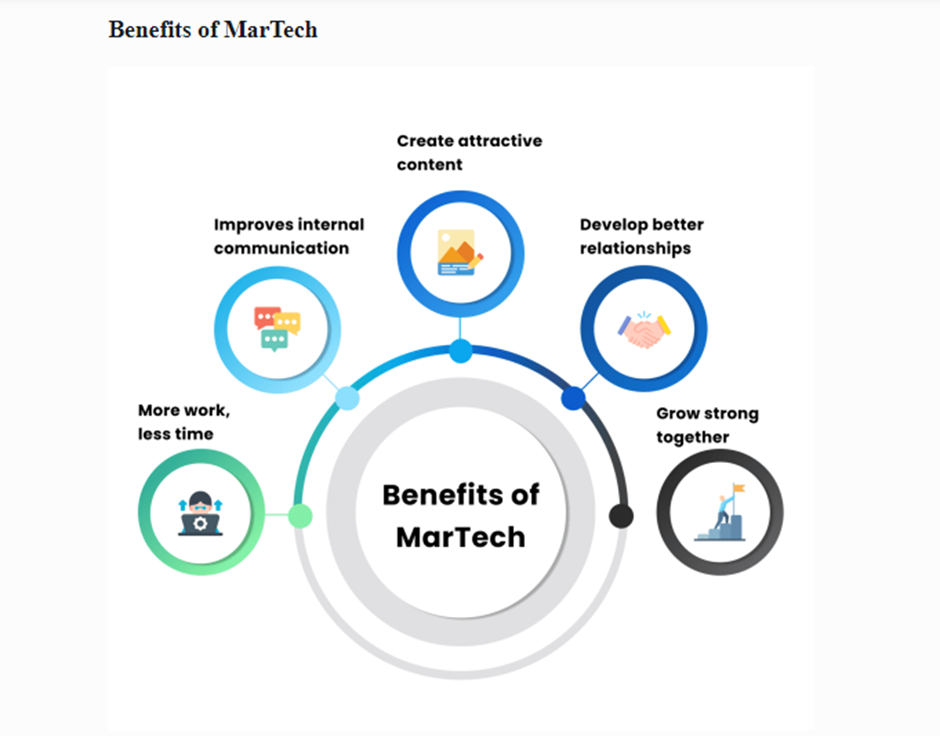
Investing in e-commerce, MarTech is essential for businesses to enhance their marketing strategies, improve customer experience, and drive sales. 

Here are a few more reasons to convince you to invest in e-commerce MarTech:

  • Data-driven marketing strategies: E-commerce MarTech helps you measure your marketing goals and create data-driven marketing strategies.

  • Improved customer experience: MarTech assists businesses in understanding their customers’ behaviors and expectations, allowing them to provide a seamless shopping experience and personalized content.

  • Competitive advantage: Adopting MarTech can give businesses a competitive edge by staying ahead of industry trends and understanding their customers’ changing needs.

  • Integration with other tools: MarTech can integrate various tools, such as CRM systems and analytics platforms, to create a comprehensive marketing solution.

  • Cost savings: By streamlining marketing processes and improving efficiency, MarTech can help businesses save money on marketing expenses.
image 1

Source

The Bottom Line

In today’s cutthroat e-commerce world, MarTech isn’t just an accessory – it’s the necessary tool you need for enhanced business performance. From personalized ads to triggered emails, it equips you to acquire leads, conquer conversions, and cultivate loyal customers. It’s high time marketers invested in MarTech for eCommerce businesses to flourish through personalized experiences and data-driven insights.

Now it’s up to you.

Do you want to stick with outdated loyalty programs, or move forward with MarTech in 2024?

Autonomous-Testing-A-Brief-Introduction

What is Autonomous Testing: A Brief Introduction

What is Autonomous Testing: A Brief Introduction

Robots pilot QA while AI hunts bugs and fuels faster testing, ushering in a strategic autonomous testing revolution. Are you ready for it?

What is Autonomous Testing?

Autonomous testing is an AI-driven software testing approach that eliminates human intervention by utilizing intelligent algorithms to create, drive, and manage tests. The ultimate aim is to streamline the testing process, allowing the system to independently handle end-to-end testing activities. This advanced automation reduces human involvement, lightening the workload for engineering teams by eliminating the necessity for additional testing code. While autonomous testing shows promise, it is still in its early stages of development.

What are the benefits of autonomous testing?

Accelerated Testing: 

By automating tedious and repetitive tasks inherent in traditional software testing, testers can expect a considerable acceleration in their testing pace. Companies adopting AI testing gain a distinct competitive edge by reducing their time-to-market. With each new update, AI can promptly generate test scenarios, execute regression test suites, and intelligently address broken test scripts caused by code changes, ultimately saving valuable time for QA teams.

Increased Productivity: 

The generative capabilities of AI empower teams to create test data, test scripts, and test scenarios at scale with greater customization. Instead of spending hours manually creating these elements, teams can instruct AI to handle the task. The comprehensiveness of generated data is higher, enabling QA teams to address a broader range of issues.

Increased System Versatility: 

An autonomous testing system can adapt itself to changes in the product thanks to embedded continuous learning algorithms. Over time, it becomes adept at generating not only better but also more organization-specific test scenarios and test data. This adaptability relieves organizations of the burdens associated with test maintenance.

Cost-Effectiveness: 

With fewer resources allocated to testing activities, organizations can achieve higher productivity per resource unit. While the initial setup and configuration costs may be substantial, and immediate results might not be apparent as the system needs time to learn organizational testing patterns, the long-term return on investment justifies the initial investment.

Competitive Advantage: 

All the aforementioned benefits directly translate into a competitive advantage for organizations. QA teams can concentrate on critical tasks, and developers receive almost instant feedback for their builds, leading to improved product quality and ultimately contributing to demand generation.

Also Read : Sophisticated Tech Is Good; Byzantine Is Not

Going Beyond the Traditional Autonomous Testing

Autonomous testing can help you be creative and also give you bug-free results. Here are a few unique concepts related to autonomous testing that might interest you:

Self-fixing tests: 

These tests detect bugs and automatically suggest fixes or workarounds, saving time and effort.

For instance, Microsoft integrates Applitools Eyesight into Azure cloud services, where AI scans interfaces for UI inconsistencies, suggesting code fixes to developers, ensuring a seamless user experience.

Nature-inspired testing: 

Algorithms mimic natural processes like ant colonies to explore software from different angles, finding bugs traditional methods might miss.

Explainable AI testing: 

AI tells you why it made a specific testing decision, helping you understand its reasoning and build trust.

Realistic user scenarios: 

AI generates test data that behaves like real users, making your software more robust to real-world situations. 

For example, Streaming services like PayPal leverage Testim.io’s AI-generated test data, mimicking real user behavior, to identify performance bottlenecks and usability issues they wouldn’t catch otherwise.

Supercharged fuzzing: 

AI evolves fuzzing techniques to constantly find new and unexpected ways to break your software, boosting its security.

How to implement automated testing?

Not all testing scenarios are suitable for automation, such as usability testing or exploratory testing, which demand human intuition and creativity. Currently, these types of testing rely on manual processes, making it challenging to develop a system capable of autonomously exploring unfamiliar systems to uncover bugs. Achieving autonomous testing is a significant milestone not only in the software testing domain but also in the broader field of AI, Here are a few more challenges:

Managing Test Data:

Ensuring the availability of realistic and diverse test data that mirrors real-world conditions can be a complex task. While test data generation is feasible with effective prompt engineering, organizations must grapple with challenges related to data privacy and masking.

Training AI Models:

AI models employed in autonomous testing require continuous training and fine-tuning to adapt to evolving applications and changing testing requirements. This demands consistent effort and substantial investment in research. For instance, OpenAI invested approximately $540 million in 2022 to develop ChatGPT, a groundbreaking chatbot widely utilized for AI-powered software testing, and yet we are currently at Stage 3 of the ASTM.

Interoperability and Integration:

Integrating autonomous testing systems with existing development, testing, and CI/CD pipelines can be intricate and likely necessitates significant customization.

AI Bias and Accuracy:

AI algorithms may introduce biases or inaccuracies in test case generation, execution, or defect detection. Ensuring that AI models are fair and reliable is of utmost importance.

Conclusion

In the dynamic domain of software testing, autonomous testing emerges as a trailblazing and futuristic initiative, promising to reshape the testing landscape. Yet, this journey is not without its complexities. The adoption of autonomous testing beckons both newfound benefits and challenges, creating a dynamic landscape for stakeholders.

Despite the potential hurdles, the fusion of artificial intelligence with automated testing tools stands out as a beacon of promise. The goal? To craft an intelligent, self-adapting testing tool that empowers QA teams to elevate their testing prowess. 

Social-Media-Lead-Generation-Strategies-to-Implement-in-2024--Website

Social Media Lead Generation Strategies to Implement in 2024

Social Media Lead Generation Strategies to Implement in 2024

Hyper-connectivity and FOMO have got everybody hooked onto social platforms. Are businesses leveraging this untapped goldmine of potential leads?

With 2025 around the corner and the focus on maximizing demand generation, this is the optimum time to formulate and adopt new social media lead generation strategies for social media platforms. What worked in the previous or the current year might be redundant for the upcoming period. Keeping up with the social media trends means consistently fine-tuning the existing scheme to churn out better leads and engagements. 

In this article, we explore eight fool-proof strategies for 2025 that would help your brand get better prospects through social platforms. 

Before we delve into the strategies, here are some interesting Social Media Statistics all enterprises must know about: 

  1. Globally, over 4.59 billion people used social media platforms in 2022 to engage with brands. 
  2. On average, a person spends over 2.5 hours daily on these platforms, browsing videos or discovering brands and businesses. 
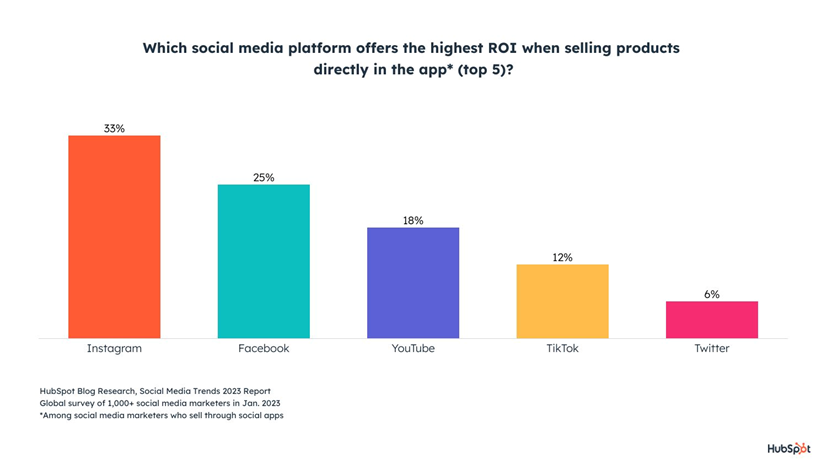
  3. For B2C marketing, Instagram offers the highest ROI for selling products (33%), followed by Facebook (25%), YouTube (18%), TikTok (12%), and Twitter (6%). LinkedIn ranks as the best platform for B2B Marketers, and 97% of companies trust its offerings as compared to other platforms. 
image

Source 

  1. Brands are predicted to spend massively on social media ads, to the tune of $207.1 billion, to attract prospects. 

Needless to say, these are some of the most thriving platforms for businesses to identify their audience or simply put, their leads. 

8 Reliable Strategies for Enhancing Social Media Lead Generation in the Coming Year

Optimize your handles

If your business has its presence across social media platforms like Facebook, Instagram, LinkedIn, YouTube, Pinterest, or Twitter, optimize these pages with the correct details. From the perfect image dimension/resolution, website link, email address, or phone number, all details should be visible on your platforms. Experts recommend using a CTA on the bio like “click on website/call for a free consultation” for a quick engagement with the prospect.

Create a gated community

Gated content helps create a sense of exclusivity for your potential customers. Content that needs sign-up or limited-access webinars not only procures data for email marketing but also makes the prospect feel special and substantially increases your brand value.

Go live

Businesses often overlook a vital fact i.e., the human connection. Static ad campaigns do their job of attracting leads, sure. But going live during a webinar, launching a new service or product, or community events affirm consumer trust in the brand, and they are likely to engage with your brand more. Sharing your expertise after a thorough preparation, emphasizing the quality of products or services, or sharing about your latest ventures during a live event ensures your leads look up to you as a thought leader.

Launch referral programs

A referral program is a great strategy to incentivize your audience instead of word-of-mouth publicity or content sharing. Giving free access to educational content, free products or services, and discounts to users encourages them to create user-generated content that attracts better leads. Statistics reveal that user-generated content like comments, videos, and testimonials appear 2.4X more authentic to consumers.

Leverage the power of influencers

There is a profound reason why brands engage with influencers to promote their products or services in exchange for perks. Influencers have a strong social connection with a wide audience base that finds them relatable and trusts their user-generated content. 92% of consumers trust influencer marketing over traditional marketing, and this is precisely why businesses must leverage the power of influencers.

Incorporate chatbots

By incorporating chatbots and conversational AI mechanisms, brands can ensure sending a robust response to a potential lead round-the-clock. If your business targets globally-based leads, it is impossible for a round-the-clock response to a potential lead. AI-integrated chatbots can execute professional conversations around acknowledging, providing FAQs, generating sign-up forms, and understanding the customer’s pain points. 63% of consumers interact better with a brand with a chatbot integrated with their social media platforms.  

Harness the power of ads and later add personalization

Lead-generation ads on social media help elevate the social media advertising strategy to the next level. The leads can sign up on pre-populated forms on social media platforms, easing the sign-up process. LinkedIn lead generation forms have an average conversion rate as high as 13% and generate high-quality leads, affirm the ad campaign’s ROI, and help better management of the leads across the sales funnel. Other platforms like Facebook and Instagram also offer lead-generation ad features to gauge better leads. Through further research on buyer personas, analytics, and data-driven insights, brands can personalize offers to the target leads to help convert them into customers.

Generate lead magnets through offers

It is imperative to launch lucrative offers like free tools, consultation, discount codes, free-trial products, and services to attract the right audience to your brand. This strategy boosts sales prospecting to a great extent. 50% of marketers confess to having better conversion rates by leveraging top lead magnets in their sales prospecting strategy.

Takeaway

As we wind up 2025, we have already witnessed how social media strategies evolved and led to newer mechanisms and pathways for 2026. Social platforms offer a hyper-connected network of prospects, and many enterprises are hitting the bull’s eye by following the right strategies aligned with their business goals. Optimizing pages, launching lucrative deals and gated content, harnessing influencer marketing, floating social media ads, and using the power of chatbots are pivotal to acing the lead generation game.

The key is to attract better leads, drive meaningful conversions, and forge stronger connections by adopting these fool-proof strategies discussed. Ultimately, it is the fusion of data-driven insights, compelling story-telling, and adoption of the above critical strategies that help brands achieve unparalleled growth and revenue along the way.