7-Sales-Prospecting-tools-for-2025

CRM Best Practices for Optimal Success in 2025

CRM Best Practices for Optimal Success in 2025

CRM in 2024 is much more than just managing contacts. Read along to know how it is impacting businesses today and how to best implement it to achieve great success

Best CRM Practices in 2025

CRM: a term we’ve all heard before in today’s times. But are you doing CRM right? Entering the year 2025, the transformation of CRM systems is quite remarkable. These systems are no longer just responsible for keeping tabs on how customers interact with your organization, they have also become an important part of the whole business process, driving growth and attracting new customers.

Moreover, as technologies are advancing, so are the customers of today, and they need a better experience, which is more personalized and convenient for them. According to WebFX, businesses that use CRM systems efficiently have seen major improvements, including a 17% rise in conversion rates, a 16% improvement in how loyal their customers became, and an impressive 21% surge in how efficiently their teams work.

In this article, we’re taking a closer look at CRM, how it is evolving in 2025, and how it can be best incorporated into a business’s day-to-day operation to achieve the most success.

Effective Ways to Transform CRM for Optimal Success

1) Tailoring CRM Solutions to Fit Unique Business Objectives

The CRM software market of today offers a wide range of options, and one can use them depending on their business’s requirements. But how do you know which software will work for you? Let’s look at the steps one must follow in order to do that:-

  • Decoding Your Business’s Unique CRM Needs

Starting a journey toward an ideal Customer Relationship Management (CRM) system necessitates an in-depth evaluation of your company’s individual and unique requirements. This essential phase involves a deep dive into the specificities of your team’s demands, alongside your strategies in sales, marketing, and customer service, as well as your overall business approaches. Consider whether you require better analytics, smooth integration with your existing setups, or a user-friendly interface for your workforce.

  • Having a Balance Between Customization and Ease of Use

In your search for an optimal CRM system, the goal is to find a middle ground between simplicity of use and the ability to tailor it to your needs. Popular CRM platforms, such as Salesforce, are known for their extensive customization options, catering to complex and varied corporate structures, particularly beneficial for larger entities or those with specialized requirements. Yet, these capabilities might be excessive for smaller or simpler operations.

In these cases, more straightforward CRM solutions like HubSpot, renowned for their user-friendly design and simple functionality, are often more appropriate. Teams with limited technical expertise or resources tend to prefer these types of CRM solutions. The decision process heavily relies on analyzing your team’s size, complexity, and technical acumen.

  • Considerations for Integration and Scalability

Be sure the CRM will work with your current IT infrastructure before making a decision. Your CRM needs to have no trouble integrating with any platform your business uses, including email, social media, and others. This helps businesses achieve a more enhanced way of data management and enables them to have more streamlined processes.

You should also give some thought to the system’s scalability. The perfect CRM would be flexible enough to add new features and capabilities as your business expands to meet your evolving demands. Following this plan, your investment in a CRM will be useful for a long time and have many applications.

Also Read : Why Is Customer Success Important?

2) Automation of Repetitive Tasks

In 2024, cutting-edge CRMs that have mastered the art of automating mundane but necessary processes will be better for businesses to use. It streamlines the tedious procedures of client relationship management with its innovative automated capabilities. The following are some of the benefits that businesses can have with CRM automation:- 

  • Streamlining Operations

The primary goal of CRM automation is to simplify operational processes. Scheduling and data entry are two examples of mundane but necessary procedures that customer relationship management systems automate. That way, more time can be devoted to strategic planning and projects that have a direct impact on consumers. This change in emphasis could have a major influence on how well a company connects with and meets the needs of its customers.

  • More time for important tasks

Implementing automation in your workflow gives your employees the chance to dedicate themselves to key tasks, such as building relationships with customers and crafting effective sales plans. This approach not only enhances production efficiency but also opens up opportunities for your team to undertake projects that are more personally fulfilling. Such a shift can significantly boost team morale and foster a strong sense of loyalty within your workforce.

  • Enhanced Accuracy and Efficiency

Automated CRM methods significantly cut down on human error, leading to more precise data management. It is crucial to constantly give service in order to maintain the trust of clients. The effectiveness of any marketing and sales effort hinges on the accuracy and timeliness of the client records, which automation makes possible.

  • Customizable Workflows

The capacity to build configurable workflows is a notable feature of modern CRM systems. By adjusting the triggers, businesses can modify these workflows to fit their unique procedures and objectives. By doing so, we may improve customer service by responding to their needs in a timely and relevant manner.

  • Integration for a Unified Approach

Every interaction with customers is saved in one place using an integrated CRM system. A customer relationship management system can efficiently record and track all interactions, regardless of the channel (email, social media, etc.). The organization and consistency of customer interactions are enhanced by integrating and making readily available all customer data through this unified method. Having a high-level overview of the client journey might help you make better decisions and provide a more customized experience for each consumer.

3) Establishing Clear CRM Guidelines

The foundation of customer relationship management success for companies is maintaining a framework of transparency and consistency. The first step is to draft certain rules so that all of the teams can use the CRM system in the same way. This method is foundational for effective company planning and decision-making, and it also stops data discrepancies and silos from happening. To determine the best level of CRM application and to set reasonable expectations among departments, it is helpful to define precise criteria. Here are some effective ways to do so:-

  • Standardizing Processes

The most important thing is that everyone on the team knows how to use the CRM system. To prevent data silos and inconsistencies from emerging and leading to erroneous strategies and decisions, this harmonization is vital.

  • Training and Adoption

    Internalization of CRM standards through extensive training programs is crucial to their performance. To highlight the CRM system’s strategic value within the broader organizational environment, these programs should go beyond just operational training. Adopting and using CRM effectively is far more likely when team members are properly trained and understand how the system applies to their daily work.
  • Data Management and Privacy

There are certain regulations that modern CRM systems must observe while transferring and storing sensitive data. Both regulatory compliance and customer trust depend on upholding these standards. The business and its partners, as well as anybody else participating, should adhere to transparent and easily available protocols for data gathering, storage, processing, and sharing.

  • Review and Update

Customer relationship management standards must evolve to keep up with the ever-changing corporate landscape and rapid technology developments. To stay up with the ever-changing regulatory landscape, CRM system features and functionalities, and evaluation and updates to these standards must be done periodically.

4) Adapting Proactively to CRM Technological Changes

CRM Systems are leading the charge when it comes to rapidly changing technological business landscapes as move ahead into this year. Let’s look at the features of these systems that distinguish them from years-old CRM systems and understand why they’re used by today’s market leaders:

  • AI and Machine Learning

Machine learning and artificial intelligence are now the talk of the town. These terms are revolutionizing the CRM industry; they are more than simply buzzwords. Everything from lead management to how a business interacts with its customers to the business’s predictive abilities is being revolutionized by these technologies. Considering that businesses have more data available to them now than ever before, they can better and much more easily understand what their customers really want.

  • IoT Integration

New ways for data collecting and analysis are emerging as a result of the integration of CRM systems with the Internet of Things. Gaining real-time insights into how customers engage with products is more important than just tracking numbers. This will allow for increased product development and customer service initiatives.

  • Cloud-Based Flexibility

Customer relationship management on the cloud is becoming more than just a trend. It’s all about empowering teams with the freedom to access vital customer data whenever and whenever they need it. No matter where team members are situated, this is transforming how teams work together and guaranteeing that customer interactions are handled with the utmost efficiency.

Conclusion

As per Statista, the CRM Market is expected to grow rapidly in the coming future – from $54.13 billion to $131.88 billion by 2028. This gives us a clear idea of how important CRM is for businesses today and in the future.
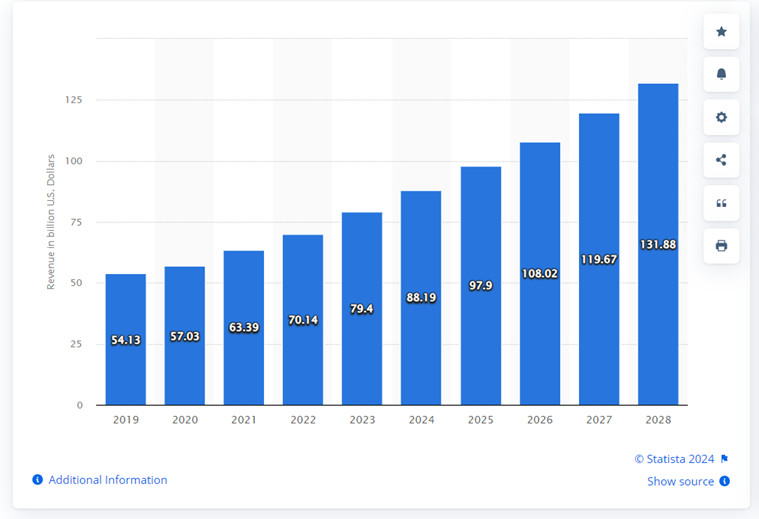
image 5

To get the most out of customer relationship management in 2024, organizations must combine strategic foresight with cutting-edge technology and a strong emphasis on team collaboration. Implementing this strategy will turn customer relationship management systems into crucial assets that enhance customer connections, drive steady growth, and streamline business operations. Businesses may secure their long-term success in the ever-changing digital age by adopting these cutting-edge CRM practices, which will put them in the lead when it comes to consumer interactions.


The Psychology of Personalization: Understanding Customer Behavior

The Psychology of Personalization: Understanding Customer Behavior

The Psychology of Personalization: Understanding Customer Behavior

Personalization is a balance between algorithmic insights and heartfelt connections. It delivers brand loyalty in a market that craves intimacy, not just relevance.

Personalization is when sellers use data to tailor messages to specific users. Personalization paints a picture of all good things – personalized messages, special discounts, customized recommendations, and handwritten gift cards are all just a short list. 

But, there is a thin line between personalization and frustrating your prospects with unwanted messages. Brands that have mastered this skill are generating a higher ROI than their competitors.

At the end of this blog, you’ll know how to approach personalization for your business.

Personalization and Customer Experiences

Need for belonging and recognition: Imagine opening a mail and finding it addressed to someone else. You’ll be confused and frustrated, right? 

Now, imagine receiving an email with your name and a special discount. You would be intrigued to interact with that brand.

That’s how personalization works. When done right, it makes the customer feel valued and understood. Hence turning them into your brand advocates and ultimately boosting your ROI.

The “Cocktail Party Effect”: You are surrounded by countless conversations at a bustling party. Yet, you can effortlessly focus on just one voice – let’s say, your friend’s. This remarkable ability, known as the “cocktail party effect,” exemplifies how our brain selectively filters information, prioritizing what’s relevant. In a crowded marketplace, this translates to attention. Consumers are bombarded with messages, but like party chatter, most fade into the background. Personalization highlights what matters to each individual, making their experience stand out.

Dopamine Rush and Anticipation: Typically, before a big purchase, people plan for it. Lucky for marketers, this is an opportunity for personalization. Many people believe that dopamine is released in response to a reward. However, it also surges in anticipation of a reward. This creates a cycle where a person sees a product and plans to buy it in the future. The anticipation of obtaining the product generates excitement and motivation, causing dopamine to spike. As the person gets closer to purchasing the product, the anticipation increases, resulting in a higher dopamine rush. This information can be useful for marketing teams who sell luxurious items.

Understanding Customer Behavior

Data-driven insights: To personalize user experience, data can be divided into three primary categories: purchase history, browsing behavior, and demographics. Purchase history provides information about the user’s past preferences while browsing behavior uncovers the user’s current interests. Demographics, such as age and location, provide a broader picture of the user. Combining these insights can help businesses tailor content, recommendations, and even entire experiences to individual users. 

Psychological principles in action: A person doesn’t always purchase a product just because they need it. There are several factors influencing a purchase, such as:

  • Emotional Triggers – Emotional triggers play a crucial role in shaping consumer behavior, as individuals often make purchasing decisions based on the emotions elicited by a product or service. Positive feelings such as joy, excitement, or a sense of belonging are powerful motivators for consumers. Advertisements strategically employ these emotional triggers to establish a deep connection between their brand and customers, capitalizing on their desires and aspirations.  
  • Social Influence – Social influence, rooted in humanity’s inherent social nature, significantly impacts decision-making processes. This influence can manifest through various channels, including peer recommendations, celebrity endorsements, online reviews, and social media trends. Businesses can capitalize on social influence by fostering a sense of community around their brand and encouraging customers to share positive experiences with others.        
  • Cognitive Bias – Cognitive biases, which are mental shortcuts or patterns affecting decision-making, also play a role in consumer behavior. For instance, the scarcity effect makes people perceive limited availability as more valuable, driving increased demand. Another bias is the anchoring effect, where individuals heavily rely on the first piece of information received when making a decision. Marketers can leverage these cognitive biases by framing their offerings to align with consumers’ cognitive tendencies.

Also Read : Technology For A Better CX

The personalization paradox: The personalization paradox is a tricky concept between relevance and creepiness. People crave recommendations that anticipate their needs but recoil when algorithms seem to know them too well. Striking the balance demands responsible data use and unwavering respect for privacy. Transparency, minimization, and accountability are essential to achieve this. Ultimately, personalization should empower, not control. When technology guides, not puppeteers, we discover serendipitous opportunities and a future where convenience respects boundaries and relevance nurtures autonomy. 

Beyond the Algorithm

Personalization requires a human touch that builds emotional connections with customers. While AI can provide data-driven recommendations, the human thread remains vital in delivering personalized experiences that build long-term trust. Through heartfelt conversations, intuitive service, and creative interventions, we remind customers that behind the algorithm beats the warmth of a human heart. In this symphony of personalization, the human touch is the maestro, conducting data, technology, and emotion to create a masterpiece of loyalty.

Conclusion

Consumer behavior psychology can offer favorable insights into the reasons and factors influencing purchasing decisions. Brands can effectively connect with their target audience by understanding the emotional triggers, social dynamics, cognitive biases, and individual preferences that shape consumer behavior. By considering the psychological factors at play, businesses can build stronger relationships, enhance customer satisfaction, and drive business growth in a constantly changing market environment.

How Implementing AI Can Transform the Selling Process

How Implementing AI Can Transform the Selling Process

How Implementing AI Can Transform the Selling Process

From insightful machine learning to engaging bots – explore how AI is reinventing customer experiences and supercharging sales strategies for businesses today. 

By now, we’re all pretty aware of how much AI has taken over in every dimension possible. AI has evolved remarkably, transitioning from a simple, interactive chatbot to a sophisticated system capable of creating content through minimal prompts. This evolution underscores AI’s significant role not just in current scenarios but also in shaping future landscapes. Particularly in the realm of sales, the influence of Artificial Intelligence is increasingly evident.

For many years now, sales was mainly a department that involved humans completely. From reaching out to customers to following up, every little step of sales was done by humans. But ever since the prevalence of Artificial intelligence has grown, the sales department has a new face, a new process, and a much more effective one at that.

So how does AI help in sales? Read ahead as we talk about how AI is transforming the selling processes, and how it is making businesses more efficient.

AI & Sales: How they work together

When artificial intelligence and sales are aligned, it involves introducing today’s technologies such as data analytics and machine learning to streamline and optimize the overall sales processes. Using such tools can help businesses achieve new heights among their competitors, placing them above in terms of efficiency and effectiveness of the sales departments. Let’s explore how this impacts the sales process:-

Automation of Sales operations

    One of the most remarkable ways in which artificial intelligence helps is in automating everyday tasks that would generally take a lot of time. As per Hubspot’s research, most sales professionals, about 78%, are on the same page that AI gives them the chance to focus more on the key parts of their job. Some examples of the tasks that AI can help with are data entry, lead qualification as well as follow-up scheduling. Leveraging AI, organizations can divert resources away from extensive and repetitive tasks, allocating more time to pivotal aspects like nurturing client relationships and venturing into new market territories. This form of AI automation helps in building a more responsive and dynamic sales force that is focused on the bigger goals of the organization, rather than meeting the targets of these tasks.

    AI & its Analytical Power in Sales

      Data is essentially the new gold in sales. But let’s face it, the sheer volume of data can feel like a tidal wave, confusing and hard to handle. Enter AI – it’s like a savvy guide that helps companies navigate through this sea of information to spot those golden insights. AI isn’t just about scratching the surface. It delves deep, scrutinizing everything that could impact sales, from the way customers interact to shifting market trends and patterns in sales.

      Take a typical online store, for instance. They’re sitting on a mountain of customer data – who bought what, who’s looking at what, and all the little details in between. With the magic of AI-powered sales analytics, they can sift through this data to uncover gems like which products are hits in certain customer groups, which ads are making people click and buy, and even which customers might be saying goodbye soon.

      Consider the experience similar to suddenly mastering a new language with ease. It’s about gaining a deep understanding of what people desire, identifying what fails to engage them, and discovering the most effective methods of connection. This shift moves well beyond mere product promotion; it signifies a more intelligent approach to conducting business. It’s about staying ahead of the curve, customizing your approach, and making decisions that really hit home. This isn’t just a assumption – it’s what the experts are saying. Analysts at Gartner are predicting that by 2026, a massive 65% of B2B sales teams are going to shift from relying on gut instincts to making choices grounded in hard data.

      AI & Personalization

      Let’s start with an example to make you understand how AI helps businesses personalize the overall experience for users. Think about having a friend who doesn’t just like to shop but also picks out the best thing for you that you truly love. That’s what AI does. With the help of AI, selling becomes easier because it helps businesses by understanding a customer’s preferences, what they like to see more, and even the things that one is browsing. It’s basically like those ads you get that say “Were you looking at these shoes? Here’s something similar you might also like!”

      But if you’re wondering how AI does that, let’s look at a simplified breakdown of its process:-

      • Collecting Data: Think of AI as a digital detective. It gathers clues – purchase history, browsing habits, age, likes on social media – you name it.
      • Cleaning Up Data: AI then acts like a data manager, organizing this info neatly so it can make sense of it.
      • Spotting Patterns: Here’s where AI turns detective again, sifting through this organized data to spot trends and connections. This will help them understand customer preferences as well as their purchase behavior so that the technologies can provide customers with personalized recommendations.
      • Generating Recommendations: Based on those patterns, AI algorithms generate personalized recommendations for each and individual customer. These recommendations can be anything from product suggestions to cross-sells or upsells and even content recommendations.
      • Feedback Loop: The process doesn’t stop after the recommendations have been generated. AI constantly keeps learning and improving its recommendations based on how the customers behave.

      Precision Prospecting

        Anyone with experience in sales understands that prospecting stands as one of the most crucial elements of the field. Now, with AI stepping onto the scene, even this foundational aspect is evolving significantly. For example, suppose a real estate company is looking to target its sales practices on people who wish to buy homes in the near future.

        By using AI, the company can analyze extensive data sets and understand based on demographic information, online activity, and even purchase behavior to identify the most profitable prospects. An example of how AI would identify potential homebuyers is perhaps based on recent life events like a marriage, a new job, or a shift to a new place. This precision targeting makes sure that the sales efforts an organization makes are focused on the most promising prospects and allows for better resource allocation and increased efficiency of the sales processes.

        AI and business communication

          The role of AI in sales transcends mere data analysis and trend identification. It’s fundamentally altering the nature of corporate communication with customers. Innovations in AI have dramatically transformed customer service, introducing chatbots and virtual assistants that provide support at any hour, every day. These tools efficiently assist customers without delay, efficiently handling basic inquiries and freeing up the sales team for more complex tasks.

          Picture yourself browsing for shoes in an online store. An AI chatbot appears, not with a standard script, but equipped with intelligent, targeted queries aimed at helping you locate the ideal pair. It’s comparable to having a personal shopper accessible right from your device. This innovation enhances responsiveness, equipping sales teams to adeptly handle the dynamic nature of modern sales environments. It then suggests shoes that fit their needs, maybe even offering a special deal on a pair that’s been popular with similar customers. This isn’t just a basic Q&A; it’s more like having a helpful, knowledgeable assistant right there, making the shopping experience smoother, more personal, and likely more successful in finding just what the shopper wants.

          AI Technology and its predictive abilities

            The predictive power of AI significantly transforms how sales forecasting and market analysis are conducted. By analyzing past data and current trends, AI offers valuable predictions, enabling sales teams to foresee changes in the market and consumer behavior. Adopting a progressive stance, sales experts are now better equipped to modify their tactics swiftly and effectively. This flexibility is key to maintaining a competitive edge in the dynamic commercial landscape and surpassing competitors.

            Imagine managing a retail store. Understanding the importance of anticipating consumer preferences and identifying trending products is essential for staying ahead. That’s where the AI system comes into play. It sifts through heaps of data, customer feedback, sales history, and the latest buzz on social media to give you a heads-up on the next big thing your customers are likely to crave. For instance, if AI analyzes, based on the content online that a specific color is been in every fashion page’s social media feed or on fashion websites, AI will recommend having more products of the color to the retail brand since that’s what the customers will want to buy or own.

            Conclusion

            In conclusion, it’s clear that adopting AI in sales has transcended being a mere trend; it’s become an absolute strategic imperative. By weaving AI into the fabric of sales strategies, businesses are now able to offer a more customized and impactful experience to their prospects, smoothing the path to transforming them into loyal customers. Looking ahead, AI’s role in shaping the sales narrative is only set to deepen, becoming more integral and influential with each passing day.

            An Expedition into Demand Forecasting with Machine Learning Models

            An Expedition into Demand Forecasting with Machine Learning Models

            An Expedition into Demand Forecasting with Machine Learning Models

            A volatile landscape fuelled by social media, geo-political changes, and innovation demands more than Traditional forecasting methods. How does Machine Learning help in this case?

            In a fast-paced business landscape, evolving consumer choices pose one challenge for businesses: Demand Volatility. Blame geopolitical changes, social media influence, fierce competition amongst enterprises, and sometimes a global pandemic. Traditional Forecasting mechanisms cannot always give accurate results based solely on historical data. Moreover, what about a variety of data sets and multiple points of consideration that directly impact the dynamics of consumer demands? Thankfully, we have AI and Machine Learning (ML) to our rescue, revolutionizing Demand Forecasting

            In this article, we dive into the realms of Machine Learning Demand Forecasting and gauge how it surpasses traditional forecasting methods to offer deep insight into the future purchase predictions of a thriving consumer base. 

            What exactly is Demand Forecasting and what are the Traditional forecasting methods?

            Demand forecasting is the process of predicting customer needs for a product or service in the future. It helps make adjustments to inventory, or rather inventory decisions, and an informed supply to meet consumer needs. 

            Traditional forecasting, or Statistical forecasting, encompasses methods like linear regression, simple exponential smoothing, ARIMA, ARIMAX, and more. These methods offer a high level of transparency but are only based on historical data and apply to a perfect scheme of situations that are not necessarily prone to disruptions. Do we completely discard the traditional methods? We will analyze this later in this article after we uncover Machine Learning’s capabilities in forecasting. 

            How does Machine Learning revolutionize Demand Forecasting?

            Machine Learning, on the contrary, works on multiple data sources, including many variables that would affect consumer demand. It does not just depend on historical data of purchase behavior gathered over, let’s say, the past two years and considers current factors and drives a high degree of predictive analysis. 

            Machine Learning models are built on data-driven predictions that consider internal and external factors influencing a product or service’s demands. Some of the data sources that Machine Learning utilizes are marketing polls, macroeconomic indicators, weather forecasts, local events, social media influence, competitors’ activity, and historical data. It is safe to categorize these data sources as structured data like past purchase orders, customer POS information, inventory, and sales transactions, and unstructured data like social media, marketing campaigns, reviews, and more.

            ML forecasting models use complex mathematical algorithms and understand complicated relationships in datasets while adapting to volatile conditions. Some popular ML forecasting models include Artificial neural networks, Classification and regression trees (CART), Generalized regression neural networks, and Gaussian processes.

            While traditional forecasting models mostly use linear regression methods, Machine learning models use a combination of linear and non-linear methods, to arrive at a prediction. The result is a high level of accuracy of forecasts and minimum loss function. It has been observed that the error metrics like Mean absolute percentage error, Root mean square error, or Weighted root mean square errors are significantly lesser in an ML model than in a Statistical model. 

            Having said that, ML works best for predictive analysis with volatile demand patterns and short-to-mid-term forecasting while launching new products or services and dynamic business environments. For example, the leading dairy brand Granarolo achieved 85 to 95% accuracy in Forecast by integrating machine learning with its existing systems. 

            How To Maximize the Benefits of ML in Demand Forecasting?

            To maximize ML’s offerings, enterprises must choose one compatible with their existing ERP or Inventory management system for a smooth operation. Businesses must know the data sources from which the solution would pull information as it gives accurate results only with the help of a large and high-quality dataset. Organizations must conduct extensive training programs for their staff to seamlessly use ML solutions. Businesses can also choose to buy ERP or WMS with an in-built model or build a custom model that requires ample investment. Finally, the ML solution needs to be tested thoroughly to see if the level of accuracy in predictions is acceptable. Otherwise, a brand would never have the correct inventory to suffice its consumer needs due to incorrect predictions by an ML model. 

            How are Traditional Forecasting models still relevant?

            Though ML models offer a holistic approach to forecasting, we cannot completely discard Traditional Forecasting models. Statistical forecasting models offer a high transparency level and are perfect for mid to long-term planning. They are apt for products or services that have survived the storm of demand volatility and would never run out of choice.

            Conclusion

            While Statistical Forecasting methods have been used for ages, the rising demand for models that predict masked market trends and navigate volatility has led to ML-driven Demand forecasting. As with every complex AI-based model with high computational prowess, Machine Learning has its requisites to perform optimally, like a smooth integration with existing systems, investment, and resource training. When integrated and utilized well, it can help businesses forecast accurately, and promote operational efficiency and cost reduction along the supply chain. ML’s offerings, coupled with human intervention, can aid in strategic decision-making for better growth and revenue. 

            Top Technology Trends Businesses Should Invest in this year

            Top Technology Trends Businesses Should Invest in this year

            Top Technology Trends Businesses Should Invest in this year

            Generative AI may steal the headlines, but its impact will be amplified and transformed by the convergence of other powerful technology trends.

            As we enter 2024, it brings to light a platform ready for more innovation and progress. This year’s advancements in democratized AI, seamless remote collaboration, and ever-evolving cybersecurity fortresses are the building blocks for the future. But the script doesn’t just end there. Contextual factors like climate urgency and economic shifts are penning their compelling narratives, driving the rise of energy-efficient tech and cost-conscious solutions.

            For businesses, navigating this multifaceted tech landscape requires more than a front-row seat; it demands a backstage pass, granting access to the inner workings of the tech landscape, allowing them to not only witness the current performance but also influence the future acts and shape their tech-driven destinies. Understanding both the established trends and the emerging techs gives organizations a crucial competitive edge. Knowing which technologies to invest in, which solutions to scale, and which innovations to champion, positions them as not just spectators, but as the directors of their own tech-driven success stories.

            Here are the technology trends that will set the stage for 2024’s technological breakthrough.

            Top Technology Trends Businesses Should Invest in 2024

            A Balanced Approach to Cybersecurity

            As threats grow more sophisticated, 2024 may witness AI evolve into a significant cybersecurity threat. Researchers predict AI-powered polymorphic malware with ever-changing forms, posing immense challenges for traditional defense systems. Additionally, AI will empower attackers to craft targeted and automated attacks, further straining cybersecurity teams.

            However, this technological advancement isn’t solely a bleak prospect. Experts argue that AI can also be a potent weapon in the cybersecurity arsenal. Its ability to handle vast amounts of data and learn from user behavior makes it ideal for implementing granular access controls and dynamic security measures. It also aligns with zero-trust architecture, where access is granted only as needed, minimizing vulnerabilities.

            Organizations deploying AI for user behavior analysis, risk assessment, and authentication management can gain a significant advantage in cybersecurity. 

            AI-Powered Personalization

            In a world increasingly shaped by artificial intelligence, generative AI can revolutionize online interfaces. By transitioning functionality from simply informative to intelligently interactive, these AI-powered interfaces will personalize the digital experience far beyond its current transactional state.

            Both consumers and brands stand to gain from this shift. Customers will feel understood and catered to like never before, while brands can leverage data-driven insights to craft hyper-personalized products, services, and experiences. 

            However, adapting to this AI-powered future requires more than technological advancement. Businesses must grapple with changing consumer behaviors and expectations, ensuring their strategies evolve in tandem with this personalized digital landscape.

            Breakthroughs and Challenges in Quantum Computing

            2024 can witness AI graduate from mere text generation to transformative, real-world action. Experts foresee action-enabled AI products spearheading advancements in hospitality, entertainment, and retail, with agile brands reaping early rewards.

            Meanwhile, quantum computing promises both leaps and stumbles. While still in its theoretical infancy, expect increased organizational investments in this futuristic technology, particularly in data-intensive fields like finance and pharmaceuticals. However, the potential for enhanced cybersecurity through quantum computing comes alongside the chilling possibility of its use for data breaches.

            2024 will see the rise of versatile, AI-powered “multimodal robots” venturing into healthcare, food service, and beyond. This human-robot synergy holds immense potential for innovation and efficiency across diverse sectors.

            As robotic-as-a-service models gain traction, practical, task-oriented bots might dominate the industry rather than humanoid replicas. However, with this automation revolution comes the urgent need for legal frameworks addressing safety, privacy, and hacking concerns.

            Balancing Hype for Business Value

            Sustainability will rise to the top of the agenda, with businesses leveraging technology to drive their environmental, social, and governance objectives. Moreover, a surge in industry-specific cloud solutions can foster deeper integration within enterprise platforms. Generative AI, meanwhile, will spread its wings, powering up extreme automation, streamlined development through low-code or no-code tools, and enhanced risk management.

            Cybersecurity also takes center stage in 2024, with businesses prioritizing resilience and bolstering their security posture. Beyond the digital realm, we can expect innovative experiences seamlessly blending the physical and virtual worlds. Underpinning these advancements will be a renewed focus on strengthening core infrastructure, including cloud, network, and hardware components.

            AI Sustainability 

            2024 unveils a sobering challenge: curbing AI’s colossal carbon and energy footprint. AI has the potential to drive innovation and tackle important issues like climate change, but it should not be a part of the problem that we are trying to solve.

            The solution lies in a fundamental shift. Businesses must ditch outdated data infrastructure and embrace modern architectures that handle AI’s resource-hungry workloads efficiently and sustainably. The old ways of storing, managing, and processing data are incompatible with our environmental goals.

            While a one-size-fits-all approach eludes us, 2024 will witness a surge in data management rethinking. Companies will optimize their systems for next-generation applications, ensuring AI’s power fuels progress, not environmental degradation. The time for action is now. Can businesses rise to the challenge and make AI a force for good?

            The Bottom Line

            2024’s tech landscape stretches before us, a vast horizon promising dazzling advancements and lurking shadows. But as we stand at the edge, we have a choice. Do we blindly chase the latest shiny gadgets, or do we chart a course toward a future not just tech-savvy, but also sustainable, secure, and inclusive?

            The choice is ours. While the former promises fast solutions, the latter bridges the digital divide, ensuring everyone has a seat on the tech highway.

            It isn’t just about the next cool app or the next groundbreaking algorithm. It’s important to create a future where technology is accessible to everyone, not just a select few, and where innovation is driven by ethical considerations, not just expediency.

            Top-Social-Selling-Tools-2025

            Top Social Selling Tools for Your Business in 2025

            Top Social Selling Tools for Your Business in 2025

            Brands tap into Gen-Z’s world by leveraging social media. But it’s the social selling tools that transform this digital engagement into real-world revenue.

            You head to social media for literally every update today. From news concerning genocides to your friend’s new wardrobe update. Social media has become an important part of our lives -for the good or the bad. And, while this could be bad for our social lives, social media occupying our prime time is a good sign for marketers. But with countless platforms competing for attention, how do you stand out and be where your audience is?

            Why Social Media Matters for Sales

            While everyone out there stresses that being where your audience is all about choosing the right platforms, it is only the first step. For your target audience to know about your brand, you must prioritize their needs, speak their language, and build genuine connections.

            The Power of Social Selling

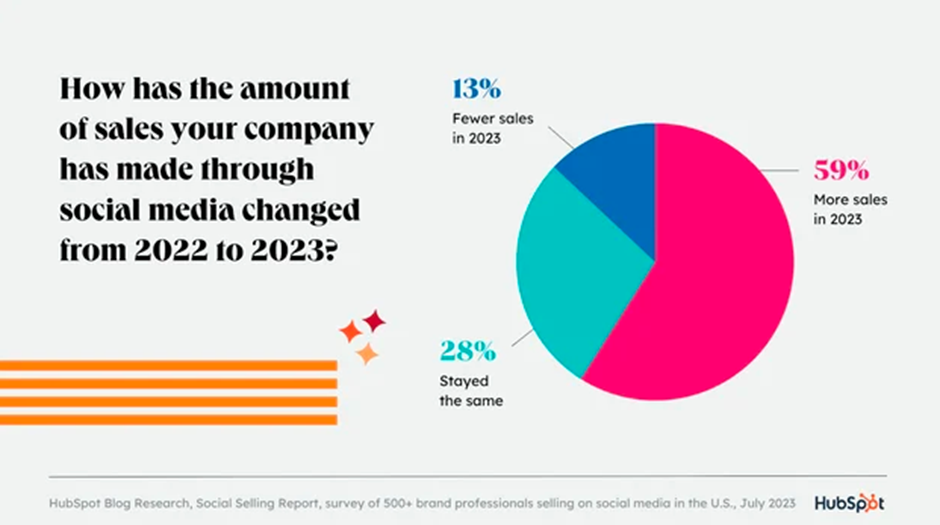
            Social media is the dominant platform for all things marketing. A report by Demandsage suggests a typical social media user interacts with 6.6 social media platforms. Having a strong brand presence is the key to reaching out to your prospects at the right time for better conversions. The businesses still not using social selling are losing out big time as your competitors are aggregating profits, and this HubSpot research is proof of it:

            image 3

            Source

            Key Insight

            In one year, 59% of companies reported higher sales through social selling.

            Cutting through the noise and catching your prospect at their most receptive hours, the ability to select the right channel, and the dexterity to present your brand in a way that resonates the most with your target audience are a few essentials for social selling. But what can really make a difference is choosing the right tools and software. 

            Social selling tools are like digital assistants for social media teams, helping them navigate the dynamic social landscape and convert online connections into real-world results. By offering features like social listening, lead generation, content curation, and analytics, these tools help teams find and engage with prospects, establish trust, and get higher conversions. Explore for High Quality Leads Generation.

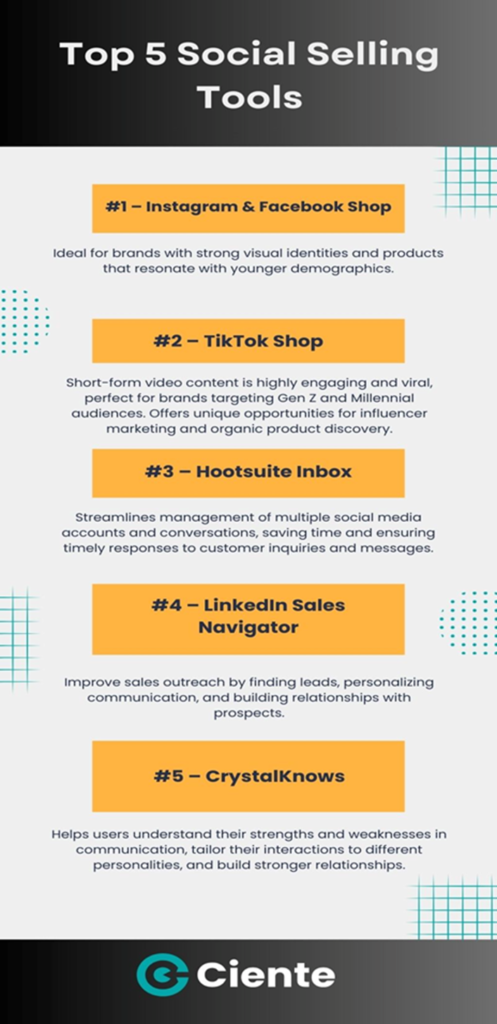
            Top 5 Social Selling Tools

            1. Instagram & Facebook Shop:

            Reaching billions of potential customers and placing your store among the active communities of Instagram and Facebook is what you need to reach your sales targets. If it was possible, marketing teams would just uproot the physical storefront whenever the target market decides to hang out somewhere else. Lucky for them, Instagram & Facebook Shop offers an integrated e-commerce solution that helps you to display your products, interact with customers, and turn visitors into purchases. These allow you to run your store, keep tabs on orders, and even do live streaming to produce engaging content that boosts revenue.

            2. TikTok Shop:

            Marketers hopped on TikTok and have never looked back since. Running on the power of FOMO, and trendy hashtags (aka #TikTokmademebuyit), TikTok transformed social selling. Running on short-form videos, the platform allows creators and businesses to seamlessly integrate product sales into their engaging content. TikTok Shop offers a unique opportunity to tap into the Gen Z and Millennial demographics and capitalize on the power of influencer marketing for explosive growth.

            3. Hootsuite Inbox:

            Hootsuite Inbox lets you simplify your social media inbox bringing together messages from Facebook, Instagram, Twitter, LinkedIn, and YouTube in one easy-to-use interface. You can respond to messages effortlessly, assign conversations to team members, and track your social media engagement in real time. Hootsuite Inbox streamlines communication and ensures you never miss a beat, building strong customer relationships and amplifying your brand’s reach.

            4. LinkedIn Sales Navigator:

            With LinkedIn Sales Navigator you can target high-value prospects, gain valuable insights into their activity, and send personalized InMail messages to build trust and connection. It also helps you maximize your sales potential, gain insights into untapped opportunities, and accelerate your deals with the advanced features of LinkedIn Sales Navigator. 

            5. CrystalKnows:

            What would happen if you could understand your customers and colleagues better?  A personality prediction tool called CrystalKnows evaluates communication styles and provides useful information to help you have better conversations and relationships. For both your personal life in addition to the professional, it is possible to enhance your communication skills as well as establish strong bonds using Crystalknows.

            image 4

            The Bottom Line

            Social selling involves establishing a real relationship with the target audience by learning what they want from you. The dialogues between you and prospects should not just be about promoting products and services , but must also bring value to them by satisfying their needs.

            The best social selling tool for your business depends on your specific needs, budget, and target audience. If you are putting the right efforts into understanding your audience, personalizing your content, and aptly using social media platforms, you can achieve the desired results and convert online connections into tangible victories.