How B2B Event Marketing Increases ROI

How B2B Event Marketing Increases ROI

How B2B Event Marketing Increases ROI

Event marketing continues to evolve – what works today will be irrelevant tomorrow. Which tried and tested strategies can help you boost your ROI?

A typical B2B sales deal can take 4 – 8 months to reach its final stage. The recent shift towards hyper-personalization and customer-centricity has made the already complicated B2B sales cycles more competitive.

Recent studies also show a slight increase in marketing spending by organizations in the post-COVID era. Of these marketing spends, almost 6.5% of the budget is invested in events by the B2B marketing leaders.

From the data above, one thing seems clear – B2B events are a crucial marketing segment. Marketers and sales reps get to spend time with their prospects in a relaxed setting outside the traditional sales setting. 

B2B event marketing has many benefits – from connecting better with your prospects to having higher chances of conversion due to the personal touch missing from the sales calls. Let’s find out how can B2B event marketing help organizations increase ROI.

Importance of B2B Event Marketing

B2B event marketing helps you hit three birds with a stone. You can:

  • Drives brand awareness
  • Educate stakeholders about your product and services
  • Boost your business growth

Here are some more reasons to help you understand the importance of B2B events: 

Networking: The most obvious benefit of B2B events is networking with like-minded peers like potential clients, partners, or industry leaders.

Lead Generation: Events can help generate leads and propel sales by positioning businesses instantly in front of their target customers.

Brand Awareness: Participating in or hosting B2B events is a great way to spread awareness about your business. You can tell people what you sell, your brand story, and your vision and mission.

Education: Events offer a chance to familiarize your target audience with specific products or services, industry advancements, and best practices.

Customer Engagement: They provide a forum for businesses to engage with existing clients, compile valuable feedback, and acquire insights.

Best Practices for Maximizing Your ROI from B2B Event Marketing
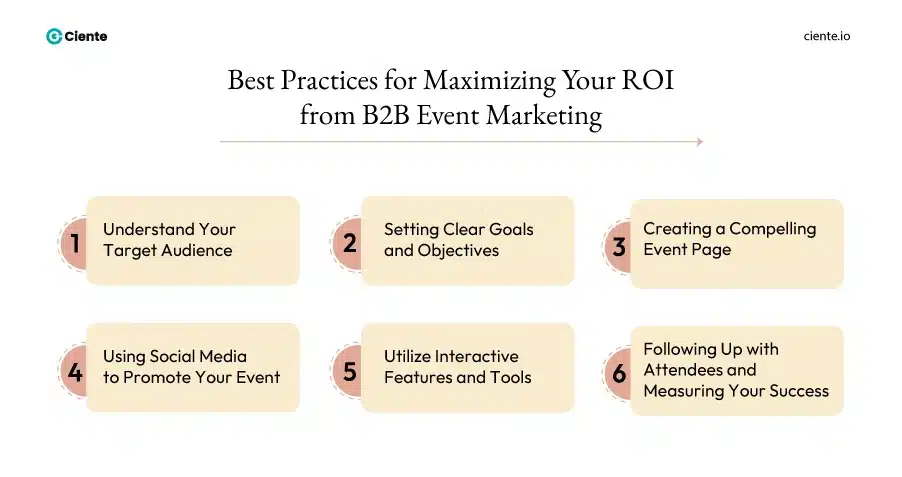
Best practices for maximizing yuor ROI from B2B Event Marketing

1. Understand Your Target Audience

Understanding your audience is the first step in any B2B practice. You must think about what your target audience would prefer. Are they more likely to prefer online events or in-person events? Do they prefer large-scale gatherings or more intimate meetings? Research their products/services, and plan things keeping them in your mind. Once you have a clear understanding of this, you can move ahead.

2. Setting Clear Goals and Objectives

Another basic yet crucial step is setting clear goals and objectives for your B2B marketing strategy. Asking these questions to yourself can make your job easier:

  • What are your aspirations for these events? 
  • Do you want more leads, or do you want to increase awareness about your brand or establish thought leadership in your industry? 

Once you know what outcome you expect, you can work towards your event platform strategy to achieve those objectives.

3. Creating a Compelling Event Page

Event platforms are vital for B2B marketing success, and one of the key factors in this case that it is imperative to mention is designing an engaging event page. Thus, the page combination should contain all basic information about the event in terms of date, time, location, and agenda, as well as the position of the given event as the attending opportunity. What is in it for them to be coming to your event? Will they get to mingle with business representatives, explore more about novelties and advancements in the sphere, or listen to appealing speeches? The inclusion of the above information crisply and prominently will assist in bringing in more audiences or registrants.

4. Using Social Media to Promote Your Event

Social networks are one of the best platforms for spreading information about any event and attracting the attention of the general public. To get the most out of your advertising, develop a social media plan that calls for constant posting in the run-up to the event. Also, include appropriate hashtags that are popular in your niche, and include industry influencers and organizations in the post.

Apart from this, you could also use a specific hashtag that would be connected with the event and carry out a small contest or give away something to share the event with friends. During the event, you should also urge the attendees to post their experiences on their social media accounts, preferably with the event hashtag. It will increase engagement, trigger the curiosity of people about the event, and allow you to reuse content in future promotions.

5. Utilize Interactive Features and Tools

You should provide them with moments to remember you. It could be from open debates, and Q&A sessions, to lively polls and open voting, or any other breakaway section using the breakout rooms option. There are many ways in which an event platform can allow the building of interactive functionality and features for particular events to make them engaging and, therefore, memorable. For example, you can add stage polls, questions, and answers or even break out sessions to the event schedule. In this way, you ensure that you offer the attendees something that they are to interact with the attendees and your brand and share with others, giving you better coverage.

6. Following Up with Attendees and Measuring Your Success

Post your event, communication should not stop. You need to continue engaging your audience and get feedback. Ideally, it is beneficial to supply the attendees with an e-mail saying thank you and possibly ask some questions or consider providing a coupon for a future event for special offers. It can promote goodwill and sustain interest amongst the target attendees towards the brands frequented by them. Moreover, evaluate your effectiveness in similar terms, namely, attendance, social activity, and leads obtained. The following information will help you to adjust your tactics for the subsequent projects and increase the ROI.

Conclusion

In short, event platforms are like supercharged meeting places for businesses to connect with future customers. By planning your event with clear goals, making it entertaining online, and using cool features to keep people engaged, you can totally ace it. You need to track how well your event does and keep trying new things to make your next event even better.
B2B Event Marketing Strategies 2025

B2B Event Marketing Strategies 2025

B2B Event Marketing Strategies 2025

Your ideal prospect could be at the next B2B event you are planning to host. Here is how you can ensure you are not missing out on them.

Events are where you meet your potential customers in an informal setting to discuss business and other trending ideas. B2B marketing is getting competitive consistently, and incorporating B2B event marketing could give your business a great potential to connect better with your prospects.

While it sounds easy and fun to execute, there is more to it than deciding the perfect cuisine or the guestlist. Learn how to take your B2B event marketing to the next level with these strategies.

What are the five major types of events?

Each event type listed below offers unique benefits. Integrating a mix of hybrid events into your B2B event marketing strategy, such as email campaigns or email marketing, can deliver increased engagement, stronger relationships, and substantial growth possibilities.

Networking events

Networking events are the most common type of event. They provide an informal atmosphere where professionals can connect, share ideas, and build relationships and business opportunities. These events can include informal meetups at cafes, to more structured networking opportunities sessions like email marketing by event planners, for facilitating meaningful connections. This leads to fruitful collaborations, partnerships, and conversion rates.

Conferences

These are large-scale hybrid events, often spanning several days. Companies with big budgets usually opt for this as they can invite various speakers, and host panel discussions, and breakout sessions for in-depth discussions on specific topics. Conferences are quintessential for showcasing thought leadership, learning about industry trends, and engaging with a broad audience.

Roundtables

Roundtable discussions are more close-knit and focused for event attendees. They usually involve a small group of industry leaders or experts discussing thorough topics. This format encourages open dialogue and is excellent for exploring niche subjects, having deep discussions, and sharing expertise.

Workshops

Workshops comprise highly interactive elements and provide practical value to potential clients by focusing on skill development or knowledge sharing. They are ideal for illustrating your product’s application or apprising your audience of specific industry skills or practices.

Product launches

A well-executed product launch can hit two birds with a single stone. It can announce the presence of your new product in among B2B marketers and create buzz about your brand. It’s an opportunity to exhibit the value and features of your new offering directly to your target audience and fundamental industry players.

Top B2B Event Marketing Strategies for 2025

Building a successful B2B event marketing strategy is pivotal in steering your business toward its goals. And meticulously chosen event planners can also lend a helping hand here

Identify your target audience and goals

The first step in building any strategy is to pinpoint your target audience. You can achieve this by asking the following questions:

  • Who is most likely to benefit from your products/services?
  • What are the specific business goals or pain points your potential customers are trying to achieve or solve?
  • Where are your prospects located?
  • What is the financial capacity of your prospects?

Attracting the right audience and a wider audience is vital for running a successful event. Understand their needs, interests, and pain points using event management software and focus on defining the goals of your business event based on this data. Your audience and goals will pilot your B2B event marketing strategy.

Choose the right event format

Each format has distinct strengths. You need to choose what would best suit you and align them with what you want to achieve. Will it be a seminar, workshop, or a virtual event? The choice depends on your potential client’s preferences and the nature of your goals. For instance, if you want to give your audience a practical experience with your products, you should opt for a workshop. Whereas, opting for a seminar for thought leadership would be ideal.

Create a compelling agenda:

Create an agenda that would provide value to your potential attendees and keep them entertained and hooked to what you have to say. A captivating agenda balances informative sessions with interactive segments. You could also consider inviting industry experts as speakers or incorporating live demonstrations.

Measure and analyze metrics:

Define your KPIs to measure event success. Remember, it is not necessary to have goals similar to your competition. What works for them might not work for you, and you do not even have to make it work that way. Identify your KPIs and how you want to measure your goals. Some crucial metrics could be attendance rates, engagement levels, leads generated, or social media buzz before the event. These help you understand what went well with your event and how you can improve the next time.

Leverage data-driven improvements

To get the maximum benefits from your future events, maximize the data you get after analyzing the reports and post-event surveys. For instance, if the experience for attendees was positive towards a certain topic, you can talk more about that. Or, if you notice issues in any section, you can work on them to give a better attendee experience the next time.

The Bottom Line

Your network could land you your next big potential clients. B2B events make these a reality by giving you and your prospects a chance to interact in an informal setting by creating memorable event experiences. It allows you to meet your prospects, talk to them in a way that does not feel too salesy, and make them aware of your product or service – all at the same time.

When this great opportunity knocks on your door, you should be ready to maximize its value and enhance the technicalities of future events you organize. With the strategies given above, you can stay ahead of your competition and meet your intent-showing potential attendees at the right time.

Disconnect Amidst Digitization

Disconnect Amidst Digitization

Disconnect Amidst Digitization

Humans have come a long way in technological advancement. But there is another side to this revolution that calls for our attention

The world as we see it today was quite different several decades ago. There was a time when possessing a television or listening to the radio was considered a luxury. Fast forward to the present generation, we are surrounded by digital miracles. Industries and businesses are always searching for the best software to obtain a cutting edge in the competitive market.

From data management to process automation and enhanced communication, all these innovations serve well in the business dynamics. While we are adopting various software and tools and building a connection with machines, maybe we are disconnecting from the rest of the world.

The Social Media Life

Like businesses, communicating with people these days has also transformed to a great extent. In contrast to older times when people would exchange letters and wait for days to hear back, we are living in a fast-paced world. All we need to do to reach out to connects across anywhere is to use an app and drop a text, or share a reel.

While this advancement is convenient, quick, and simple, there is another side to the coin. These days, our lives are wired differently. On social media, some people tend to show a curated version that can induce feelings of comparison and inadequacy. Such platforms may create an illusion of one’s life, disconnecting you from the real world. Accomplishments and quality of life may be judged by social media presence. How active are you on a specific channel? Did you share photos from your latest trip?  

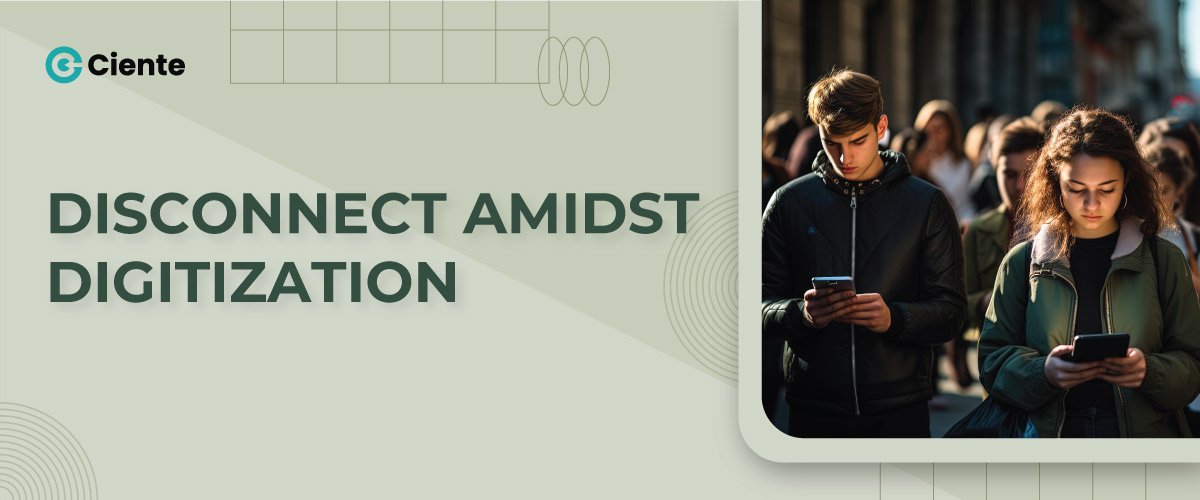
What’s more — our in-person interactions are influenced by technology, where human relationships may be impacted. You can probably relate to this: when out with people, we do not hesitate to check messages or emails or capture the moment on our devices. As we embrace technology, we must remember the significance of striking a balance between the tech world and in-person interaction, which is more important now than ever.

If we do not nurture human relationships, we endanger our mental health. Social media, although beneficial, may become addictive and cause isolation.

Rising Mental Health Issues

Over the recent years, we have outdone our human existence by developing amazing innovations. The digital transformation has made the world tightly knit, where communication is just a click or a text away. But at the same time, it has also created a world where we feel distant and lonely. You can notice a change in the social and emotional connections. We may be interacting with several friends and family members on apps daily, but how often do we meet them in person? The concept of staying connected to people has been narrowed down to virtual modes.

Life has so much technology, but the downside is rising health issues. Studies indicate a link between excessive use of social media and mental health concerns like anxiety, depression, and sleep problems. While social media channels can connect people from any corner of the world, excessive indulgence can make you feel isolated and glued to screens. As we immerse in technology, it could cause technostress — a psychological response associated with an inability to cope with or feel overwhelmed with technologies.

Balance is The Key

Technology has undoubtedly introduced a stream of positive changes in our lives. However, it is crucial to acknowledge and address its impacts on our social circle. We should prioritize fostering robust connections in all aspects of our lives. We can begin by implementing simple steps like living in the present moment when interacting with others, putting away phones, and engaging in more face-to-face conversations.

We must deliver conscious efforts towards building and nurturing human interactions rather than solely relying on digital communication. We can also participate in community activities, volunteering, or social events. When we prioritize relationships and work towards connecting with others, it will be easier to create a balance between technology and socially-fulfilling life.

Final thoughts

The tech-savvy world is expanding at lightning speed. Although we have progressed technologically, we have also become socially distant. Tasks and processes are being automated, increasing productivity and quality of outputs. It is easy to get swept away in the fast-paced dynamics to such an extent that in-person connections decline. If we continue the tech or social addiction, our mental wellness is likely to suffer.

Given the digital transformation, we need to nurture social connections and develop meaningful relationships outside the pool of social media. Participate in group activities or events every chance you get. Organize awareness campaigns in your network on how technology and social media addiction can affect mental well-being. As we incorporate various software and digital tech in our lives, let’s remember to foster human connections.

Key Elements of a Successful Email Marketing Strategy

Key Elements of a Successful Email Marketing Strategy

Key Elements of a Successful Email Marketing Strategy

Email marketing helps you establish better connections with prospects.How can you tweak your strategies to turn these prospects into paying customers?

Studies show that the number of global email users reached 4.26 billion in 2022 and is projected to grow to 4.73 billion by 2026. Email marketing remains one of the most promising ways to reach your prospects and drive more conversions.

Yet, completing a good email marketing campaign needs more than just writing a message and hitting send. You must consider a few critical elements to make your emails engaging, persuasive, and effective.

For a start, you can begin with a good subject line and a strategically segmented email list. A promising email marketing strategy must focus on creating emails that resonate with your target audience and drive real results.

Important Elements of a Successful Email Marketing Strategy

All successful email marketing strategies include a few key elements. Here are some you could consider:

Opt-in Confirmation

It is practically indisputable that this is one of the crucial stages in email marketing. Yet, it seems that a considerable part of people miss asking for permission before sending them emails. Buying email lists is also a big no-no, as it makes it nearly impossible to know when someone sees your ad. You should never send letters to anyone before letting them opt-in. Such behavior would send your emails to the spam folder. It could also harm your reputation. 

Made to be accessible

Today, many people are turning to smartphones to access news. Research indicates that up to 46% of opens come from mobile devices. Make sure you can engage with your consumers. Make all your marketing emails with limited text. Also, ensure the engagement is high by including images. Many people consider the “fold” to be the very top area of your website. Put your most important info here. It will ensure that visitors see it when they first enter your site. Make your CTA memorable and relevant for customers by leaving a white space around it. Adding such buttons alongside your content will make it easier to use. It will increase the likelihood that visitors will engage. 

Content Schedule

Your email marketing team must be active to stay a big part of their subscriber’s daily lives. They should send content at least twice a week. I am just saying: who wants to end up in the spam folder, right? Design the content schedule. Specify the dates for email delivery. When you manage multiple departments, update all emails in your calendars. This way, you can see the whole picture. 

Email List Management

Managing an email list is vital to effective email marketing. A good strategy aims to dodge returning bounced emails. It also aims to avoid sending old emails and reporting you as spam. You should conduct monthly or quarterly email list audits. Briefly, segment some of your email lists into smaller ones. That way, you can aim your message at demographics or behavior groups. For example, loyal shoppers, customers you didn’t reach out to, or newly onboarded customers. Personalizing the message will make our email marketing platforms & campaigns more impactful. 

Personalization

We all like the depth of forming a real-life relationship. Sending and receiving cold, robotically friendly emails makes us feel distant. Sharpen your emails. Make them informal and add emojis. Use their first name.  

Value-Addition

One key feature of every email to prospects is that it should answer the: ‘What’s in it for me?’ question. You tend to explain your product and its utility well. It makes the prospect clear – to make it relevant, you need to tell them what their benefit will be. If it is not answering the problem that the users have, then surely they would not engage with your email.  

Shareable Content

Create your content so that it is easy for others to share. Add email and social share buttons to all emails. Let customers tell their friends to see an email by mailing the link. Your community members are your biggest brand fans. They are among your best advocates. You intend to offer them a platform to spread the news with their network (a.k.a. potential customers).  

Email Tests 

Before you send emails, check for grammar and big mistakes. Also, check that all links work. Also, sending them a campaign email through the email tool is a clever plan. These will help you know the odds of your deliverability. They will alert you to things that might get you flagged as spam. They will let you see how your emails look.

The Bottom Line

Truly, there is no one-size-fits-all way to build your email strategy. You know your customers and prospects better than anyone, so listen to them and their needs.

Experiment with different formats, designs, and words. Also, try different types of emails. See what your audience likes best. 

Lastly, get creative, and do not be afraid to change things. Over time, you will find what works best for you. As long as you are honest and provide real value, readers will appreciate your emails. They will keep coming back for more.

Primary Email Marketing Metrics to Measure Your Success

Primary Email Marketing Metrics to Measure Your Success

Primary Email Marketing Metrics to Measure Your Success

Tracking your email marketing performance is the best way to know your audience and build a suitable strategy. Find the metrics that could change the game for you.

Email marketing, a direct marketing channel, lets you connect with your target customers and inform them about your latest product, service, or any new updates. A large part of marketing involves marketers sending and tracking the performance. But what happens when you are not sure of what email marketing platforms to use, what metrics to track? Or when you end up tracking the wrong metrics?

Find out the list of the most important metrics for email marketing that can help you measure the performance of your campaigns and keep you on the right track.

Top Email Marketing Metrics

What looks like success to you might not be the same for others. If there was a clear indication or a finish line for success – things would be easier. Sadly, the truth is quite different. So, how do we gauge the success of our painstakingly executed campaigns? Email marketing metrics – that is the answer. With proper email marketing metrics carefully chosen based on your goals, you can measure the success of campaigns. Let’s just say that these metrics act like the finish lines for your campaign – based on the performance of your campaigns you can judge where these campaigns stand.

The list of effective email marketing metrics is quite long:

  • Click rate
  • Conversion rate optimization
  • Bounce rate
  • Open rate
  • Overall ROI
  • List growth rate
  • Email open rate
  • Spam complaints
  • Revenue per subscriber
  • Unsubscribe rate
  • Revenue per email
  • Forward rate
  • Delivery rate
  • Time
  • CTR
  • Domain name
  • Email list
  • Campaign ROI
  • Churn rate
  • Email open time
  • Email performance dashboard

To save you the confusion, we will talk about the top 8 email marketing metrics:

1.  Click-Through Rate (CTR): Consider this example to understand things better: Imagine your email is an online flyer. In this case, the CTR would show how many people who saw your flyer (in our case, the email), actually clicked on the link given in it. A higher CTR indicates your email is catching more attention and prompting your audience to do what you intended.

2.  Bounce Rate: A bounce rate in email marketing shows emails that could not get delivered because of incorrect addresses or spam filters blocking them. A high bounce rate means you should clean or adjust your email list.

3. Unsubscribe Rate: It shows the number of people who opt out of the emails you send. A high level of people unsubscribing could be because you are sending your emails too frequently, or the content is not of interest to the recipient.

4. Conversion Rate: It shows the effectiveness of your email through a score. When assessing it, it would help you answer this question – did your email marketing campaign meet the set goal?

 5. Open Rate: Open rate is a term used in email marketing to calculate the percentage of recipients of a certain email who actually opened the particular email. It is akin to responding to an invitation that one is to attend a party. If your open rate is high, you must have crafted a good subject line and a tempting preview of the email to your ICP.

6. List Growth Rate: The metric shows the growth rate of your subscriber base to your email list. A long list enables you to convey your message to a larger population. Expanding the list gives you more people to market to for your desired objectives.

7. Return on Investment (ROI): ROI measures the monetary benefits of your email marketing efforts.

8. Spam Complaint Rate: The spam score tells how many people would leave your email in the trash. It is as bad as it sounds. You need a lower spam rate for success. If your rate is higher, then it might be that your emails are spammy or irrelevant, and you might need to tweak your content and sending frequency.

Conclusion

A good email marketing metric will gather and report necessary insights. But the real trick is to add the human touch to those graphs and figures. If there is a drop in your desired numbers, understand what is going wrong – is there something you could do to make numbers rise? And if things are well for you, you still need to understand what your subscribers like about your emails and keep doing more of that. Using creative tactics and insights from your campaign is what can keep your campaign on track.

A-Letter-from-One-Writer-to-Another-From-Parody-to-Prayers-and-Everything-in-Between

A Letter from One Writer to Another: From Parody to Prayers and Everything in Between

A Letter from One Writer to Another: From Parody to Prayers and Everything in Between

What happens when a writer almost becomes a hypocrite? How do you save yourself from fleeting trends? Is AI a friend or a foe?

ChatGPT and Gemini like AI tools brought happiness to many professions, but one sector was majorly affected – the content writing community. It was a hard hit – people everywhere were making claims about how the jobs of writers would be taken over by AI. At once, the story of robots and AI controlling the world almost seemed like a reality.

Speaking of personal experience, I was not at all in the mood to check out the latest tech everyone around me was raving about.

“Hey did you see, ChatGPT can write poems like Edgar Allen Poe”

“Hey check this funny rap verse GPT wrote like Kendrick Lamar”

It did not amuse me at all! Being an avid reader, and an aspiring writer, I took it upon myself to never compare the writings of people with brainless robots. If writing a book was all about copying emotions – there would have been hundreds more like Shakespeare and Stephen King. And, even though I was not a Kendrick Lamar fan – I am now a proud owner of a t-shirt with his face printed all over it.

If it’s not already clear – I hated these new technologies without even trying them. Why? Because it claimed to do something I do and people liked that better! Trust me being competitive is not always good – especially if you are made to compete with AI that has data from thousands of different successful writers.

We writers are probably the most misunderstood ones in the professional world. There are times when people make fun of us saying “Oh! Your work is so easy, you just have to write stuff!” and then they insult us by paying peanuts for our work, and justifying it by saying that (aka two cents) should compensate for our time and efforts.

Imagine if the copywriter for Nike’s tagline – “Just Do It” was paid based on the number of words they wrote. What outsiders fail to understand is that, yes we just churn out words, but those words are exactly what drive your target audience to pay you for your products or services – at times our words are exactly why prospects even turn heads toward your products.

Coming back to AI and its effect on content writers. I did try it! And, guess what – I hated it even more – at first, because yes it was giving answers that made sense. But as I used it more, I understood AI was really stupid and could never replace me.

The Hypocrisy

The same people who once sang praises for the technology were now being way too harsh on it rendering it useless. The so-called keynote speakers on LinkedIn who once could not get enough of AI were now hopping on the trend of demeaning it.

The Happy Ending

I got my answer. My competitive mind was happy. My job was secure as long as there lived people who understood the basics of the language, emotions, and the human touch.

And for those who think replacing their workforce with AI is the way to go – my prayers will always be with you. May you get the courage to see beyond saving some cents and into what really matters at the end of the day – your customers who like to buy from real people and not bots, who love to read what real people write, and hopefully who can now, after so much outrage and news, can make out what is the difference between AI written content and something good.

From a writer who once almost got caught in the fading trends of AI-generated content to someone out there who might still be wondering – “Can AI really replace me?” No, it won’t. It can never. As long as you stay true to yourself and the people around you. You have your job, your skills, and the path to take you forward.

Moral of the Story

Even though AI-generated content ranked high enough for these keywords, it might in all honesty be another fading trend. Some people can’t get over it, and some are waiting for it to go out of trend. And, it’s okay if you use it to assist you when you are stuck with something, maybe a writer’s block, as long you are on the right side of the bridge.