Top 12 Cloud Computing Trends of 2025

Top 12 Cloud Computing Trends of 2025

Top 12 Cloud Computing Trends of 2025

The realm of cloud computing is dynamic, characterized by a whirlwind of transformations. How can you use the 2025 trends to amplify brand productivity?

Given the era of technology, all businesses are swiftly migrating to cloud networks, harnessing a plethora of advantages.  From mass storage, data backup, recovery, and security to an array of services and software solutions, cloud computing offers unparalleled benefits. Moreover, its trends are booming, enriching user and business experience.  

This technology provides resources that allow users to access resources remotely. All you need is a device and a stable internet connection. Cloud infrastructure can generate $178 billion a year! As companies brace themselves for a digital wave filled with innovations, challenges, and unprecedented opportunities, molding into these cloud computing trends will be a key driver of success. This proactive approach will promote better decision-making while balancing an environment conducive to brand expansion.

12 Cloud Computing Trends to Watch Out For 2025

Cloud tech has been growing over recent years, fueling its adoption across the B2B landscape. Let’s dive into the tools that can bring about a 360-degree shift in your business performance.

AI & ML

Artificial intelligence and machine learning are emerging technologies intertwined with cloud technology. Both of these are known for their cost-effectiveness. The projected trends include self-automation, personalized cloud services, and enhanced data security. As a B2B brand, you must consider investing in these innovations to accelerate growth and gain a competitive advantage.

Resource optimization

A highlighting feature of AI and ML is resource management optimization. AI-driven cloud management empowers organizations, reducing costs, improving performance efficiency, and streamlining overall cloud operations. ML algorithms add value while optimizing various aspects such as resource allocation, identifying cost-saving opportunities, and automating routine management responsibilities.

Data security

Since data is digitally available and accessed, its security holds great value for all businesses. If not careful, data breaches can leak crucial information about your brand. It is imperative to implement proactive steps to prevent such risks. Cybersecurity integrated with cloud networks can heighten the security systems using encryption and multi-layer authentication. If you apply Cloud systems for robust security, it is sure to safeguard your data, including those exchanged with your customers.

Hybrid & Multi Cloud

Customized cloud services pave the way for a dynamic and personalized approach, combining public and private clouds. In 2024, hybrid and multi-cloud environments are redefining the business paradigm. This synergy offers on-premise infrastructure plus anything else in the cloud platform, and the resultant is unparalleled flexibility. You can leverage multi and hybrid cloud resources for particular workloads, thus delivering vendor-agnostic solutions. 

Low code and No code solutions

The application of coding expertise as a precursor for technological advancement is fading, thanks to low-code and no-code cloud solutions. These platforms are user-friendly, empowering businesses to launch diverse applications. When you streamline the development cycle, it allows solutions to reduce errors and increase access to the latest innovations. Cloud-based platforms enable users to design and implement applications seamlessly, requiring no extensive coding. 

Edge Computing

This cloud tech has simplified data processing to a great extent by linking computational capabilities with data sources, thus improving performance efficiency. Edge computing creates a compact computing environment near the data source, reducing latency. The 5G network boom in the market has given momentum to edge computing. You can now leverage real-time data processing accompanied by boosted security and privacy measures.  

IoT

The Internet of Things is revolutionizing businesses with new software integrations daily. It integrates many sensors generating chunks of data that can be stored on cloud servers. With the latest IoT sensors and actuators, you can analyze data to support informed decision-making. Cloud-connected IoT devices enable your business to collect data from a series of sensors and devices, acting as a mediator between remote systems and smart device management. Implementing this trending tech will help you employ smart connectivity. 

Serverless architecture

Serverless cloud computing is reaching an upward trajectory this year. It’s a way of building and running applications/services without stressing about managing the cloud infrastructure. Such an architecture comprises servers but it is distinct from app development. Utilizing these networks will allow your brand to build and incorporate agile, cloud-native applications. 

Pay-as-you go

Since cloud networks may charge hefty bills for storing enormous volumes of data, explore the pay-as-you-go models. When you opt for these services, you only pay for the network resources you use. In this way, you experience the flexibility of turning private connections up and down to meet your different workloads. And the outcome? The capital expenditure is low, leaving you more time to focus on the core business activities. 

Disaster recovery

Organizations deal with chunks of data every day. What if unforeseen circumstances occur and a server crashes? You may not only lose the unsaved data but also incur huge financial losses. This is where Cloud’s disaster recovery works like a total lifesaver! It can restore critical information and systems in case of any mishap. Cloud computing stores data back-ups, allowing you to swiftly recover from potential data loss, power outages, cyberattacks, or hardware failures. You can entrust your brand with this robust system to maintain electronic files and upload them on external cloud servers. 

Bridging the Skills Gap

The migration to cloud platforms might have happened swiftly, but it accentuated a skills gap for some professionals. The demand for skills like AI experts, system administrators, and software engineers is expected to intensify as cloud adoption scales up. This year has witnessed the cloud computing landscape become more multifaceted, which means businesses must adapt to keep up with this shift. You can stay ahead of the cloud learning curve by harnessing the power of these systems, while simultaneously managing the associated risks. 

Cloud & Sustainability

As businesses compete with technological advancements, the drive for sustainability remains a top cloud computing trend. With more companies becoming serious about integrating sustainability, cloud service providers are dedicated to reducing emissions. For instance, Amazon is focused on accomplishing net-zero carbon emissions by 2040. While working towards the SDG goals may seem tedious and never-ending, the trend of launching sustainability initiatives has gained significant momentum in 2024.

To Sum up

2024 has been promising in terms of cloud-inspired transformations. It’s become a vibrant catalyst, introducing innovations across different sectors. The convergence of AI, ML, disaster recovery, sustainability, and other new solutions paints a vibrant picture of the cloud’s contribution to helping B2B companies build a bright future with technologies. Utilize the diverse ecosystem of trending cloud solutions to leverage new potential and seamlessly navigate the stream of data and digitization. 
Cloud Migration Strategy 101: Type, Steps, & More

Cloud Migration Strategy 101: Type, Steps, & More

Cloud Migration Strategy 101: Type, Steps, & More

A cloud infrastructure offers a secure and scalable solution for data management. But how can you ensure a successful migration from on-prem to online?

As digital technologies are evolving, more companies prefer cloud platforms for their on-demand resources. The cloud computing landscape is fast-paced and dynamic. Its strategies offer a roadmap enabling brands to identify the best approach to transfer applications and data to the cloud.

Cloud migration provides significant benefits, but you may encounter roadblocks without a concrete strategy in place. These include high cost, compliance risk, and elaborate migration.   Awareness of the types of cloud migration and the steps involved will promote a smooth transition from on-premise to remote servers.  

We’re kicking off this blog with an in-depth discussion of cloud migration, followed by its types, steps, and tools. This compilation will guide you to successfully integrate a cloud and move all data to this platform without glitches.

Cloud Migration Process

A cloud migration strategy comprises a variety of services, databases, IT resources, and applications. It refers to the plan a company designs for moving data and applications from on-premises to a cloud infrastructure. A systematic and documented migration strategy will ensure an efficient migration.

Let’s take a look at the types of strategies for data transfer.

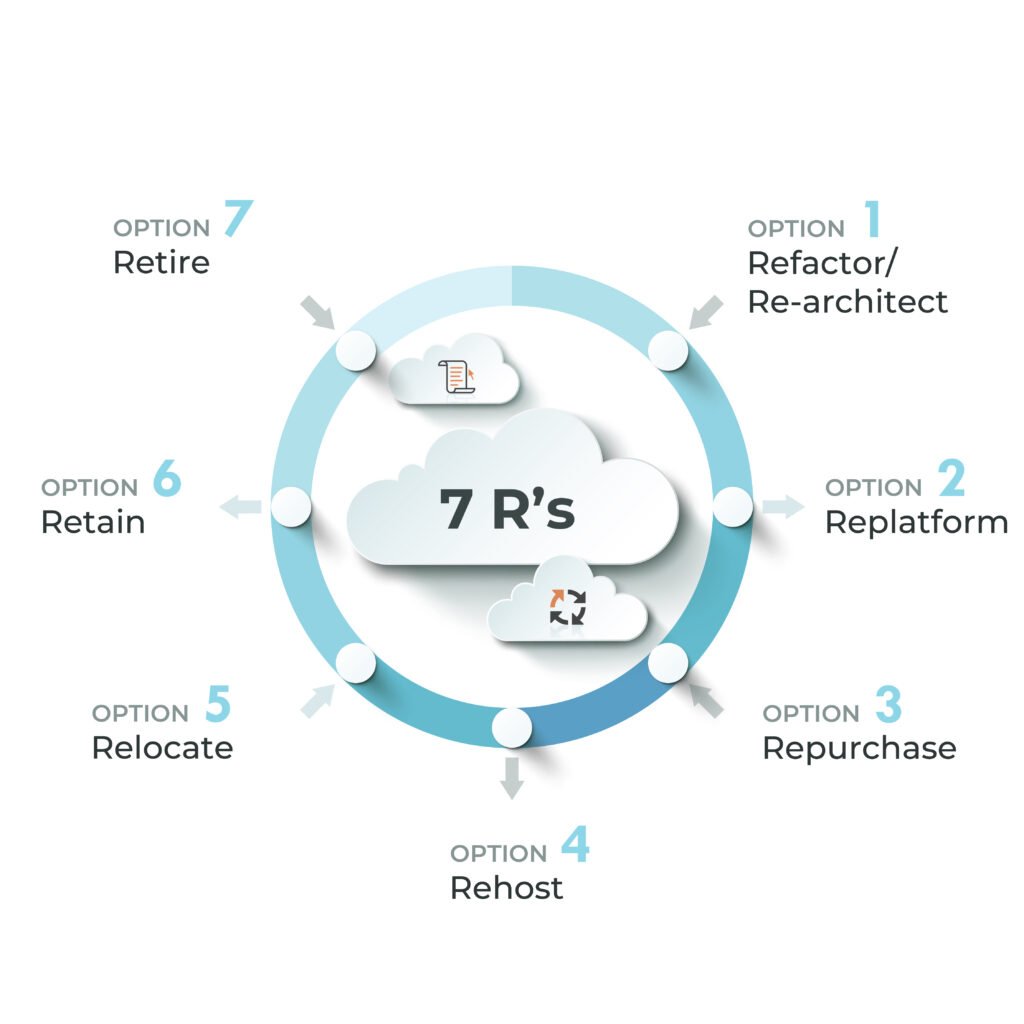
Strategies to transfer into the Cloud: The 7 R’s

When migrating to the cloud environment, you can choose from seven strategies. Gartner originally referred to them as the 5 Rs, which later expanded to 7 Rs.  Here’s a brief about each:

Infogarphic cloud 02

Refactor/Re-architect

You can transform an application by modifying its architecture and incorporating cloud-based features. This cloud migration strategy provides more agility, better performance, and enhanced scalability. With refactor migration, you can port the operating system and database hassle-free.

Replatform

When you opt for the replatform strategy, it allows the transfer of an application to the cloud while using optimization to leverage cloud-native capabilities. The source code and core architecture remain intact, and the legacy applications are operational. With replatform migration, you can experience heightened flexibility, agility, and resilience along with automation. It conserves your time and resources while allowing you to select components for modernization.

Repurchase

This migration strategy allows you to swap the internally administered systems for third-party managed services accessible in the cloud environment. This enables you to retire legacy systems and upgrade to a SaaS subscription model. As and when the services increase and third-party vendors get involved, this model seamlessly manages operations for in-house teams. The migration process gets expedited while reducing downtime and enhancing scalability. It applies to workloads requiring enhanced application performance/ user experience and minimal operational heads.

Rehost

The rehost migration utilizes cloud infrastructure as a service (IaaS) that retains the core infrastructure of the application. Also known as the Lift & Shift strategy, it enables the migration of an application to the cloud without making any changes to use the platform’s features. With this, you can transfer all data and workflows to relevant cloud networks. It ensures alignment between the existing storage, networking, and computer requirements between on-prem and cloud services.

Relocate

Relocate the infrastructure to the cloud without any new hardware, application rewrites, or impacting the current operations. When you use this strategy, you can migrate a collection of servers from an on-premise platform to a cloud version of the same server. You can experience minimum downtime and disruption, reducing the need to retrain staff or invest in upgraded hardware.

Retain

Some applications cannot be retired, so they remain operational in the existing framework. Retain cloud migration strategy is best fitted for such apps. Businesses choose to retain a workload when they rely on other applications to be migrated first.

Retire

As the name suggests, utilize this strategy to discontinue any application not required in the source network. You can implement a retire migration when terminating or downsizing applications that do not add much value.

Benefits of Cloud Computing Migration 

Here’s a list of reasons to migrate resources to the cloud.  

Scalable

In traditional IT environments, companies will buy physical server software licenses and set up a network system. With a cloud network, you can easily scale your brand with the capacity to handle large workloads and more users.

Cost-effective

With cloud computing, you can access managed services that reduce operational overhead, thus simplifying maintenance tasks such as upgrades. When you migrate to a cloud environment, you invest less in finance as compared to IT operations. This allows you to allocate more resources to innovating new products or improving the existing ones.

Performance

One of the pros of cloud migration is performance improvement and better end-user experience. When you host applications and websites on the cloud, you can scale up and serve more users. What’s more— you can run and access from various global locations near end-users. In this way, you experience an enhanced overall performance efficiency.

Digital experience

The key highlight of the cloud network is secured accessibility from anywhere. This applies to employees as well as customers. A cloud contributes to a better digital experience, thus providing modern and flexible tools.

Steps for An Effective Cloud Migration Strategy

Cloud migration spans five key stages: preparation, planning, migration, operation, and optimization. Let’s dive into each of these in more detail.

Preparation

Before designing a cloud migration plan, consider your brand’s unique infrastructure demands. In this phase, analyze the existing framework, its strengths, and loopholes, and identify your needs. Once you have determined this aspect, you can work towards ensuring the cloud meets your requirements. Involve your potential cloud service partner experts, cybersecurity associates, and IT team to assess cloud migration priorities.

Planning the migration

Before diving into the process, define the reasons for migration and which strategy is best-fitted. This stage involves assessing the current legacy infrastructure and the existing resources and expertise. It provides clarity on the ideal cloud solution for your business. Along with your migration team and cloud services partner, select the cloud model, vendor, and the nitty-gritty of the migration process. Decide whether you want to adopt a private cloud or hybrid, or opt for multi-cloud services like Azure, AWS, or Google.

Migration

Once you have done your analysis, the next step is to implement the decision and migrate to the selected infrastructure. However, despite all rigorous planning and preparation, the process could sail smoothly, or there could be hiccups. It is a good idea to keep a data backup and recovery option.

Operation

It is tough to say whether or not a cloud migration was successful without evidence that it is working as expected. Going live is one way to find out. There is more to this step than merely announcing the ‘live launch’ of the cloud environment. You need to prepare well for the go-live event.

Begin with a data freeze —before going live, halt all changes to your legacy environment and perform a final data sync.  From here on, record any changes made to the going-live process and synchronize after. A trial go-live can also be considered if you have the time and capacity. And most importantly, have a plan B to lean on if any unexpected issues arise or the go-live takes much longer than anticipated.

Ongoing support

When you use the cloud, you will need a support framework to keep you going. The ongoing assistance will offer maintenance and monitoring strategies to promote cloud success. You need to review updates at least monthly and go through software updates periodically. Also, you will benefit from consistent performance monitoring in place, providing the relevant tools for monitoring. This would have an added benefit, especially if your brand does not have a dedicated migration architect.

Cloud Migration Tools

Believe it or not, integrating with the right tools can make a huge difference. Cloud migration tools can benefit businesses by providing diverse solutions. Some may be specific to major cloud platforms like AWS, Azure, OR Google Cloud. And others are likely to be compatible with migration to a series of cloud providers. Whether you are running a small business or a large corporation, an in-depth knowledge of these tools will support informed decision-making for a smooth cloud transition.

Azure Migrate

This cloud migration service is a Microsoft Azure tool that streamlines workloads to this network. You can opt for Azure if you are looking for tools to help with assessment, migration, and optimization. Whether you are operating on a small or large scale, you have the option to move from on-prem to Azure. One of the added advantages of this cloud tool is its capacity to handle different types of migrations, such as servers, databases, and web applications. Moreover, it also delivers assessments and tools for optimizing resources after migration to the cloud. Thus, you can experience improved performance efficiency while maintaining cost-effectiveness.

AWS Application Migration

With the AWS tool, you can seamlessly transfer and modernize applications from several source infrastructures to this cloud network. It serves well by automating the conversion of source servers, enabling them to run natively on AWS. At the same time, this cloud environment offers custom and built-in optimization options. You can access over 200 migration services that reduce the overall cost.

Google Cloud Migration Tools

This platform unifies migrations from on-premises or other clouds. It is suited to various starting environments, including on-premises, private hosting, and public clouds. You can receive support for legacy and cloud-optimized workloads, thus catering to various operational needs. When you integrate with Google Clouds, you can experience the features of the cloud such as replatform, refactor, re-architect, rebuild, and repurpose as per your business goals.

Datadog

This offers a comprehensive security system that allows you to map your brand’s legacy and cloud-based framework. You can access real-time data during each phase of the cloud migration process. While using Datadog, you can be sure that the migrated applications comply with the targets and provide a unified view across servers, applications, and services. Long-term retention of metrics, for about 15 months, and specialized cloud monitoring are some of its highlighting features.

IBM Turbonic

It combines cloud migration with an in-depth, real-time analysis of the resource requirements of application workloads. With IBM Turbonic, you can tailor migration plans of applications, while optimizing the costs. Whether you are using a singular cloud or a hybrid or multi-cloud approach, Turbonomic adapts well to your requirements. It helps to boost the overall performance efficiency of cloud migration.

Wrapping up

Businesses deal with chunks of data daily, much of which is critical information. A cloud offers a secure platform for storing and exchanging sensitive data. There are many advantages of using the cloud, including compatibility with different software and a seamless experience altogether. With cloud migration, you can shift business data and applications to an online server. Although beneficial, it is a complex process involving informed decision-making. You need to select the right application between the 7 R’s. And the choice will depend on several factors like hardware requirements, scalability and availability, technical compatibility with cloud infrastructure, your business goals, and budget constraints. With plan and precision, you are sure to develop a robust cloud migration strategy.

Understanding Cloud Infrastructure: All You Need to Know

Understanding Cloud Infrastructure: All You Need to Know

Understanding Cloud Infrastructure: All You Need to Know

With the surge in digital transformation, the cloud infrastructure market promises substantial growth. How can business leaders leverage it for their organization’s benefit?

Cloud infrastructure consists of all the hardware and software needed to execute and support the delivery of cloud services to customers. The cloud has become an omnipresent force in the modern computing domain. According to Gartner, worldwide end-user spending on public cloud services is expected to reach $675.4 billion in 2024, up from $561 billion in 2023. This growth is attributed to generative AI (GenAI) and application modernization.

Today, when the world is filled, or rather fuelled, by tech-savvy people, cloud computing infrastructure gives them the agility to digitalize core components of their business operations without spending excessive money on on-premise hardware. It also helps when the hybrid work culture is gaining popularity. The shift to the cloud can give employees access to apps from anywhere in the world – basically bringing the concept of workations a reality.

Types of Cloud Architecture

Cloud infrastructure does not rely entirely on third-party, public cloud service providers. The three widely adopted cloud architecture models use the same primary elements of cloud infrastructure to deliver computing services.

Private cloud architecture

model, only one organization can access the cloud infrastructure. The private cloud infrastructure could be developed in-house by on-site IT staff, or it can be delivered by an external service provider.


Public cloud

includes third-party providers offering cloud resources to paying customers over the Internet. Public cloud providers use a multi-tenant environment model to lower the cost of computing power and data storage for their customers. The multi-tenant environment lowers the overall cost of computing resources, but it may also create privacy concerns for companies dealing with sensitive data.

hybrid cloud

computing model is defined as private and public cloud systems integrating in a separate but connected system. Organizations that deal with sensitive data may opt for maintaining data privacy by storing sensitive information in their on-site servers while hosting less sensitive applications and other resources in the public cloud where the costs are lower. Organizations that use hybrid cloud maintain their confidential cloud environments but may utilize public cloud services for added capacity or computing tasks on a flexible basis.

Three Cloud Infrastructure Delivery Models

Cloud service providers deliver cloud infrastructure and related services in three main delivery models: Infrastructure-as-a-Service (IaaS), Platform-as-a-Service (PaaS), and Software-as-a-Service (SaaS). These delivery models differ by the parts of the technology stack that are outsourced.

IaaS model

a cloud service provider delivers networking, data storage, servers, and virtualization capabilities. The customer earns access to unlimited data storage and computing power, but they must have their own software platform to run on it. The software platform includes operating systems, runtime, middleware, data, and applications.

PaaS model

a cloud service provider supplies the cloud infrastructure, including networks, servers, data, and virtualization, along with a software platform comprising operating systems, middleware, and runtime. The PaaS model provides customers with the capability to develop, test, deploy, and execute their own applications in the cloud without the usual expense and intricacy of building on-site IT infrastructure.

SaaS model

a service provider delivers an application via a web-based portal, removing the need to store any information about the application on a local hard disk. The entire data storage is located on the servers of the service provider. SaaS companies are reliable for every element of the tech stack – from upholding the cloud infrastructure that supports the application to the application itself.

Cloud Infrastructure Components

Storage

Cloud storage stores data, gives you access to the latest version of a file and its previous versions, and stimulates remote access as required. It is a virtual storage – it enables people and organizations to access, edit, store, and backup their data from anywhere and anytime. There are three primary cloud storage models:

  • Block storage—segments and stores data into blocks instead of complete files. It is perfect for storing static data that does not need to change regularly.
  • File storage—like the file manager systems operated with regular PCs.
  • Object storage—suited for storing unstructured data or data that needs frequent modifications.

Virtualization

Virtualization means creating a virtual version of a physical machine. It adds a separate machine layer that allows multiple virtual machines to run on a single physical machine. It reduces hardware costs, improves scalability, and provides better security.

Network

A network in cloud computing infrastructure is a bunch of interconnected computers and devices used to share resources and data. Cloud computing networks can be private, public, or hybrid:

  • Private cloud networks are owned and managed by a single organization, and the public cannot access these.
  • Public cloud networks are the ones that are owned and operated by a third-party provider and are available to anyone with an internet connection.
  • Hybrid cloud networks combine features of both private and public networks for people to offer a balanced combination.

Hardware

Hardware is a physical machine or a tool that can be kept anywhere and is used to connect computing machines to a cloud. Hardware components comprise servers, power supplies, memory and storage, processing units, and more — all of which play a significant role in delivering services, information, and security to businesses and individuals.

Benefits of Cloud Infrastructure

Here are the main benefits of using a cloud infrastructure:

Flexibility

Cloud infrastructure helps you with easy and quick access to resources that you can use to self-manage and better align the infrastructure for your business needs.

Reliability

Cloud vendors build and maintain extensive infrastructure, providing various tedium options using availability zones to deliver dependability at scale. Each vendor offers distinct service level agreements (SLAs) that guarantee a certain level of availability.

Cost

cloud infrastructure can eradicate upfront capital costs spent on on-premises infrastructure, using a consumption-based model to deliver infrastructure readily. Cloud vendors use a pay-per-usage model to bill users for the infrastructure they use hourly, weekly, or monthly.

Security

cloud vendors invest in and enhance their infrastructure security and provide customers with attributes to set up their security controls. Cloud infrastructure allows you to access high-end security features that are inaccessible or too pricey.

Cloud Computing Infrastructure Best Practices

Migrating to and adopting cloud infrastructure could be quite challenging, given the security considerations and the intricacies. Here are a few best practices you could stick to while starting your journey with cloud computing infrastructure:

  1. Switching to cloud computing infrastructure is a strategic change in your business and should be approached with the exact focus on policies as any other change. It ensures a seamless transition and brings the entire organization on board with the switch.
  2. You must thoroughly research the diverse cloud solutions and options and choose the cloud infrastructure that best supports your requirements — both in the delivery models illustrated above and the potential of different cloud networks for your distinct business operations.
  3. Analyze how to use modern technology to your benefit. Cloud servers support the use of these tools, and it is worth probing whether they can help with automating your services or supporting a global expansion plan.
  4. Carry out tier optimization to make the most typically accessed data easier to find on a higher level as compared to the one that is rarely searched for and opened. This simple trick can streamline internal and external access within the network and works similarly to a multi-tiered file manager.
  5. Governance is essential to ensure that your data is always secure and up to date. It is worth having a contingency plan in case of any unforeseeable disaster. It is not unlikely that things can go wrong where technology is involved, so putting in place a risk mitigation plan is a reasonable way of training for the worst and guaranteeing that should it happen, your team knows what to do.

Wrapping it up

Up until now, IT equipment and data center systems worked on the circled wagon approach. Everything was behind a firewall and facing inward. The only users were inside the company and the firewall, as were the apps used by them.

The cloud – and to some extent mobile – forces a pause in that circle. Now, businesses need to face outward to cloud companies. Businesses must create a secure data flow in their firewall to connect securely to the public cloud and keep invaders out while at the same time maintaining optimum levels of performance. Now, here is the thing. There is a common delusion among organizations that migrating workloads to cloud infrastructure will automatically result in cost savings. In reality, that is not always the truth.

Reducing cloud costs and maximizing cloud infrastructure ROI should always be a conscious decision. Along with this, cloud security is a growing concern for organizations and businesses relying on cloud infrastructure to deliver the underlying resources that support fundamental business services.

Whether you are contemplating signing up for cloud services or working in the cloud industry, a good understanding of the cloud infrastructure opens a range of possibilities for you. As a business leader, you can optimize and automate the primary processes, saving time and improving productivity.

Top Event Marketing Trends in 2025

Top Event Marketing Trends in 2025

Top Event Marketing Trends in 2025

Events can transform business dynamics, but organizing them involves a lot of behind-the-scenes work. Keeping up with the latest trends gives a cutting edge to your marketing plan.

Event marketing combines planning, execution, and promotion to achieve business awareness, brand credibility, and audience engagement. It is an essential ingredient for building relationships with the target audience and driving the sales cycle.

Technologies like AI and GenAI are transforming business functioning, and events are no exception. The world of meetings is also evolving, integrating digital tech to engage with potential prospects. To stay ahead of the AI wave, know-how of the top event marketing trends will promote brand success.

With an array of innovations surrounding us, it can be daunting for marketers to keep track of what’s in and what’s best to boost inbound strategy. We’ve prepared a comprehensive list for you to incorporate into your marketing programs.

Event Marketing Trends: Must-haves for 2025

Let’s look at the most trending techs this year has witnessed.

1. AI integration

AI and Gen AI offer a dynamic market with a diverse set of tools to choose from. In 2024, there has been a rise in experimentation with AI for campaigns and event planning. It does not come as a surprise that these technologies also inspire event planners to discover new ways of enhancing customer experience. A key feature of AI integration is automating tedious operations and doing it flawlessly. Marketers can experience seamless outsourcing and management with the emerging tools.

2. Involvement of modern technology

Planning and executing an event comprises several elements and departments, each managing a specific portion. It may all seem chaotic with challenges such as staffing shortages, late deliveries, and budget restrictions. But thanks to technological advancements, you can sail through these hurdles. Tech innovations can take the collaboration between event planners, suppliers, and venues to the next level. For instance, design tools can support better visualization of how the venue will look like. What’s more— scheduling and invitations can be automated.

Technology competency is no longer a buzzword, it is the need of the hour. Implementing the latest innovations enhances brand awareness and organic lead generation. Event marketers can utilize technologies such as AI, data analytics, and automation in their stride to amp up performance engagement. They must also consider applying a single-platform and cloud-based technology to store previous bids and contracted rates.

3. Social media

The era of social media brings together people from all corners of the world. You can leverage different channels to promote upcoming events, attract more attendees, and track engagement. It also opens up walls of communication with audiences of diverse demographics. When you get to know them, it provides you the opportunity to tailor events and campaigns that would generate a good response.

4. Mix of in-person, Hybrid & Virtual Events

Since the world is increasingly adopting digitization, why not extend it to events? 2024 has welcomed the hybrid era, a mix of virtual and in-person sessions that can accommodate a diverse audience. It can greatly expand your brand presence and increase the scope for brand loyalty. Integrating technology can improve customer engagement and allow you to host more virtual events. The blend of these event formats is more like a response to the evolving needs and preferences of potential prospects.

For instance, although in-person events promote immersive experiences, they can consume significant resources. They are demanding in terms of time, energy, and finances. When you mix in-person with hybrid and virtual seminars, webinars, and meetings, you expand your reach, given the diverse audience preferences and constraints.

5. Centralized event marketing

If you are in charge of organizing events, you probably have hands full with a complex set of intertwined tasks, from registrations to interacting with partners and sponsors, overseeing the entire program, managing speakers, and so on. While event marketing is a powerful approach to building customer connections and showcasing brand expertise, planning, executing, and measuring performance can be exhausting. This is where the trend of a centralized event marketing system comes into place. It is a software solution that manages all aspects of an event, streamlining the process and optimizing the outcomes. 

Over the years, CRM and marketing technologies have worked with centralization, and now it is time to sync it with event technology. Centralized marketing can help you conserve time and resources, improve consistency and quality, increase reach and engagement, and optimize performance. It eliminates the struggles of a single system and offers a cost-effective, flexible platform. Organizations can adopt a centralized framework for strengthening connections with suppliers, investing less time in data consolidation and more time adding value to the attendees.

6. Implementing Sustainability

B2B companies realize the significance of becoming eco-conscious and consider implementing sustainability initiatives. With the UN launching SDGs, integrating sustainability, although challenging, can be feasible. For instance, in your next event, you can choose to adopt some of these measures:

  • Managing waste disposal and recycling
  • Electronic waste management and reuse
  • Using bamboo and other sustainable alternatives to plastics wherever applicable
  • Planning the logistics carefully so there is regulation of carbon footprint

What’s more— when promoting events, including virtual ones, you could show off your green credentials to win like-minded sponsors and attendees. After all, it’s not just about following the event marketing trends but leaving a positive and lasting impact on the people and planet.

7. Value-based Marketing

Studies indicate that over 70% of millennials consider experiences more valuable than material possessions. Focusing on delivering human-centric, less sales-oriented events will work in your favor. When you apply a value-oriented approach, it appeals to the values and ethics of the customers, and they resonate with your brand better. It’s no longer just about products and services. Addressing the values of the target audience portrays an image of the brand that they feel connected to.

Value-based marketing conveys to consumers how they will benefit by doing business with you. As you work towards aligning with your target accounts, pay attention to their desires and motivations. Research and find out the type of value most likely to influence them in your favor. Once you know the values, it will be easier to customize a value-based proposal.

8. On-demand Events

An on-demand event means one that can be accessed by interested prospects anytime. It creates a fine balance between attending an event and aligning it with the work schedule. The access to on-demand content can be beneficial to the brand as well as the audience. They can learn insights about market trends and the latest innovations that can amplify their brands by choosing an on-demand slot matching their convenience. Some companies also offer these online free of cost. High-quality on-demand content can enable you to continually deliver value-based material, with impacts lasting long after the initial event.

9. Personalized Events

Although the modern audience is adaptable and satisfied with in-person or virtual events, the element of personalization never loses its touch. However, before launching a customized event, it is important to understand your audience and gather relevant data. Personalization can be a real game-changer. The number of potential attendees, activities, and relevant content to address their needs will guide you in planning the best event.

When you tailor events as per the unique tastes and preferences of the audience, it helps cater to a diverse audience. Imagine throwing a surprise party for a friend without considering their preferences, compared to one where you have curated them to their likes and dislikes. Personalized events can deliver a more impactful experience for the clients, and are likely to resonate with more individuals.

Final thoughts

Launching events offers a remarkable opportunity to connect with customers and highlight your expertise. When done well, event marketing can help build brand loyalty, increase lead generation, and improve the overall customer experience. This industry domain is ever-changing, but if you implement these projected event marketing trends, you already have an advantage. You can use technology to navigate through the various components involved in making an event happen. In this way, you can reduce the stress of doing all the work and focus on connecting with the prospects.

10 Email Marketing Lead Generation Techniques to Gain Customers

10 Email Marketing Lead Generation Techniques to Gain Customers

10 Email Marketing Lead Generation Techniques to Gain Customers

Email marketing provides a direct channel to connect with potential customers. Are you aware of these top 10 email lead gen techniques that boost your ROI?

Email lead generation helps you collect leads through an email opt-in form. The opt-in form, often introduced with other value-providing content, accumulates information about potential customers, such as name and email address. Next, that information is stored in an email marketing database. Using the database, you can understand people from what segments are interested in your business and send messages or emails accordingly.

Email marketing can generate leads and nurture relationships with prospects by mailing them content that will convert them into paying customers.

Ciente delivers HQL campaigns to get quality leads by targeting the right audience segments and ensuring high engagement through strategic email outreach. Their expertise in HQL campaigns helps businesses attract and convert leads with greater precision and efficiency.

Benefits of Email Lead Generation

Email marketing is a direct channel that lets brands and prospects connect personally. A well-thought strategy could land you your next client. Email marketing is an effective way to target leads, communicate clearly with potential customers, know their preferences, and ultimately, grow your customer base.

Many people claim that with the advent of other marketing channels, email marketing is lost. But that is far from the truth. 77% of marketers have seen an increase in email engagement over the last year. Not only were people more engaged with email, but email marketing had a significant impact on many companies’ bottom lines.

When done right, email marketing can help your business:

  • Grow brand awareness.
  • Build relationships with prospects.
  • Deliver value to prospects.
  • Convert prospects into loyal brand advocates.

7 Best Practices to Generate Lead Generation From Email Marketing

Optimize efforts with lead scoring

A big chunk of marketing includes reaching out to the right people when they are most receptive to your offer. Lead scoring can be your aid in that as it helps you capture high-quality prospects.

Lead scoring helps you segment and prioritize your leads. It is a helpful technique for ensuring you get qualified leads most likely to accept your emails.

Email automation is a great way to use lead scoring in your marketing for scoring leads. For instance, if a potential consumer has already viewed a particular product on your website, it is more likely that you will be able to convert them with an email offering them a 25% discount on that product.

If the visitor is not already in your database, you can use this opportunity to get them to sign up by displaying an exit intent popup as they leave the product page.

Design clean and concise emails

When it comes to lead generation, the structure of your email should be your priority. It is crucial to have concise emails, and should not be overly long. A lot of extras in the design of the templates can distract the audience from your message.

Here are a few tips to follow when developing your emails:

  • Plain fonts: Your emails should not be flamboyant. They should be easy to read, so use plain fonts.
  • Simple Design: Choose a clean, simple template design that makes your emails easy on the eyes. Nowadays, people prefer subtle colors like pastel shades or anything that does not hurt the eyes.
  • Text Formatting: Use well-spaced, concise wording – do not keep stuff too much text or do not leave too much white space. Maintain a good balance between the two and highlight important information to make it easy for your subscribers to digest your email content.
  • Clear CTA: Your call-to-action button must be easy to notice and click on, particularly for readers on mobile devices.

Draw attention with your subject line

It is important that your subject line stands out and inspires curiosity or urgency to click. Write it in a way that either addresses their pain points, offers something they cannot miss, or something that induces curiosity.

It can make a massive difference to the success of your email campaign by boosting your email open rates, and your customer conversion rates.

For instance, if you started a tech blog with an email list of engaged contacts, you will want to focus on current tech news to connect with your audience. But, to go even further, you will want to leave a hint of curiosity to engage the subscribers.

Always include a strong CTA

Your CTA should be easy for readers to act on. To include a strong CTA in your emails, use creative language to attract your readers’ attention and encourage them to follow through.

The most effective CTAs are those with an element of urgency, excitement, or mystery. They are hard to ignore and prompt readers into action, helping you to improve your conversions.

Utilize content upgrades and gated content

Content upgrades and gated content allow you to use your most beneficial content in an email collection tool.

Gated content is accessible only after your visitors have provided their contact information or the other details that you have asked from them. You should always use gated content as a content upgrade to entice your readers to subscribe to your email list non-invasively.

This type of content is great because it incentivizes lead generation. Content upgrades are handy because they are contextual and appropriate. The reader’s curiosity is predetermined, making it more potential that they will convert.

Split test to boost open and click-through rates

Split testing your emails is crucial for optimizing your copy and your strategy. There is always some scope for improvement, and by testing the different versions of your emails, you can find the best-performing emails that improve your conversion rates.

For each email that you want to test, first decide on a metric you want to test. This could be any element, including the CTAs, subject line, body, images, or the structure of the email.

Once you’ve decided which components to test first, you can then use AB testing tools in your email marketing software to start running the test.

Provide valuable content

Rather than sending out random content for the sake of sending an email, provide valuable, targeted content that will keep your subscribers engaged.

Always prioritize value over everything else. To fulfill the valuable content needs of your subscribers, all you have to do is find your audience’s major pain points and create content around them.

Conclusion

Email is a fantastic tool for generating leads, gaining customers, and boosting your bottom line. But choosing the right methods over the easy ones is what matters when looking to generate leads.

Just remember the basics of creating a great email – an engaging subject line, concise body, and relevant images, and use the tactics mentioned above to make the most of your strategies.