SEO Tools 2024

17 Best Trending AI SEO Tools in 2025

17 Best Trending AI SEO Tools in 2025

As AI ramps up its capabilities, it is time to start using it now. Here’s the best 17 AI SEO tools for you.

SEO is not dead. But it is changing with AI. AI is a great disruptor, and it will not stop for a long time. But does that mean everyone working in SEO should be scared? No, it means it is time to pivot and adapt. After all, SEO is all about the customer experience.

Change is scary. But we can help each other navigate the market safely. There is an abundance of SEO AI tools that promise to boost search engine rankings and help ease the pressure off SEO teams. These tools promise to create helpful and high-quality content, improve existing content with strategic target keyword insertion, provide market research, and everything in between. These AI SEO tools might be the game-changers.

They are built to save time and help you focus on vital things.

Namely, creative strategies.

However, AI tools are abundant in the market. Which one should you go for? It will depend on your preference. And, boy, SEO analysts have a lot of preferences.

We will go through the 17 best SEO AI tools in the market. We chose them based on G2 Reviews, with at least 100 reviewers using them (at the time of writing). Most tools except Rytr, Gemini, and ChatGPT were created for SEO.

We will break down the consensus and go through the features so that you can find out which tool is the best for you.

AI SEO is part of the marketing automation toolset. The tools selected here are in no set order.

AI SEO is changing the organic landscape, but you should not be afraid to experiment.

How is AI changing SEO?

AI has long been causing disruptions in the market. And marketing seems to have taken the brunt of it. Look at how Google is changing. AI is called the End of Search.

apocalypt GIF

And yet, marketers and creators alike have an optimistic view of AI in terms of growth and success.

AI has made human authenticity a necessity, and vital players in the SEO scene have understood this. SEO will change to become more human-centric and brand-focused.

It will no longer be about getting backlinks and views, but it will talk about brand values and the expertise a brand brings. EEAT, Google is looking for brands that embody this conviction. A niche edits service can support this by securing contextual backlinks within authoritative, relevant content, helping reinforce your brand’s expertise and trustworthiness in the eyes of search engines.

SEO is just another part of a cohesive experience. And marketing will need the help of AI to bring this cohesion to the forefront of their campaigns. The seamless experience is not a simple task but coming together of different channels echoing a cohesive message. Yours.

And the message has to be based on the EEAT principles outlined by Google. Google understands what marketing teams need and provides clues and hints about where they should go next.

Why does a marketing team need AI SEO tools?
image

The screenshot above seems like it came out of the dreams of a graphic designer.

Simple, sleek, and clean. It is an AI snippet. And it is created through an AI SEO tool. Look at the way it integrates a seamless experience for the user. One of the foundations of SEO is to provide the rich user experience.

And AI tools will help you provide that. Either you can create your own AI tools, and good luck with that. Or you can use the tools that are available in the market.

17 AI tools for your SEO campaigns

You can go through our list of 17 best tools in the industry. There are differences in them, and they provide a varied experience for your users and your teams.

By analyzing these tools, you can understand which one to go for per your unique needs.

You can go through our list of 17 best AI-powered SEO tools in the industry. There are differences in them, and they provide a varied experience for your users and your teams.

By analyzing these tools, you can understand which one to go for per your unique needs.

Writesonic

Price: Free and Paid Based on your requirements)

image 1

Writesonic Review:

  • Score: 4.75/5
  • Number of reviews  1,959

Writesonic is a beloved tool. One look at their g2 page, and you will understand the value it brings to the table.

Writesonic provides its users with a free demo to try and test to see if the tool resonates with them. There is a host of tools available for you. Their free tools include: –

  • Sentence Rewriter
  • Title Generator
  • Rewording Tool
  • Script Generator
  • AI Content Detector
  • Humanize AI Text
  • AI Answer Generator
  • Meta Description Generator
  • Paraphrasing Tool
  • Conclusion Generator
  • Content Idea Generator

Of course, each free tool has its limitations, but they are rewarding nonetheless. Perfect for small teams starting and venturing to see what AI-driven SEO tools are available in the market. Other than that, Writesonic has its proprietary AI Model gateway called the GPT Router. It pulls from different LLMs like ChatGPT, Gemini, Meta AI, etc., to keep its information diverse. Its AI system then detects search intent classification and creates content for your website.

Writesonic provides:

  • Real-time data on the latest topics Fact-checked, cited content.
  • Competitor semantic analysis
  • In-depth web research
  • Automated internal linking
  • Word length control
  • Brand voice and style customization
  • Built-in SEO-optimized content Auto-generate FAQs

AISEO

Pricing: Paid
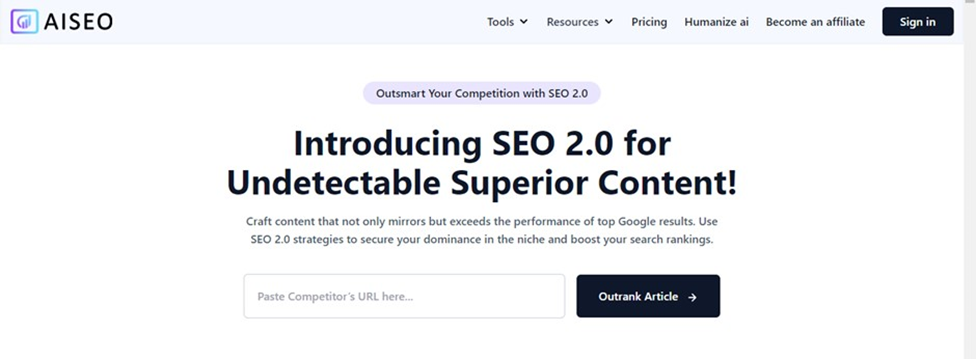
image 2

AISEO Review:

  • Score: 4.6/5
  • Number of reviews: 560

AISEO is dedicated to writing high-quality SEO-friendly content that targets entire SEO content lifecycle and helps companies outrank their competition.

  • The AI SEO tool simplifies complex SEO tasks through automation so that SEO analysts can focus on their digital strategy.
  • Creates informative and unique content for search engines and the user. This content is undetectable, maintaining your site’s integrity and uniqueness.
  • Improves the readability of your content
  • Has predictive analytics to help refine your effective SEO strategies.
  • Multichannel content optimization and Customizable AI tools.

AISEO also provides free tools for creators to ideate and create. And free tools for the analyst.

AISEO is recommended for teams with limited resources. It will elevate your efforts and let your team focus on the message part of marketing rather than mundane and repetitive tasks..

SURFER

Pricing: Paid

image 3

SURFER Review:

  • Score: 4.8/5
  • Number of reviews: 511

Surfer describes themselves as a 24/7 SEO expert. Providing you and your teams with every SEO tool under one belt. The tool promises to research, write, and optimize for you in under 20 minutes.

From editing to optimization— Surfer provides a broad range of AI SEO tools for their users. Surfer AI has free tools that marketing teams can use to enhance their content or create a new content strategy.

But these have limitations, and for bigger projects, you will have to use the paid versions. Whether you are a freelancer or an agency, they have options and solutions catered to your needs.

SEMRUSH

Pricing: Free/Paid
image 4

SEMRUSH Review:

  • Score: 4.5/5
  • Number of reviews: 2,119

Who does not know SEMrush? Often touted as the best SEO tool (uh-oh all Ahrefs users must have felt this one).

SEMrush is not a conventional AI tool. It still sees you taking most of the effort. However, with the new integration of AI, SEMrush has improved its capabilities.

Their topic research is a fantastic tool, while the SEMrush writing assistant helps the readability score and maintains a consistent tone of voice.

It is a multidimensional tool that helps SEO analysts and advertisers craft a robust keyword strategy and takes a granular approach to SEO with the assistance of AI.

Screpy

Pricing: Paid

image 5

Screpy Review:

  • Score: 4.7/5
  • Number of reviews: 147

Screpy is an All-in-one SEO toolset. It automates most of the basic tasks.

It checks: –

  • Your keyword search rankings
  • Monitors the page speed
  • Monitors SEO metrics
  • Monitors uptime and downtime
  • And syntax checkers

According to Screpy, they monitor your site’s overall health and provide updates and actions to improve it.

Screpy is priced humbly. It is a good option for budding teams learning about organic search and its process.mbly. It is a good option for budding teams learning about organic search and its process.

Scalenut

Pricing: Paid
image 6

Scalenut Review:

  • Score: 4.7/5
  • Number of reviews: 304

Scalenut calls itself the AI-generated content research and copywriting platform. Their AI creates content, does keyword research, adds automatic internal links wherever necessary, and competitor analysis.

It also has tools to identify any gaps in your content and suggest improvements or do them for you. It is a handy tool that streamlines the entire SEO content creation process.

FRASE.IO

Pricing: Paid
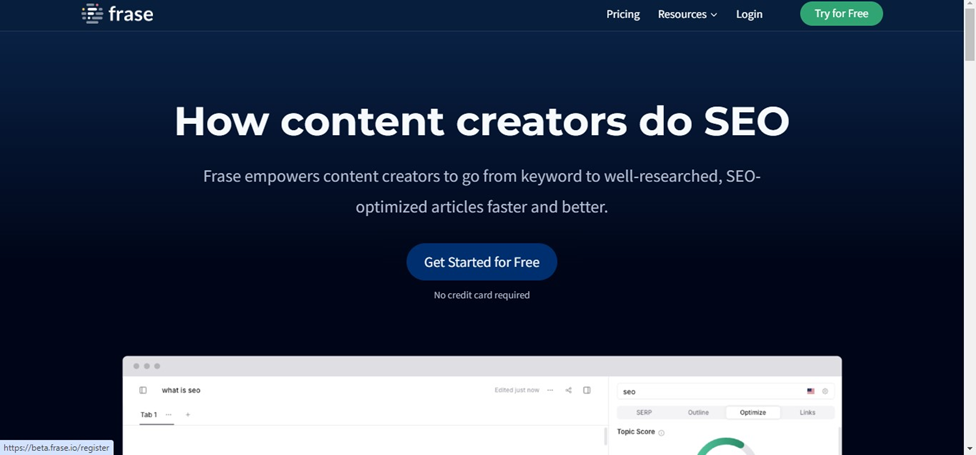
image 7

FRASE Review:

  • Score: 4.8/5
  • Number of reviews: 295

Frase distinguishes itself by placing itself as an empowering tool for creators. Frase offers all the basics of an AI SEO tool for creating content and optimizing it for search results.

But it goes further and helps you create ‘Wikipedia concept maps’. Which are visualizations of connecting topics related to the query. SEMrush users will be familiar with this one.

Frase integrates with your GSC accounts to provide a comprehensive report and analysis of your queries, pages, and site health.

This AI SEO tool has a free trial, and pricing varies on the plan..

Writer Zen

Pricing: Paid
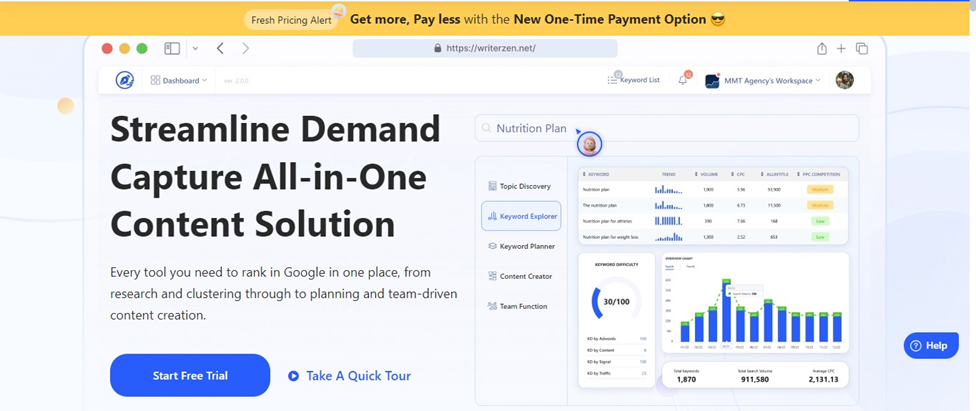
image 8

Writer Zen Review:

  • Score: 4.7/5
  • Number of reviews: 201

WriterZen is workflow-centric AI SEO tool. Like all tools, it helps you research, track, and deliver SEO-optimized content.

They also provide valuable insights into keywords and titles using the Allintitle and Keyword Golden Ratio.

The all-in-title helps WriterZen find the best keywords for your strategy. On the other hand, the KGR provides keywords with levels where the all-in-title competition is low, and the search volume is high. It is an interesting concept worth exploring.

It is a paid AI SEO tool. And the plans vary according to tiers.

INK for ALL

Pricing: Paid
image 9

INK for ALL Review:

  • Score: 4.7/5
  • Number of reviews: 169

INK-as-a-service. If you go to the boot camp section of INK for all, you will find that with a certification course.

Ink places itself in high esteem. They offer to save you countless hours. One of the highlights we found was the relevance task.

The AI uses state-of-the-art technology to identify what is relevant to your users and optimize your content to reflect intent. With it, you can understand the strategy of your top competitors and help you fill the gaps in your plan of action that may be missing.

There is a free trial and two tiers at varying prices.

Narrato Workspace

Pricing: Paid

image 10

Narrato Workspace Review:

  • Score: 4.9/5
  • Number of reviews: 162

Narrato offers a boundless experience compared to its competitors. It provides a complete content workflow management system for its users, enabling them to post their content in one click on WordPress and Webflow. Narrato also provides a social media management and content creation suite.

Narrato does something different than most AI SEO tools in the market and is worth checking for its host of suites and tools. As well as their AI Content Autopilot.

They have a pro and business pricing model.

Gemini

Pricing: Free/Paid

image 11

Gemini Review:

  • Score: 4.4/5
  • Number of reviews: 153

Gemini is not your traditional AI SEO tool. But it is free-to-use and quite helpful if you know your prompts. Like most LLMs, Gemini offers your resources to conduct research and ask for advice. Or write your content (which is not a good move). But it does create content outlines that get your creative ideas flowing.

It is also a good companion for editing. It gives you pointers to strengthen your blogs, articles, and posts. And dive deep into topics quickly. For content teams tight on budget, give Gemini a try. It does shine with its host of data.

It has a free model and a paid one.

ChatGPT

Pricing: Free/Paid
image 12

ChatGPT Review:

  • Score: 4.7/5
  • Number of reviews: 578

Does this need an intro? But as an AI SEO tool, we need context. The updated version of ChatGPT is effective for many things, including SEO.

It is not a dedicated SEO tool and has its limitations. Nonetheless, this revolutionary tool elevates content and gives you tips on improving it for your strategies.

Its free version is good; the paid version is a winner. It does many things for you, especially with the 4-o update. The only drawback of ChatGPT and Gemini is that it needs good prompts to deliver compelling results.

And experimentation with those results.

Moz

Pricing: Paid

image 13

Moz Review:

  • Score: 4.3/5
  • Number of reviews: 497

Another big player in the SEO game, Moz Pro is a favorite of SEO analysts. There is a fair chance that every expert you know has a Moz extension.

They are trustworthy. Having entered the AI game recently, Moz has worked to improve SEO workflow and provide helpful insights with its tool. It offers a comprehensive toolset with the addition of AI.

From link building to local listing, Moz AI offers to lessen the burden on teams by automating mundane tasks.

Moz Pro has four tiers of pricing models for unique needs.

Ahrefs

Pricing: Paid
image 14

Ahrefs Review:

  • Score: 4.5/5
  • Number of reviews: 534

Ahrefs is probably the most stand-out tool on this list. It is often considered the best backlink builder because of its robust data sets. And they have combined AI to create powerful analytical models.

From the content analysis tool to recommending features based on user data, Ahrefs lets its data sets create predictive analysis to enhance your strategies.

There are four pricing models in Ahrefs.

Jasper

Pricing: Paid
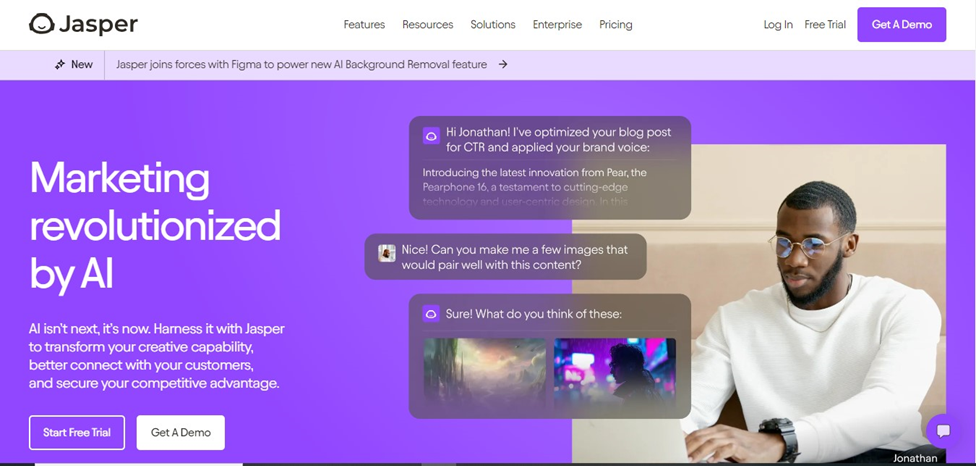
image 15

Jasper Review:

  • Score: 4.7/5
  • Number of reviews: 1,243

Jasper is beyond normal AI SEO and offers tools for the entire marketing lifecycle. It is often said to be the best AI writing tool on the market.

Jasper helps you manage your account and create content in collaboration with its different users in the same team. It also has multi-language support, integration with other apps, brand voice consistency, and more.

It has three pricing models. For the business suite, you will have to contact their sales team.team.

Copy AI

Pricing: Free/Paid
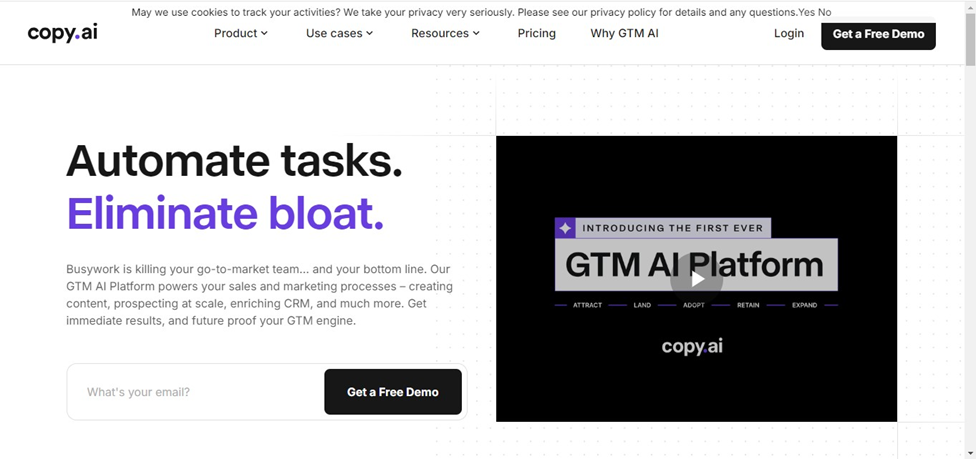
image 16

Copy AI Review:

  • Score: 4.7/5
  • Number of reviews: 179

G2 Review:

  • Score: 4.7/5
  • Number of reviews: 179

An all-in-one sales and marketing AI tool. Copy AI has been making waves as a go-to AI SEO tool.

Their GTM-based approach to sales and marketing allows teams to create strategies based on it and lets you collaborate with teams using AI. Copy.ai enables sales and marketing alignment with its use of AI solutions.

It helps the teams craft content that ranks, does keyword research, and long-form and short-form content based on customer insights.

There is a free forever model and two pricing models for this AI SEO tool.

Rytr

image 17

Pricing: Paid/Free G2 Review:

  • Score: 4.7/5
  • Number of reviews: 804

Rytr is not a dedicated AI SEO tool, it is used to write content and copies. It is very well received by people who use it.

It can be used to create content of high value for better user engagement. It will help your team boost content creation process, and extract value keywords from your competitors. It is a good tool for any marketing team. It is free and has two priced models.

Using AI in a changing world can be daunting, but it is why we must experiment with what we have and strategize accordingly.

Using AI has become the norm for most marketing teams. And they are cautious and optimistic about it.

There is growing evidence that AI will not take away creative jobs. Rather, we must enhance our creativity by learning to think in new ways.

And that can only happen through a force that does not think like us or has more freedom to create connective pathways. Use AI to find what it can do for you and what it cannot.

That will make all the difference in your strategic approach and your competitors. But do not make it your sole reliance. Humans are getting better at identifying completely AI-generated material, even when humanized.

FAQs

Can SEO be done by AI in 2025?

Currently, AI is performing basic SEO tasks. SEO reporting is one of them. Also, keyword tracking, basic on-page optimization, and website analysis will be automated. But, it wont fully replace SEO expertise in strategy creation, report creativity, and changing SEO methods according to trends. AI supports SEO, but human input is still essential for long-term success.

Is AI writing good for SEO?

No, AI writing can be a go to go outline for writer to write content quickly. But on the other hand, to ensure quality, engagement, and relevance, the subject experts need to be involved. At the end, human expertise is important to deliver relevancy, quality, and freshness.

Is AI a threat to SEO in 2025?

AI is not necessarily a threat to SEO, but it will change the approach how SEO was being executed.
It still requires human oversight for strategy and creativity but here the basic SEO involvement will be gone. Every AI tool is a thread for those tasks that follow limited rules.

Data-hygiene

Data Hygiene: 5 Best Practices

Data Hygiene: 5 Best Practices

Outdated, missing, or incorrect data can adversely impact customer experience. How can data hygiene streamline information and accelerate engagement?

Data forms the core of every business. Any gaps in it can hinder effective communication with the target audience. That’s why, all information needs to be accurate and error-free. Hygiene in data makes it possible for brands to seamlessly manage all critical information. When integrated with automation, it can swiftly improve customer experience and brand productivity.

For data hygiene, you need to focus on two types of data: dirty and clean. Dirty data refers to the information that piles up, duplicates, and eventually has no use. If most of your data is outdated and tough to access, it indicates that it’s time to implement a cleaning process. Dirty data can cost around $3 trillion per year in the US. The hygiene process must be implemented to maintain data quality. Clean data is clear, concise, and easy to access, increasing performance efficiency.

We have prepared a list of best practices to help you manage and maintain a clean business database.

How to implement Successful Data Hygiene

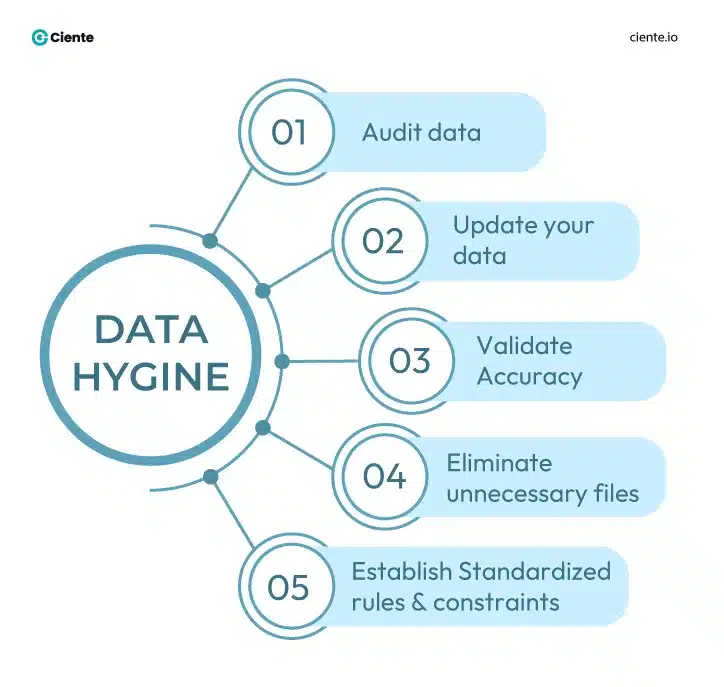
These 5 steps will enable you to minimize inaccurate information and maintain your brand’s integrity and reputation. Let’s dive in.

Data Hygiene

Audit data

As a B2B brand, your teams have most likely collated data from multiple sources, which can pool into siloes. And when this happens, the data is difficult to identify and may become prone to errors. Nearly 27% of business leaders have reported being unsure of their data accuracy. An audit helps to keep things in check and store high-quality data.

This step provides a clear overview of the brand’s database and finds gaps, if any.  It involves identifying data fields critical for integration and monitoring the quality and completeness of each field. With data audit, you can easily identify consistencies, duplicates, missing values, and outdated information. Since manual audits can be time-consuming and tedious, automating data hygiene can go a long way.

Eliminate unnecessary files

Brands deal with so much data daily that unnecessary records may pile up. Excess data can produce clutter if not managed properly. And when you have irrelevant information, it becomes cumbersome to analyze and audit the infrastructure. This can be avoided by conducting a periodic review of your data. Removing outdated information would streamline your customer database and make it concise.

Validate Accuracy

Data accuracy is an essential element that promotes customer satisfaction. You can ensure accuracy by incorporating validation rules that verify data integrity and adhere to predefined criteria. Validate email addresses, phone numbers, and postal codes to double-check if they are in the correct format. If you run a data check regularly, you can avoid messy and fragmented information, transforming it into accurate and unified records.

Establish Standardized rules & constraints.

When standardization is not regulated, it may lead to the piling of dirty data. Studies indicate that around 60% of dirty data is due to human error, and you can reduce these instances with automated data hygiene. Standardization can take you a long way in preventing dirty data. All you need to do is look into the input fields. Simply put, all numbers and monetary values require standardization. And there should be no case sensitivity, spelling errors, or abbreviations. Data standardization and consistency are crucial elements in creating uniform databases. Applying rules and standards filters out unnecessary information while delivering brand consistency.

Update your data

Data, if not maintained, can become outdated, which makes it frustrating to sort through. Your prospects may change addresses, get new designations, or change jobs altogether. Studies suggest that nearly 21%of CEOs change every year. You may be surprised to know how fast data can decay —at the rate of 70% per year. If the data is not updated, you may deliver messages to the wrong contact. Updating your customer database in real-time with data hygiene prevents your teams from chasing dead-end leads and helps build strong relationships with prospects. Since you cannot predict when data will go outdated, opt for an automated data cleaning tool.

Final thoughts

Data is an asset for your business. Without a concrete strategy in place, it can create inconsistencies/errors, and require investment of resources to get it in order. These practices will build a solid foundation for data accuracy and reliability. The best bet is to be proactive about data hygiene, ensuring that all information entering a system is accurate, reliable, and comprehensive. It allows efficient integration of data in your system. Keeping your company database clean and compliant with regulations minimizes your chance of poor data.

AI,-Marketing-and-why-content-strategy-cannot-be-automated-(website)

Why content strategy cannot be automated.

Why content strategy cannot be automated.

AI and automation have created tension. Jobs are under the threat of being replaced, and our intrinsic value is at risk. But is that true?

f

Everyone has been afraid of AI disrupting their survival. One industry at the forefront of this onslaught is marketing or, rather, content marketing.

Creatives in the field are terrified and excited about what this technology will do. Will it transform how we consume content and deliver it to the user?

But let us present a hopeful future—one that shows that AI cannot replace the value of creativity.

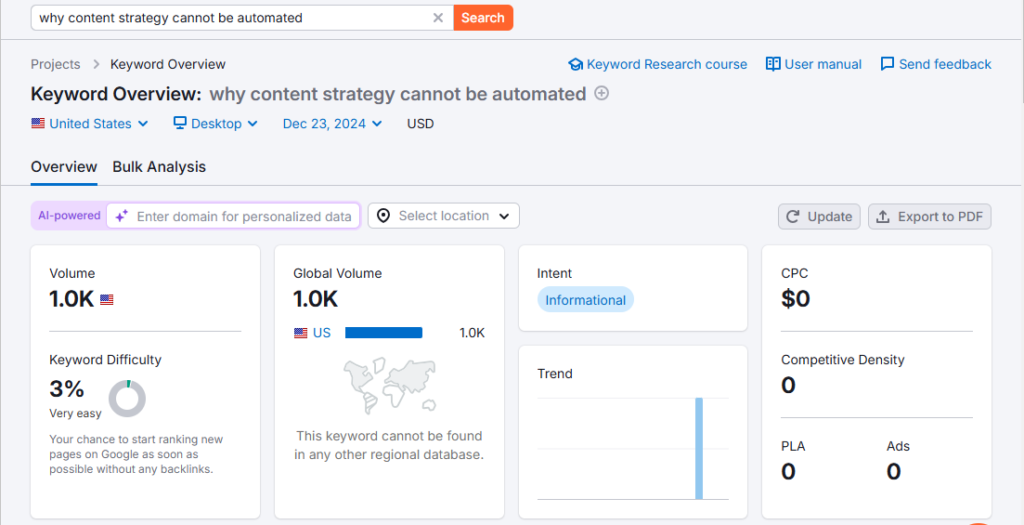
Look at the screenshot above—we call it a gem. It was found through human experience. While the search volume and KD ratio can be automated, finding the keyword that might attract the right audience needs lived experience.

Marketing, especially SEO, is full of these gems. It can be found by understanding that people of all backgrounds are curious about topics, especially ones that intrigue or scare them.

Human beings want to know the answers immediately and are equipped with an encyclopedia in their pockets to answer queries, doubts, or fears, usually in the form of content.

We look for answers in the stories of others, hoping one would match our circumstances and provide an answer.

The answer to end uncertainty.

AI and Content Marketing

HBR wrote a piece on the three priorities of a CMO. In it, they declare that the principal role of a CMO has always been to be a great storyteller.

We can say it is a fact.

Great marketing is born out of stories. In technical terms, it is positioning yourself.

What perspective are you bringing, and what value does it provide? The CMO then directs their team to work towards that single goal. Sure, there are pivots along the way. Maybe a campaign does not meet its goal, or there are not enough qualified leads, but the story continues in a new iteration. Perhaps it’s rewritten.

But for a CMO— talented individuals who bring their vision to life is vital. Yet, they are still human and prone to errors. Writers may take time to write the content, or designers may create designs that are not on-brand. Maybe someone important on your team is on maternity leave.

Everyday problems disrupt businesses. After all, we are not machines that can work 24/7.

But now, there is one that can! AI.

It can write content that is informational, helpful, and in-depth— depending on the prompt, of course.

It can tell an expert story for you. Sounds great. Though, there is one hiccup.

The content will no longer be that of someone with similar experiences. Why? Because, as far as we know, the intelligent machine does not have any experience.

Content quality and promptsimage 2 1image 2

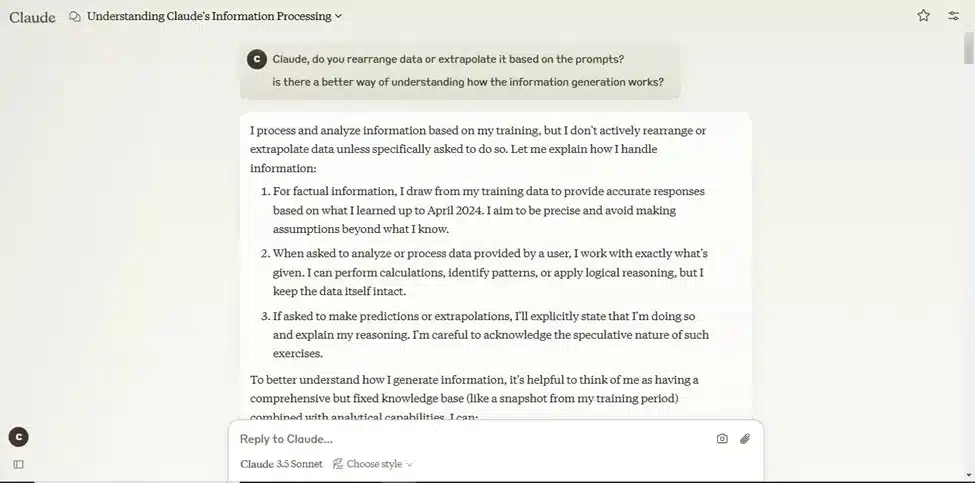
This conversation with Anthropic’s Claude reveals something profound. And for now, this is the definite way of how AI works.

They provide a reflection for the questions you ask. What you input will be the output, and everything that follows will be a refinement of your thought processes. To get something unique out of the AI systems, you will need to spend time and dig deeper into your own experiences to ask the right questions.

AI is the extension of all accumulated human knowledge. It is the natural evolution of our desire to inquire and reflect on the answers provided to us.

The type of content you produce will depend on the accuracy of your prompts and the subject matters involved. If the process were fully automatic, there is a chance AI could hallucinate the information and feed an incorrect story to your prospects.

That’s why AI machines can be prompt hacked. They cannot be perfect because the data they are trained on is inherently biased.

Marketing Teams and the lived experience

With strategies like demand generation and brand awareness campaigns, marketing teams stir the natural curiosity of the human mind. The prospect is identified, and their pain points are tackled.

But we are quickly hitting a saturation point. Products, solutions, and the content surrounding it have surpassed the limits of production. Ahref reports 96.55% of content does not get traffic from Google.

Imagine, that is almost millions of pages. A lot of good businesses with good content probably fall under that spectrum. Why is that? It is because the whole of the web is inundated with outdated content, and now we have AI-made content in the mix. Marketing messages are just not working as effectively as they used to.

However, there is one thing that works like no other: Out-of-the-box-thinking.

Every successful campaign follows this. Either it simplifies things or creates a novel way of experiencing. These are created through understanding the present condition of the market, by relating to the pain points of the target segment, and by providing an experience that delights them and makes them feel understood. Automated systems cannot do that.

But your teams can. They can craft strategies that are in relation to prospects’ life experiences.

You can create ICPs based on data that AI can analyze and create content around, but actual understanding needs a lived experience.

Why content strategy cannot be automated.

Strategy sounds elusive. Because it is not planning, it is trying to create an intended outcome by hypothesizing the needs of the market. And yet, marketing teams and business leaders know that strategy is what brings success.

It offers tangible outcomes in uncertainty. However, there are a lot of inherent risks in playing a strategy.

  1. It might fail
  2. There will be a monetary loss
  3. Time invested in the strategy will go to waste.

Money and time cannot be recovered when it is gone. Competition will not wait for your strategies to succeed, and failure can threaten your position in the market. These are real concerns that leaders have to gripe through.

So, it becomes easier to rely on AI that is perceived as more concrete. Think about it— automated systems make fewer errors. Machines are tight-bound by laws and rules that human beings are not. The question, then, is: Why not automate strategies and make them definite?

Strategic Choices for Certainty

Roger Martin, one of the most prominent business strategists alive today, says that there are five choices a business must undertake to ensure strategic success. It is called the Strategy Choice Cascade.

They are: –

  1. What is our winning aspiration?
  2. Where will we play?
  3. How will we win where we have chosen to play?
  4. What capabilities must be in place to win?
  5. What management systems are required to ensure the capabilities are in place?

If this is all it takes, an AI system created solely for this task might use this logic and craft strategies—content marketing and business— for wild profits. It might even generate something novel and creative. Viola, there’s success.

Strategy is strangely human.

But as we know, AI and automation are based on rules and logic. It does not account for the changing dynamics of human behavior. Our models have trouble predicting long-term behaviors—we cannot even accurately predict weather beyond 10 days.

That’s because our models are incomplete for analyzing small details imperceptible to them. They are created by people, and we cannot account for everything. Changes happen on a minute scale, and they cascade rapidly, making it difficult to predict the future.

You must use these methods, data sets, and tools to enhance human intuition. For some reason, strategy is strangely human.

There is one trait common among good leaders: An imperceptible eye or “good taste”. Successful CMOs have developed an instinct for what resonates with their market because they have in-depth knowledge of their audiences and buyers.

The CMO, marketer, and writer who understands this will craft a creative content strategy that resonates with its intended audience. And that is how successful brands thrive.

We call it intuition, but it is pattern recognition that happens quickly and without thought. It follows the same logic as understanding what your spouse or friend will like as a gift.

This accumulated pattern recognition is not happening through mathematic models, and for now, it cannot be automated by a machine. Strategy is finding relatable experiences and bringing them to a market segment that will appreciate them.

Content strategy automation is unlikely because…

There are two examples that illustrate why content strategies cannot be automated. Do you remember the above screenshot? It was found through searching for a topic.

Our team found it while discovering topics for our newsletter. It came through discovery and a deep understanding of our SEO team’s understanding of our core audience’s needs. Through this, we can find such gems.

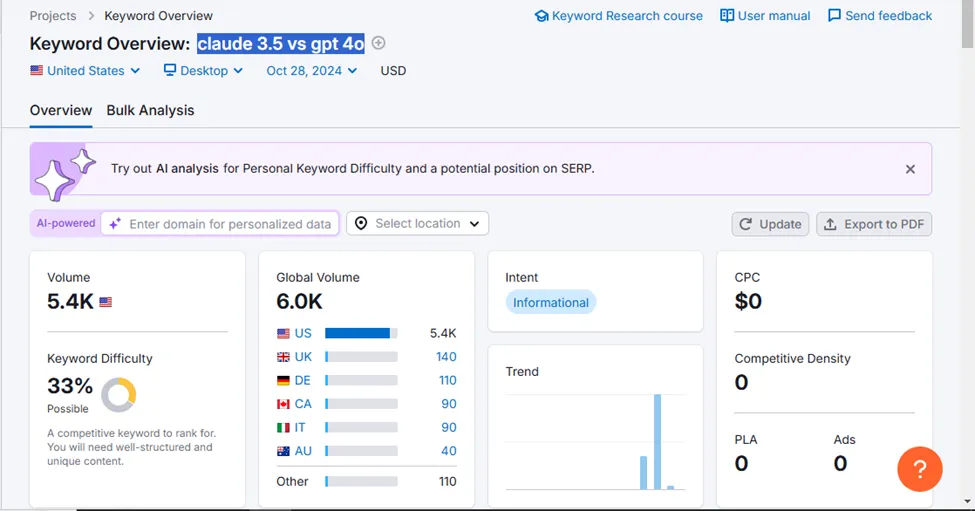
Another is this that we found by capitalizing on trends.

This is another gem. The keyword Claude 3.5 V.S. GPT 4o is relevant and has a low KD of 33%. Making it possible for teams to talk about a relevant and timeless topic (Machine vs Machine), helping brands rank. Through such unique activities, we were able to find and create strategies that helped us identify keywords to rank for.

This process of discovery is difficult for a machine to do because it cannot, as of yet, self-direct itself and self-reflect.

Two metrics of effective content creation that urge its readers and move them.

Now, Let us talk about the second one.

Staying on trend is essential.

Sensory marketing is picking up steam. It is essentially the ability to make your potential buyers feel the product or what it does. The above post is one of the hundreds that talk about a makeup brand called Rhode by Hailey Bieber.

This example may seem very B2C or better for tangible products. But it can be used in B2B contexts. Through design, teams can give the illusion of software tangibility.

The question is: How can you and your teams leverage your unique propositions to create this new experience? And what will be the context for it?

Automating your content strategy might be an option. But it is not the correct one.

Content marketing will always be about conversations and relationships with the ideal buyer. They will need their risks mitigated and experiences validated.

Marketing teams, through ingenuity, must show them that you understand the value of their problem and have a solution. The strategy you take differentiates you from the competition.

But as AI becomes accessible and you rely on the same tools as your competition, you will need free-thinkers and creatives who think in novel ways and create experiences. CMOs are asked to do less with more and operate on a lean model. Stakeholders and C-exes must ensure that the CMO is free to tell the story of your product.

Automation and AI are an extension of your teams’ creativity, but they must not be conflated with the certainty you seek.


How-you-can-leverage-Email-Cadence-for-Acing-Campaigns-(website)

How you can leverage Email Cadence for Acing Campaigns

How you can leverage Email Cadence for Acing Campaigns

Delivering emails at the right time can make a huge difference in customer engagement. But how do you strategize the best scheduling?

Building strong relationships with customers can greatly determine a brand’s identity among the target audience. To achieve this goal, companies often launch email campaigns. Studies indicate that most marketers send around  2-3 emails daily. However, it is unlikely that every email will be read entirely. And that’s why it is important to add an element of personalization.  

Creating personalized messages helps prospects related to your brand understand your brand’s expertise. These emails also enable companies to nurture leads and enhance engagement. The impact rate of emails gets further amplified with an effective call-to-action. It should be effective enough to convince them to take the next step outlined in the objective.

There’s another factor that determines the success of email campaigns— cadence. It’s all about timing emails accurately to give the desired results. Zeroing in on email cadence streamlines the scheduling, enabling businesses to send emails at specific touchpoints in the buyer’s journey. Campaign Monitor highlighted that delivering emails as per a consistent cadence, say weekly or bi-weekly, allows brands to experience higher open rates. This is because recipients know when to expect emails, leading to better engagement.

You can perceive email cadence as a component that can determine the outcome of a campaign. Sending the right emails to the right target audience helps you achieve more mileage from your campaign.

Why brands must consider integrating email cadence

Email cadence finds the ideal email delivery times and sending frequency to satisfy the subscribers and maximize engagement. By optimizing email cadence and reaching out to subscribers, brands can run a successful marketing campaign that generates the desired results.

Determining email frequency is possible when you consider factors, such as business goals and what the subscribers prefer. How frequently the target audience wants to receive emails will depend on their preferences. For instance, you can send emails daily to some customers, whereas others may prefer one email every week. After investing the time and effort to build a subscriber list, you don’t want to see that list shrink because of sending too many or too few emails. Finding the best email cadence will build a strong relationship with customers.

Think of email cadence as a roadmap that transports your buyers from point A to B. The ultimate goal is to dictate the best strategy for an email cadence. Being too intrusive or directionless could make you lose opportunities to guide leads along their buyer’s journey. And overwhelming prospective customers with promotions and newsletters may result in a low email open rate.

The time at which brands send emails helps retain existing subscribers. Paying attention to the trends of your subscribers and adjusting your strategy from time to time will play a significant role in your campaign’s performance.

Practices that will take your Email Cadence to the Next Level

Designing different engagement models for your email campaigns will cultivate trust between you and the audience. 60% of subscribers listed the frequency of emails as a major deciding factor to unsubscribe. These steps will pave the way for effective cadence.

Define your Goals

Before designing a cadence plan for your email campaign, brands need to be clear about the goal-setting. Brainstorm with your team and identify what you are trying to accomplish with your email campaign. Is it sales, brand identity, or something else?

By understanding the goals, brands can create an email cadence that will help craft the perfect strategy for cadence. For instance, if you want to get more traffic to the site, you need to plan a cadence that supports this goal. Without a pre-defined goal, your email cadence will become haphazard. And it will seem like emails are being sent aimlessly, without a specific purpose. But once you have a clear target ahead of you, you can tailor the content and cadence of your marketing emails.

Understand your Customers

Email cadence gives your messaging the power to resonate with your customers, which calls for crafting emails that your customers find relevant. And what better way to figure it out than understanding your buyer’s journey? When you look into their purchase history, you know how they evaluate, what they consider, and what makes them arrive at a purchase decision.  The content of your message will vary with the stage of a buyer’s journey, which will increase the chances of your customers resonating with your brand.

Personalize your Emails

Your customers will not connect with emails that seem generic. Personalized messages will enable them to resonate with your brand. So, you need to prioritize your customers and design the email layout accordingly. The number of clicks emails receive and how much or how soon prospects move through their buyer’s journey will decide the success of a cadence. Personalization will speak differently to every recipient, and you can accomplish this by making small changes in your approach. It will improve the email open rates, having a positive impact on your cadence.

Find the Right Frequency for Your Brand

There is no hard and fast rule for the frequency of emails. The scheduling will vary depending on your brand and the buyer’s journey. Although it may take some time for you to decide how often you need to send out emails, analyzing averages will give you a good idea. Email frequency is not a science, but you can perfect it after some trial and error before figuring out what works best for you.

Offer flexibility to your Subscribers

Old or new, your subscribers must get the flexibility to set their email frequency. You can include a link at the end of your emails, which allows them to change their preference. But to avoid this, strategize and try not to overwhelm your customers.

Segment Your Audience

One of the best things about email marketing is it enables you to identify different types of audiences. When it comes to cadence, the preference will vary with the audience. While some may like weekly emails, others may feel overwhelmed by this frequency. With segmentation, you can control the cadence and maintain it as per the preference of each segment. Segmenting your audience helps you break the smaller groups having shared interests, preferences, and behavioral patterns. Use segmentation in your email marketing campaigns to send targeted messages that align with individual segments.

Collect Feedback

While working around email cadence campaigns, keep an eye on the results it’s giving you. Are your prospects engaging or taking action? The same goes for customers who have stopped engaging with your brand. Brands ought to continue collecting feedback because there’s always room for improvement.

Perform a test run

Cadence is powerful for structuring your email. But even though it’s a great tool, it is still a framework that requires perfection. And that is possible only after a series of trials and errors.  

Wrapping up

Email campaigns offer a great platform to build relationships with your customers. But the timing and relevance are of prime importance. It is detrimental to whether or not your audience wants to continue your subscription. Email cadence helps you strategize the timing and frequency of sending emails at the right time to relevant customers. When you take this route, it improves email open rates and drives conversations with customers. Strategizing the cadence of your campaigns is sure to empower customer engagement along with brand identity.

demand vs lead generation

Demand Generation and Lead generation – same or different?

Demand Generation and Lead generation – same or different?

Are demand generation and lead generation the same?

The answer is no!! Their differences are just as evident as between alligators and crocodiles.

Yes, you read it right. While both the reptiles appear similar, a closer look reveals stark differences: crocodiles have V-shaped snouts whereas alligators have U-shaped snouts.

The same is true for lead generation vs demand generation. Both practices generate leads, however, demand generation is involved in the initial stages. It raises brand awareness among a wider audience helping generate leads from a diverse group of potential customers, whereas lead generation comes into play later. This strategy targets brand aware prospects and leads them down the sales funnel to convert.

Lead generation thrives when demand generation does its work precisely. Demand generation is similar to a brand ambassador subtly promoting varied services and products. It creates the need for the product by showing how it could resolve a specific challenge.

A quote by Brian Tracy, a Canadian-American motivational speaker, perfectly fits the context here:

“Approach each customer with the idea of helping him or her solve a problem or achieve a goal, not of selling a product or service.”

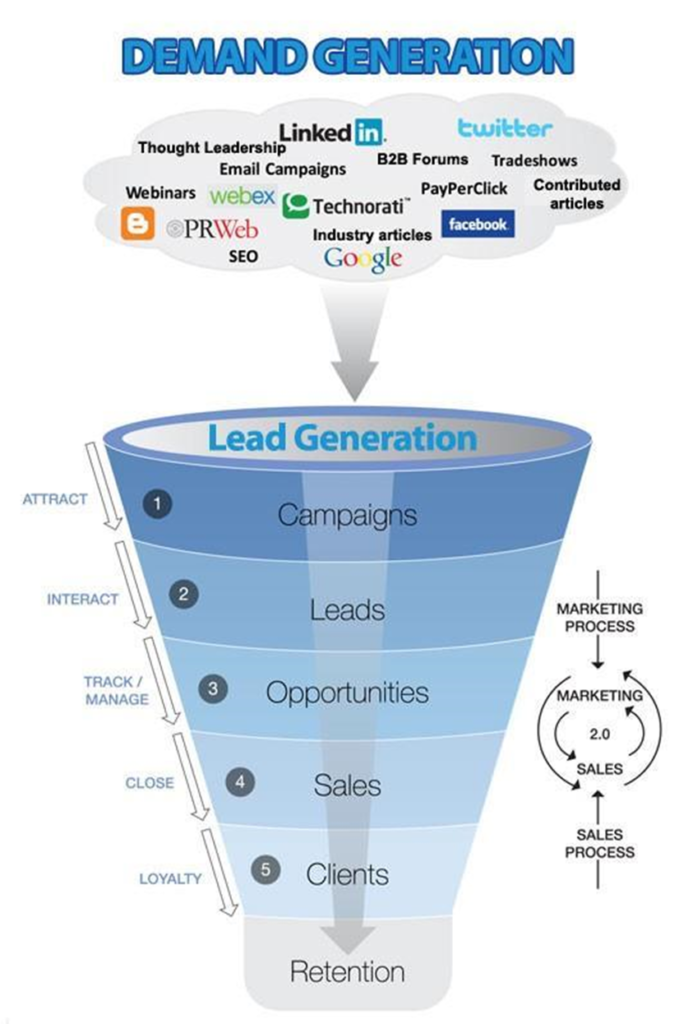
Lead generation takes over the role of facilitator that gets the best leads down the sales funnel.  Find the image below for a better understanding:

demand generation funnel

Source: brandalyzer.blog

So, can you understand this funnel? If not, let’s delve deeper. At the top, you can see how demand generation works. Marketers reach audiences on different social media platforms and through email marketing campaigns, leveraging B2B data for precision targeting. Inside the funnel, leads have to go through varied stages: attract, interact, track/manage, close, and loyalty. The stages are self-explanatory. In the first stage, you need to attract leads. These leads are no longer strangers, they’re now aware of your brand. So, they would interact freely with your rep’ which is done in the second stage.

In B2B selling, you need to maintain specific standards and avoid pestering customers to make a purchase. Instead, focus on being patient while tracking and managing (nurturing relationships) in the third stage of the process. Finally in the fourth stage focus on closing deals and fostering customer loyalty.

Which one is Better Demand Generation vs Lead Generation?

The answer is there is no winner or loser here!!

They are two sides of the same coin. The difference between lead generation and demand generation is clear, they work together to achieve business objectives. It’s you (as a marketer) who has to determine howto use these practices effectively, therefore doubling the profit of the organization.

If you want to gain in-depth knowledge on this subject, you’re at the right place. You’d learn the nitty-gritty of demand generation and lead generation and further have a competitive advantage.

What is Demand Generation?

Demand generation is a marketing strategy aimed at creating awareness and interest in a company’s products or services. It involves various tactics like content marketing, social media, and paid advertising to attract potential customers and nurture leads.

Assume you’re working in a startup. And your targeted customers aren’t aware of your product/service. So, how do you reach them? Here demand generation comes into the picture.

You adopt different practices (demand generation practices) to ensure prospects notice your product and further connect with you. Marketers seek visibility and brand recall (remembering your brand whenever prospects see your logo, color combination, or specific letters and others). It’s not enough to show that you exist, you need a serious effort to create a strong impact and pull customers to your brand.

For large enterprises this isn’t challenging as they have passed this test long back. Start-ups and small businesses need to go through the same path to create demand among prospects. With various practices, marketers build a strong sales pipeline with the sales team.

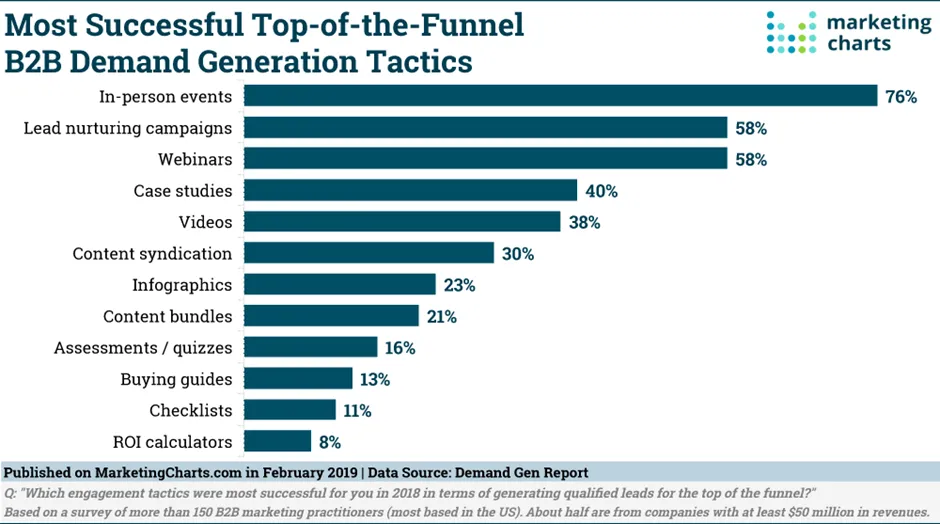
 In the below image you can see various B2B demand generation tactics:

semrush 5

As you can see here, some of the successful B2B demand generation tactics have been in-person events (76%), lead nurturing campaigns (58%), webinars (58%), case studies (40%), videos (38%), and so on.

Marketers in a start-up could reach prospects through in-person events-one of the best practices derived from old-school thoughts and still effective. Prospects interacting in-person are bound to remember your brand. But is it that simple? Yes, it is. It is human nature to remember incidents and events that give them different experiences. And an in-person event where you physically meet the prospects makes that impact.

Lead nurturing campaigns are next-level campaigns where you subtly push the prospect down the sales funnel through the right communication and nurturing practices. B2B companies need to follow this pattern as they can’t just push their product to customers. They need to make the customer believe (win trust) that the product would resolve business challenges and yield profit. This is necessary as B2B deals are high-end deals and no customer would invest without having absolute knowledge of the product/service.

Demand Generation Case study:

Now we’d analyze a case study of Digipart Limited, an electronics parts supplier company, based out of Norway and with headquarters in the USA. The organization was looking to meet the demands of customized machine parts in different parts of the USA. They were using different tactics to bring qualified traffic but no luck.

Later, they took the help of a demand generation agency and the results were as good as expected. The agency offered solutions such as paid search strategies and integrated the demographics of audiences. This was aimed to attract the relevant audience through relevant searches.

Demand Generation Case study Results:

The results were truly impressive with an 8x conversion rate, a 300% increase in ROI, and a 30+ increase in click-through rate.

View the complete case study

As a company that was looking to reach an audience in the USA, this is a remarkable achievement. It shows with the right guidance; you can connect with the right audience across varied regions and countries worldwide.

What Is Lead Generation?

As discussed, this practice involves moving brand aware prospects down the funnel from a pool of leads created by demand generation.

It’s skimming out the non-real leads (they’re the window shoppers or regular crowd) from real prospects (who intend to buy if not now but, in the future,). The skimmed-out leads are then moved to the sales team (with contact details) who further interact to understand the mindset of leads. With that, they could plan their next move and convert these leads into customers.

Now, which companies need lead generation practices more often?

It’s a fact that large companies face challenges in generating leads. As these companies have a stronghold in the market, they might have it easier than some small companies or start-ups. But they still have their share of struggle which lead generation practices help ease. Most large enterprises and multinational organizations adopt lead generation practices rather than demand generation practices as they don’t have to spread awareness about their product or arouse interest in their services.

These lead generation practices are integrated for a sole purpose- sales and revenue.

Lead Generation Case study:

This is a case study of ThinSlim Foods, a business that witnessed impressive growth rates of 100-150%. It was a steady growth that not many businesses could achieve in a few years. Their advertising strategy was also showing remarkable results with accounts that were generating almost $70-$80K in a month.

So, everything looks fine or what we believe. Companies must avoid stagnation or they risk becoming obsolete (this was the challenge).

Now, what is the company here looking for? They were aiming for ROAS (Return on ad spend) which basically implies a willingness to receive a good return on every investment in advertising. The organization took the help of a leading digital marketing agency for the right advice.

Lead Generation Case study Results:

The results were really impressive. With the right advertising strategy, ThinSlim Foods had a good (95%) impression share for the clients.

Check out full case study

And it didn’t stop there, dynamic product ads had a nearly 200% increase in the rate of conversions. This case study just shows that marketers should never settle for less, you never know with improved strategies and implementation, you could achieve enviable results.

What are Common Strategies Followed by Both Lead Generation & Demand Generation?

Some of the most effective strategies followed by both lead generation and demand generation are as follows:

Drip Campaigns:

What are drip campaigns?

Drip campaigns are email campaigns that send out targeted messages at scheduled intervals. They’re essential for nurturing prospects by reaching them at the right moment.

By leveraging latest email marketing insights & stats, marketers can fine-tune these campaigns to hit optimal open and click-through rates based on customer behavior patterns.

Additionally it helps to know when the prospect is most likely to buy such as buying during a specific time of year, or after budget allocation leads to a successful drip campaign. It is automated so that you don’t miss out on sending emails and losing opportunities.

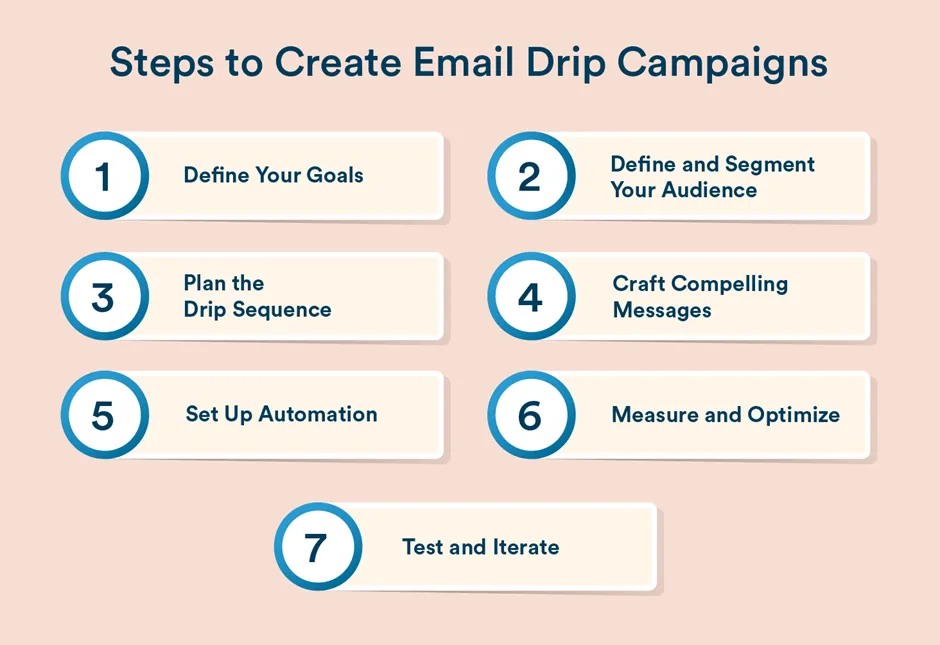
Below is the pictorial representation to plan for a successful drip campaign:

Source: clevertap.com

In this image, you can see the first step starts by defining the goals, followed by defining and segmenting the audience. The segmentation is done based on different criteria such as industry, region, requirements, and so on.

How is the drip sequence executed?

Drip sequence means sending specific emails on a monthly, or weekly basis to have meaningful interaction (this could be by triggered event/action). It helps maintain relationships for a longer period. And with that, you need to craft compelling messages, a simple message won’t get noticed easily.

After that, you need to set up automation that automatically sends out emails (you need not memorize every date and detail to send out in emails). Finally, you could measure and optimize the campaign through testing and iteration.

The drip campaigns are mostly used in lead generation tactics, whereas they can be also used in demand generation strategy to arouse interest among the audience.

2. Content Marketing:

Content marketing helps maintain relationships, and guides prospects with the usage of a product/service, further resolving the business challenges of the prospect.

So, isn’t this useful in lead generation? Of course, it is…

And how does content marketing help demand generation?

As the demand generation strategy (through content marketing) disseminates product information and solutions to business challenges, the prospects are motivated to know more. This is why marketers pay strong attention to this marketing form. The only motive is to make a strong impact on the above-the- funnel stage (demand generation stage) to make the process easier later.

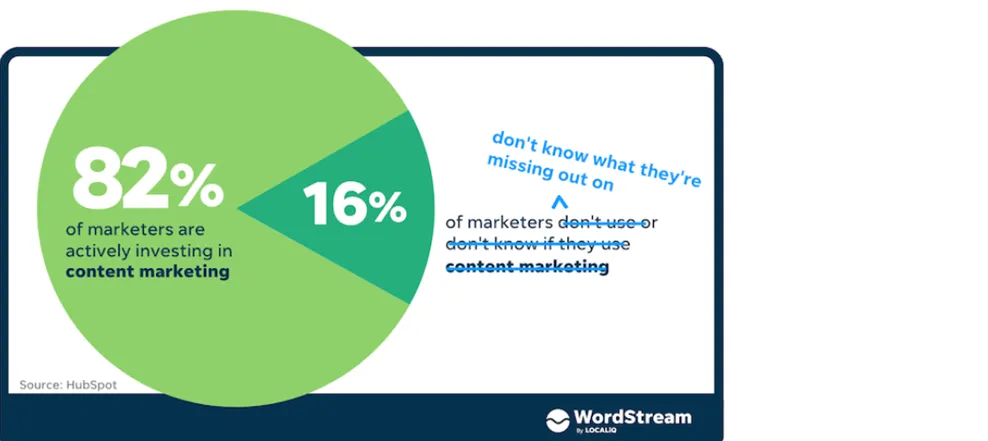
Find the below pie-chart to understand the importance of content marketing strategy:

Source: wordstream

In this chart, you can see almost 82% of marketers are investing in content marketing strategy, whereas 16% of marketers aren’t aware of what they’re missing out on.

3. Social Media:

Last but not least, social media marketing strategy is used in both lead generation and demand generation practices. The tactics used here connect with qualified leads (who are converted within a reduced sales cycle).

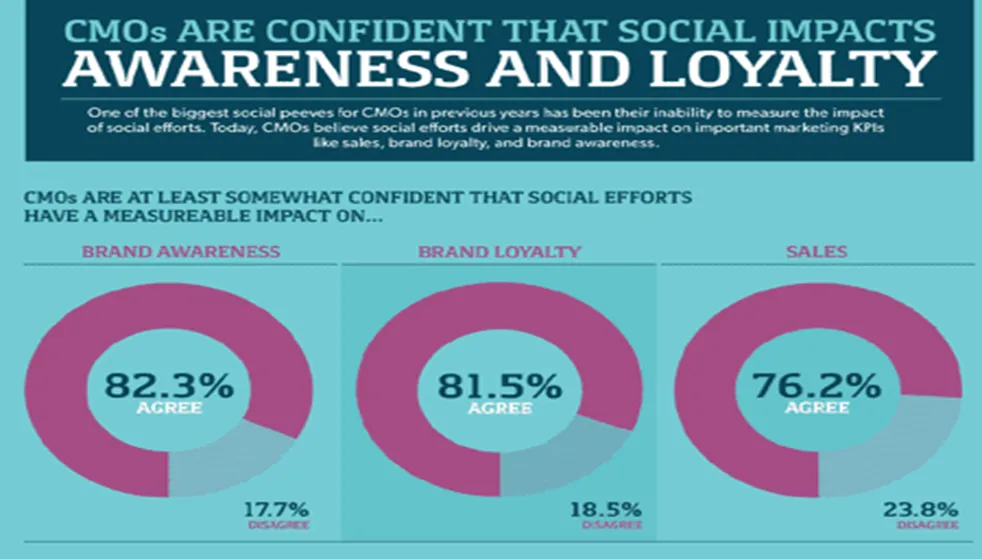
Find the below image:

semrush 6

Source: directiveconsulting.com

In this image, you can see that CMOs are confident of social media impact; they are brand awareness (82.3%), brand loyalty (81.5%), and sales (76.2%). Demand generation practices outreach prospects on LinkedIn, Facebook, and others across the world. These prospects often see the product’s content regularly giving them sufficient information to recall. The result- they’d approach when they need the product.

Lead generation practices are more aggressive in this context. The content is informative and stimulative, further motivating the prospect to take action.

What Organizations Want from Lead Generation?

Undoubtedly, organizations want to achieve these objectives:

1) Increasing The Number of Convertible Leads:

A good lead number isn’t enough if 90% of it isn’t converting. Not a good sign, right?

Lead generation plays a significant role in filtering out these leads and allowing mostly convertible leads. It just accelerates the deal closure and subsequently the revenue. Additionally, saves time for sales reps’ who would have wasted time chasing non-convertible leads.

2) Increasing Deal Size:

Now a good number of deal closures is necessary, but you should also have closures with larger deal sizes. As revenue generation increases, so would the profit. In a competitive market, a high-end customer just gives the boost that you need to stay relevant in the market. A good lead generation tactic helps attract high-end customers.

3) Improving the Loyalty Among Customers:

As customers have many options to choose from, marketers need to be on their toes to retain customers. They need to understand what’s going on in the customer’s minds? Are they satisfied with the product? What are the odds they would go for other brands in the near future? And so on. Further, marketers can use the right tactic to retain customers when they have answers to these questions.

 Lead generation practices such as nurturing, maintaining relationships, and others help improve loyalty.

4) Brand Advocacy:

Good leads most likely get converted and further, they refer your brand to their families, friends, and others. It helps increase the conversions as these leads now could witness good reviews about the product from varied sources- websites, and word-of-mouth marketing from customers familiar to them.

As a marketer, you’re lucky if your existing customer does promotion of your product free of cost (you’d have invested time, money, and other resources and yet might not get the desired results).

5) Better Understanding of Targeted Market:

With good leads entering the funnel, you now have an in-depth understanding of the market (how it works, how you can use your USP to target this market and others). Marketers receive valuable insights into improvising their lead generation tactics.

Instances such as prospects backing off from buying products, or customers ditching their old preferences are real…

As a marketer, you can’t afford to lose prospects or customers at such a critical stage. So, better be prepared than feel sorry later. You could do this by having personal(one-to-one) interaction with your customer or prospect. Customers will love this approach if you do it professionally and empathetically through nurturing campaigns (lead generation).

What do organizations want from demand generation?

A) Making Customers Aware of Presence:

Bitter truth- Customers won’t buy your services if they don’t know your brand!

Demand generation plays a crucial role in showcasing the USP of a product to a broader audience. It makes the organization stand out in the global market.

In fact, many leads will make the decision in the first interaction. So, demand generation practices need to be effective.

B) Building a Regular Pipeline:

Without a steady pipeline, you can’t have a quality customer base. The demand generation practices maintain this flow to the pipeline by reaching new and niche markets. The practices are aimed at making an everlasting impression on customer’s minds. 

C) Identifying Customer Needs:

When you interact with a larger audience, you get better insights into their needs. It’s important to remember that an organization develops products to resolve customers’ business challenges. If challenges aren’t resolved, there will be no new customers. By identifying the gaps, you can fix the features to meet customers’ requirements.

Conclusion:

Demand generation and lead generation work together to create a seamless process. They stabilize the company and provide a continuous flow of leads.

In this blog, we explored what exactly these terms are, and how you could use the right tactics to make the best use of these practices. 

Why You Must Consider Outsourced Lead Generation

Outsourced Lead Generation Benefits

Outsourced Lead Generation Benefits

Struggling to meet your lead gen targets? Outsource experts to manage this for your brand and experience a drastic shift

Brands launch various campaigns and initiatives with the hope of garnering target accounts. Studies indicate that brands succeeding in lead nurturing can generate 50% more sales-ready leads at a 33% lower cost! These numbers highlight the significance of effective lead-gen strategies highlighting their role in accelerating brand growth.

But what if you are juggling with too many projects at the same time? Outsourcing lead gen experts is your best bet.

Investing in lead generation is a stepping stone to help you enhance your team’s sales performance and the brand’s market presence. One of the main roadblocks you may come across with an in-house outreach program is resource availability. The foundation of an impactful lead generation strategy is strong communication with the right audience at the right time. To be able to do so, brands need to assimilate the correct contacts and data, resources that will be a game-changer for lead gen.

Outsourced Lead Generation Benefits

While there are several benefits to having a robust framework for leads in place, outsourcing expertise is a reliable approach, especially if you lack the bandwidth &/or resources to accomplish this objective. These tell-tale benefits may clear your confusion and help understand the significance of incorporating outsourced lead gen.

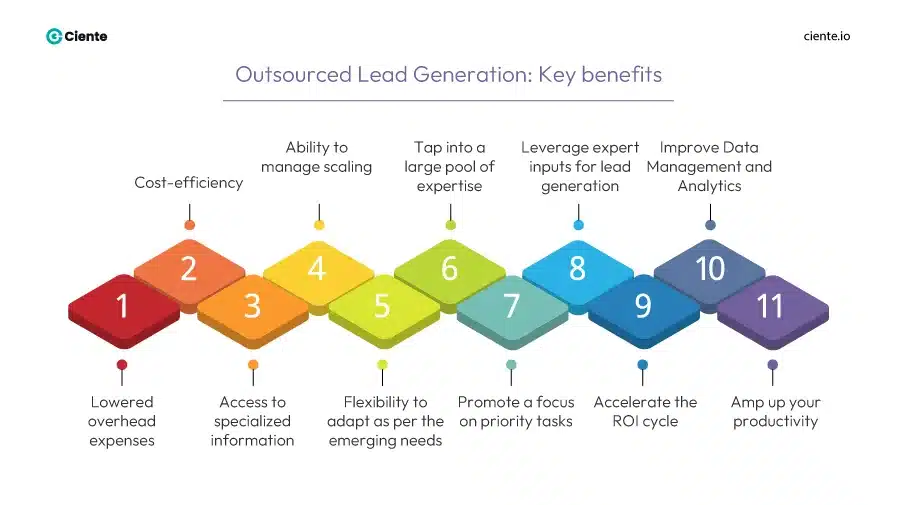
Outsourced Lead Generation: Key benefits

Lowered overhead expenses

When you outsource lead generation, you can save expenses spent on the overhead prices. Maintaining an in-house lead gen team can involve resources, space, equipment, and employee benefits, all of which you probably don’t have the budget for. Partnering with an outsourcing provider or agency is a smart step for eliminating these costs while delivering effective campaigns. In this way, brands can strategically allocate resources in the right niches.

Cost-efficiency

Outsourcing your lead generation into a reputable company removes the stress of chasing leads, meeting targets, and nurturing prospects. A good lead gen organization typically comprises a team of experts well aware of the nitty-gritty to generate high-quality leads. They have the resources and the capability to draw quality prospects that are likely to convert into paying accounts. This allows you to focus on other aspects of your business that need your attention. It’s a big time-saver without hampering your lead gen campaign.

Access to specialized information

Outsourced lead gen providers offer a rich resource of information in this domain, from staying tuned to the industry traits to effective tactics. When you leverage the know-how, you increase the lead conversion prices and in the long run, drive commercial enterprise increases. Working with a lead gen provider frees up your resources so that you can invest in other core elements of the brand.

Ability to manage scaling  

Providers of outsourcing lead gen scales efforts, quickly amping up assets and altering techniques as and when needed. While generating a large volume of leads, outsourcing helps scale into the right client base. It focuses on the core strengths and helps improve the overall performance while increasing your client network. One of the core benefits of working with a team of professionals is amplifying your leads pipeline and sales conversions without the stress of internal resources.

Flexibility to adapt as per the emerging needs

The business landscape is dynamic and so are its needs. Outsourcing lead gen is a perfect solution for evolving according to these shifts. It could involve tweaking your advertising strategy or venturing into new markets. This approach aligns with your objectives and the changing market demands in no time. The team of experienced professionals ensures that lead efforts convert more prospects into paying accounts for your brand. It’s a great way to save time and money while elevating brand growth.

Tap into a large pool of expertise

Outsourcing experts to generate leads is the gateway to gaining access to a rich resource of reports. It enables you to diversify into a broader expertise pool to improve your overall performance efficiency. The larger the network you are exposed to, the more scope you have to expand your client base. And you can accomplish all this without stressing about managing in-house lead gen teams.

Promote a focus on priority tasks

Garnering high-value leads is an extensive process involving several components. It requires the undivided attention of your teams along with significant resources. And it doesn’t end at getting leads. You ought to nurture them for the desired results. The cycle can be so demanding that other aspects of your business may become side-tracked. All this shifts completely with outsourcing. When you outsource for lead gen campaigns, it frees up a lot of your time and resources for your core teams to divert on strategic initiatives. Such a goal-centric approach propels improvement, market expansion, and client courting management.

Leverage expert inputs for lead generation

Partnering with an outsourcing provider can benefit you in the long run. They possess a strong knowledge base of the lead gen panorama, allowing you to align with best practices. Outsourcing lead providers enables you to leverage such expertise, thus optimizing your lead gen efforts. The performance efficiency scales up, delivering the best outcomes.

Accelerate the ROI cycle

You will observe a striking difference when you outsource a reputable agency for your led gen campaign. Leverage their knowledge to increase your revenue generation. And focus on your core competencies to allocate resources and time better. In this way, brands balance priorities while not having to worry about expanding the client database. What’s more your ROI cycle also reaches its peak.

Improve Data Management and Analytics

Outsourcing introduces the added advantage of better data analytics. Lead gen providers utilize advanced tools and technologies to monitor, analyze, and manage the quality of lead data. You can acquire valuable insights and understand the patterns of lead behavior and engagement with your brand. All this data enables brands to make informed decisions, fine-tune marketing strategies, and enhance targeting efficiency.

Amp up your productivity

Hiring professionals for lead generation gives you the time to focus on your other priorities. Since you entrust the lead gen to an outsourcing agency, you can streamline your workflows and deliver the best performance. Leverage their insights and assets and put them to use for strategically enhancing your team’s productivity. Outsourcing lead generation helps you focus on various projects with the knowledge while increasing performance efficiency.

Summing up

Generating more and more high-quality leads is the ultimate aim of every brand. You probably brainstorm ideas and launch a strategy to add more leads to your database. However, in some cases, achieving this goal with in-house resources may not be feasible. Such events call for the need to outsource providers. Outsourcing offers you several advantages such as cost savings, scalability, access to specialized expertise, and improved efficiency. You can expand your database and accelerate brand growth while saving resources and accessing relevant market trends. While outsourcing, you must be actively involved in every step of the campaign. Whether brands are struggling with several projects or unable to meet targets, outsourced lead generation is the perfect solution for amplifying performance efficiency.