
How-Can-AI-Agent-Development-Revolutionize-Your-Business-(website)

How Can AI Agent Development Revolutionize Your Business?

How Can AI Agent Development Revolutionize Your Business?

Artificial Intelligence is more than a buzzword today; it has become necessary for businesses to stay competitive in the market. In one way or another, organization are trying to make the most of this technology. However, only a few are able to hit the mark with the correct decisions by making themselves aware of the market trends.

Currently, the wave of adopting the top AI agent development solutions is gaining momentum among organizations. Unlike chatbots, these are a step ahead of modern-tech innovation with advanced capabilities to improve business operations. These can perform tasks autonomously on behalf of a user through workflow design. It would be better to call them autonomous agents.

However, every industry operates differently, and it would be better to invest in custom development with an experienced AI development agency. Ensure you work with the right team to help build an AI-specific solution that meets your needs.

Brief Overview of the Working of AI Agents

It is vital to understand the workings of AI agents before actually investing in their development. Data is the primary source behind how they work. These intelligent agents are trained on many datasets, and their performance entirely depends on the quality and quantity of data.

This wide array of data is collected from different channels, including social media, interactions of users on the website, and transaction-related histories. Data collection is one thing, but these agents are smart enough to make decisions independently on that data by leveraging AI/ML technologies at their best.

The usage of machine learning algorithms helps in examining data and identifying patterns. Though, the main thing to notice is the learning ability of these agents. The better an AI agent learns, the more specific query-based replies it offers.

What are the Benefits of AI Agents Development For a Business?

When investing in a technology, it is wise to ascertain its benefits to your business. Flukes won’t work; hence, having a detailed understanding of the technology can help you further in making a competitive edge. AI agent development provides various benefits to a business, and here are some important ones that you must check out:
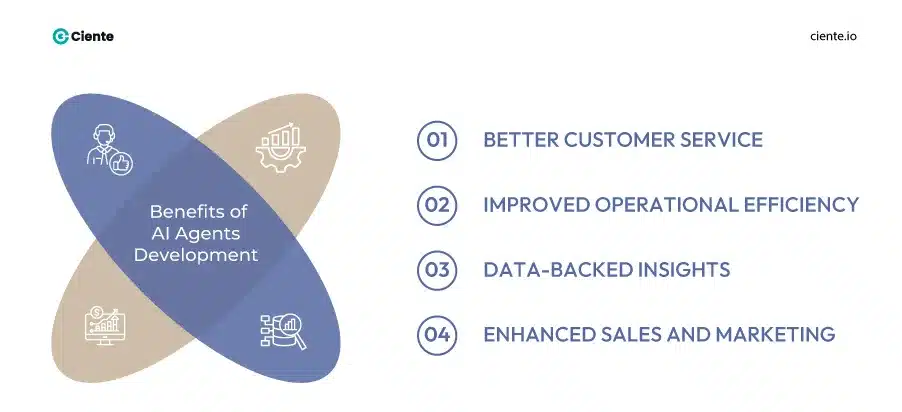
Better Customer Service

Customer service is the key aspect that most businesses ignore due to excessive workload and pressure. This indeed impacts the growth negatively. AI Agents here serve as a tool that elevates a business’ growth.

But the question is how? These agents remain active 24 hours and 7 days a week, offering prompt responses to specific queries as and when user required. Data is the primary source, and AI agents analyze data to deliver personalized responses to users in the language they raised a question.

Improved Operational Efficiency

What sets an organization apart from competition? Its ability to perform operations with efficiency. The introduction of AI has leveled up the bar, especially AI agents that help improve the efficiency of organizational operations.

Mundane operations, like data entry, order processing, or appointment scheduling, majorly kill productivity as one has to perform these operations on a daily basis. AI agents remove the stress of daily operations by automating them, saving employees time and allowing them to focus on more complex and business-specific tasks. Also, these software programs are assistive in streamlining the workflow.

Data-backed Insights

The introduction of AI agents in your organization will eventually improve the way you use data and draw insights.

How?

  • These intelligent agents analyze large volumes of data to identify any trend or pattern you are missing.
  • By analyzing and identifying patterns, AI agents power your business to predict customer behavior and make adjustments in strategy accordingly.

This is how the top AI agent development solutions will empower your business to use data and help you make informed decisions. It will significantly improve your decision-making capability as you leverage the insights that help improve product development and customer engagement.

Enhanced Sales and Marketing

Analyzed data can help you tailor your marketing campaigns in a way that you target the right customer for your product. This enables you to create and deliver personalized messages to them.

As a result, you will qualify more leads through improved customer engagement. This can better optimize the sales conversion ratio of your products.

Crucial Considerations While Investing in AI Agents Development

The more precautions you take, the better AI agents will perform. Development takes time and effort, but all that would be in vain if one doesn’t consider the essential things that can help stand out your developed product. Here are the main ones to consider before investing in the development:
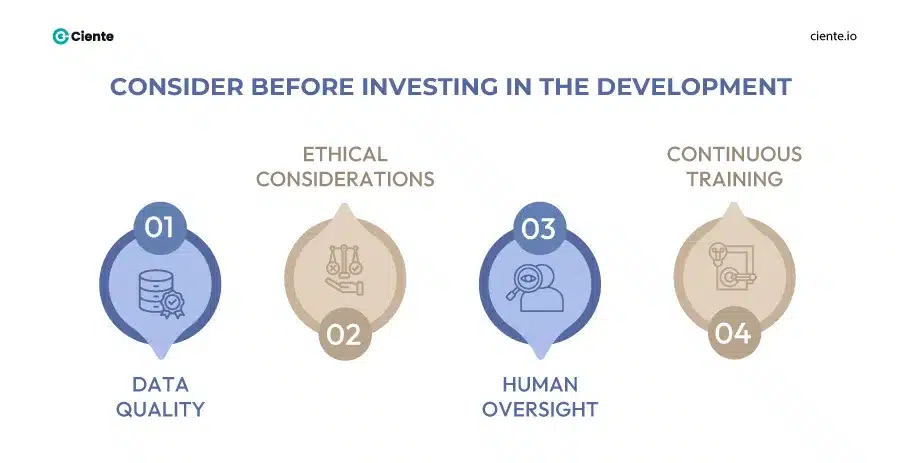
Data Quality

Data is the backbone of how AI agents perform. It should not be compromised if you are aiming to build a software project that would work longer. The quality of data matters the most. Focus on not compromising it to ensure your AI agent will deliver high-quality responses to users by making the most of data-driven insights. You can do this by:

  • Adhering to privacy regulations when using and collecting sensitive data
  • Ensuring consistent and accurate labeling of data for supervised learning models.

Ethical Considerations

Checking data quality is necessary, and you will take care of that aspect. Now, consider transparency, data privacy, accountability, bias mitigation, and more to ensure the smart agent you develop will provide unbiased responses that are true to the query asked. This factor is of utmost importance in building AI agents that stay neutral in every condition.

Human Oversight

Overreliance on technology is not a better approach to every problem. You must maintain a distinctive space for humans to share their insights and control the tool effectively. Maintaining a proper balance is crucial for long-term success.

Continuous Training

AI is a technology, and it never works on its own unless it is being trained. However, one-time training is never enough while aiming to deliver specific responses promptly. Hence, you must invest in the continuous training of your AI agents to improve their accuracy and performance. Partnering with an AI development agency is wise for efficiently and continuously training your agent to be better and more specific to user queries.

Conclusion

AI agents have been in use since the early 90s, but in recent years, they have become more prevalent in the market. Every business (that visualizes a sustainable presence) is investing heavily in this technology. From improving customer service through round-the-clock presence to enhancing sales and marketing via data-backed insights, these offer various benefits to a business.

AI agent integration is gaining momentum in industries like e-commerce, Finance, Healthcare, and more. All because of AI agents’ ability to allow a business to gain a competitive edge in the market in their niche. However, the subtle nuance behind making the most of these smart agents lies in the requirements of your business.

While investing in the development, ensure that the data is of high quality and you are working with an AI development agency for continuous training and improvement of your AI agent. Remember to hire a skilled and highly experienced company for your project. A small mistake in development can ruin the entire effort. Hence, it is wise to thoroughly research service providers and select the right team for your project.


Rethink-Marketings-Handoff-to-Sales-(website)

Rethink: Marketing’s Handoff to Sales

Rethink: Marketing’s Handoff to Sales

Lead Generation can no longer be about numbers. It’s all about building relationships. But have your strategies caught up?

There is a deep-rooted issue with B2B marketing right now. And it can be called the lead generation problem. The leads that are handed off to sales are dipping in quality each year, and the bottom of the funnel remains unaffected.

To this effect, there is a lot of blame going on. Salespeople are quick to blame the problem on marketing for their delivery of leads.

Of course, outbound and inbound lead generation is in the hands of a company’s marketing department. Sales are there to close, and they can’t close an account that isn’t interested in the company offers.

This premature handing off of leads is the cause of many problems- major of which is the damage to a brand’s reputation and the waste of prospects’ and organizations’ time.

Buyers are becoming cautious. The unfulfilled promises by companies, lackluster solutions, and time-consuming communications have made the buying committee jaded.

And what about the saturation of the market? The SaaS buyer is overwhelmed with the options available to them, and still, the marketing industry continues on with its old tricks and plays.

These playbooks are failing and falling rapidly. We are in an age where lead generation is increasingly about the buyer.

It’s time to re-evaluate lead generation and the handoff to sales.

Part 1: What’s happening in marketing?

Marketing as an industry was based on reaching the ideal buyer. The ICP is crucial- that’s why the industry niched down and tried reaching its relevant prospect who would appreciate the communication and would “resonate” with it.

Marketing became a message to the buyer, and that message was, “We understand you; this is who we are, and this is what we can do for you.” This attitude worked for a while and then came the unmet promises.

Marketing messages promised efficiency to the buyer, but it was met with bloat. You don’t have to go far to see this bloat. Google your product’s solution or ask an AI what solutions are available in your domain- you will find thousands of results in the same category. All promising the same as you but in a different tone and language.

Can the buyer navigate all thousands of these messages? No, and thus, they became self-directed. They knew what they wanted, so why not do all the work themselves? It was easier and hassle-free.

To this response, marketing became more forceful. All organic interactions called MQLs were sent to sales, and then salespeople started contacting or calling them or both. This leads to failure.

But the good thing about low-quality MQLs is volume delivery. Out of 1000 leads, at least two were good. And that was acceptable for a while and justified the ROI.

And then organic reaches began to drop. So did MQLs. Outreach became the only way, and the buyers’ inbox was filled with marketing spam. And with AI making it easier to generate content, buyers have become more cautious and guarded.

The problem is deep-rooted.

Before we speak of the handoff to sales, we have to understand that the problem is a deep-rooted one.

Before generating leads and before lead scoring, the marketing team must define their ICP. Luckily, SaaS products are well-suited for this.

SaaS founders, product teams, and marketing teams know their ideal buyer. The common mistake here is bombarding prospects without understanding the overall context.

Marketing is about understanding the culture of the buyer. And this is a crucial step missed by many. Just because a product is amazing, it won’t translate to an understanding by the buyer. Think of all the messages you receive. How many do you give the time of your day?

Probably very few. But that one message that delights you or speaks to you is the one that receives your attention.

These messages are the ones that know the culture and the context you are in. When someone says lead gen is a problem, you think, “Hey, that’s right!”. That is, a marketer understands an existing problem.

The more of these conversations you have with your potential buyer, the more they will grow to trust you. However, it requires heavy research into the domain.

First and foremost, marketing must be looked at as a messenger. Not just a bottom-line driver of immediate growth.

As McKinsey says, “Marketing is a long-term investment of growth.”

and that is true. Marketing is a brand’s way of communicating values, diving deep into desires, and promising to make the desires come true.

Organizations, especially B2B, need to understand the value of brand-customer relationships because it is the basis of all lead-generation activities.

  1. Friction
  2. Touchpoints
  3. Social Proofs
  4. and everything crucial to marketing metrics is based on this relationship.

To build high-quality lead pipelines, the brand must: –

  1. Using the right channel, founders must share their industry-specific perspectives and what they have learned.
  2. The social-channel methodology should not be self-promotional but should include the problem you solve and why.
  3. Your email outreach and newsletters will speak for your product, the problem you are solving, and how.
  4. You can break these rules to see what works for you.

But that last step requires steeping into uncertainty, and today’s marketing teams are ill-prepared for it. There is too much reliance on data and very little on relationship-building and perspective-making.

Part 2: Sales’ role

Sales’ role is changing. Now that AI agents can set up meetings, and answer queries, score leads —everything that can be automated will be automated.

The low-level stuff of sales jobs will go to AI. That means more time to do things that build relationships with the prospects.

This includes researching and providing the real-time paint points of the buyer to the marketing team. Which is crucial in coming to an understanding of what constitutes a lead.

Yes, the definition of lead is vital to the handover. If there is no agreed-upon definition and qualification criteria, it will cause a disconnect between the leads that are qualified.

Sales must take responsibility for this.

Part 3: The Handoff

Last year (2024) saw many sales teams reporting a lack of high-quality leads. The issue seemed endemic to the B2B SaaS industry. Inbound leads were not up to the mark.

This must have caused tensions to increase between marketing and sales teams. Even if the sales teams do everything right, there’s no point if the transfer itself is defective. Marketing teams have gotten into the habit of delivering quantity over quality.

The saturation of the market is one reason that has been going around recently. There aren’t as many leads as there once were.

We’ve all seen the stat from Ehrenberg-Bass Institute— at any given time, the people in-market is as much as 5% and less.

But here’s the problem. CEOs, CFOs, and CSOs want numbers to reflect quickly- marketing must prove its ROI or face scrutiny.

And the cycle of trying to attract the buying pool of the 5% begins. Every competitor will be after them, reducing the chance of being discovered. With self-buying, especially, the chances have become slimmer.

Understanding self-buy

The buyer is self-directed. They know what they want and why they want it. They aren’t as much looking for a solution as they are confirming their choice.

These 5% that are so valuable to the B2B SaaS industry have already made up their mind before their buying journey has started. They’re just comparing other options with their initial and desired choice.

If you can sway the account in your favor, that is good. But looking at the numbers, only a few have been able to do so.

The solution is the 95%

Lead scoring is vital for the quality of leads received, and so is nurturing. But often, lead scoring is confused with the buyer’s behavior with the vendor.

For example, if a buyer downloaded a whitepaper and signed up for your webinar, that’s 20/20 points for interest.

If the buyer sits for your webinar, that’s a lead ready to buy.

Your sales team, primed and excited, calls them and gets shot down.

The buyer had already decided on the vendor. They just wanted to see if you offered anything else.

Because if they did like what you had to offer, there’s a good chance they might have asked to talk to a sales rep— that behavior is actually the one deserving a good score.

So, what? Do you stop inbound and outbound? No. Quite the opposite, you market to an audience of 95%.

95%, and the 5%

Lead scoring and nurturing should be divided into two segments: –

  1. The watchers – 95%
  2. And the takers- 5%.

CEOs must understand what the CMOs have known for years— marketing affects the bottom line first incrementally and then exponentially.

Both segments require different strategies. What marketing teams have to do here is to create separate rules and scoring systems for two distinct groups.

The watchers

  1. For the watchers, the crux of the strategy should be relationship-building and understanding their needs. This is simple. By analyzing their behavior, you will be able to personalize the content.
  2. Then, assigning scores to certain behaviors. The real creativity would be to understand what the data is saying. e.g., Can any behavior of theirs help you detect the timeline of their purchase?

These leads— are not quite MQL but rather a Qualified-for-Nurturing segment. With this list, you can start building authentic and meaningful relationships.

Buyers usually have a list of first preferences. With this strategy, be a part of that list.

The only thing a business needs to thrive at this point is patience.

The Takers

For the takers, the strategy calls for something more attention-grabbing. This requires a lot of trust in the product you are selling and an understanding of the buyers’ core problem.

The accounts you’re selling to will have a lot of bias. The committee set for decision-making has bias embedded in them. Each individual has their role and risks to mitigate.

There are two possible options:

  1. All of them agree on a first-choice vendor
  2. But everyone also has their first-choice vendor.

Both of these possibilities can be simultaneously true. The question: is your solution one of them?

To understand that and implement an effective ABM strategy— your solution will have to understand the explicit intent of the account and where it’s tending towards.

The question here is: What solution are they looking for, and the reason for doing so?

Here for the lead scores— you can implement a BANT-like questionnaire that answers questions like:-

  1. Why is the prospect switching?
  2. What are they looking for in possible solutions?
  3. What are their business priorities?
  4. What are the risks they are facing?

Of course, you must design these questions into their experience so that the answers come organically.

The next step would be to assign scores.

But what should the scoring system look like? As discussed, it can’t be one-dimensional— that is where marketing teams are losing prospects.

It should be behavioral but also be contextual.

  1. Is the account proactive in its search?
  2. What has been the response from the communication?
  3. What conversations are the sales teams having with the stakeholders from the accounts?
  4. Have they spoken to a stakeholder?
  5. And so on.

This presents a very dynamic view of the buyer and helps you save time and cost.

The good thing about the takers is that they are time-waste averse.

You need to do that, too.

Collating the leads.

Once you have the scores down- it’s time for the handoff with meticulous detail.

Marketing teams are experts in drawing insights from data, and before the handover, they must lean into this, providing a detailed report of each lead scoring segment, why that score has been assigned, and what it means.

This level of transparency will help sales teams understand where the buyer stands and what level of communication they are prepared for.

crm 4 step strategy

Steps to Maximize CRM Performance

Steps to Maximize CRM Performance

Competent CRM systems foster strong bonds with existing customers and accelerate the sales pipeline. How can brands guarantee success with these solutions?

semrush 4

Customers want to feel understood so they can trust your brand and resonate with the offerings. For any B2B brand to survive and sustain in the evolving landscape, customer centricity is essential.

Have you been facing challenges to build a connection with the audience?  Zeroing in on a powerful CRM solution can help you achieve this.

Potent CRM strategies provide resources to derive valuable insights into target customers, such as data from sales, customer service interactions, and marketing campaigns. CRM systems store important information specific to customer preferences and behaviors. With this data, brands can build upon loyalty and boost sales through a consistent and positive customer experience across all touchpoints in the buyer’s journey.

How CRM Enhances Business Performance

CRM drives productivity, resulting in better customer satisfaction and higher profits. It helps address the needs of customers and allows businesses to be more strategic in activating customer relationships. Without the help of a CRM, it can be challenging to manage customer data, track leads, and gather customer feedback. This tool simplifies customer communication channels, maintaining ongoing customer contact through nurture campaigns.

Implementing CRM allows you to seamlessly streamline operations and focus on what matters most, delivering great customer service. However, investing in this solution can be a costly affair. The resources involved in its implementation and maintenance can be demanding.

That is why, before taking the plunge, it is best to assess all available systems and choose the best one.

What Goes into Successfully CRM Strategy Implementation

The CRM process is a concept in action. It involves tangible steps to attract consumers through the cycle of brand awareness. When you are clear about how you want to use it, an effective CRM can be a true asset for your brand.

These steps help brands improve outcomes with CRM solutions.

Set Clear Objectives

The first step is to map out the objectives and be clear about the expectations you are setting for yourself. A long-term approach helps you get the most out of your CRM, streamlining sales and marketing activities based on how they relate to customers and targets. Training sales and marketing employees on CRM use cases is imperative. This provides a clear understanding of the features and functions needed to meet the goals.

Qualify Leads

Work with your sales and marketing teams to navigate qualified leads and follow through on potential opportunities. A proactive approach like this helps garner more leads. Incorporating intuitive dashboards within your CRM can also provide real-time actionable insights. It will not only help filter out irrelevant targets but also align resources to pursue the top leads and convert them into customers.

Data Management

Understanding what data is entering the CRM helps ensure the quality. An effective system can manage and secure vast volumes of data. If customer data is incorrect or incomplete, it can hinder the consistency and quality of the system. You can achieve this balance when sales and marketing teams identify, collect, and input the correct data into the CRM. The best part about this software is its mobile access, which can be accomplished from virtually anywhere and anytime.

Acquire Leads

Presenting your brand to a potential customer network is only the beginning of the CRM process. Moving forward, brands must encourage the target audience to learn more about the offerings. The lead acquisition steps will vary depending on the structure and objectives of the company. For instance, a brand’s marketing team may encourage website visitors to share email addresses with a CTA attached to a newsletter. The sales team could use the CRM solution to start a live chat on the website.

Convert Leads into Customers

After engaging with your leads and capturing their interest, it’s time to focus on the lead conversion rate. The best way to approach this is to equip the sales team with relevant skills to identify how interested the leads are and whether there is a likelihood of purchase. A CRM assimilates historical data from past sales to narrow down lead-qualification criteria. These can be added as attributes to the CRM’s lead-scoring tools, providing identification opportunities with the highest probability of a sale. When a lead shows potential to convert, nurturing them will enhance trust enough to bring them on board. A simple way to achieve this is by sharing case studies, white papers, and relevant resources with the leads. Sales reps must also use CRM platforms to set reminders and tasks to follow up with interested leads. A CRM dashboard serves as a reminder that follow-up ensures that there are no missed opportunities.

Drive Upsells

How do you convince customers to switch products? Personalized recommendations via email are a great place to start. You can use CRM solutions to organize customers into smart lists based on similar purchase histories. You can then create custom email templates that send relevant product releases to entire lists of customers at once. This helps you rest assured that the promotional deals or releases you send reach the people who are most likely to purchase.

Align the Sales Pipeline with Your Customer Journey

Aligning the sales pipeline with the buyer’s journey amplifies success beyond measure. When brands address the touchpoints, motivations, and problems during all stages, it helps them connect with customers. This step predominantly involves outlining the sales pipeline stages, such as prospecting, qualification, proposal, negotiation, and closing. The alignment should be so perfect that these stages correspond to a particular phase of the customer journey, as encompassed in the CRM solution.

Set Up AI and Automation

Automation is redefining the modern business landscape. Integrating this feature into CRM systems helps manage routine tasks like sending follow-up emails, scheduling appointments, and updating sales opportunities. AI-integrated automation reduces the workload, leaving time to focus on other business operations and improving performance efficiency. For instance, you can send emails to new website visitors or follow-ups with prospects.

Provide Superior Customer Service

You may have successfully converted target leads into customers, but the CRM system doesn’t end here. A key aspect of business expansion is customer retention. You need to figure out what will keep the customer coming back. One of the proven ways is excellent customer service.

Zendesk’s 2020 Customer Experience Trends Report illustrated that customer service reflects a consumer’s loyalty to a brand. For instance, poor customer service can reduce lead conversions and hinder your reputation. Support teams must be efficient enough to deliver premium support whenever, wherever, and however, their customers expect it.

49% of customers declared that a brand’s problem-solving ability is the best aspect of a satisfying customer service experience. CRM software elevates customer satisfaction by giving easy access to the data required to provide the ideal solution. This creates a stress-free and efficient experience for both customers and support agents.

CRM software is enriched with high-quality data, which allows brands to dive into past leads and customers to better understand the target audience. It goes beyond demographics and basic information. When implemented effectively, CRM systems help analyze the conversion potential of leads.

Measuring CRM Strategy Success

Although AI models and automation are in place, brands must review their performance and business impact. You can accomplish this with relevant CRM metrics to evaluate the success of the CRM strategy. Periodic analysis using metrics helps determine what is working and what needs improvement. Using a powerful CRM, you can track customer satisfaction scores, sales growth, and customer retention rates. Metrics like close rate, upsell rate, length of the sales cycle, customer lifetime value (CLV), and customer acquisition cost are essential. Implementing these tools will help brands stay on track and ensure things are progressing as they should.

Wrapping up

Marketers launch campaigns and initiatives to build deeper connections with prospects. Consider CRM systems like your personal assistant minus the coffee runs. A strong customer relationship management (CRM) strategy sets in motion competent business strategies to thrive in the market. These practices generate more revenue by enhancing customer relationships and brand trust.

Tailored interactions, delivered consistently, create customer-centric journeys that improve customer loyalty and business growth. CRM systems don’t have to be intimidating. With training and the best application, they can drive target leads and accelerate the sales cycle.

If you want to know more about incorporating technology to enhance customer engagement, please visit our publication network.

Why Dropbox is the Best Choice for Lead Magnets

Why Dropbox is the Best Choice for Lead Magnets

Why Dropbox is the Best Choice for Lead Magnets

Since lead magnets help draw more customers to a brand, they must be created and stored in a reliable source. How can Dropbox safeguard such an asset?

Expanding businesses require a continuous back-and-forth of sales and marketing practices that are updated from time to time. But with all this growth comes the responsibility of managing more data. And then, there is the dilemma of where to store them. The same concern applies to lead magnets.

A lead magnet is a valuable resource offered to potential customers in exchange for their contact information. Typically, it is a holistic solution to a challenge. You can offer it at a lower cost or as a downloadable to understand how it sparks interest in your brand. A lead magnet must also be valuable, and brands can charge for it. The idea is to make the lead magnet appealing enough to compel people to make purchase decisions.

And there is one way to determine if your lead magnet is good enough- If it can derive more engaged customers!

With a value-driven magnet in place, this is how a lead gen framework pans out :

It begins with creating a magnet to garner more leads for a brand. A form is then created, followed by setting emails to share lead magnet details with anyone searching for them. The form can be available on the website so prospects can fill in the essential information and request lead magnets. After people start filling it out, the email marketing system receives a notification of the contact details of these prospects. You can also automate thank-you emails to these contacts with the lead magnet.

For storing and sharing these lead magnets, Dropbox proves to be an excellent platform. It is, by far, the most reliable source on cloud platforms, making lead magnets easily accessible.

Let’s explore this in more detail.

Setting your Dropbox for Lead Magnets

Dropbox plays an important role in B2B lead generation services by offering a platform to store, organize, and share lead magnets. It is a secure and accessible space to organize valuable content and distribute it among the target audience. Brands can use Dropbox to upload files, share, and use links.

Incorporating Dropbox for managing lead magnets helps you benefit from the following

Centralized Storage

One of the outstanding features of Dropbox is it allows you to keep all lead magnet files in one central location. This simplifies the process of management and access whenever needed.

Smooth Collaboration

With Dropbox, you can experience seamless collaboration with team members or customers. It also lets you share files and folders, allowing multiple people to work on the lead magnet.

User-Friendly Interface

The interface is easy to navigate and systemize your files. Dropbox makes it easy to create folders, categorize lead magnets, and search relevant content.

Secure Sharing

Dropbox offers reliable security features to protect lead magnets. With this, brands can control people who access files, set passwords, and fix the validity period of shared links.

Diving into the basics of Dropbox and its role in lead generation establishes the foundation for effectively utilizing this platform for your lead magnets. Setting up your account is the first step towards harnessing its power for your lead magnets.

Create High-Value Lead Magnets with Dropbox

Dropbox offers a versatile platform that allows you to create various lead magnets. Here are some popular lead magnet formats you can create using Dropbox:

eBooks or Guides

Brands can launch informative content providing valuable insights, best practices, and strategies through ebooks or comprehensive guides.

Ready-to-use templates

Create templates or worksheets to help solve a specific pain point or allow customers to execute complex tasks in a simpler manner.

Checklists

Build a compiled collection of checklists or cheat sheets that outline a step-by-step guide to map the route for achieving a desired outcome.

Webinars

Uploading informative webinars or tutorials to educate the target audience on relevant topics or provide solutions to specific pain points.

Whitepapers

Another form of content is crafting in-depth whitepapers or case studies that provide valuable insights and illustrate expertise and industry insights.

Resource Libraries

Assimilate all valuable resources like articles, podcasts, tutorials, or tools that help the audience learn more about your brand and understand the way to solve specific pain points.

Steps to Make your Lead Magnet influential

1. Identify Your Target Audience

Before crafting the skeleton for the lead magnet strategy, narrow down the target audience and what pain points you want to address. This approach will allow the development of content that resonates with the pain points.

2. Select a Format

Figure out which format works best for your brand and the value you can deliver effectively.

3. Create Compelling Content

Attracting the right audience requires high-quality content offering valuable insights, practical tips, or actionable steps. Brands must organize content with substance that aligns with audience interests and pain points.

4. Design

The lead magnet must be visually appealing. You can enhance this by adding professional design elements, clear formatting, and engaging visuals.  

5. Save Your Lead Magnet on Dropbox

Once you have a lead magnet in place, save it on the Dropbox account. Build a dedicated folder to organize all lead magnets in one place.

Tracking the performance- a step you must not skip

Measuring the efficacy of your lead magnet and optimizing the lead generation strategy requires keeping tabs on the performance. Dropbox has features that help you monitor and collect insights on the access and application of your lead magnet. Brands can visualize the access stats, where they check the views, downloads, and interactions with lead magnets.

You can also use link analytics, where you share links for lead magnets and access these to understand how these links perform. These links can comprise data such as the number of clicks, geographic location, and sources. Another way to go about this is to integrate analytics tools. Dropbox supports seamless integration with applications like Google Analytics to offer in-depth insights into lead magnet performance. Brands must leverage these to understand the outcomes of lead gen efforts.

Monitoring the performance of lead magnets on Dropbox allows data-driven decisions and fine-tuned strategies for better outcomes.

3 Best practices for Effective Dropbox management

Following this step-wise approach will pave the way for successful data management with Dropbox.

1. Organize Your Dropbox

Keeping the Dropbox organized works well in a couple of ways. Firstly, it lets you access files in a jiffy. You can save time spent on sorting through different fodders for lead magnets. It is much easier to dedicate a folder to all the lead magnets.

Clearly label the files and folders with names that indicate their content. Consistent naming conventions simplify the search for and management of lead magnets.

Consistent naming conventions make it easier to locate and manage your lead magnets. Creating subfolders is another way of introducing a system. It is also a good idea to remove lead magnets that have become outdated or are not relevant. Eliminating these allows Dropbox to be clutter-free and organized with the latest resources.

2. Safeguard the Files

Adding a two-factor authentication (2FA) will ask for a verification code in addition to your password when logging in, thus giving an extra layer of security. You can also choose to restrict access permissions to individuals you trust. The other team members can receive view-only access. Brands that share lead magnets through links can opt for password protection.

All this aside, you need to update the Dropbox password regularly. A strong and unique password helps maintain account security.

3. Optimize Your Lead Magnet for Best Results

Making lead magnets visually appealing helps to attract the target audience. Create compelling headlines and descriptions that communicate the value and benefits of the lead magnet. To make it visually appealing, use high-quality images, engaging graphics, and a layout that is easy to look through. Before zeroing in on the best format, experiment to understand what resonates best with the audience. Once the format is selected, keep track of the performance and tweak as needed to encourage high engagement. The periodic monitoring helps understand whether they are relevant to the audience. Incorporate new insights or trends as and when required to keep the lead magnets enticing. Drive better conversions with Ciente—ranked among the top lead generation companies in the USA for creating high-impact, audience-ready leads.

Summing up

Lead magnets are an efficient way of casting the net over a wide audience. It gives a trailer of your brand expertise, which increases the chances of garnering more audience. When it comes to using Dropbox for your lead magnets, there are both sides to the coin. Whether you are new to Dropbox or looking to optimize lead gen strategies, it is crucial to understand the role of this platform.

Although there are several types of lead magnets, what you implement will depend on the target audience, industry domain, and the value you bring to the table.

Ciente - Content cyndication

Elevating Content Syndication with a Leading Vendor in the USA

Elevating Content Syndication with a Leading Vendor in the USA

Content syndication providers have a large audience that helps you maximize reach. But how can you select the best syndication provider to achieve this?

Brands work hard toward crafting a content strategy and publish different forms of content to interact with the audience. However, despite all inputs, the business outcomes may not be as expected. And the main reason for this pitfall is a lack of reach.

How Content Syndication Boosts Engagement and Sales

Distributing content across various platforms increases reach and engagement with new or existing followers. Studies have shown that businesses leveraging content syndication experience 45% more sales.

If brands outsource syndication services, it can help more prospects move through the funnel.

Content syndication vendors help you distribute content across multiple channels that the target customers spend a huge chunk of time. They manage the logistics, ensuring that the content reaches the right audience and new markets that you probably never had access to.

Let’s understand this in more detail in the next section.

Why Hire a Syndication Partner?

A syndication vendor helps derive the most out of the original content, expand reach, and improve audience interactions.

Content syndication could give tangible results, but at the end of the day, it is about partnering with the right vendor. The best providers would be well-versed in distributing and promoting your brand’s content across several channels to reach specific customers. Across the most appropriate channels. Since there are different types of content pieces, you need to tweak your strategy based pm the content: blogs, whitepapers, newsletters, and more.

Vendors offering syndication services help a brand’s content reach a wider audience. They connect you with the target audience on relevant channels, distributing high-value content- leveraging online platforms and an already engaged audience to give your brand more visibility and ensure s continuous flow of qualified prospects- accelerating the sales funnel.

How to Identify a Reliable Content Syndication Vendor

Considering these factors facilitates identifying the providers who meet your criteria.

Pricing Structure: Start by checking every vendor’s pricing model and verify whether it matches your budget or if its value is worth the investment.

Reputation and Credibility: The best way to verify these is to tap into the vendor’s track record, client testimonials, and industry awards.

Network Reach and Quality: Research the platforms it collaborates with to understand its reach potential. Gathering details like size, diversity, and quality of the vendor’s distribution network will also help with this.

Targeting Capabilities: Since the objective of hiring a content syndication partner is to launch targeted content, brands must verify customization potential. Figure out personalization abilities based on audience segments, demographics, interests, etc.

Content Quality: Among the many options you come across, prioritize vendors that maintain a standard for content quality.

Content Amplification Strategies: Tap into the vendor’s tactics to boost content reach and engagement via social media and influencer partnerships.

Compatibility: Before narrowing down on the vendor, align it with your existing marketing technology stack, including CRM systems.

Customer Support and SLAs: Evaluate the vendor’s customer support capabilities and inquire about the SLAs (service level agreements). Their technical support and campaign management must ensure timely issue resolution.

Scalability: Going for a vendor offering scalable solutions and flexible campaign management solutions will help you achieve the desired outcomes. Select a vendor with scalable solutions and adaptable campaign management tools to accommodate your evolving growth objectives.

Data Security and Privacy: Pay attention to vendors who follow the GDPR and CCPA regulations and implement actions like data encryption and access controls.

What makes Ciente the Best Content Syndication Vendor in the USA

While searching for a syndication vendor, several options could pop up on the internet. Here’s why Ciente is the most reliable option.

Ciente is a leading tech publication with a global reach of millions. We understand the content and ensure it reaches the right customers through our tailored syndication strategies.

Our team makes sure all content is SEO-enriched, helping all content get more search rankings.

Here is a list of our key USPs

Multi-channel distribution: Our team uses channels like emails, social media, and our in-house platform to generate highly-qualified responses through content.

Massive network: We have an active audience comprising senior leaders and decision-makers.

Editorial expertise: Ciente optimizes all content to improve engagement and consistently A/B testing to put the best foot forward.

At Ciente, we strive to boost brand credibility by amplifying your content on our in-house publishing network, allowing you to tap into our wide audience base. Our tailored syndication services help overcome the problem of generating traffic and provide consistent engagement with the target customers.

Final thoughts

The value of content is derived when it is visible to more target customers and triggers a response. Content syndication is the doorway to escalate the visibility of what is published. And it does so by publishing materials on the channels where the prospects are most active. Effective syndication helps draw a network of audience to your content. But for that to happen, brands need to choose an efficient vendor. Ciente’s content syndication services make your job easy by improving the optimization efforts and publishing content on relevant third-party channels.

Why Content Classification Matters?

Why Content Classification Matters?

Why Content Classification Matters?

Value-driven content plays an important role in attracting the target audience. How can classification enhance search rankings?

Brands publish a series of content to help customers with relevant information for navigating through the complex digital landscape. But, if the content is not structured properly, it can hinder the performance. Classifying any content has the potential to boost search rankings. Structuring content with classification improves how search engines index web pages, helping brands get better visibility.

At its root, content classification allows companies to organize and categorize content into meaningful groups. You can integrate relevant tags and keywords here to give the audience a clear understanding of what each content illustrates.

When we talk about content classification platforms, they indicate the process of classifying a document into one or more classes based on its content. Brands can select classes from a pre-established list a hierarchy of categories.

Content classification eliminates the stress of manual decision-making and automates information management. Brands can leverage the process to filter out irrelevant content that does not hold any business/customer value. The essential materials are sorted into relevant categories that can be easily accessed.

The classification process analyses documents, distills the main crux, and assigns a category. So, you do not just search for a single word or phrase. It helps improve accuracy since the system adapts to the unique nature of your business. Blog content classification works by identifying different categories from the examples that you provide. When the system receives feedback, it adjusts in real time and implements any corrections made. Classification accuracy must be adjusted to the changes in your business.

Types of Content Classification

Brands can select among two main types of classification: rules-based and machine-learning automation. The choice depends on factors: content type, audience, and end goal.

Rules-based classification

This type of document classification works for both digital and scanned content. Rules-based classifiers, as the name suggests, are rules-oriented for classifying content. It is based on predefined rules that analyze specific features within the content. For example, there could be a set of criteria to label certain services or offerings based on a keyword used to identify them. Although simple, rules-based classification could seem restricting and confusing. Brands need concrete plans to label and distinguish content, improving the structure of this system.

Machine Learning Automation

Machine learning is evolving rapidly, and its applications have extended to content classification. B2B companies can now harness the power of this technology for intelligent automated blog content classification. This approach focuses on developing a machine learning-based model involving collecting training data. Labeling data improves classification efficiency. However, there may be a risk of human judgments interfering with these labels. To avoid this interference, brands must use behavioral data to keep track of possible judgments.

why content classification is important.

We have enlisted some major points highlighting why brands must classify content-

  • Enhanced User Experience: Well-structured content makes it easier for readers to find relevant insights.
  • SEO Advantages: Search engines favor structured content, increasing the chances of higher rankings.
  • Improved Engagement: Readers are more likely to explore your blog when they can easily navigate it.
  • Automation: Categorize your content automatically.
  • Flexible & Customizable process: A flexible system allows brands to comply with content classification requirements.
  • Cost-efficiency: An advanced content classification platform will help avoid storage expenses by saving only necessary information.

Some tools that help with content classification

There are several tools available to assist in managing blog content classification. Content classification is managed with efficient tools that simplify categorization. For example, Trello is great for visualizing content plans and tracking progress. Google Analytics is another example that provides insights into how users interact with your content, helping you refine your strategy.

Then, there is Evernote, an all-in-one tool for capturing, organizing, and sharing notes related to your content. 

The tool you choose to integrate will depend on the type of content you are dealing with and the content strategy you are implementing.

Step-by-step guide for acing the classification

Content classification offers the power to improve SEO to great lengths. But how do you ensure its effectiveness?

Follow these pointers to skip the hurdles and seamlessly navigate through this process.

Define Your Categories

The first step to classifying content is to run through different categories that match the content you want to classify. It could be just blogs or include more than one form of content. Brands must ensure that they are open to including multiple posts while being specific to offer clear direction. For example, you could go for Digital Marketing: SEO, Social Media, Email Marketing, Content Marketing KPIs.

Strategically Integrate Tags

Although categories are about broad groupings, tags are best suited for more specific topics that fall under those categories. Many types of tags can be used on websites to improve classification and search ranking. When considering tags, use them as keywords that help further classify your posts.

For instance, while administering sites, you can typically add tags for meta, title, header, and blog post. You can tag single words or phrases. If words like news, events, awards, etc. are used for category headings, then tags should include the major industries you serve and the services you offer. Tags work best for projects, employees, recruiting, and anything else that may apply to multiple posts.

Here is another example- if you have content under the category of social media, tags like Instagram, FB advertising, and content strategy will be ideal. Using tags appropriately can help in internal linking, thus enhancing user experience plus SEO ranking.

Create an Editorial Calendar

Have you experienced a situation where you want to deliver different types of content but have been unable to execute your plans? Well, that’s why brands need an editorial calendar. An editorial calendar enables brands to plan, schedule, and organize content in advance. This streamlines content delivery and ensures consistency but also spans across various content over time. Either create using Excel or PowerPoint or use suitable software. Consider using Trello, Asan, and Google Sheets to prepare an editorial calendar.

Integrate a Consistent Format

Consistency goes a long way in aligning with your brand voice and setting the tone of communication through content. A consistent format helps readers connect with the brand and the message you are trying to convey. You can use a fixed structure for posts, like beginning with a robust introduction and main body, ending with a conclusion, and including a CTA. A systematic flow helps readers know what to expect, making it easier for them to navigate your content.

Implement a Search Functionality

Search functionality is boosted with elements that attract an audience and enhance engagement. It could involve adding visual elements like images, infographics, and code snippets to enhance readability. Alternatively, components like clear headings and sections can be used to make content more systematic, giving it a better flow and readability.

Regularly Review and Update Categories and Tags

The demand for new content is constant, new materials are bound to be released. As more content gets added to the database, categories and tags require a periodic review. In the absence of this check, it may become difficult to keep track of whether the new content aligns with the strategy. Updating categories and tags ensures that all content remains organized while enabling you to identify potential gaps.

Summing up

Brands spend hours figuring out the best strategies for amplifying content performance. We often miss the significance of classifying content and the difference it can make. A well-organized content form is pivotal for its success and reach. These blog content classification tips will help enrich the user experience, improve SEO, and drive more traffic. That said, classification is not a one-time task but requires continuous attention and adjustment to remain effective.