AI Use Cases For Marketers

AI Use Cases For Marketers

AI Use Cases For Marketers

AI use cases are many. But AI is eroding marketing trust- what’s wrong? The way marketing teams are using it. Here’s a better way.

“Our first point of contact with most information is rarely the information itself but some lossily compressed derivative that’s already been processed and strained through a dozen layers of reinterpretation.” – The Theory of Dumb by Lane Brown, New York Magazine (2025)

In an article about AI use cases for marketers, information must take front stage. As the quote says, and everyone has come to understand, the quality of information available has been degrading.

But why does this matter to us and the use cases for marketing? Because marketing, as a function, must reclaim and stand against the en-shittification of the internet. The reason behind this is simple: if the internet becomes desolate and untrustworthy, marketing as a function will be affected.

And do you need numbers to prove this? Marketing is equated with noise. It’s called marketing noise for a reason. And AI magnifies this noise and transforms content into slop. And slop it is.

Who are marketing teams producing this content for?

  1. It’s Google’s ranking systems to bring in more buyers.
  2. AI LLMs that can be hacked to bring in more buyers.

This buyer-attracting focus has made marketing teams less buyer-centric and more spammy. The industry must not fall prey to this. But you may think that this is not true- marketing is still appreciated, right?

This is partially true. Great marketing is still reaching people, but observe and see that many marketing campaigns are appreciated by fellow marketers.

Marketing is threatened by its own echo chamber. And AI will make it worse- unless everyone decides to stop and take action. The good news is that AI itself will help the industry get there, while positioning itself as the function of the AI era

The potential of marketing has never been this infinite, nor this polar. Depending on the usage, AI will change the industry for the better or worse. The goal of this article is to persuade you to a better way.

What is AI’s role in marketing?

AI has affected marketing and developers the most. After all, intelligence replaces intelligence. That’s why organizations laid off many marketing and development teams and tried to replace them with machines, only to call them back.

But as it stands, AI is still a threat to knowledge work as it becomes better and better. There’s a growing debate that the thinking machines will hit a wall. And as with all things tech, that wall will eventually be overcome by a new innovation.

So AI might be a mainstay for at least the next few decades, conservatively.

We know two things:

  1. AI slop is real, and people can identify AI after they see the patterns emerge. The patterns become repetitive after a point.
  2. Automation has made things easier, and with intelligence in the mix, it is no longer necessary to physically create messages. The AI does it based on the segment.

These two realities have eroded trust in marketing. Organizations are just vying for similar buyers. If you are a manager or above, reading this, you must get calls daily.

Buy this and buy that. Please hop on our 15-minute call to show you our solution.

And now AI telemarketers and SDR agents have increased the number of calls an organization makes.

The use of AI in marketing today has been that of the factory, churning out messaging to the buyers at light speed.

Yes, there’s also market research, report creation, and strategy (god forbid), but teams are using AI tools as a volume farm. Usually, because marketing teams know their product needs volume, either because it doesn’t solve a core problem or the market is highly competitive.

But as all contradictions go, this one will be solved by itself. AI can fix AI slop.

The question is how?

AI Use Cases for Marketers

Okay, let’s put marketers into two camps:

  1. Storytellers
  2. Strategists and Analysts

All marketers belong to one of two camps, depending on the campaign. So the strategies and use cases can be interchanged depending on which hat you’re using. You must choose the distinction you’re going for.

The difference exists because there are two different things.

You have to be a storyteller to battle slop and a strategist and analyst to understand what the customer wants.

AI use case 1: Storytelling or Content Creation (call it what you may)

Okay, content creation with AI sucks. The pattern repeats, and there are ample logical mistakes it makes. But why is that? Well beyond someone not editing the articles, the second part is not knowing what you’re doing.

For example, the article has an AI-written paragraph; if you can guess which, you win.

The difference between the paragraph and slop is simple: the intent behind it. A lot of articles, videos, and scripts- if you open Instagram or YouTube, you know what this means- sound exactly the same.

They don’t have any intent beyond self-promotion. And that’s where they falter.

Plug in your perspective in the LLMs or content creation tools, and you will see a difference in quality. Then feed it your own original messaging and positioning, and see it improve.

Even free tiers of ChatGPT and Claude start to sound original. But it requires you to have knowledge about the thing you’re writing about. Without it, you are creating slop of the highest kind.

It has no thought. It has no perspective. It is a thing about a thing. Not the thing itself. And you’re adding to the erosion of trust.

AI use case 2: Product Experience and Tool Creation

No. This does not mean the abuse of your Lovable credits, though it does mean thinking of AI not just as an assistant but as a co-creator.

Many AI tools are either the controller or the assistant. But one perspective that isn’t often heard or accepted is that it can be a co-creator of experiences. Think about this, you have a blog or website- but someone on Instagram is outselling you, whether that’s services or products. Why? They have realized how to use Instagram’s superior product experience and algorithm to their advantage.

AI can and will decentralize this- how?

  1. This is a prediction; feel free to disregard this point, but AI will soon start giving algorithmic recommendations- this will become the context or the illusion of it. So that means people who integrate AI will be able to personalize their product and website experience based on the segment or individual.
  2. Your current AI systems are not glorified chatbots and information management systems; if used right, they improve your experiences. You can create tools that your buyers want based on their journey. Think of content, right? What are they but experiences of other people? AI can collate this experience into a framework that can be played with.
    1. For example, a simple tool that, if you put the details of your ICPs, can give probabilistic answers of what messaging might work for them. And if you add an RAG function, based on your own user data, imagine the power of this tool. It would give answers based on data that you thought were unconnected.

The trick is always to use the tool in ways that are simple yet uncommon. You already have a lot of power (data) as a marketer. What can you do with it? You can create things with AI that aren’t content but tangible, free products that deliver experiences.

Instead of a blog, you can give them an actual tool to play with. It’s democratizing the HubSpot approach and dialing it to eleven.

AI use case 3: Channel Management

This use case is quite common. Every marketer knows what the omnichannel experience is, yet it eludes most.

The main challenge of the omnichannel experience is data silos and organizational context. Yes, this is a simplified explanation. The developers will be better suited to explain what you ought to do. But there is a solution here: AI helps unify data because it is currently the best information management system.

Of course, there are biases; that’s why there should be a context layer- these could be your MCPs or other custom methods that you use to unify all your data points.

One answer that Satya Nadella gives is the semantic embedding of data into one layer that the AI systems can use as context. One of the most powerful applications of this idea is channel management. It can help marketers: –

  1. Orchestrate the omnichannel experience.
  2. Divert resources to channels that show high growth potential.
  3. Predict user behavior and direct their actions in subtle ways.

While these ideas are not novel, they are not being represented in conversations about the positive change of AI in business. However, this does raise a huge ethical dilemma: the control of your users’ minds. With AI in the mix, as it becomes smarter, the sophisticated recommendations and experiences will affect the users.

The power of this implication is vast, and you, as a marketing leader, need to be aware of this.

AI Use Case 4: Audits

A quick question: when you or your team can’t solve a problem because you’re too invested in it, who are you turning to?

For many teams, it is AI. There’s a good chance that if you don’t understand something, you can ask ChatGPT (or whichever LLM you prefer). This gives you data or something akin to an answer that you already knew but didn’t want to vocalize. Now, you have a third person, “unbiased” view of your problem.

But LLMs are not quite there yet, creatively. They can give you past answers, but never what can be created, which makes them perfect for audits.

The most powerful AI use case is its ability to audit systems and data, and provide predictions based on its probabilities. This does require RAG integration and should not be overlooked.

For example, a recent audit you can run is this: how does your website stack against your competitors based on your audience’s behavior?

The AI will give you probabilistic scenarios based on their behavior and patterns.

Marketers need to think about AI as a creative enhancer.

The use cases presented to you aren’t the only ones. They are the result of asking a simple question: what if?

Marketers need AI to do one thing, in an ideal scenario: break out of conventional thinking. Aren’t there many ways to solve a problem? But revenue waits for no one. If a function doesn’t bring in money and prove its tangible impact, why does it even exist?

That is the consensus of many.

Marketing must not devolve into noise by producing more volume, more doing. Instead, it needs machines that help teams focus- and prove the impact. This is what AI can do.

But only when used effectively. To break constraints. To make sense of the data. And prove it.

Curating Customer Personas for Financial Services: Beyond the Demographics

Curating Customer Personas for Financial Services: Beyond the Demographics

Curating Customer Personas for Financial Services: Beyond the Demographics

Customer personas in financial services fail because they reduce people to data points. The real question isn’t who your customers are, but what they’re afraid of.

Every financial services firm builds personas.

Retirement Rebecca. Investment Ian. Millennial Mike.

Catchy labels. Fun in a workshop. Thin in practice. A stock-photo smile with a bullet list below it. This passes for insight. This is supposed to inform trust. Anyone who has ever sat across from a real customer knows how far this is from reality.

These personas sit inside decks. They appear during onboarding. Marketing pulls them when they need to defend a campaign. Sales nods because it is easier than questioning the premise. No one uses them after the meeting ends.

They are not tools. They are in the theater.

A record that someone ran research. A slide that proves the budget was spent. A step completed. A checkbox. Nothing changed in how teams work. The understanding does not deepen. The business does not shift toward the people it claims to serve.

Personas do not fail because the idea is flawed. They fail because the way the industry builds them is empty. Financial decisions are emotional. Persona templates never touch those emotions. They stay on the surface. They cling to demographics, titles, and predictable lines about goals. They avoid the question that actually matters: why does someone pause before doing what they know they should do? Demographics cannot answer that.

Why Traditional Financial Services Personas Fail

Financial services lean on numbers.

AUM. Credit scores. Income ranges. Timelines. Risk scores. Behavior data. Compliance fields.

Everything that fits into a cell looks real. It looks objective. It feels safe. The problem is that numbers stop where humans begin.

Data will not tell you why someone binge-reads your site and then disappears.

Data will not show you why a high-risk investor freezes as soon as volatility hits.

Data will not explain why someone avoids planning while knowing they are behind.

The internal process is predictable. Someone decides the firm needs personas. Someone else pulls demographic slices. They run a survey. They talk to a few cooperative customers. They package everything into clean profiles.

Here is Sarah.

Forty-five. Married. Two kids. Household income 180K. Plans for retirement and college.

That profile does nothing.

It tells you nothing about her hesitation, past, fears, her relationship with money, expectations from an advisor, or how she makes decisions. It says nothing about the emotional history that shapes her behavior.

Real Sarah might have watched her father lose everything in 2008.

Read about finance comfortably, yet freeze when she has to act.

Or wanted a human conversation, even though she runs her entire life through apps.

Her demographic profile cannot capture this. Her persona will push her into a box she does not belong in.

Traditional personas collapse because they ignore the human layer. Trust sits below the surface. Behavior sits below the surface. The story someone carries matters more than any field in any CRM. If you avoid that layer, your persona is cosmetic.

Creating Customer Personas for Financial Services: The Description vs. Understanding Gap

Most personas describe. They do not understand.

They record what a customer does and avoid why they do it. They track tasks, preferences, and demographic traits. They do not touch the reasons that create those traits.

Here is the difference.

Version A:

Mark is 38. Software engineer. Earns 150k. Prefers index funds. Research online. Wants low fees and is a self-directed investor.

Version B:

Mark grew up with constant arguments about money. He built stability but still fears losing it. Research gives him control. Self-directed investing is not about distrust. It is about not knowing how to articulate his needs without sounding naive.

Same person. Two different maps.

One tells you how to market to him. The other tells you how to speak to him.

One is a description. The other is an understanding.

If you stay in Version A, everything you produce will sound generic. If you operate from Version B, your message carries weight. You speak to the part of him that decides, not the part that clicks.

That is the real gap. Description is quick. Understanding takes time. Most teams take the quick route.

Building Effective Customer Personas for Financial Services

Personas that work are built from the inside out.

Age, income, device preference, location, profession. These are reference points, not drivers. They sit at the edges. They do not tell you how people behave with money.

The forces that matter do not appear in a typical template. Emotional history. Learned patterns. Fears. Levels of trust. Relationship with risk. The environment where decisions are made. The weight someone carries. That is where the persona lives.

Financial History Shapes Persona Behavior

Everyone carries a financial history. It dictates more than any demographic line ever could.

Some grew up around stability. Bills paid on time. No chaos.

Some saw debt stacked on debt. Some watched jobs disappear. Some watched families lose homes. Some learned to save early because they had to. Some learned avoidance because watching the numbers created fear.

Only 27 percent of Americans work with advisors. Trustworthiness is the top concern for those who do at 60 percent. That gap is not random. People remember where trust was broken. They remember dismissal. They remember being talked down to. They remember being sold something they did not need. These memories form part of their financial identity.

Your personas need this layer.

  • What shaped their understanding of money?
  • Whether stability or volatility is familiar to them.
  • Whether they trust institutions or are wary.
  • Whether money was used as safety, control, escape, survival, or status.
  • Which financial events left a mark?

Two people with the same income and age can behave in opposite ways because their histories are different. That is why demographics do not predict behavior.

Decision-Making Context in Financial Personas

Financial decisions do not happen in stillness. They occur inside noise.

People decide between distractions. They decide while tired. They determine between obligations. They decide under pressure. They decide in discomfort.

Your personas must reflect the world people actually live in.

Meetings that cut into evenings. The rent increases every year. A child’s school fees. A parent’s medical expenses. Work stress.

Uncertainty.

The industry often acts as if people think about money in a calm place. They do not. A couple planning retirement while supporting aging parents and paying for their child’s education does not behave like a stereotypical “retirement planner.” They operate inside a strained environment. They react faster. They hesitate longer. They need acknowledgment, not assumptions.

If your persona ignores context, your understanding is incomplete.

Trust Factors in Financial Services Customer Personas

Trust determines everything in financial services. Not features. Not tools. Not funnels.

Trust.

Seventy percent of consumers expect personalized advice. That expectation does not come from convenience. It comes from fear of being treated like a number. But personalization without trust feels manipulative.

Different people trust different things. Some trust credentials. Some trust calm voices during market drops. Some trust clarity around fees. Some trust referrals. Some trust repeated small proofs of reliability. Some trust being spoken to as equals.

Your personas need to identify these trust signals. They also need to identify the moments that break trust. If you do not name those, you will repeat them.

Trust is the real product in financial services. Everything else is structure.

Communication Preferences That Drive Engagement

Channel preferences tell you almost nothing. Email or phone does not define how someone absorbs information.

The real material sits deeper.

  • How much detail do they need before they feel confident?
  • Whether they want an explanation or direction.
  • How they react to complexity.
  • How tone affects them.
  • Whether they look for reassurance or efficiency.
  • Whether they seek human connection or independence.

This is communication. Not the channel. The internal rules people follow when they receive information.

Pragmatists span all ages and regions. They care about clarity. They care about speed. They do not care about novelty. If your persona misses that, your experience will drift back into generic patterns that fail them.

Customer Personas Financial Services Companies Actually Need

Leave behind the playful names. You need personas tied to behavior, not vibes.

The Control Seeker: A Critical Financial Services Persona

This persona wants clarity. They examine everything. They do not do this to challenge you. They do it to manage fear. They do not distrust you. They distrust uncertainty.

They need transparency. Clear steps. Clear fees. Clear mechanics. If you rush them or obscure details, they shut down. If your answers feel scripted, they stop listening.

The Overwhelmed Achiever in Financial Planning

Strong career. Strong skills. Financial literacy gap.

They hide the gap. They move quickly in other parts of their life, so the hesitation in finance feels embarrassing. They either avoid or rush.

They need clean language. No jargon. No assumptions. They need a place to ask simple questions without feeling judged. They need a structure that reduces their cognitive load.

If you overload them, they check out. If you assume they know the basics, they feel exposed.

The Burned Skeptic: Understanding Financial Services Distrust

This persona expects to be harmed. They have been burned before. That memory guides every step.

Fraud affects 26 percent of adults. Data breaches hit 61 percent. Scam awareness is low. People are cautious for a reason.

They need things explained without persuasion. They need honesty. They need clarity around how you make money. They need to verify. They need small proofs before bigger commitments.

If you pressure them, they retreat. If you hide fees, they walk. If you overpromise, they stop trusting everything you say.

The Responsibility Carrier: Multi-Generational Financial Personas

This persona carries more than themselves.

Their decisions impact their family. Their risks hit more people. Their fear is multiplied.

Nine percent struggle to manage income. Eighteen percent worry about retirement. Add dependents, and the pressure spikes.

They need plans that account for multiple obligations. They need flexible structures. They need acknowledgment of their load. They need clarity around trade-offs.

They do not need guilt. They do not need rigidity. They do not need advice that pretends their situation is simple.

The Future-Focused Builder: Wealth Creation Personas

This persona is building. Not escaping. Not repairing. Building.

Stability. Independence. Legacy. Freedom.

They make long-term trade-offs because they know why they are making them.

They need a strategy. They need alignment. They need proactive thinking. They need someone to help them see further.

Generic advice kills trust with this persona. Short-term thinking does too. Tools that reduce their goals into averages frustrate them.

How to Create Customer Personas for Financial Services

The problem is not only what firms build. It is how they develop it.

Most firms treat persona development as a project. Research phase. Synthesis phase. Presentation. Storage. The personas exist. The work stops.

Understanding never works like that.

Start with Actual Customer Conversations

You cannot build real personas from surveys. You cannot curate them from analytics dashboards. You need direct conversations where people tell you uncomfortable truths.

You ask about their past. You ask what shaped them. You ask what they feared. You ask what almost made them say no. You ask what they avoided. You ask what made something easier.

These conversations do not scale. They do not need to. They are the only way to hear what actually guides behavior.

Map Behavioral Patterns, Not Demographics

Once you collect those stories, patterns appear.

Avoiders. Overthinkers. Skeptics. Builders. Delegators. People who want control. People who desire guidance. People who need reassurance. People who operate from fear. People who operate from ambition.

Group them by behavior. Not age. Not income. Not location.

Behavior tells you how to serve someone. Demographics do not.

Document What Matters for Strategy

Your persona documentation should serve the business, not decorate a slide.

It must answer what builds or breaks trust, what creates fear, what builds confidence, how decisions are made, what overwhelms them, and how one can simplify things.

Skip stock photos. Skip cute names. Use real quotes. Use real explanations. That is what gives the persona weight.

Test Personas Against Real Decisions

If personas do not alter decisions, they are useless.

Test them in service design. Test them in product meetings. Test them when writing content. Test them during advisor training. When advisors see themselves in the personas, they know how to shift.

If a persona does nothing, replace it.

Common Mistakes When Creating Financial Services Customer Personas

1: Optimizing for Acquisition Over Service

Firms build personas for the top of the funnel. That leads to churn. Financial services depend on long-term relationships. Personas should help you serve better, not just attract more leads.

2: Prioritizing Firmographics Over Behavior

Firmographics help you qualify. They do not help you understand. Two people with the same title in different companies or industries can behave in opposite ways. One wants control. One wants delegation. Firmographics cannot predict that.

3: Creating Too Many Personas

Some firms build ten personas. No one remembers them. No one uses them. If a team cannot recall your personas without checking slides, you built too many.

4: Treating Personas as Static

People change. Markets move. Understanding deepens. Personas should evolve. They must reflect the reality of the customers you learn from.

Implementing Customer Personas Across Financial Services Operations

Personas only matter when the organization uses them. Otherwise, they stay inside presentations.

Marketing and Content Strategy

Content must speak to someone specific. Not a broad category. A specific mindset. A specific hesitation. A specific fear.

Map content to personas. Identify gaps. Create with intention.

Service Design

Walk through a service from each persona’s point of view.

  • Control Seekers will look for clarity.
  • Overwhelmed Achievers will look for simplicity.
  • Burned Skeptics will look for transparency.
  • Responsibility Carriers will look for flexibility.
  • Builders will look for a strategy.

Design for these differences, or you create friction.

Advisor Training

Advisors must detect personas during live conversation. Tone. Pace. Detail level. When an advisor adjusts correctly, the customer feels understood. When an advisor ignores the signals, the customer retreats.

Technology and Tool Selection

Tech choices should support personas, not force them through a uniform process.

  • Control Seekers want visibility.
  • Overwhelmed Achievers want clarity.
  • Burned Skeptics want transparency.
  • Responsibility Carriers want simplicity.
  • Builders want depth.

Tools that ignore this break trust.

The Real Purpose of Customer Personas in Financial Services

Personas are not segmentation. They are a discipline of empathy.

Financial expertise blinds. You forget how confusing this world feels to people who do not live inside it. Personas correct that blindness. They bring customers back into the conversation.

When personas work, they sharpen how you speak, how you design, how you explain, and how you support. When they fail, they turn into another unused deck.

What Happens When You Get Customer Personas Right

You stop treating financial services as something you push. You start treating it as something you earn.

Marketing becomes sharper => Advisors become more adaptive => Services become easier to use => Customers feel understood.

People stay because they feel safe with you. That is the foundation. And safety comes from understanding. When you get personas right, retention, referrals, and long-term growth follow naturally.

Ciente's Picks of Underrated Fintech Marketing Campaigns

Ciente’s Picks of Underrated Fintech Marketing Campaigns

Ciente’s Picks of Underrated Fintech Marketing Campaigns

Fintech seems like it’s all technology. But it’s about imagination that transcends this limited perception. And here are fintech marketing campaigns that prove it.

At its core, fintech marketing is like any other industry-specific marketing. The tech complexity and nitty-gritty in fintech oscillate. But the shell framework remains the same.

What’s true for traditional financial institutions is true for fintech- reliability, trust, and credibility. These are essential requirements for even the earliest adopters. Because the to-and-fro of money isn’t mundane.

This automatically makes fintech marketing not about marketing a fintech, but about meeting your customers where they want you to. And transparency isn’t just a marketing trend.

Traditional financial institutions are going to catch up. Digital adoption is becoming imperative. Not a nice-to-have, but a must-have. Transparency or any other elements mentioned above can’t be used as value propositions by fintechs for the long term.

But fintech isn’t done. The revolution hasn’t ended. And that’s the sparkle.

However, this isn’t being leveraged correctly. There’s a dissonance because most customers belong to a non-financial background. They end up feeling disconnected from the brand’s vision. And overexplaining only makes them feel unintelligent. It’s challenging to connect with the audience because, honestly, no one gets up in the morning to feel enthusiastic about balancing their checkbooks. It’s tedious and not all that entertaining. But the demand’s there because it’s imperative to our living conditions.

How do you make your audience feel excited about something so acutely banal?

You build a truly innovative fintech marketing campaign.

It’s nothing new. There are brands out there that have mastered the art of fintech marketing campaigns.

And that’s precisely what we’re here to talk about. Fintech marketing campaigns that broke through the tradition with their bold moments. And made an impression on the industry.

Fintech Marketing Campaigns: Breaking the Humdrum Routine of the Fintech World

Catching and engaging the attention of your ICPs is not a simple feat. Especially when it’s something so monotonous. You must be tactical enough not to rub them the wrong way. Or create more problems when you wanted to solve one.

What does that require? Positioning yourself as a credible and trustworthy fintech brand. You can’t mix and match random marketing strategies and expect them to work. Fintech demands finesse and insight. It requires strategy and creativity along with the statistics and features.

We’ve five fintech marketing campaigns to inspire you. And to help you break through the insipidness of marketing such crucial tech-centric solutions.

1. Nuvei x Ryan Reynolds

Nuvei is a payments powerhouse based in Canada. It has an impenetrable audience base of large enterprise merchants- it’s very challenging to reach these accounts. But without a way to reach its potential customers, Nuvei knew it would lose its market positioning.

The company had to find a way out of this conundrum. And the solution was quite unorthodox.

Nuvei stepped into influencer marketing.

Yes, it seems ambitious for a fintech company. But the point is that it actually worked. Nuvei, a Canadian platform, would now have to choose an influencer who would be its poster child and propagate its brand story in the best way.

It chose a Hollywood A-lister: Ryan Reynolds. Known for his humour and quirky demeanor. Actually, it was Reynolds who invested in his homebound brand. And as part of the deal, he became a part of Nuvei’s ads.

image

Source: Nuvei

These ads became the talk of the fintech world. Because of its unique intersection of a B2B brand such as Nuvei and Reynolds’ B2C storytelling method. He had complete control over the ads and the content, which allowed him to have his humor on full display.

The impact?

“Huge. Especially on brand awareness,” shares Alexandra Bucur, Nuvei’s Head of Content Marketing.

They could reach publications that were difficult to get to unless you paid. SDRs‘ job became a tad bit easier because now they could use Reynolds as the opener. And they had millions of views, that’s impossible without paid ad channels.

It didn’t come down to leads and sales for Nuvei. But the awareness that it brought? That had long-term effects on Nuvei’s brand positioning.

Maybe it’s not always about the numbers. But about creating memorable impact.

2. Your Way In by Revolut

Revolut is as ambitious as it was years ago. It aimed to become the leading digital banking platform globally.

In 2022, Revolut teased a special marketing campaign to “reach” each and every UK consumer wherever they were at home, outdoors, and online. It sought to meet its potential customers wherever they were. And that was quite a strategy.

Source: YouTube

Your Way In was Revolut’s most significant brand awareness omnichannel campaign. And it made substantial splashes because the brand hadn’t published campaigns at such a scale previously.

The marketing strategy revolved around a unique message: financial inclusion. It spoke directly to the financial underdogs, not experts. For example, one of the clips illustrated a woman trading on her phone in a bathroom. And then the wall breaks and collides with a room full of traders.

Revolut challenged financial stereotypes with this campaign. The rooms that were previously too difficult to crack? Cryptocurrencies? Trading? Investing? The most rewarding opportunities were only accessible to some segments.

Revolut wanted to show its audience that it was possible to enter these “closed off worlds of money.”

As ordinary characters (or regular people) crash through these barriers, the digital banking services platform illustrates them bursting through walls of financial arenas and through challenging financial situations by leveraging the Revolut app.

This campaign worked because the time was right. As the cost of living surges, ordinary people want more channels to gain confidence, financial advantages, and financial freedom.

Revolut understood the timing. And it delivered the campaign, full of relevance.

The impact? It resonated because users could enter a world they couldn’t before.

3. Monzo: “Money Has Never Felt Better”

The anxiety of money management plagues us all. And Monzo wanted to be relatable.

Its “Money Has Never Felt Better” campaign was a humorous juxtaposition- published across OOH and a 60″ hero film. This campaign was based on two sides of the same coin: the good and the bad.

In a consecutive series of shots, the video illustrates what managing money generally feels like and how it feels with Monzo. It’s creative and built to highlight Monzo’s value proposition. The former is cold, stressful, unsatisfying, and even painful. Meanwhile, using Monzo feels warm, peaceful, and zen.

Source: YouTube

The imagery is commendable.

In one part of the film, money management feels like the middle of your workday, and you keep on banging your head on the keyboard. Meanwhile, with Monzo, it feels like learning Kung Fu to break through a wooden board with your head.

That’s hope. And the power of learning. And that is propagated through a bunch of juxtapositions. Anxiety with celebration. Screaming match with a loving moment. Cold with warmth. Failure with success. The list goes on and on.

The idea is simple. And it requires no further explanation. The campaign delivers Monzo’s message straightforwardly. It’s placing Monzo under a bright light, but also showcasing that it cares about its users’ feelings.

“Leveraging us will dispel the discomfort that you feel in your daily lives.”

The campaign promotes Monzo’s solutions for customers. Not about itself and what it can do for them. Monzo’s VP of Marketing puts it quite simply- “

Across the country, money evokes a variety of feelings, usually stress, anxiety, and avoidance. However, our customers tell us that on Monzo, money feels different, so much so that they’re seven times more likely to use the word ‘love’ when describing us than any other bank.”

The Gross Error Fintech Marketing Campaigns are Making

There are specific things to learn from these three fintech marketing campaigns.

The messaging comprises a similar authoritative and informative tone across all channels. Even if the customers at the end of the day are humans. Those who feel and partake in critical thinking.

But fintech companies must grasp that not all buyers are CFOs. CFOs, Controllers, and Treasurers have financial literacy. But they’re just one segment of the buying committee. Most of them are motivated by financial business and operational needs. IT Directors, Operations team, or even end users don’t really entail expansive financial knowledge.

Talking in terms that only make sense to your own brand can drive your potential customers away.

Most buying decisions are made with problem-solving in mind. It’s not about having the financial or technical acumen. Even fintech companies orchestrate solutions with non-financial users in mind. It’s not about who the buyer is, but the end users who will leverage the solutions down the line.

That’s why fintech requires storytelling. Clarity in what they offer and merely presenting the same information isn’t enough. Your fintech campaigns rely on financial jargon neatly packed with ribbons- “zero fees” or “instant loans.” But these copies only end up feeling spammy.

There’s no real value- A tempting yet bare minimum offer.

Do you really think buyers remember these statistics? They don’t need more reasons to make a purchase. They are scared of the investment that could turn futile. Your buyers aren’t simply confident in their decision. And that’s what you need to help them weather this dilemma.

They need reasons they shouldn’t hesitate. Leaning into the uncertain is scary. How do they know if these solutions will reap rewards? They don’t. But they need to move past the hesitation. And feel safe in the decision they’re making. It’s not a fintech problem. It’s a market problem.

Fintech Marketing Campaigns: What They Should Be

In a far-fetched scenario, your competitors have it all figured out. The top to bottom of fintech marketing. It’s all about presenting valuable information for them.

The same message circulates in the industry like a single meme. You laugh at it again and again until it loses its essence. That’s what happens with marketing messages. Your fintech company requires its own unique storytelling to penetrate the complexity and oversimplification.

Beyond the financial tidbits, you must humanize your brand. The brand-building front isn’t the maturity of your marketing operations that align with market structures. It’s merely a single part. In fintech marketing, the emotional part is always a bit neglected because, honestly, which business leader needs emotional gibberish?

That’s incorrect.

If you don’t instill storytelling across campaigns, you lose your customers. Product differentiation in fintech is at an all-time low. And you need a truly disruptive product to stand out. There’s only an incremental or marginal difference in solutions, such as Stripe v/s PayPal. Where’s fintech’s true worth? It gets lost in all of the noise.

Your fintech marketing campaigns should revolve around empowerment- that’s what this digital transformation trickles down to. Traditional financial institutions have neglected financial inclusion for the longest time. Especially in the domain of asset and wealth management. It’s time for fintech to change that. And that should reflect in their messaging.

Marketing Campaigns as a Growth Lever for Fintech.

For most investors and newcomers, fintech remains a sparkling diamond. When combined with the promise of digital transformation, the spark becomes brighter. And that’s what fintech is trying to master now- A balance.

In the midst of chasing the tech fever, this up-and-coming industry has forgotten a crucial aspect- storytelling. Storytelling with emotions. Fintechs might be great at underlining the how, but they aren’t that good at explaining the why.

Underneath all the layers of security, complex features, and algorithms, the story gets lost.

Numbers are easy to explain. But this has erased the human story. Fintech must bring this back.

Because numbers may stale. But human experiences and their story doesn’t.

Fintech: Managing the Modern Undercurrents of Wealth Management

Fintech: Managing the Modern Undercurrents of Wealth Management

Fintech: Managing the Modern Undercurrents of Wealth Management

Financial advice is primarily limited to phone calls and emails. But with fintech making splashes, will wealth management firms come out of their bubble?

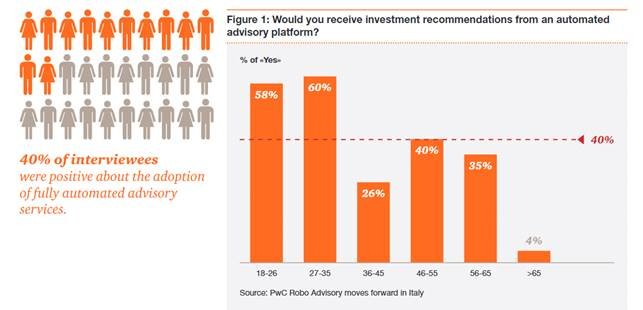
Precisely in 2017, PwC published a four-part report on the impact of fintech. One of them outlined the launch of “robo-advisors” investment platforms across Italy. It was fundamental to assessing whether the financial world was ready for automated advisory solutions.

And the analysis graph looked something like this:

image 12

Source: [PwC]

Over 40% of the interviewees positively feel that the future of investment advice will be automated. That was the basic conclusion drawn over eight years ago.

And eight years later, financial institutions such as BlackRock and Charles Swab are amongst the first ones to incorporate robo-advisors into their portfolios.

But the survey also highlighted a hitch- one-size-fits-all advisory models wouldn’t cater to different customer profiles. And three different ones should be considered- traditional, multi-tasking, and intelligent. So, the underlying logic drifted strongly towards traditional advisory models. With a few preferred banks opting for gradual digitization and automation to revamp this model.

However, eight years later, the demographics of the investors have changed. The same conclusion is deemed inconclusive today.

But we can’t blame the survey; it’s merely a comparison.

Wealth Management and Advisory Models: Targeting the Crux of the Problem

Automated advice, in the long term, didn’t hold a definitive face. And with investment performance and advisory services working in tandem, the expectations were always higher. Face-to-face carried more weight, and considering the risks, why shouldn’t it?

Fintech’s movement into wealth management was merely a whispered suggestion when this PwC report was published.

However, investor expectations today are afflicted with a generational gap. And at the center stage for the wealth management firms’ new clients are millennial investors. It’s a conundrum- the global wealth is shifting across generational demographics. While traditional wealth management firms wish to stick to old methodologies, with a few upgrades here and there, this creates a gap.

This doesn’t pair well with millennial investors’ requirements: faster, cheaper, and better service, with transparent fees and highly personalized advice. The impact of fintech on the wealth management industry is precisely about five customer-centric facets:

  • speed
  • quality
  • accessibility
  • efficacy
  • convenience

But they’re skeptical whether traditional advisory models can meet these demands. After all, this generation is more tech-savvy, especially after they witnessed what is one of the worst financial crises in 2008.

This has left wealth management firms under duress- they’ll have to meet millennial investors’ needs if they don’t wish to lose their market share. And they want to retain the people element, while leveraging tech to augment existing skills and services.

With the firms realizing this shift, they’re poised to enter a new era of value creation. Led by the front-running driver of this much-needed transformation: Fintech. Honestly, it’s nothing new.

You can trace fintech’s introduction back to the mid-20th century- to the ATMs and credit cards. However, it truly gained ample momentum when users began relying less on physical banks. A new era was born- one of mobile banking apps and digital wallets.

Hence, the way we view, leverage, and interact with money has evolved to some extent. The wealth management industry has now realized that fintech is a complement, not a substitute for traditional advisors.

Here, the blog navigates what fintech’s impact is actually about and why it holds a crucial space in wealth management.

What is Wealth Management?

The tools, actions, and tactics used to improve someone’s financial state or position are referred to as wealth management. It combines investment and portfolio management with financial life planning to achieve specific goals over a period.

There was a vital knowledge gap previously. People assumed that only high-net-worth families, industry leaders, and individuals could afford this financial service.

But the advent of fintech has proved them incorrect. It’s for everyone with a definite financial goal. That’s why we have JPMorgan, Goldman Sachs, and Morgan Stanley today.

Wealth management is basically consulting. Because financial markets are unpredictable, clients wish to manage their portfolio to avoid as much market turbulence as possible. These firms help clients plan out their retirements, accounting and tax, and legal and real estate planning. And curate a personalized fund-allocation strategy under a portfolio.

Not all investments yield expected returns. There’s substantial risk in managing portfolios when you don’t have financial as well as market knowledge. But there’s immense growth potential.

That’s the crux that clients and investors wish to target. And that’s precisely where fintech in wealth management becomes imperative. Especially in overcoming significant challenges that halt clients from gauging the best possible advice regarding their portfolios. And for firms to improve their value offerings.

Challenges such as these:

  • data security and privacy (high-value challenge)
  • modular coverage across both human and digital touchpoints
  • Customers must have better knowledge of investments
  • extent of reliability on tech platforms
  • pricing of wealth offerings

Fintech in Wealth Management: An Innovation or a Disruption?

Wealth management isn’t just money exchange. And neither is it a simple transaction.

It requires a portfolio-specific, personalized strategy to yield actual returns. And given that there are monetary processes involved, this function comes with greater client expectations:

  • Transparency into fee pricing.
  • Consistent rules and frameworks.
  • Stricter government-instilled wealth management regulations.

These inefficiencies easily drive people out of this business or limit their growth. It has nudged financial institutions to question the adequacy of existing frameworks and the resilience of traditional banking systems.

Wealth management firms must improve their customer experiences. Or they end up in a ditch- losing mindshare. That’s precisely what 80% of investors and clients also prefer.

Because the investor base today wants to zero in on investment opportunities that transcend traditional assets. But very few actually hold any financial literacy.

How do wealth advisors match the expected levels of professional management- from financial planning for the middle class to sophisticated advice for the high-net-worth individuals?

Proactive digital adoption.

For cost-effectiveness. Transparency and control. Personalized investment strategies. Enhanced price-to-value. That’s how clients choose the firms- they gravitate towards ones that offer them the security, trust, and safety net.

The Innovation

Amidst all the fintech innovations rampant in the market, there are some making huge waves-

Blockchain, AI/ML, and big data analytics. It’s the multi-faceted impact of fintech on wealth management.

And observably, that’s what is imperative today.

Investors want personalized and accessible wealth management services. They have the appetite, just not the access to it. It’s because these clients, especially across Africa, Asia, and Latin America, have never had access to such sophisticated avenues.

Fintech is clearing away these hurdles. It’s eradicating the wealth managers’ dilemma- connecting them to previously untapped capital pools.

Think of a mid-sized wealth management firm in Singapore. Its clients are, to a fault, ambitious and resourceful. And quite eager to diversify beyond local equities and bonds. They wish to take a leap of faith towards the venture capital opportunities in Europe and growth equity funds across Silicon Valley.

And they inquire about their wealth manager about this. The answer is always the same echo: a lack of access. Small funds lack track records. The paperwork is always too complex. Or fund allocation is only open for elite players (HNWIs).

This has halted wealth engagement, distribution, and ownership. And concentrated it within a few high-net-worth communities. Creating an inequality in credit and asset ownership.

It’s never been about scarcity. It’s about accessibility- Access parity.

The millennial investors of today, irrespective of class, look to diversify their portfolios into alternatives and seek safety from market volatility.

Fintech across wealth management is granting them that gateway. It’s becoming a norm- the infrastructure of a revolution in financial advisory. Fintech is the missing puzzle to that access.

Fintech is the concrete filling the problem of financial inclusion. And the structural gaps are addressed by abolishing the need for traditional intermediaries and developing a low threshold for entry.

It’s an eager step towards wealth democratization through robo-advisors, mobile payment systems, peer-to-peer lending, and overall decentralization of finance.

There’s intense pressure on wealth advisors. From personal meetings to demand for lower fees and personalized advice, the dynamic client investors’ needs are creating an environment for firms to adopt new tech. With fintech, firms wish to unlock billions in untapped market demand.

  • Blockchain: The decentralized, tamper-resistant client ledger that can only be accessed by approved systems. One can merely store and share a golden copy of the clients’ data to retain integrity. You don’t have to store multiple client records. It also fosters real-time portfolio rebalancing without human intervention. Think of when a client’s portfolio deviates from its target due to unpredictable market movements. Blockchain streamlines this.
  • Cognitive computing, ML, and AI: This helps extract valuable insights from big data. And facilitate high-level accuracy and algorithms by diving into heaps of client data and optimizing for higher returns on investment. AI helps predict which assets might potentially be at risk. Additionally, cognitive functions help answer complex client queries in real-time and instill deep personalization, curating investment strategies.
  • Robo-advisors: A shift from an advice-based model to an algorithm-based consultancy model. They are automated investment advice providers that help with financial planning based on clients’ risk appetite and cost minimization. Robo-advisors are basically poster children for low-barrier entry, transparent, and low-cost advisory services.
  • Embedded automation: Wealth management platforms and apps are being embedded into non-finance platforms, such as Shopify or Uber. Especially to streamline user access.

The incorporation of these tech and more into wealth management is the building block for a hybrid advice model.

What precisely does that look like?

Hybridity of Your Tech-Powered Wealth Management Services

Clients choose advisors for communication. And for emotional resonance. That’s what drives connections in wealth management.

Personalized and relevant communication elevates confidence in advisors by 77%. And that’s a whopping lot. Meanwhile, a lack of responsiveness is cited as the second fundamental reason for dropping a wealth management advisor.

And often, administrative tasks take away crucial time that could be spent engaging with clients. That’s the door fintech has opened.

Fintech’s adoption in wealth management has helped automate menial and mundane tasks. Especially for advisors to do what they do best- communicate with their clients with trust and patience. From chasing paperwork to comprehensively understanding their financial situation and offering an impressive recommendation.

This is what actual wealth management advice is. The client-advisor relationship is the nucleus of wealth management.

And where investors aren’t happy with digital solutions or the flaws of a robo-advisor, human interaction is what’ll help row their boat. Face-to-face interaction often communicates more value than one can even assume in a broad industry with diverse segments and distinct requirements.

Wealth management today doesn’t boil down to the technicalities. It’s about flexible and tailored solutions that cater to all demographics. Because there’s a deep inclination towards digital interactions, and that’s true. But clients still appreciate personal, face-to-face communication

“There is a need for digital wealth platforms to be both fully digital and fully human, as clients can switch seamlessly between the digital and human experience. This offers a hyperpersonalized experience that caters to the needs of different clients at different times.”

Fintech in the wealth management industry is no longer a differentiator as it was a decade ago.

From being a nice-to-have, tech in wealth management has become a must-have. Today’s investors, both Gen Z and millennials, are skeptical, cost-conscious, and research-oriented. Their general trust in banks and non-bank financial institutions isn’t at the levels it should be.

“The new generation of investors wants solutions based on their life goals and events- older millennials starting families want to know how they can save up for a house, and Gen Z are looking at the mounting national student loan debt, want to understand how they can pay for college.”

It’s why the wealth management advisory model is crucially built on communication. Because your millennial investors are hesitant, why we discussed the need for a hybrid advisory model.

Because fintech in wealth management is not merely about technological breakthroughs. And how these emerging technologies integrate into existing traditional models. It trickles down to finding why fintech is a need in wealth management in the very first place-

The client demographics and the segments that actually opt for your financial advice have inherently changed.

It’s a remodeling of wealth management- one where digital tech frees advisors from time-consuming, computationally heavy tasks. And refocuses their priority towards relationship building to instill trust.

Data-Lakes-Ending-the-Confusion-1

Customer Acquisition Strategies to Vamp Your Marketing Funnel

Customer Acquisition Strategies to Vamp Your Marketing Funnel

Customer acquisition is broken. Here’s the actual playbook buyers actually respond to, built on trust, momentum, consensus, and outcomes.

Customer acquisition strategies are a strange creature in B2B.

Everyone speaks as if we will eventually find the perfect mix of channels, the perfect cadence, the perfect system of nudges that will somehow turn strangers into customers.

Somehow, we convinced ourselves that acquisition is a matter of craftsmanship.

If we run intuitive campaigns, optimize conversion paths, and sharpen our templates, growth will happen. But something inside the modern GTM machine feels hollow. Mechanical. Forced.

Most companies do not have an acquisition problem because they lack channels. They have a problem because they lack architecture.

We keep polishing the parts without repairing the structure. We keep upgrading the tactics without changing the design. And so the system keeps producing the same outcomes: high visibility, low trust. Heavy activity, weak pull. Noise, but no gravity.

What is Customer Acquisition?

Customer acquisition strategies fail long before execution. They fail because the company misunderstands what an acquisition actually is. It is not attention. It does not lead. It is not traffic. It is not retargeting. It is not what the dashboards show.

Acquisition is the process through which a buyer slowly chooses to believe a better version of their own future with you in it.

Until that belief forms, nothing else matters.

After that belief forms, almost anything works.

What’s Not Working in the Conventional Customer Acquisition Strategies?

The tension in B2B today is that belief no longer forms through funnels.

It forms in places you cannot control, inside conversations you cannot access, and through impressions you did not even know you made. It forms through perception, momentum, consensus, and realization. These are the four forces that shape every customer acquisition strategy, whether you acknowledge them or not.

They do not overlap. They do not repeat each other. They cover the entire journey without competing for territory. They are the spine of acquisition. Beneath every tactic, these forces either support or sabotage you.

Let us go through them the way they exist in the real world, not how the marketing textbooks pretend they do.

The First Customer Acquisition Strategy: Shaping the Perception

Your buyer has already decided whether to take you seriously. Before they even read your website, interact with your campaign, watch your video, or click your ad.

This first decision is not conscious. It is not based on your messaging or features. It is based on perception, the silent filter that shapes how every future interaction will be interpreted.

Perception is not a brand in the cosmetic sense. It is not polish or storytelling. It is the deep mental shorthand a buyer forms about what you represent. The story the market tells itself about you without your involvement. It is your identity in the shadows, the one that appears before your actual content does.

Companies overlook perception because it seems intangible. It can’t fit in a spreadsheet. And does not offer instant gratification.

But perception decides whether your acquisition strategy has air to breathe or suffocates at the first touchpoint. A buyer who does not trust you will ignore you even if you present perfect logic. A buyer who trusts you will overlook the minute flaws.

That’s why traditional funnels are collapsing: buyers don’t believe in funnels. Their perception shapes their path.

Acquisition begins with the mind, not the funnel.

For years, marketers obsessed over channels and formats. But channels do not shape acquisition. Perception does. A thousand impressions cannot fix a broken perception. One moment of clarity can reshape it entirely.

Perception is the spark that determines whether a company can even enter the conversation.

The Second Customer Acquisition Strategy: What Moves Buyers Forward?

Once perception opens the door, momentum decides whether a buyer steps through it. Momentum is not frequency. It is not volume. It is not the act of showing up everywhere. It is the continuity of meaning across every interaction. The sense that your company has direction and that every message is part of the same arc.

Most teams confuse momentum with activity. They flood the market with high-frequency output that has no connective tissue. A disconnected series of campaigns, messages, experiments, and posts cannot create motion. It creates fatigue.

Momentum is the opposite of noise. It is accumulated clarity.

Every message reinforces the last. Every touchpoint pulls the buyer one step deeper into understanding, not because the content is persuasive, but because it is aligned with itself. That’s what differentiates a company with gravity from a company with reach.

Reach scatters attention. Gravity sustains it.

Markets do not reward inflated promises. They reward believable systems. Momentum is the feeling of believability that compounds. Without it, even great tactical work falls apart. With it, even modest tactics outperform expectations.

When momentum takes hold, the buyer does not feel marketed to. They feel guided rather than forced. And when momentum is absent, the buyer feels interrupted rather than moved.

Acquisition strategies collapse when they treat attention as an event instead of a progression. Momentum converts attention into movement.

The Third Customer Acquisition Strategy: Diving into the Internal Politics

This is the part of the acquisition no one prepares for, and the cost of ignoring it is devastating.

In B2B, you are not selling to one person. You are selling to a coalition. A buyer does not convert when they understand you. A buyer converts when the people around them stop resisting the change you represent.

Think of this:

Sarah is not the buyer. Sarah is the champion who must walk into an internal war. She carries your narrative into rooms where no one cares about your messaging, where everyone is incentivized to minimize risk, where the CFO is suspicious, the IT head is overwhelmed, and the legal team is anxious.

Most companies treat acquisition as if they are in conversation with the champion.

In reality, they are in conversation with the champion’s environment. If your value cannot survive those internal conversations, you will lose deals even when your champion believes in you.

Consensus is not persuasion. It is not a feature explanation. It is the alignment of incentives across the buying committee. And if this alignment does not happen, even the strongest acquisition strategy collapses under the weight of internal friction.

This is where most strategies die. Not in the funnel, not at the top, not in the ads. They die in the rooms you never entered.

A buyer may like you, but their committee must trust the choice. And trust cannot be established at the end. It must be architected from the beginning.

Customer acquisition strategies that ignore consensus build interest but cannot convert belief into commitment.

The Final Act of the Customer Acquisition Strategy is to Realize.

Most companies assume the acquisition ends at closed won. But that assumption turns the entire system into a short-term performance engine with no compounding power.

Real acquisition is only complete when the buyer experiences the transformation they were promised. That moment of realization, the moment where expectation aligns with outcome, is the real currency of growth.

If this experience is profound, customers become an extension of the acquisition engine itself. If this experience collapses, every marketing effort becomes more expensive, harder to scale, and weaker over time.

It becomes the foundation of exponential acquisition. The story of the customer’s transformation is the most credible form of demand creation. It invites more buyers into the narrative with more conviction than any performance play can replicate.

When realization is strong, acquisition gets cheaper every year. When realization is weak, acquisition becomes harder every year.

Most companies try to accelerate top-of-funnel motion without repairing the bottom-of-funnel truth. The result is a system that looks successful on dashboards but collapses in financials.

Realization is the force that closes the loop. It turns one successful outcome into the seed of the next. Without this loop, customer acquisition becomes an endless hunt.

With it, customer acquisition becomes a flywheel.

The Real Customer Acquisition Strategy: Unified, Human, and Structural

Everything above forms the architecture that decides whether tactics succeed or fail. But tactics still matter. They merely cannot operate without alignment.

So what does a customer acquisition strategy look like when these forces combine?

It looks like a company that understands its buyers’ psychology rather than channel behaviors. It’s like a market presence that builds trust rather than pressure. It’s a system- marketing, sales, and customer success become three limbs of the same body rather than competing silos.

It’s driven by intention and truth.

Your customers do not want a perfect funnel. They want clarity, conviction, and competence. When a company builds the architecture that supports these qualities, acquisition accelerates naturally.

And when a company refuses to build that architecture, acquisition becomes an endless negotiation with diminishing returns.

Customer acquisition strategies today are not failing because they are outdated.

They are failing because they lack cohesion. They are failing because they chase techniques instead of principles. They are failing because companies misunderstand the order of operations.

  • Perception shapes attention.
  • Momentum shapes movement.
  • Consensus shapes commitment.
  • Realization shapes the next cycle.

Ignore these forces, and you will keep reinventing campaigns without ever reinventing results. Understand them and you will stop chasing customers, because customers will begin to choose you before you even show up.

That is the only acquisition strategy that truly scales. That is the one the market cannot ignore.

A Nuanced Insight into B2B's Customer Acquisition Process

A Nuanced Insight into B2B’s Customer Acquisition Process

A Nuanced Insight into B2B’s Customer Acquisition Process

Stop optimizing your funnel. It’s a lie. Your B2B acquisition problem is a structural, human, trust-driven mess. Start there.

Let’s be honest. The B2B customer acquisition process is a complete mess.

It isn’t merely broken. It’s inherently misaligned with reality. We are all spending more money, burning out our teams, and getting weaker results. Costs are soaring. Real, high-quality pipeline is not.

We are trapped in a cycle of “more.” More MQLs. More cold emails. More ad spend. More content for the content graveyard. We run on a high-speed hamster wheel. We obsessively optimize a machine that points in the wrong direction.

Why? Because the model is based on a lie.

The lie is the linear funnel. The lie is that B2B buyers move in a clean, predictable path from Awareness to Purchase. The lie is that if we find the right MQL and “nurture” it with five emails, a sales-ready lead will magically appear.

That world is dead. It never existed.

The modern B2B buyer is entirely in charge. They are 70% of the way through their journey before they ever talk to a sales rep. They are self-educating in “dark-funnel” channels we cannot track. Think Slack communities. Think peer-review sites. Think private forums and social feeds. They form a consensus with a 10-person buying committee before we even know they are in the market.

We’ve responded by putting up more walls. More gates. More forms. We’ve turned the customer acquisition process into a gauntlet of transactional hurdles. We demand a prospect’s email address before we have even given them a reason to trust us.

The result is devastating. We are not building relationships. We are just qualifying MQLs. And this is killing our growth.

It is time to stop optimizing the broken model. It is time to build a new one. The fix is not a better funnel. The fix is an entirely different engine. It is an engine built on trust, momentum, and proven value.

What Is the Customer Acquisition Process, Really?

First, let us clear the air.

The customer acquisition process doesn’t merely concern your marketing funnel. It is not just your sales pipeline. It is definitely not just the MQL handoff.

A really functional customer acquisition process is the single, unified engine that aligns your entire revenue organization. Under one umbrella: acquisition and retention of high-quality accounts.

If your definition stops at “Closed-Won,” you have already lost. If your marketing team measures success on MQL volume while your sales team measures success on revenue, you are running two different companies.

This is the core human problem. We have functionally siloed our processes to the point of absurdity. The B2B buyer experiences a single, exhaustive journey. We manage it in three disconnected, misaligned pieces. The fix starts by acknowledging this deep structural flaw.

The Potential Gaps in Your Customer Acquisition Process

The first part of the new engine is about reframing the “top of the funnel.” The goal is not to “engage” as many people as possible. The goal is to become the only credible answer for the right people.

The old model was transactional. It said, “Give me your email for this e-book.” This is a low-trust interaction. It forces your buyer to lie with a fake email. It forces your sales team to pounce with an immediate, unwelcome SDR call.

The new model is about trust building.

This means you must stop gating your best content. Your best, insightful, and most strategic content should not be a “lead magnet.” It must be a brand magnet. It must be out in the open. Insert it on your blog. Publish it on your social media. And put it in your podcasts. Prove your expertise to the world.

When a prospect is in the dark funnel and learning on their own terms, you want them to find your ungated helpful content. You want them to read your article and think, “Finally, someone who actually gets it.” You want them to see your CEO’s LinkedIn post and feel understood.

It’s how you build trust before the transaction. The goal is to be so ridiculously generous with your expertise that when the buyer is finally ready to talk, you are the only company they trust enough to call.

It’s not about ignoring metrics. It is about changing it. Stop measuring MQLs. Start measuring “in-market” accounts that are consuming your ungated content. Start measuring the influence your content has on closed deals, not the leads it generated. This phase of the customer acquisition process is about winning the mindshare battle. When you win the mindshare, the “lead” is a byproduct. It is not the goal.

The Nitty-Gritty of Your Customer Acquisition Process: What it Should Be?

This nuance of B2B is often ignored.

We pretend we are selling to “Acme Corp.” We are not. We are selling to Sarah in Marketing. She is our champion. And Sarah is about to walk into an internal war.

She has to convince her skeptical boss, the Economic Buyer. She has to get approval from the overworked Head of IT, the Technical Buyer. She needs a sign-off from the paranoid Head of Legal, the Risk Buyer. She also needs to appease the end-users who hate change. These people do not share a brain. They often do not even share goals.

The traditional customer acquisition process is comically bad at this. We sent Sarah a generic, 30-slide “sales deck” full of our features. We expect her to do the rest. We are sending our champion into battle unarmed.

This part of the process is not about selling. It is about coalition-building. Your job is to make it easy for Sarah to build an internal consensus.

This means your sales process must become a consulting process. You need to map the buying committee. You must understand their individual pains. You have to create specific assets for them.

This is not a simple checklist. It is a unified strategy. When you learn the CFO is the blocker, you do not just send a pricing sheet. You co-build a custom, one-page ROI model with Sarah that speaks directly to the CFO’s P&L concerns. You do not send a 200-page compliance document when IT flags a security threat. You host a 30-minute “security and integration” call with their IT team and your engineer. You build peer-level trust.

You are building a micro-community around the solution. You are using tools like Digital Sales Rooms not as a content library. You are using them as a “deal cockpit.” All stakeholders can see the mutual action plan. They can access their specific documents. They can collaborate in one place.

The nuance here is critical. Your customer acquisition process must pivot. You must move from persuading a single buyer to empowering an entire committee. You win when your champion looks like a hero for finding you.

The Marketing-Sales Handoff: Customer Acquisition’s Treasure Trove

This is the most dangerous, most broken part of the entire B2B machine.

We have all seen it. The deal is finally done. The contracts are signed. The sales team celebrates. They ring the bell. They collect their commission. The “Closed-Won” deal is marked in the CRM.

And then there is silence.

The customer, who was just showered with attention, is thrown over a massive, invisible wall. They land in the lap of a “Customer Success” or “Onboarding” team. That team often has no idea what was promised. They do not know the customer’s actual goals. They do not understand why they bought it in the first place.

This is where B2B companies die. This is where the painfully built trust is shattered in an instant. The buyer’s remorse is immediate. The customer acquisition process has failed. And the metrics will not show it for another 12 months.

This part of the process is not about the signature. It is about the handoff.

A human-centric, high-trust customer acquisition process treats this handoff as the most critical step. The “sale” is not the endpoint. It is the transition point.

The fix is structural. The Customer Success Manager (CSM) should not meet the customer after they sign. The CSM must be part of the final stages of the sales process. They should be on the final call. They must co-create the “First 90-Day Value Plan.”

Think about the power of that. The customer sees a unified team. The CSM has full context. The promises made by sales are documented. They are transformed into an action plan before the ink is dry.

This simple, structural change obliterates the “wall.” It transforms this part of the process from a transactional event into the first act of a long-term, profitable relationship. It cements trust at the moment when trust is most fragile.

Your Best Customers Are Your Best Acquisition Channel

If your customer acquisition process stops at the first sale, you are operating an expensive, inefficient business. You are constantly hunting. You are incessantly trying to fill a leaky bucket.

This final phase is where the engine becomes a flywheel. It is where the process becomes self-funding and compounds.

This is not about “upselling” or “renewals.” Those are transactional outcomes. This is about proving and articulating the value you promised.

Your Customer Success team is not a “retention” department. They are your new growth department. Their job is not to be a friendly support rep. Their job is to be a strategic partner. They must be focused on making the customer a hero.

The CSM’s mandate is to quantify the value you have delivered. Six months post-sale, they should be working with your champion, Sarah, to build the “Value Realization Report.”

“Sarah, when we started, your team’s processing time was 40 hours a week. After implementing, you are down to 4 hours. We have verifiably saved your team 1,440 hours and $150,000 in six months.”

This report does two magic things.

First, it makes the renewal and expansion conversation a formality. The value is proven.

Second, it becomes the primary fuel for your entire acquisition engine.

That “Value Realization Report” is the single most powerful asset your company owns. It is the case study that Marketing turns into your next high-performing ad campaign. It is the proof point that your Sales team uses to arm the next champion in their own consensus-building battle.

This is the closed loop. The customer acquisition process for your next customer begins with the documented success of your current one.

Stop Optimizing the Funnel. Start Unifying the Engine for Your Customer Acquisition Process.

The B2B customer acquisition process is broken because it is siloed, transactional, and inhuman. We are so obsessed with our own internal metrics. We love MQLs, SQLs, and conversion rates. We have forgotten what the buyer actually experiences- a disjointed, high-friction, low-trust gauntlet.

You do not need a new dashboard to navigate this. And neither a new AI tool.

You need a new mandate.

The fix is structural. It is a commitment to unifying marketing, sales, and customer success under a single, unified revenue organization. It is about tearing down the walls between departments. It means rebuilding the entire process around the customer’s journey.

It is about changing your metrics. Stop celebrating MQLs. Start celebrating pipeline influence and proven customer value.

It is about building an engine, not a funnel. An engine where trust is the lubricant. An engine where proven value is the fuel. That is the only customer acquisition process that will win the next decade.