Work Smarter with the Best B2B Sales Prospecting Tools

Work Smarter with the Best B2B Sales Prospecting Tools

Work Smarter with the Best B2B Sales Prospecting Tools

Sales reps, busy with grunt work, have lost their morale. How can they feel empowered and confident? B2B sales prospecting tools can help.

Modern buyers want businesses to position them at the center of sales, i.e., at the nucleus of growth. Whether it’s by restructuring the business’s tech, infrastructure, culture, or talent, it doesn’t matter how.

Today’s buyers want on-demand, simple omnichannel engagement practices that prioritize their needs. It’s not about you (the vendor) but them (the customers).

With this understanding, they expect informed conversations that entail expertise on diverse industry and market challenges. If not, these modern buyers don’t have qualms about moving on to your competitor.

If their core must-haves aren’t met during the buying journey, or the experience turns sour, prospects would happily choose to push past your brand.

Despite holding this knowledge, B2B sales is still struggling to embark on a customer-first mindset.

It starts with B2B sales prospecting.

The significance of B2B prospecting is hard to outline.

Let’s say it acts as a springboard for your sales processes. It could also be the reason you either have a consistent stream of promising opportunities or your strategies end up futile.

Prospecting is where at least 42% of sales reps face crucial challenges. And they spend a majority of time merely searching for the right leads, making B2B sales prospecting quite a time-demanding task.

The B2B sales prospecting tools and software become paramount here.

However, before we outline the right tools for refining and accelerating your B2B prospecting, let’s understand what it really means. And why a new approach is imperative.

What is B2B sales prospecting?

B2B sales prospecting is one of the very first layers of your B2B sales process. It technically means identifying, connecting with, and nurturing a prospective buyer in hopes of kickstarting a deal.

It sounds straightforward, but it is actually one of the trickiest aspects of the job. Because it involves different facets, and all of them are fundamental to successful prospecting. The job demands insightful outreach, meticulous research, and continuous rejection, succeeded by frustration.

But when carried out effectively, B2B prospecting helps sales teams stay afloat.

Why are B2B sales prospecting tools necessary to refine your sales strategy?

Prospecting is a crucial fragment of your lead generation strategy, and to maximize your sales pipeline. It’s the first step toward cruising the digital undercurrents to locate the most high-value buyers for your business.

Amid the overwhelming number of people in the digital mud, it’s necessary to unearth the ones that matter to your brand.

Or if the timings are too off or the approach is too invasive, they move on to your competition.

This is what makes adopting B2B sales prospecting tools a strategic move.

And it’s been proven effective by Fortune 500 companies such as Microsoft and IBM.

So, let’s get into some of the best B2B sales prospecting tools and software that are all the rage in the market at the moment.

Benefits of sales prospecting tools

Automating Lead Identification to Boost Sales Team Efficiency

To begin with, salespeople no longer have to manually do the arduous process of lead identification, thanks to the automation aspects of these tools. A huge step forward in task management has been the automation of formerly manual operations, freeing up salespeople to focus on what they do best: building relationships and closing deals. According to the research done by Hubspot, 81% of sales leaders believe that AI has the potential to reduce their time spent on manual tasks.

Leveraging Advanced Analytics for Deeper Customer Insights

Moreover, these software systems offer insights that have never been seen before. With the use of advanced analytics and machine learning, sales teams can obtain detailed profiles of potential customers. This allows them to understand their needs, preferences, and obstacles even before they reach out to them. Having the capability to tailor outreach efforts to individual clients is now essential in today’s corporate world, as clients demand and value personalized interactions.

Seamless Integration: Connecting Sales Tools with Your Digital Ecosystem

One other major perk is how well these tools work with preexisting digital infrastructures. It is critical to ensure smooth data transfer across social media, email providers, and customer relationship management systems in this era of ever-growing connectivity between sales, marketing, and customer service. Since integrating these tools ensures a consistent and personalized customer experience across all touchpoints, the chances of successful conversions are substantially increased.

Real-Time Analytics: Driving Agile and Data-Driven Sales Strategies

Finally, sales prospecting software’s strategic true value is shown by its ability to provide real-time analytics and insights. Organizations in sales may monitor their performance, assess customer involvement, and adjust their strategies with lightning speed and pinpoint accuracy. Sales activities are responsive and strategically aligned with developing market conditions and consumer expectations because of the capacity to iteratively improve techniques in reaction to real-time data.

Top 5 B2B sales prospecting tools that are making all the difference

Even in this undeniably crowded market, the top-performing B2B brands have managed to find the perfect leads. And in ideal volumes.

Ever wondered how?

The secret actually rests in their tech stack. The best B2B brands aren’t using B2B prospecting tools as just tools, but as game-changers that can make all the difference in their pipeline.

To further understand how these tools help B2B businesses revolutionize sales prospecting, let’s take a nose dive into the five best B2B sales prospecting tools.

1. LinkedIn Sales Navigator
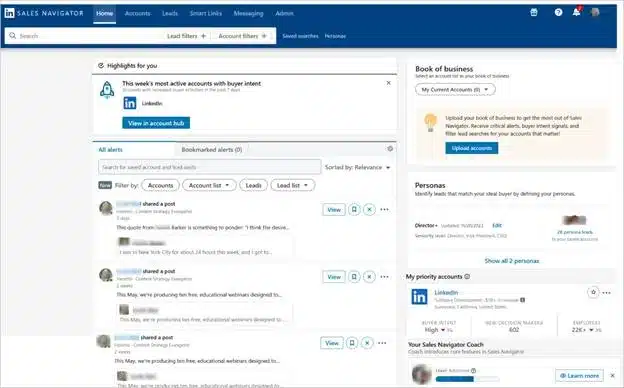
image 13

Source: LinkedIn

LinkedIn Sales Navigator is a premium tool for sales professionals to enhance their virtual selling skills and amp up B2B prospecting. It helps sales teams leverage LinkedIn’s 900 million+ member network to identify and reach prospects with precision.

The sales navigator isn’t just a business platform, but a dynamic prospecting software that helps connect with leads on a deeper level.

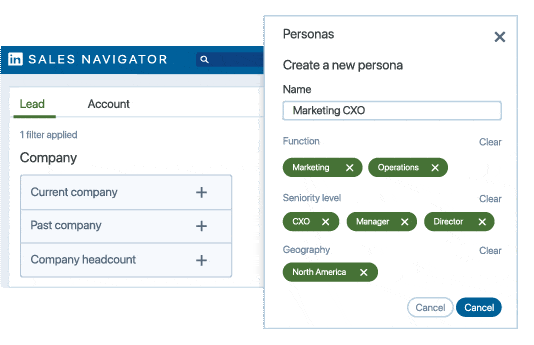
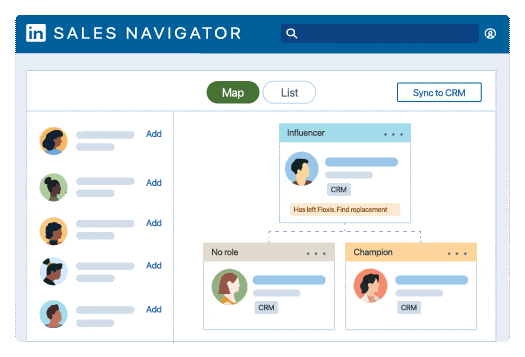
Its advanced filtering and relationship mapping feature ensures that you aren’t reaching all stakeholders in a single buying account. And understand their purchasing intentions by focusing on each stakeholder, not just a few.

Combined with company alerts and prospects’ posts, every bit of LinkedIn data offers a granular purview of the target account. It helps illustrate whether the prospect would be interested in hearing you out, let alone complete a purchase.

Your sales reps can identify warm paths and then send personalized InMails to offer genuine value, not just generic sales pitches. An insight into what your prospects are searching and the values they lean towards can turn a cold outreach into a warm one.

And LinkedIn’s Sales Navigator is adept at that.

LinkedIn is exceptional at B2B prospecting because its features help develop hyper-personalized ABM approaches to connect with every decision-maker in a target account.

This way, B2B sales teams can reach the right prospects through multithreaded engagement and social media.

LinkedIn Sales Navigator is a comprehensive B2B prospecting tool that works to amplify your sales team’s networking and prospecting skills.

2. ZoomInfo
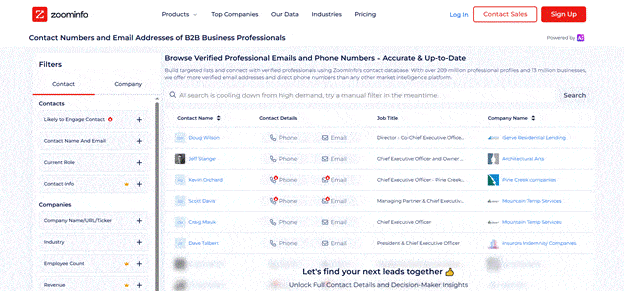
image 8

Source: ZoomInfo

When it comes to B2B data, ZoomInfo is considered one of the most noteworthy data intelligence and prospecting platforms. It’s regarded as a gold standard amongst industry giants due to the extensive contact database it offers.

The database entails business profiles and contact information, which you can filter out to find the ideal ones for your solution. And businesses of every size can leverage ZoomInfo’s prospecting tool.

It uses advanced filters to target profiles by company size, industry, job title, etc. And hosts a digital phonebook with updated numbers and email addresses for reaching the target accounts.

The prospecting software has proved quite efficient in eliminating the use of stale data. It has an auto-refresh feature that updates your CRM automatically. It can be seamlessly integrated with CRMs and sales enablement tools to automate prospect outreach sequences.

The appealing aspect of ZoomInfo is that there’s a very trivial need to move things manually. It has AI assistants in place to make your job more efficient and easier.

But it truly boils down to the platform’s broad coverage and utilization of intent data. It has helped increase response rates and create highly targeted campaigns for over 35,000 clients worldwide.

And propelled more intuitive sales strategies through accurate and real-time B2B intelligence.

3. Apollo.io
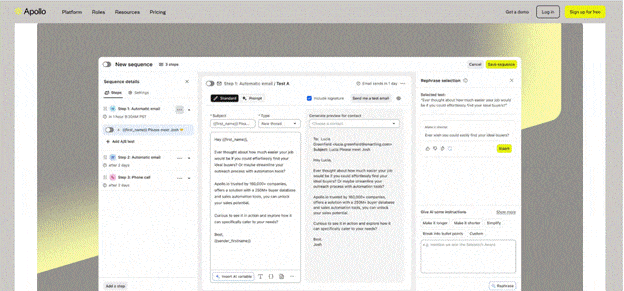
image 10

Source: Apollo.io

Why Apollo?

It’s one of the most peculiar B2B sales prospecting platforms in the market.

Apollo combines sales engagement with an extensive B2B database of over 250 million+ contacts. It takes an integrated approach to B2B prospecting.

This all-inclusive software has helped businesses elevate appointment numbers and cut down manual outreach efforts by half. Its capabilities basically range from phone outreach to data sourcing.

Apollo entails comprehensive features that tackle every intricate modern sales challenge, whether it’s lead scoring or understanding buyer intent.

What are the features of Apollo that actually help ensure this?

  1. Advanced filters to sift through the contacts based on seniority, job title, technographics, etc.
  2. An automated lead scoring system that leverages buyer intent.
  3. Automated email sequencing features and existing email templates.
  4. A built-in dialer to take on sales calls.
  5. Seamless integration with LinkedIn and CRM systems to sync contacts.

Now, sales can focus on what they do best: nurture accounts and close deals. They are devoid of grunt work.

Technically, it works as both an automated outreach tool and a data provider, making it a one-stop B2B prospecting kit for SMBs and small businesses. You can identify relevant leads and reach out to them on scale, all on a single interface.

Apollo is cost-efficient, which is why it works as a go-to for small businesses. It offers you unlimited email credits even with low-tier plans.

Now, startups and small businesses don’t need to buy two different solutions- a prospecting tool and an email automation platform. Apollo serves as a convenient, one-stop solution.

4. Lusha
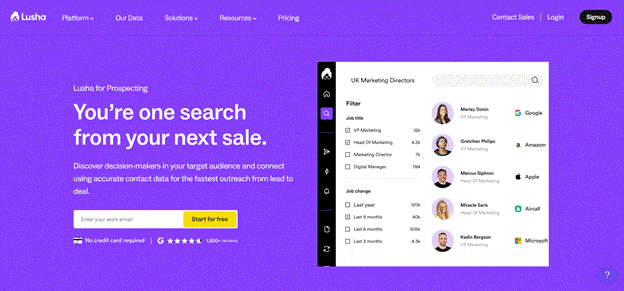
image 9

Source: Lusha.com

“You’re one search from your next sale.”

Lusha is a simple B2B sales prospecting tool known for its contact data enrichment capabilities.

It’s known for its Chrome extension that allows sales professionals to uncover phone numbers and email addresses as they browse through LinkedIn. Pull up a prospect’s profile on LinkedIn, and the extension feature will promptly offer you the contact details.

It’s more lightweight than other B2B sales prospecting tools. Especially one that smoothly integrates with your workflow, making outreach easier. The user experience is quite smooth.

And your sales reps have direct contact details, without having to cruise through the clutter.

Unlike ZoomInfo, which is heavyweight, Lusha offers an extensive database of business contacts but at a lower price point. You can similarly integrate it with your CRMs and enrich data in bulk.

It also hosts a feature that allows your reps to build lead lists and an API for marketing and advertising.

These features are add-ons. Lusha’s actual focus remains on data compliance and accuracy, i.e., high match rates. You ultimately spend less time chasing information on prospects and more time connecting with prospects.

It’s a simple and popular tool for small businesses to find just one missing number or email. And for sales teams that fundamentally use LinkedIn.

While it may not have the global coverage synonymous with ZoomInfo, Lusha does empower individual sales reps by working as a supplement and boosting overall data quality.

5. HubSpot Sales Hub
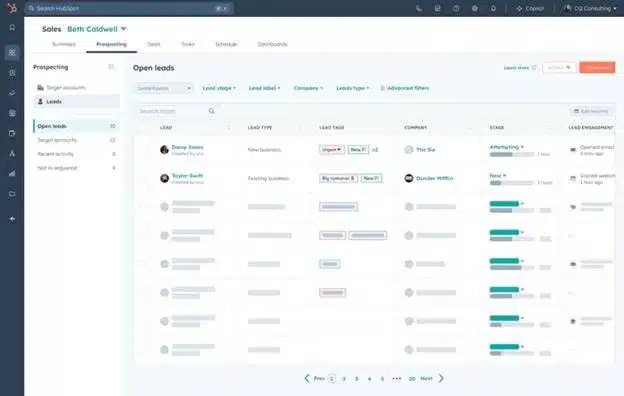
image 12

Source: HubSpot

HubSpot combines CRM with a built-in B2B sales prospecting tool. For sales teams that want an all-in-one platform, it’s popular for lead generation.

And in 2025, its capabilities have only skyrocketed after recently integrating Breeze intelligence.

It now affords businesses lead tracking and contact data enrichment capabilities, along with email automation, email tracking, automated follow-ups, etc.

All of these actions can be completed within their single CRM. How efficient is that?

It hosts all the company data, profiles, and deal information. Meanwhile, the sales hub add-ons offer unique email templates and sequences, direct phone calls, and appointment schedule links.

The Breeze intelligence adoption only contributes further to HubSpot’s prospecting capabilities. It helps fill in the missing prospect details, cross-verify emails, and update its lead scoring system based on real-time insights and intent.

HubSpot also hosts intuitive reporting features that help with sales forecasting and tracking pipeline performance.

This makes the platform comparatively more effective for email prospecting. This is the efficiency that a single login on HubSpot promises to afford its clients.

HubSpot has been a go-to for several brands because it combines marketing and sales data into one. And presents all of it in a user-friendly interface that even amateurs can navigate.

6. LeadGenius

LeadGenius is a tool for B2B firms focused on improving interactions with key accounts, shortening the sales cycle, and elevating their revenue generation. 

Advantages:

  • Precision in targeting through AI algorithms along with human computation, minimizing time on unqualified leads.
  • Facilitates global market penetration with its extensive international data access.
  • Easy to use website, allows users to easily navigate and get what they need without much hassle

Limitations:

  • May bring out unwanted, unusable, or old leads at times
  • Can’t be easily integrated into CRM platforms such as Hubspot
  • It is mostly automated and one may wish for a more human touch while interacting with the interface

Cost Overview: Pricing is tailored, necessitating direct consultation for accurate quotes, reflecting the solution’s bespoke nature but complicating upfront cost comparisons.

7. Salesforce Sales Cloud

This CRM powerhouse offers unmatched customization, allowing businesses to mold the platform to their unique workflows, enriched with AI-driven insights for strategic decision-making.

Advantages:

  • Seamless External Integrations: Excellently integrates with external and proprietary systems, streamlining CRM functionalities.
  • Tailor-made Customization: Offers a wide range of adaptability options to mold the platform according to business-specific requirements, including enhanced data analysis features.
  • Extensive Suite of Features: Facilitates comprehensive management of the customer’s journey from lead to settlement, bolstered by data insights from tools like Einstein Analytics.

Limitations:

  • Complex Interface for Beginners: New users may find the platform’s interface and design challenging to navigate, necessitating a substantial learning period.
  • High Cost: The platform’s pricing can be prohibitive, especially for expanding needs or accessing more sophisticated capabilities, which may limit its use among smaller enterprises.
  • Significant Training Required: Given its wide array of features and customization potential, users often face a considerable learning curve, requiring in-depth training or technical expertise.

Cost Overview: Entry-level plans start from $25 per user per month, with escalating prices up to $165 for advanced functionalities and customization capabilities.

6. Overloop

As a versatile sales automation platform, Overloop simplifies prospecting and follow-up, boasting a user-friendly interface and efficient task automation to boost productivity.

Advantages:

  • Simplified management of sales pipelines and campaigns through an intuitive interface.
  • Automation of repetitive tasks accelerates the prospecting phase and follow-up efficiency.
  • Compatibility with a wide array of software enhances its utility within a sales tech stack.

Limitations:

  • Adjusting to the rebranded platform may require a transition period for existing users.
  • Advanced features are gated behind higher subscription levels.

Cost Overview: Pricing initiates at around $49 per user per month, offering accessibility for small to medium businesses while providing scalability options for growing operations, going up to $125 per month per user for enterprises.

7. Owler Max

Delivering competitive intelligence, Owler Max equips sales teams with timely news alerts, comprehensive company insights, and trend analysis, fostering a strategic approach to market engagement.

Advantages:

  • Effortless Monitoring: Simplifies tracking the latest updates and news on key accounts, enhancing market awareness without manual effort.
  • Valuable Industry Insights: Offers personal insights and competitive comparisons from professionals across various industries, aiding in strategic planning.
  • User-Friendly Experience: Features an easy-to-use interface, with a free version available for initial exploration and a straightforward sign-in process, making it accessible for regular use in prospecting activities.

Limitations:

  • Limited Free Version: While the free version is beneficial, the limitation to tracking a certain number of competitors compared to premium accounts restricts comprehensive market analysis.
  • Data Accuracy Concerns: Challenges with ensuring the reliability of user-contributed company information, such as employee numbers and income, which can detract from its utility as a data source.

Cost Overview: Offers a free community package for personal use and starts its professional plans from $35 per month.

B2B sales prospecting tools transform your prospecting from a hit-or-miss to a data-driven, insightful approach.

All the key advantages of the aforementioned B2B sales prospecting tools echo one thing: empower your sales reps.

These tools are intuitive navigators, not just technical instruments. They help sales teams make a connection with strategic direction and confidence. And more advanced B2B prospecting tools help abandon basic filtering and pivot to hyper-targeting practices with accuracy.

This is what the evolving sales landscape demands-

Spearheaded focus on promising leads to maximize profitability and business reach.

Appointment setting isn't about using tricks but about leading human interaction with purpose and value. Because buyers are no longer here to merely buy solutions, it's not a one-and-done process. They want to purchase stories and relevancy, especially from brands that understand them. But there's an added dilemma: B2B buyers are pressed for time. They are constantly bombarded with emails. And their calendars remain tightly packed. Given the time crunch, these decision-makers have to prioritize. Your outreach is just another amid an influx of countless similar ones. They're also skeptical of unsolicited and generic sales pitches. So, most business leaders carry out their research even before talking to your SDRs. They know how the market operates. Understanding how to reach them through this noise is crucial to unraveling the complexities of B2B appointment-setting. But how? By respecting the decision-makers' time and instilling genuine interest in them. B2B appointment setting isn't merely about locking dates on the calendar. Buyers have become too cautious and selective. As soon as they get an indication that you're dialing for dollars or sending templated emails, they drop off. What they truly want are conversations driven by empathy and personalization. Who better to deliver this than appointment-setters? What is a B2B Appointment-Setter? B2B appointment setters are the first point of contact and lay the groundwork for the rest of the sales process. They identify, interact, qualify, and schedule meetings between the potential customers and your business's Account Executives (AEs). They operate on the front lines of your sales team. Appointment setters warm up leads for further sales conversations. Whereas, your senior sales reps focus on delivering the presentation, handling objections, and closing the deal. They help you grasp that much-sought-after spot on the decision-makers' calendars. If you think about it, without a proper appointment, you're just another unopened email in someone's spam. Why are B2B appointment setters significant for businesses? It's the law of the business world- Your solutions could be more intelligent or the next big thing in the market. But without appointments, i.e., the smallest opening into the market, you remain just another brand amid the clamor. Appointment setting isn't a cinch amidst today's intensifying market competition. It demands nuance and empathy that doesn't treat humans as algorithms. If prospects realize that your SDRs are using another templated sales pitch or preprogrammed psychological tactics, it erodes trust. The problem here is that buyers are only perceived as individuals or businesses that need your solution. It all boils down to a monetary exchange. But even this is a gross oversimplification. Modern buyers follow more complex journeys and are sophisticated. They aren't predictable machines. Appointment setting isn't contacting your target accounts and asking them to sit on a call with your sales reps. It's not unidirectional. While using a pre-outlined psychological tactic might help you schedule an appointment, will it lead to a successful deal? Not generally. Because you haven't inherently understood the "why," i.e., underlying aspirations, intricacies of their pain points, and buying motivation. Technical structures may help you gain clarity on how selling works in the modern landscape. But intuition, active listening, and adaptability are what truly help convert. That's how appointment setters can influence conversion rates, without actively closing deals. Let's reroute to how appointment setters contribute more to your sales strategies than just successfully blocking dates. Elements to Zero in on: How Appointment Setters Help Amplify Your Sales? Appointment setters instill efficiency across your overall sales operations. The business value they add to your brand is straightforward. They are an extension of your sales team and help optimize your pipeline from the get-go. And help: 1. Boost sales productivity Appointment setters don't just schedule meetings. They also handle initial outreach and qualify leads. By handling such tedious tasks, they free up time for sales reps, allowing them to focus on what they do best- close deals. And engage with SQLs and IQLs efficiently. Now, your AEs and closers have more time on their hands to develop compelling presentations, negotiate without focusing on arranging meetings, or come back to empty calendars. Appointment setters also ensure that your sales reps have a consistent stream of scheduled meetings, maximizing calendar utilization. Ones that aren't just on the calendar, but get realized. This actively reduces downtime and helps avoid wasted effort on irrelevant customers. 2. Improve lead quality Appointment setters are trained to qualify prospects based on advanced qualification frameworks. Ones that prove effective for your business and market. This allows your sales team to interact with prospects that don't just fit your ICP but also hold purchasing intent. Pre-vetting prospects offers an edge to your sales process. Uninterested and irrelevant leads are filtered out from the start. This way, you don't waste resources on dead-end conversations. This opens up a window of opportunities for your AEs and closers to dedicate time to the selling bit, which in itself is a time-consuming back-and-forth process. 3. Ensure a consistent flow of opportunities Sales often witness feast or famine cycles. Appointment setters help tackle this conundrum. They reach out to new prospects with dedication and ensure that meetings are scheduled consistently. And there’s a continuous stream of opportunities flowing through your pipeline. And as these opportunities grow, dedicated appointment-setting services facilitate scalability. It opens up space for the business to amp up its outreach efforts without derailing other sales functions. 4. Develop a feedback loop Appointment setters are on the front lines. And constantly in touch with the customers. It helps them gather valuable insight on market trends, competition, common objections, and the shifts in buyer needs. Which ultimately creates a bridge between marketing, sales, and appointment setters. It becomes a feedback loop. With a 360-degree understanding of the market gauged from the appointment setter, your teams can refine their marketing messages and overall sales strategy. We all recognize that customer-first insights are always imperative. And help understand the triggers and pain points rather closely. Especially ones that signify whether a prospect is ready to buy "now.” And, if yes, then why- the crucial context behind the scheduled meeting for the closing teams. The essence of the value that appointment setters bring to the table lies in the multifaceted role they play. They aren't just schedulers. They help your business maintain a healthy pipeline and initiate valuable customer relationships. Additionally, they work as an extension of not just your sales team but also your support. Until the deal is finalized, prospects remain doubtful and curious. They require consistent guidance across the sales pipeline, and even after they become first-time customers. Savvy B2B appointment setters adopt a holistic approach to initiating interactions. They also handle customer queries and give them the attention they deserve. The result? A positive and helpful first brand impression. Customers feel understood, and their needs are valued. And a strong rapport is established from the outset. Appointment Setter Skills: The Must-Haves Not everyone can excel at this. It all sounds easy, but a nuanced approach demands impactful skills that elevate them from good to exceptional at appointment setting. And they transcend the obvious ones, such as persistence, basic sales knowledge, and strong communication. These are the fundamentals. What additional skills are paramount in appointment setters? 1. Strategic empathy This goes beyond just being pleasant and understanding in front of your customers. You go beyond gauging their surface-level pain point. But take a deep dive into highlighting their: 1. Impact of persistent business challenges 2. Emotional drivers 3. Personal motivations of the buying committee An exceptional appointment setter should move beyond asking very commonplace qualification questions. Rather, they should unravel the real impact of their problem on their role, business goals, and overall operations. This way, the scheduled meeting isn't just about getting the decision-maker to agree to it, but to address a deeply felt need. The meeting should be positioned as a potential solution to build trust and relevance from the initial interaction. 2. In-depth research and pattern recognition Your market research shouldn't be a chore, an added task. But a strategic advantage. Appointment setters should possess the ability to sift through public data seamlessly. And spotlight specific triggers and patterns. They must be able to understand the prospect's footing- what are they lacking, and whether they hold a strong market perception. What do their customer reviews highlight? Are there any gaps in their existing tech infrastructure? Or are they failing to curate a distinct voice? All of these insights are significant for your prospect to unearth what's stagnating their growth. Instead of pushing your own agenda, you're mirroring back their own market to them, and spotlighting what they're missing out on. The lack is what all your outreach efforts focus on. With this information, appointment setters can entirely forsake generic outreach for personalized and highly relevant messaging. They aren't just delivered to the prospects, but pack a punch and give them a reality check. 3. Persuasive skills that sound un-salesy but articulate value Persuasion in appointment setting doesn't necessarily have to be about manipulation. It's about leading prospects to their own conclusion: they should want the meeting. This requires the ability to articulate value in the form of possibilities and growth, not benefits and features. The most usual response to sales pitches is "I'm not interested." Instilling value in your comms helps you bypass this. It's not a generic sales pitch anymore, but a potential solution to an identified problem. To propagate this, appointment setters must use relevant case studies and ask thoughtful questions. Ones that demonstrate their market research and their attempt to understand the prospects. This will pique their curiosity and illustrate industry expertise. This way, prospects are drawn towards the benefits of a deeper conversation. Their time and position are equally valued, resulting in high-quality appointments. It narrows down to taking a consultative approach rather than a transactional one, helping you earn the prospect's time and trust. The Underlying Logic that Drives Appointment Setters Sales meetings don't focus on persuading a decision-maker to meet you. It's not synonymous with convincing, but strategic thinking. As an appointment setter, you must create a moment of curiosity that urges them to learn more about your brand and its value proposition. Technical frameworks and guidelines will help you elevate the efficiency of appointment setting and also aid new sales professionals get started. But if you're deep at the nexus of the sales game, you realize that appointment setting isn't about the application. It's actually about understanding why taking up specific pathways offers better results. Modern sales must move beyond generating appointments to earning conversations. And for this, they require dedicated appointment setters. Only then do your meetings have the potential to translate into meaningful long-term partnerships. With an appointment setter, your sales strategies upgrade from technical tasks to customer-centric endeavors that escalate business growth.

Everything You Should Know About Appointment Setters

Everything You Should Know About Appointment Setters

Exceptional appointment setters go beyond memorizing scripts. Their precedent? Build genuine curiosity that earns a coveted spot on prospects’ calendars.

Appointment setting isn’t about using tricks but about leading human interaction with purpose and value.

Because buyers are no longer here to merely buy solutions, it’s not a one-and-done process. They want to purchase stories and relevancy, especially from brands that understand them.

But there’s an added dilemma: B2B buyers are pressed for time.

They are constantly bombarded with emails. And their calendars remain tightly packed. Given the time crunch, these decision-makers have to prioritize. Your outreach is just another amid an influx of countless similar ones.

They’re also skeptical of unsolicited and generic sales pitches. So, most business leaders carry out their research even before talking to your SDRs. They know how the market operates.

Understanding how to reach them through this noise is crucial to unraveling the complexities of B2B appointment-setting.

But how?

By respecting the decision-makers’ time and instilling genuine interest in them. B2B appointment setting isn’t merely about locking dates on the calendar.

Buyers have become too cautious and selective. As soon as they get an indication that you’re dialing for dollars or sending templated emails, they drop off.

What they truly want are conversations driven by empathy and personalization.

Who better to deliver this than appointment-setters?

What is a B2B Appointment-Setter?

B2B appointment setters are the first point of contact and lay the groundwork for the rest of the sales process. They identify, interact, qualify, and schedule meetings between the potential customers and your business’s Account Executives (AEs).

They operate on the front lines of your sales team.

Appointment setters warm up leads for further sales conversations. Whereas, your senior sales reps focus on delivering the presentation, handling objections, and closing the deal.

They help you grasp that much-sought-after spot on the decision-makers’ calendars.

If you think about it, without a proper appointment, you’re just another unopened email in someone’s spam.

Why are B2B appointment setters significant for businesses?

It’s the law of the business world-

Your solutions could be more intelligent or the next big thing in the market. But without appointments, i.e., the smallest opening into the market, you remain just another brand amid the clamor.

Appointment setting isn’t a cinch amidst today’s intensifying market competition.

It demands nuance and empathy that doesn’t treat humans as algorithms. If prospects realize that your SDRs are using another templated sales pitch or preprogrammed psychological tactics, it erodes trust.

The problem here is that buyers are only perceived as individuals or businesses that need your solution. It all boils down to a monetary exchange. But even this is a gross oversimplification.

Modern buyers follow more complex journeys and are sophisticated. They aren’t predictable machines. Appointment setting isn’t contacting your target accounts and asking them to sit on a call with your sales reps.

It’s not unidirectional.

While using a pre-outlined psychological tactic might help you schedule an appointment, will it lead to a successful deal?

Not generally.

Because you haven’t inherently understood the “why,” i.e., underlying aspirations, intricacies of their pain points, and buying motivation.

Technical structures may help you gain clarity on how selling works in the modern landscape. But intuition, active listening, and adaptability are what truly help convert. That’s how appointment setters can influence conversion rates, without actively closing deals.

Let’s reroute to how appointment setters contribute more to your sales strategies than just successfully blocking dates.

Elements to Zero in on: How Appointment Setters Help Amplify Your Sales?

Appointment setters instill efficiency across your overall sales operations. The business value they add to your brand is straightforward.

They are an extension of your sales team and help optimize your pipeline from the get-go. And help:

1. Boost sales productivity

Appointment setters don’t just schedule meetings.

They also handle initial outreach and qualify leads. By handling such tedious tasks, they free up time for sales reps, allowing them to focus on what they do best- close deals. And engage with SQLs and IQLs efficiently.

Now, your AEs and closers have more time on their hands to develop compelling presentations, negotiate without focusing on arranging meetings, or come back to empty calendars.

Appointment setters also ensure that your sales reps have a consistent stream of scheduled meetings, maximizing calendar utilization. Ones that aren’t just on the calendar, but get realized. This actively reduces downtime and helps avoid wasted effort on irrelevant customers.

2. Improve lead quality

Appointment setters are trained to qualify prospects based on advanced qualification frameworks. Ones that prove effective for your business and market. This allows your sales team to interact with prospects that don’t just fit your ICP but also hold purchasing intent.

Pre-vetting prospects offers an edge to your sales process. Uninterested and irrelevant leads are filtered out from the start. This way, you don’t waste resources on dead-end conversations.

This opens up a window of opportunities for your AEs and closers to dedicate time to the selling bit, which in itself is a time-consuming back-and-forth process.

3. Ensure a consistent flow of opportunities

Sales often witness feast or famine cycles. Appointment setters help tackle this conundrum.

They reach out to new prospects with dedication and ensure that meetings are scheduled consistently. And there’s a continuous stream of opportunities flowing through your pipeline.

And as these opportunities grow, dedicated appointment-setting services facilitate scalability. It opens up space for the business to amp up its outreach efforts without derailing other sales functions.

4. Develop a feedback loop

Appointment setters are on the front lines. And constantly in touch with the customers.

It helps them gather valuable insight on market trends, competition, common objections, and the shifts in buyer needs. Which ultimately creates a bridge between marketing, sales, and appointment setters. It becomes a feedback loop.

With a 360-degree understanding of the market gauged from the appointment setter, your teams can refine their marketing messages and overall sales strategy.

We all recognize that customer-first insights are always imperative.

And help understand the triggers and pain points rather closely. Especially ones that signify whether a prospect is ready to buy “now.” And, if yes, then why- the crucial context behind the scheduled meeting for the closing teams.

The essence of the value that appointment setters bring to the table lies in the multifaceted role they play.

They aren’t just schedulers. They help your business maintain a healthy pipeline and initiate valuable customer relationships.

Additionally, they work as an extension of not just your sales team but also your support.

Until the deal is finalized, prospects remain doubtful and curious. They require consistent guidance across the sales pipeline, and even after they become first-time customers.

Savvy B2B appointment setters adopt a holistic approach to initiating interactions. They also handle customer queries and give them the attention they deserve.

The result? A positive and helpful first brand impression. Customers feel understood, and their needs are valued. And a strong rapport is established from the outset.

Appointment Setter Skills: The Must-Haves

Not everyone can excel at this.

It all sounds easy, but a nuanced approach demands impactful skills that elevate them from good to exceptional at appointment setting. And they transcend the obvious ones, such as persistence, basic sales knowledge, and strong communication.

These are the fundamentals. What additional skills are paramount in appointment setters?

1. Strategic empathy

This goes beyond just being pleasant and understanding in front of your customers. You go beyond gauging their surface-level pain point. But take a deep dive into highlighting their:

  1. Impact of persistent business challenges
  2. Emotional drivers
  3. Personal motivations of the buying committee

An exceptional appointment setter should move beyond asking very commonplace qualification questions. Rather, they should unravel the real impact of their problem on their role, business goals, and overall operations.

This way, the scheduled meeting isn’t just about getting the decision-maker to agree to it, but to address a deeply felt need. The meeting should be positioned as a potential solution to build trust and relevance from the initial interaction.

2. In-depth research and pattern recognition

Your market research shouldn’t be a chore, an added task. But a strategic advantage.

Appointment setters should possess the ability to sift through public data seamlessly. And spotlight specific triggers and patterns.

They must be able to understand the prospect’s footing- what are they lacking, and whether they hold a strong market perception. What do their customer reviews highlight? Are there any gaps in their existing tech infrastructure? Or are they failing to curate a distinct voice?

All of these insights are significant for your prospect to unearth what’s stagnating their growth. Instead of pushing your own agenda, you’re mirroring back their own market to them, and spotlighting what they’re missing out on.

The lack is what all your outreach efforts focus on.

With this information, appointment setters can entirely forsake generic outreach for personalized and highly relevant messaging.

They aren’t just delivered to the prospects, but pack a punch and give them a reality check.

3. Persuasive skills that sound un-salesy but articulate value

Persuasion in appointment setting doesn’t necessarily have to be about manipulation. It’s about leading prospects to their own conclusion: they should want the meeting.

This requires the ability to articulate value in the form of possibilities and growth, not benefits and features.

The most usual response to sales pitches is “I’m not interested.” Instilling value in your comms helps you bypass this. It’s not a generic sales pitch anymore, but a potential solution to an identified problem.

To propagate this, appointment setters must use relevant case studies and ask thoughtful questions. Ones that demonstrate their market research and their attempt to understand the prospects. This will pique their curiosity and illustrate industry expertise.

This way, prospects are drawn towards the benefits of a deeper conversation. Their time and position are equally valued, resulting in high-quality appointments.

It narrows down to taking a consultative approach rather than a transactional one, helping you earn the prospect’s time and trust.

The Underlying Logic that Drives Appointment Setters

Sales meetings don’t focus on persuading a decision-maker to meet you. It’s not synonymous with convincing, but strategic thinking.

As an appointment setter, you must create a moment of curiosity that urges them to learn more about your brand and its value proposition.

Technical frameworks and guidelines will help you elevate the efficiency of appointment setting and also aid new sales professionals get started. But if you’re deep at the nexus of the sales game, you realize that appointment setting isn’t about the application.

It’s actually about understanding why taking up specific pathways offers better results.

Modern sales must move beyond generating appointments to earning conversations. And for this, they require dedicated appointment setters. Only then do your meetings have the potential to translate into meaningful long-term partnerships.

With an appointment setter, your sales strategies upgrade from technical tasks to customer-centric endeavors that escalate business growth.

Lead Tracking: Shifting Probability in Your Favor

Lead Tracking: Shifting Probability in Your Favor

Lead Tracking: Shifting Probability in Your Favor

Marketers have become addicted to certainty. Yet, the industry is inherently uncertain and cannot be predicted. But lead tracking can help marketers shift the probability in their favour and understand the rhythm of the buyers.

While this oversimplified definition might entice you, it shouldn’t. Lead tracking is anything but simple; it is observing the whole movement of a segment and trying to make sense of it. Luckily, CRM tools and martech stacks will help you go a long way, but they won’t be able to make sense of what truly matters.

Buyer Behavior: The Core of Effective Lead Tracking

Lead tracking is only as good as the team observing these leads and making their hypothesis of what’s working. Though this is a good feedback loop, the more leads of the same segment you track, the more you understand behavior, and when you understand behavior, your tracking becomes smoother.

That’s all easier said than done. Marketers have tried for decades to capture and codify buyer behavior, but it seems elusive. However, there are three tools that can help you.

Here’s why your teams need to track leads and how marketing mix modelling, multi-touch attribution, and GA4 can shift the probability to your side.

Lead tracking is observing behavior across touchpoints.

Sales and Marketing Alignment

Before we get started, your sales and marketing teams need to define what a lead is and the qualification criteria.

Not all leads should be tracked; more data isn’t always a good thing because it can skew predictions and increase the uncertainty factor.

The leads you define will decide whether this is a wild goose chase or a worthy endeavor. No marketing leader or C-suite is going to enjoy a goose chase.

Why track leads?

Marketing is, at its root, uncertain. Marketing teams have always known what the buyers’ past behavior was, but never what it will be, and they make choices based on the past, hoping people will exhibit similar behaviors.

Lead tracking helps the team contextualize data from past behavior.

For example-

  1. What touchpoint was most lucrative?
  2. Where did most of the leads come from?
  3. What messaging was more useful, i.e., which ones got the most CTR and open rates?

Lead tracking answers, or helps marketing teams observe such metrics and make informed decisions.

But by their nature, these metrics cannot be fixed. They are ever-changing. For example, during 2023s Black Friday, a store had a lot of customers, enough to overwhelm staff, and the following year, perhaps not so many.

What changed?

Hardly anyone could answer such questions, and they pervade the industry.

What is lead tracking?

Lead tracking is segmenting leads that exhibit shared behavior and observing their relationship with the touchpoints. Lead tracking starts from the initial touchpoint to the drop-off or conversion.

How do you track leads?

Lead tracking can only be done through software.

  1. You can have leads fill out forms like the famous ‘where did you come from?’ form.
  2. Through UTM links
  3. CRMs
  4. GA4

Each is a unique way of tracking leads. The combination provides a holistic view of the lead and helps you attribute it.

Which leads to the next step, which is MMM, MTA, and tracking the lead using GA4 to optimize your channels.

Lead tracking with MMM, MTA, and GA4.

What is MMM?

Marketing Mix Modelling, or MMM, is a statistical model that uses historical data to identify the most effective marketing channels.

MMM is used to find which channel provides the intended ROI and which channels need to be ramped down. It also shows potential for emerging channels that you may use in the future. It is a mathematical model and is completely probabilistic.

The model uses regression analysis. Which is essentially looking at various independent variables and one dependent variable, and mapping them out to create a relationship.

For example, if you spend $1000 on Google Ads, you get 350 sales. The 350 sales are the dependent variable, and your Google Ad spend is the independent variable. Since you can use multiple variables, you can calculate different channels based on buyer behavior and even seasonality.

MMM is currently the best tool available for marketing teams to make sense of their spend, invest in the correct channels, and explain the cost of marketing to the CEO and CFO as an investment, giving tangible results in return.

What is MTA?

The complex buying journey means that buyers are interacting with many touchpoints before making a decision.

It has become nigh-impossible to attribute sales to a single touchpoint. Multi-touch attribution is a marketing model that bypasses this problem and attributes sales to multiple touchpoints by giving them an aggregate or percentage.

MTA is deterministic and provides definitive proof of which channels contributed to the sale; it shows the entire buyer journey and is the reason why lead tracking is so crucial.

Lead tracking strengthens MTA, and MTA gives a clearer picture of the lead. They are positive feedback loops.

Here’s a resource to help you understand this with more depth- https://lifesight.io/blog/multi-touch-attribution-mta/

Test Incrementality

Incrementality testing is something you must do to assess the performance of individual campaigns. Basically, it strengthens the findings of MMM and MTA, giving you a clear picture of each campaign you have run.

Here’s a resource to understand the concept better: https://business.google.com/in/think/measurement/incrementality-testing/

But essentially, incrementality testing is about running a specific marketing campaign on a group and watching its effect on sales vs a group who has not been subjected to that campaign.

It gives you insight into whether your marketing campaigns are affecting sales. It will also prove your MMM and MTA findings.

Steps for lead tracking and optimization

Phase 1: Foundation Setup (Based on MMM insights)

Step 1: Configure Attribution Models

  1. Navigate to Advertising → Attribution → Attribution models.
  2. Start with GA4’s data-driven attribution model, which assigns credit based on how each ad interaction changes the estimated key event probability.
  3. Set your attribution model in Attribution Settings – this change is retroactive and will adjust historical data.

Step 2: Set Up Key Events Based on MMM Channel Insights

  1. Log in to the GA4 admin section and select your property
  2. Create events for the high-performing channels that MMM identified
  3. Use unique transaction IDs and trigger events right after successful actions to avoid double-counting

Phase 2: MTA-Informed Custom Events

Step 3: Create Touchpoint Sequence Events

  1. Click Admin → Events → Create Event
  2. Use enhanced measurement events for precise user actions without complex implementation
  3. Set up events for the specific touchpoint combinations MTA revealed as high-converting

Step 4: Set Up Attribution Path Tracking

  1. Use GA4’s two main attribution reports, Model Comparison and Conversion Paths, to see how different marketing channels lead to conversions.
  2. Access these under Advertising → Attribution → Model Comparison

Phase 3: Validation and Optimization Loop

Step 5: Create Validation Events

  1. Set up custom events that capture both MMM strategic patterns and MTA tactical sequences
  2. Monitor new events in the Custom events table – they’ll appear in Recent events once Analytics processes them

Step 6: Regular Review Process

  1. Use Model Comparison reports to validate MMM insights.
  2. Monitor Conversion Paths to confirm MTA patterns.
  3. Leverage GA4’s enhanced cross-device tracking and machine learning algorithms for more accurate attribution across devices and sessions.

The Role of Lead Tracking in Smarter Marketing Decisions

Lead tracking is about data. Bad quality tracking will derail your entire campaign.

The piece must have made it clear that lead tracking is a process that improves your marketing accuracy. However, marketing teams often get caught up in how to do the process rather than doing it right.

The amount of data marketers have today is no joke. And while dashboards show what is most necessary, only the users can judge which data is worth tracking.

Through precision, MTA, MMM, and incrementality testing should help you find the accurate data to track. But that requires historic data and active campaigns.

Before that starts, you must, through instinct and market research, create the definition of a lead and only input data that seems to matter to your specific market. Many fall into the trap of telling you what to do instead of giving insight.

And that is: The data that matters to your organization is specific to you.

You must be ruthless with what you remove from your tracking. Probabilistic and deterministic values can quickly go askew if the data sets aren’t accurate.

Even a 0.1% difference could mean the end of accuracy.

This includes: –

  1. A lead qualification process
  2. Lead nurturing and behavioral analysis.
  3. Scoring leads based on behavior that has been pre-set by your teams.
  4. And finding bias in your findings.

This is an ongoing process.

The organizational buy-in

This all leads to the organizational buy-in. Marketing leaders have great ideas but get little support from the rest of the C-suite.

Even though the data marketing brings to the table is a goldmine for the CFO, CMOs often don’t translate that value well.

Why?

Because the CFO needs tangibility. And marketing, which deals with human behavior, cannot give definitive proof. But lead tracking and the strategy it enables can help CFOs and CEOs align with marketing and see definitive evidence of growth.

Marketing affects the bottom line.

Even though marketing gets the brunt of it all. It has made a difference. But tracking was always a problem for marketing.

The correct method of lead tracking can end this loop. It will help you directly tie marketing efforts to the bottom line and prepare a financial report for the stakeholders.

Yet, many teams are failing to do so, and that’s because they are unwilling to accept that there is no one-size-fits-all approach. The framework might be the same, but the results will vary based on your market position.

Your data must reflect your unique place in the market and what matters to you. Industry standards are not definitive proof of success.

You can create one of your own.

Find the Right Prospects with LinkedIn Sales Navigator

Find the Right Prospects with LinkedIn Sales Navigator

Find the Right Prospects with LinkedIn Sales Navigator

LinkedIn Sales Navigator is at the nexus of virtual selling. But most gloss over it. With shifting buyer practices, it’s time for sales to also gear up.

Today, modern buyers want to engage on their terms and at their own pace, even within B2B. But there’s a hindrance: the operations and functionalities are more complex than B2C.

At the end of the rope, there’s not a single individual trying to purchase your solutions, but an entire committee of 6 to 10 decision-makers. Most often, they are all geographically spread out with their personal levels of motivation, priorities, and influence.

Catering to the distinct personas within a single buying committee isn’t as simple as one might think. One strategy won’t resonate with the different decision-makers.

In a sprint to catch up, modern sales has designed a strategic solution, one that caters to distinct buyers’ with their shared need for agility and control.

Strategic virtual selling.

The move to the virtual selling landscape wasn’t anticipated. But it was the need of the moment, especially when COVID-19 took the world by storm. It wasn’t just about adapting to the new normal in the digitally-led landscape.

But a way to accommodate the shifting psychology of sellers and buyers.

While the rise of digital sales rooms and collaborative data-driven tools has accelerated sales roadmaps, there is always an latent need for a more intuitive catalyst. One that informs a balance between a psychologically and technically resonant sales strategy.

The LinkedIn Sales Navigator is designed to do just this.

What’s the LinkedIn Sales Navigator?

As per Salesforce, Sales Navigator is:

A platform for sales teams that facilitates virtual selling on LinkedIn by empowering salespeople to build and manage client relationships backed by LinkedIn’s data and advanced sales tools.

In short, it’s a premium tool designed solely for sales professionals to amp up their sales strategies.

At its nexus, this sales navigator operates as an intelligence and engagement platform built to tackle the fragmented and dynamic nature of B2B selling head-on. It’s a robust engine that affords modern sales professionals with the data and tools they need to navigate the undercurrents of the evolving B2B buyer psychology.

This tool has become imperative for sales teams to reach the right prospects. And connect with them seamlessly.

Today’s buyers crave a relational comms approach, where they aren’t just perceived as numbers but as humans in need. Sales Navigator is built on this notion- to meet the buyers where they are.

It opens up a new avenue for sales reps to become more personalized and insightful in their approach. The question here is, how?

The salient features of LinkedIn’s Sales Navigator

1. Advanced filters that foster deep research into prospective buyers.

The LinkedIn Sales Navigator allows businesses to move beyond surface-level demographics. It entails advanced filters, such as seniority, industry, job title, skills, tech infrastructure, and years in the role, among others.

This helps sales teams identify the different individuals in a buying committee and understand the professional context. All of this even before the appointment setters have made initial contact.

It’s more of a psychological preparatory step where sellers attempt to gauge the buyer’s self-research journey. And also understand the buyers themselves. Such that your SDRs arrive at the virtual interaction with purpose and direction, rather than dropping generic sales pitches.

But this isn’t the actual perk of leveraging LinkedIn’s Sales Navigator.

Benefit 1

It helps you meet your buyers at the most opportune moment when they’re more open to listening to you. The tool literally uncovers signals as buyers conduct their research.

image 5

Source: LinkedIn

There are features like activity alerts and “Buyer Intent” that offer clues as to what buyers are researching or the kind of niche topics they’re interacting with- basically, what matters to them in this moment. And it’ll also let you know if they’re looking at your brand’s page.

Tactically, the navigator outlines when the buyer is ready for a sales interaction.

This helps your sales teams send InMail requests that offer genuine value. Not a templated sales pitch you forward to a hundred others. This means not messages regarding your solution, but relevant add-on content on their posts or opinion pieces. Something that invites them towards a fresh perspective.

This feeds into the buyer’s want of control over the narrative and builds trust.

2. TeamLink to transform sales teams into consultants and trusted advisors.

The Sales Navigator allows businesses to track prospects’ professional lives. It offers real-time insights into company updates, shared connections, title changes, and the content they’re generally interested in.

This data may look minimal and generic, but for sales, it’s crucial to develop messages and comms that highlight empathy. And of course, understanding.

One of the most common downsides of virtual selling is that it could prove to be too impersonal.

But Sales Navigator’s advanced features ensure this isn’t the case.

An overview of the prospect’s LinkedIn profile outlines possible challenges and genuine interests. With this, you can ask insightful questions and show up prepared for the meeting.

The point is to dodge the initial skepticism. But how? Through warm introductions.

image 7

Source: LinkedIn

Benefit 2

Sales Navigator also affords you reach and accelerates connections and introductions, expanding your network.

Through TeamLink, you’re discovering warmer paths to interacting with prospects to build long-term, genuine connections. This feature offers further insight into who, amongst your entire sales team, has a first-degree connection with the prospect.

Thus, also encouraging collaborative work across your team and leveraging each other’s connections.

With a warm path already laid out, you’re more likely to get a positive response.

3. An account-based approach to navigate fragmented B2B buying committees.

In 2020, LinkedIn and Forrester found that 86% of marketers focus on the accounts that sales hope to target.

Then, they found a crucial disjuncture- marketing and sales don’t share the same goals or KPIs. It’s been five years, and there remains room for improvement. Sales and marketing have too often operated in silos to make a 180-degree shift overnight.

Taking an account-based approach creates room for seamless collaboration and coordination. It combines the two different roadmaps into one, narrowing the focus to key accounts that are the most promising ones.

Marketing and sales, both their perspective must merge to form a unanimous decision.

LinkedIn’s Sales Navigator has proved to be a lynchpin for precisely this.

Benefit 3

The tool affords both teams resources to operate together and for siloed operations. Marketing can now curate personalized messages based on LinkedIn data. And sales have become more proactive and insightful.

image 6

Source: LinkedIn

It helps boost multithreading, i.e., an act of building connections with multiple stakeholders across a single buying committee.

It’s not a piece of cake to establish key players. But the Sales Navigator offers broad transparency into organizational structures to imbibe insightful outreach practices.

How does it work?

A list feature in LinkedIn Sales Navigator helps SDRs build a list of 6 to 10 top decision-makers with the ability to make purchasing decisions. And offers a multithreaded account list.

These lists are then shareable with AEs for building a strategic selling approach that resonates overall.

4. Gauge the effectiveness of your sales strategy through the Social Selling Index (SSI).

image 10

Source: LinkedIn

In simple terms, the Social Selling Index (SSI) score is a benchmark that highlights the efficiency of a salesperson in social selling on LinkedIn.

There are four fundamental categories, each of which is attributed a score out of 25:

1. Establish a professional brand, i.e., build a professional and complete account with:

  • Multimedia on profile
  • Cover picture
  • Endorsements
  • Long-form posts

2. Find the right prospects through lead finder, prospect profile views, people searches, total days active, etc.

3. Engage with key relevant insights– unearth or share valuable information to build connections through shares, comments, InMail response rates, messages sent, groups joined, etc.

4. And build relationships to expand your LinkedIn network through internal and VP+ connections, and the acceptance rate of connection requests sent.

The overall SSI ranges between 0 and 100 based on how the salesperson performs across each category.

Benefit 4

With the SSI scores, users can gauge their own performance and compare it with their competitors and connections. LinkedIn suggests that for business leaders to be considered thought leaders, the overall score should be 75 and above.

The more insight you’ve into your SSI scores, the more strategically you’ll be able to maximize the performance of your social selling tactics and elevate adoption.

And track your sales team’s progress to urge the right digital selling behaviors.

LinkedIn Sales Navigator isn’t just a dispensable tool or an add-on for your sales strategy.

It’s a comprehensive solution and one of the main drivers in shaping the modern digital selling landscape.

But the traditional LinkedIn Sales Navigator is evolving to offer brands more.

The upgraded solution: AI-powered LinkedIn Sales Navigator

LinkedIn came to a fundamental realization: A higher SSI score is no good.

It doesn’t translate into measurable outcomes, and neither does it illustrate a sales professional’s efficacy. The modern sales arena demands a revamped solution that doesn’t distract sellers from what they must do: develop a human-first approach to building client relationships.

LinkedIn now hosts a new version of its Sales Navigator. One that’s driven by artificial intelligence.

According to the social platform, it cut down the total virtual selling time by helping sales professionals save 65 hours annually.

From automated account alerts to layoff announcements, this version of the Sales Navigator feels like the diamond in the rough. It offers:

  1. Advanced lead-gen capabilities with 50+ advanced search filters that allow you to filter out all stakeholders in the target buying account.
  2. Insight into company data, such as growth and headcount, and then sort them through intent and connections. The platform syncs the relevant LinkedIn data with your CRM, also optimizing pipeline management.
  3. A warm path to work across complex business connections to stand out in front of the target account, beyond a high SSI score.
  4. Understand how stakeholders in that account are connected through the Relationship Map. And move the buying committee faster through the funnel cycles.
  5. Spark high-quality conversations with already-provided conversation starters by leveraging tools as Message Assist and Lead IQ. And curate personalized InMails.
  6. Regulate relationships with priority clients and send post-sales InMails that keep them engaged and interested.

These Sales Navigator features aren’t just amping up your sales strategy. But redefine sales success with the help of AI.

However, integrating it into an already familiar framework seems a bit queasy for sales teams. To successfully adopt AI-driven tools across LinkedIn’s Sales Navigator, sales teams must reiterate their knowledge from the crux.

The improvised Sales Navigator is your vehicle to detangle the complex knots of LinkedIn’s customer ecosystem.

To gauge the maximum potential of LinkedIn Sales Navigator, your sales team must drop the conventional reliance on the SSI metric.

It has to reiterate what sales success truly means to them. And whether the desired outcomes really depend on the SSI scores.

The underlying logic is clear- adding AI features has only enhanced the capabilities of the Sales Navigator.

It’s no longer about connection requests and prospecting in the wild, without a clear vision. But about adopting innovation and leveraging it to cruise the landscape of dynamic buyers.

And helping your sales team feel more confident and less intimidated, for building long-term profitability.

Brand Management: The Complete Guide

Brand Management: The Complete Guide

Brand Management: The Complete Guide

Brand management isn’t deciding between logos and catchy phrases. But rather forging an identity that positively impacts your bottom line in the long run.

Did you know? 81% of customers do not consider buying from a brand unless they trust it. But what makes a brand trustworthy? Is it the number of products they have, their marketing budget, or the number of people endorsing the brand?

The truth is, while a brand needs a good product portfolio, a marketing budget, and brand endorsers, building a successful brand is much more than that. Today, consumers have numerous choices to choose from, regardless of how unique a product may be. A strong brand is what makes it different from a company that captures the market and one that just exists.

Brands aren’t just about attractive logos or good slogans; they’re a representation of trust, values, and customer experience. In this article, we’re discussing everything you need to know about brand management – from its core definition to its application in building a memorable brand.

What is Brand Management?

Similar to how your personality impacts the relationships you have, you need to think of your brand’s personality too. Think about the kind of impression your brand leaves when a customer interacts with it, and not just the first time. Is your brand able to show your customers your vision behind it, and can the brand express it like you intend to?

Branding is what makes the brand’s identity, including the brand name, its logo, and its unique selling proposition. On the other hand, brand management is making sure the identity remains relevant to the target audience for years to come.

Let’s talk about it in more detail:

  • What’s a Brand?

It’s what people see and notice, along with how they perceive and feel about your company.

  • What’s Brand management?

In simple terms, brand management is anything and everything that your company actively does to shape and strengthen your audience’s perceptions positively and consistently.

For example, we’ve all seen how strong Apple’s presence is as a company. From its design to its visual branding, it stays consistent with the help of minimalism and promises premium quality. Not only does it take care of the looks of it, it stays true to the brand image. You will never see an antagonist of a film use their products because their brand value is to be perceived as a positive product. This image stays consistent because their efforts, strategy, and discipline stay consistent.

That’s exactly what good brand management is all about. No matter the platform or service provided, the brand and its products must always stay aligned.

The Importance of Brand Management

If you find yourself questioning why you need to spend energy or resources on brand management since you have good enough products or services, you should understand that your brand shouldn’t just have a lot of customers; you need them to stay loyal as well. Let’s look at key reasons why brand management is a must:

1. Consistency that helps build Recognition

Customers trust your brand more when it always looks, sounds, and feels the same. As per AdWeek’s research, if your brand has consistent and clear messaging, it can help you improve brand perception by 70%.

2. Trust that drives Loyalty

Think about your favorite restaurant, for example. What is the reason behind it being your consistent top choice? While the taste of their food matters, the consistency and quality of the food are what make it stand out. The consistency of experience and the confidence of choice, knowing that they will always treat and serve you the same. That kind of dependability builds trust. The same goes for brands of different industries. No matter what, your audience must be able to trust you and rely on you. 

3. Differentiation that Protects your Market Share

Having a consistent brand is what can differentiate you from the competition. In a time where every industry has tons of companies offering similar services, standing out as a brand with effective brand management allows you to maintain higher prices and protect your market share, especially in saturated markets.

4. Internal Alignment that Boosts your company’s Efficiency

If you have the same set of guidelines being followed as a standard practice, your internal teams will always be aligned. It reduces the confusion and allows your teams to be more focused on your goals rather than debating about the basics of your brand’s visuals/messaging.

5. Marketing and Brand Management Work Hand in Hand

Marketing can enhance your branding efforts and help your brand get noticed. However, it’s brand management that ensures your message is not only consistent, but it also impacts more people. With strong brand management practices, your marketing efforts can certainly be more effective and capture a more loyal customer base.

Core Elements of Successful Brand Management

A strong foundation builds a strong brand, and paying close attention to the elements that build the entire foundation of your brand ensures it remains authentic and impactful in the long run. Let’s look at the key elements of successful brand management in detail:

1. Clear Brand Purpose and Positioning

Why did you start your brand? What was your key goal behind the brand? Profit, market share, and clever products can get you on the map, but they’re not enough to keep people truly invested. Every brand needs a clear “why.” The brand purpose explains why you do what you do, why your brand deserves the audience’s attention more than your competitors, and what the audience needs to know about your vision.

On the other hand, brand positioning is how your customers perceive you. It’s the answer to what makes your brand different from the others in the market, why anyone should care about the brand, and what about the brand makes customers’ lives better. Once you perfect your positioning and purpose, anyone who thinks about your industry will have your name at the back of their mind.

Take Google as an example. Their mission is to make all the little information that is available in the world searchable quickly and accessible to all. They speak with the same voice no matter how you interact with them, and they’re not just trying to sell you something; they’re also shaping a culture where people feel connected and supported.

2. Consistent Brand Identity

If you were asked to guess a brand with just two colors – red and yellow, would you be able to? It’s easy, isn’t it? It’s a brand loved by all ages, and you would be able to recognize it by just the colors, even if the words keep changing. McDonald’s makes sure it is consistent in its digital channels, branding offline, packaging, and everything else. It’s a holistic approach to standing out.

Here’s another example – since Coca-Cola owns the copyright to its font, no other company is allowed to use it or look like it. Your brain automatically recognizes the Coca-Cola font even if it is used for other words. That’s exactly how you build a strong brand identity, so that even if variables are changed, your brand is easily recognizable. It isn’t just about the aesthetics, it’s about the representation.

3. Compelling Brand Messaging

You may want to reduce the definition of brand messaging to a clever slogan or catchy tagline. And sure, those are important and can certainly grab attention. But getting the right attention from your audience needs more.

The brand messaging must convince your customers that you’re worthy of their attention, and resources. With the right messaging, your brand will be able to grab the attention it deserves and earn the trust of your customers

4. Emotional Connection and Customer Experience

Let’s say you want to know more about a brand’s product. You go to their social media and send them a personal message, and immediately receive a kind response. Are you more likely to buy the product then? In contrast, would you still choose a brand if it is hard to contact, offers poor customer service, and hardly ever engages with its clients, online or offline?

Successful brands know how important it is to build emotional bonds with their customers, even if not directly. Selling a product is simple; what matters is selling it to a customer who then tells their friends about it. Every customer interaction, be it a website visit, a store visit, a customer support chat, or any other type of communication, is an opportunity to reinforce your brand’s vision.

5. Brand Authenticity and Trust

Customers today want to have only authentic experiences. Anything that seems pretentious will just be disregarded, if not followed up with action. The audience can connect with a brand that they feel they can trust. That’s what turns casual buyers into loyal advocates. Take Dove’s “Real Beauty” campaign for example – by celebrating body positivity and calling out unrealistic beauty ideals, the brand earned loyalty that advertising dollars alone can’t buy.

Types of Brand Management

Similar to how no two brands follow the same marketing strategies, brand management also differs for different contexts and strategic goals. Here are the different approaches to brand management with examples:

1. Product Brand Management

Product brand management deals with a parent company that has several individual products or product lines in its portfolio.

Every brand must have a different visual identity and stay true to the parent company’s vision and brand messaging.

For example-

Procter & Gamble has a lot of brands like Tide, Pampers, Gillette, etc., under its wing, and all of these brands are positioned according to what they offer.

2. Corporate Brand Management

Corporate brand management looks at the big picture. It’s about safeguarding the company’s reputation, values, and identity as a whole, then weaving that into every department, product line, and message so the story never feels disjointed. Google maintains this efficiently – from its search engine to its projects, the thread of innovation, creativity, and technological excellence runs through everything it does and says.

3. Personal Brand Management

Behind every successful business leader, celebrity, influencer, or entrepreneur is their brand management team. This type of brand is called personal brand management, as it refers to cultivating and managing a person’s image and reputation. It might sound similar to a PR management team, but brand management is what helps build the foundation of a personal brand, as opposed to having a team that protects and repairs the reputation.

4. Service Brand Management

Service brand management can deal with any brand that focuses on providing a good service along with serving its products. One of the top industries following this type of brand management is the hospitality industry. Their goal is to provide customers with an experience that they will not forget and will want to keep coming to. For example, a five-star hotel isn’t just luxurious by the looks of it. It’s much more than that. They focus keenly on how each of the hotel guests is treated and how consistent and special that experience is for them to differentiate between other hotels.

5. Digital Brand Management

The time is truly digital now. We’re all almost always online. So, shouldn’t your brand also have a presence that stands out digitally? Digital Brand Management deals with making sure that your brand is cohesive and consistent throughout all the digital channels, including social media, paid ads, and other platforms like search engines. It also includes making sure of your brand’s responsiveness, checking the strategy you employ, and the caliber of the information you publish online.

How to Measure Brand Management Success

There are several metrics that can help you check the success of your brand management efforts and see if they align with your goals. Let’s look at what they are:

1. Brand Awareness

How familiar is your audience with your brand? Do they remember your brand when they need something that you offer? Here are the metrics included in brand awareness:

  • Recall & Recognition: This is about how easily customers can recall your recognize your brand among your competitors. It applies to your brand’s visuals and services, too.
  • Website & Social Media Analytics: Your analytics dashboard provides a complete view of your brand’s performance. It shows you who visits your website or social media feeds, their friction points, and when they’re most likely to interact with your brand or any other brand from the same industry.

You can also use heat-mapping tools to see clicks, scrolls, to identify friction points across your products, websites, and apps.

2. Brand Equity

Brand equity is the value that your customers have about your brand beyond the products or services you offer. It includes the following metrics:

  • Perceived Quality: How customers perceive your products and services, and whether it is living up to their expectations and standards
  • Brand Associations: Can the customers connect with your brand?
  • Brand Loyalty: How many customers repurchase your products or come back to explore more from your company? Brand loyalty shows the frequency of those purchases and how loyal the customers are to your company’s products or services.

3. Net Promoter Score (NPS)

NPS goes beyond just customer loyalty. It shows how likely someone is to promote your brand to their social circles or acquaintances. A high NPS score indicates that your brand has a high quality of brand advocates who are willing to spread positive information about your brand.

4. Customer Satisfaction (CSAT)

You’ve made your efforts to sustain your brand and keep your customers happy. But are they satisfied with your brand? CSAT assesses that and must be regularly measured to make sure your services align with customer expectations and they stay loyal to your brand in the long run.

5. Brand Sentiment & Reputation

Brand sentiment is a representation of your reputation. To stay relevant, you should constantly monitor customer reviews, social media interactions, and their viewpoints, whether they are conducted online or off. It will be neutral, negative, or positive.

6. Market Share

Where do you stand amongst your competitors? Are you able to provide your customers with something unique, or are you just existing in the mix?

Maintaining a steady market share is crucial because it indicates that your branding initiatives are effective and that your positioning is sound.

7. Customer Lifetime Value (CLV)

CLV is the total revenue that you can expect from a customer over time. This includes variables such as brand loyalty and repurchase frequency. A higher CLV means that you have strong brand loyalty and are managing your brand well.

8. Return on Brand Investment (ROBI)

Each company invests a certain amount in brand management and must also assess if the efforts are paying off. If not, you need to rethink strategically and plan new efforts that can work better for you.

Common Brand Management Mistakes to Avoid

Even the most powerful brands can still make a number of mistakes, even after they are aware of what must be done and how. You can prevent a negative reputation for your brand and guarantee long-term success if you are aware of these typical errors in advance.

1. Inconsistent Brand Messaging and Identity

As we have mentioned several times above, consistency is one of the most important aspects of brand management. This makes brand inconsistency one of the biggest pitfalls that your company can face. If your visuals, messaging, or customer experiences don’t align and customers feel that shift, they’re less likely to trust the company and become loyal customers.

Pro Tip: You should have clear brand guidelines that stay consistent even if the people managing your brand change over time. Additionally, you should maintain consistent branding across every platform and customer touchpoint.

2. Neglecting Brand Purpose and Values

Each brand represents a purpose and a value, and if it sounds or looks inauthentic to the customers, they will lose trust really quickly. Customers today need brands to be authentic and will more likely go away from brands that sound superficial or

Pro Tip: You should have a brand value book that clearly defines your brand’s purpose. Not only that, you should constantly communicate your mission and vision to your entire company to make sure they represent what you want to portray.

3. Underestimating Customer Feedback

Customer feedback should never be ignored, neglected, or mistreated. Customers are your brand’s advocates and have the power to make your reputation or entirely break it. Not only will that limit how your company grows, but ignoring customer feedback can make you entirely lose customer loyalty.

Pro Tip: You should actively check for feedback on your social media pages, on your Google reviews, and monitor customer support chats and calls. It provides you with the opportunity to consistently improve your brand.

4. Failure to Differentiate from Competitors

Following industry trends is great, but not having a strategy that differentiates you from the competitors can easily put your brand behind. Your customers should still be able to distinguish your brand from others, or else they would prefer to choose a brand that stands out.

Pro Tip: Have your own USP and work on enhancing it constantly. Your unique selling proposition shows how different you are and why a customer should go for your products or services.

5. Ignoring Employee Branding

Not only your customers, but your employees are also representatives of your brand. You should treat your employees as brand ambassadors, as they can help build your reputation outside of the company. If they don’t represent the same values as your brand does, anyone who interacts with them will be less likely to prefer your company. It weakens your brand messaging entirely.

Pro Tip: Invest in building a positive company culture and have branding programs that make your employees feel proud of being involved with your company.

The Final Takeaway

Brand management is much more than something you check off the list; it is the foundation of your company’s success. Investing in it can build your company’s reputation, value, and prepare it for long-term growth. This is because brands that stand out today are doing much more than designing flashy logos or creative marketing. A successful brand communicates with its audience authentically and builds real trust with them.

A great product may win you a sale, but that will only be temporary. A strong brand will win you loyalty from that sale for life. You should build your brand with intention, nurture it with discipline, and let it speak for you.

Optimize Your Campaign Performance with the Right Display Ad Metrics

Optimize Your Campaign Performance with the Right Display Ad Metrics

Optimize Your Campaign Performance with the Right Display Ad Metrics

Tracking only CTRs can leave you questioning your ad campaign’s success. But with the right display ad KPIs, it’s not guesswork, but an informed strategy.

The consumer journey has become more complex than ever. With prospects exposed to multiple touchpoints and channels, it has become taxing to track their behavior.

Here, display ads become quite an effective means to grasp prospects’ digital footprints more precisely than before. And estimate how ad exposure influences online consumer behavior.

Consumers exposed to display ads show a higher propensity towards active search. It means they’re more likely to actively put in effort to search for a solution or brand.

This shift in behavior underscores a latent impact of display ads, one that moves beyond immediate clicks. It shows how even passive exposure can nudge customers, influencing their intent.

But traditional models struggle to capture this nuanced effect. And focusing primarily on CTRs introduces doubts about whether your display ads are truly effective.

The solution? A framework that doesn’t prioritize just measuring surface-level performance metrics like CTRs.

This is where tracking display ad KPIs and metrics becomes crucial.

Why Is Measuring Display Advertising Metrics and KPIs Crucial?

The digital environment today is unbarred, and your display campaigns are outwardly visible. With the right KPIs and metrics, you can precisely measure display performance.

Clicks don’t offer an accurate picture- Users who click on ads are as likely to convert as those who don’t.

While CTRs represent a tangible action, they don’t highlight how these translate into brand recall, recognition, or awareness. Or even sales.

The overall purpose of display advertising is to drive your campaign goals, whether it’s awareness or revenue. But clicks on their own don’t equate to influence or impact that can help you reach the said goals. Those who click on display ads are as likely to be influenced by them as those who merely view them.

On the other hand, even the savviest marketers end up prioritizing campaign ROI as the principal metric.

However, the impact of the display ads isn’t just visible across the bottom funnel. It also impacts the awareness and consideration stages. And that, in turn, can result in a purchase.

Clicks and conversion- they are just two pieces of the display ad puzzle.

It’s the exposure that’s ultimately imperative.

Don’t merely jump on the market bandwagon or ride trends. The KPIs and metrics you must measure boil down to your campaign goals and what suits your business. Not all metrics and KPIs are equal.

While all KPIs can be key metrics to measure your ad effectiveness, not all metrics can be KPIs.

Display ad metrics to monitor and KPIs to measure, especially for a deeper dive into how your display ads influence consumer behavior, where do you start?

Display Ad Metrics to Focus on to Amp Up Your Campaign

You have to gauge how well your ad campaign is targeting the right audience. This will help you understand where the wins and the lags are. And tweak your display ads strategy accordingly.

Measuring the relevant KPIs won’t just outline the correct placements, but also help revamp your creatives. It’s not just about conversion, but guiding prospects down the funnel. This includes lead-gen efforts, increasing web traffic, retargeting, and nurturing.

So, your display ads metrics should focus on each stage of the marketing funnel.

Let’s spotlight the display advertising KPIs you must spotlight, especially to understand ad effectiveness across different stages.

1. Cost Per Click (CPC)

Cost-per-click outlines the total number of users that engage with your ad and the overall cost-efficiency of your ad campaigns. It’s the cost paid by a brand every time someone clicks their ad.

Cost-per-click helps outline your marketing budget accordingly and ensures that your ad spend translates clicks into potential purchases. This is why it’s widely used in the PPC model.

Your brand agrees to pay a preset amount to the chosen ad network every time a user clicks on the ad that’s been published. The amount is dependent on keywords, bidding strategy, and quality scores.

2. Ad Frequency

Ad frequency equates to the average number of times a browser encounters your ad. Monitoring this helps you keep track of whether users even notice the ads or if you are overexposing them.

Ad frequency helps avoid both extremes.

You must avoid overexposing the same ad to the audience. This could easily trigger ad saturation and damage your brand’s perception.

Ad fatigue is the chief cause of low engagement. So, you must ensure that your ad reaches the relevant audience at the right time.

3. Cost Per Impression

Cost per mile (CPM) or cost per thousand impressions is another significant display ad metric to track. It allows you to calculate the average cost of a thousand ad impressions on channels such as Facebook and Twitter.

This way, CPM allows you to measure and compare the performance of ads across different platforms and channels. And of multiple ad campaigns for accurate assessment.

Think that you’re running two different ad campaigns across Instagram and Facebook. The analysis showcases that the CPM for Instagram is less than that of Facebook.

This ultimately means that you are spending less on Instagram to reach those thousand people.

CPM can be measured through several ad manager tools. But it’s also easy to calculate manually:

CPM = (cost/impressions) * 1000

4. Ad Impression

Ad impressions don’t equate to how many times a user perceives your ad. But the number of times it has been displayed on a webpage. This metric is tricky to understand.

Ad impressions help you gauge your campaign’s reach and the potential number of customers who are exposed to it. But only when used correctly.

For example, a higher number of impressions signifies elevated reach. This is a considerable display advertising metric to track, especially for optimizing your brand visibility.

But ad impressions should align with other metrics. On its own, it merely outlines how many times your ad is seen. But overlooks engagement.

So, it should be aligned with conversion rates and engagement metrics to understand the ad’s actual effectiveness.

5. View-through Conversions

There might be several such conversions from users who don’t click on the ad but actively see it.

It follows an essential truth: No one enjoys clicking on random ads, hesitating about whether the click downloads a virus onto their device. But that doesn’t mean ads don’t influence conversions.

You should attempt to assess how many prospects take the next step after visiting your website and are served an ad. The reality is that your ad could directly influence the prospect to visit your brand website or use the search engine to research further.

This is why view-through conversions should matter- it inspires active brand search.

It also provides an accurate insight into your display ad’s performance.

6. Cost Per Acquisition (CPA)

The amount spent to acquire new customers is a crucial display ads metric. And highlights the efficiency of your display advertising efforts.

For a genuine understanding of CPA, divide the total campaign spend by the total number of customers. For example, your total ROI is $15,00, and the total number of customers acquired in that period is 30. The CPA would be $50.

So, if each customer generates $70 in revenue for you, then your campaign is profitable.

This is how CAC assists you in keeping track of your ad’s performance across the entire funnel. It also spotlights how efficient your teams are at closing and retaining customers.

Bonus Display Advertising Metrics to Keep in Mind

  1. Bounce rate: Track how many customers drop off after viewing only one page. Because it indicates how well your ads, as well as the landing page, engage web visitors.
  2. Viewability: Measure the impressions seen by users. An ad is viewable only when 50% of your online display ad is visible in the browser window for at least one second.
  3. Engagement rate: Calculate the interaction your ad receives from the target audience. And also how actively your audience interacts with the rest of your posts and campaigns. This could be the number of likes, shares, or comments.

A high engagement rate equates to magnified resonance with your audience throughout the brand.

Additional Factors to Consider Before Deciding on Your Display Ad KPIs

What should you primarily focus on?

Pay attention to metrics that truly align with your campaign objectives. Just because they are listed as essential doesn’t mean they are relevant to your brand objectives. What you’re trying to achieve and how you’re hoping to achieve it are two disparate motives.

What is your campaign goal? Is there a benchmark?

After identifying the display advertising metrics you’ll prioritize, set a benchmark or a goal- what are you trying to achieve with your campaigns?

Your display ad KPIs should be directed, not free-floating. Once this element has been set, you’ll know how hard you must push yourself and in which direction.

Do you have the tools to measure your progress?

If your goal is to track sales, then there must be systems in place to help you track your sales volume. The same applies to brand awareness. If that’s your objective, then you must develop frameworks that gauge impressions, website traffic, and social mentions to help illustrate the progress of your campaign.

Your teams must possess the right tools and resources to spotlight the required KPIs.

Tweak your display ads campaign.

Your campaigns might not always perform as you want. First, implement the see-what-sticks formula.

But it’s not a done-and-forget approach.

Once you outline what’s working and what’s not, you must tweak your campaigns. Rethink where it’s underperforming. Tweak your CTAs, check your targeting tactics, recreate your creatives, and repurpose content.

Here, testing goes a long way. Continue testing your assets and strategies, and periodically optimize them.

Tracking display ad KPIs is an iterative process.

Display ads influence customers across different stages, from awareness to conversion.

How do you gauge their impact across each touchpoint?

Traditional display ad metrics, such as CTRs and conversion rates, only scratch the surface. Improving your display ad performance demands more from modern advertising.

So, dive into more nuanced KPIs, such as ad frequency, CPA, or view-through conversions. They aim to offer you an accurate picture of your display ad campaigns.

And ascertains that you aren’t stuck riding the coattails of a new trend or focusing on generic metrics. But you’re streamlining the relevant display advertising KPIs with your business goals.

The bottom line is prioritizing what truly matters.

Leverage the correct data and let it guide your decisions from there.

With the relevant display ad metrics and KPIs, you don’t just measure for the sake of measuring. But with a particular purpose and impact in mind.