Appointment Setting vs. Cold Calling

Appointment Setting vs. Cold Calling: How Do You Reach Accounts That Matter Most?

Appointment Setting vs. Cold Calling: How Do You Reach Accounts That Matter Most?

Expecting an appointment for every call made is unrealistic. Here’s where drawing a line between appointment setting and cold calling becomes crucial.

Appointment setting in the 90s was all about the traditional cold calling method. The decision-makers either picked up your call or they didn’t. And to avoid the risk of losing the buyer account, you found another channel to get in.

Over the years, this process has not remained stagnant; it has actually improved. From merely conducting cold calls, it came to comprise follow-up strategies, recon tactics, plan Bs, among other things.

It’s because with more access to information, prospects hold a tiny bit of the upper hand. They can seek out qualified providers and vendors online, so why should they even go to the extent of setting appointments with your brand? It’s not worth the risk, and prospects have it all calculated.

These changes have also instilled new doubts and confusion surrounding appointment setting and cold calling- Do you abandon the cold calling altogether? But then, what’s left of appointment setting?

These are the questions this piece will set, as it comprehensively decodes the difference between cold calling and appointment setting. And then we jump into the nitty-gritty of cold calling as a vital tool for appointment setting.

The (very) fundamental differences between appointment setting and cold calling

1. Initial contact

Appointment setting used to be just cold calling, and keeping your pitch forward in case the decision-maker receives your call. Or you get through the gatekeeper.

But in recent decades, it’s become more proactive.

In appointment setting, you engage potential buyers who are qualified and deemed the right fit for your brand offerings. There are much tighter screening processes and qualification frameworks. Each account that appointment setters reach out to entails a degree of intent.

The initial brand interaction of the prospect has already taken place. And now you’re initiating contact based on the level of interest they illustrated- did they browse your webpage for a couple of seconds, or download your whitepaper and even sign up for your newsletter?

Cold calling is, as they state, cold, i.e., devoid of any connection. The prospects you’re reaching out to aren’t even aware of your brand or offerings, let alone interested in it.

The first three seconds are where you make the most impression, whether they’re interested or not. Because the prospect doesn’t know your brand, you must underscore in those first few seconds whether you’re worth listening to or not. And the other thing is, you don’t even know if they’re in-market or even your buyer.

But the point isn’t that- it’s to communicate value under any circumstance. If the POC (point of contact) doesn’t vocalize their lack of need, it’s even better. Maybe they can point you towards someone who might be, and that’s what your cold call should aim towards.

So, cold calling functions crucially as a tool to create interest or awareness.

Those few seconds are the foundation of your brand, and it is all that holds precedence. This starting point will always remain the foundational interaction that’ll come to pass if the prospect actually sets a meeting and closes the deal. Or drops off even before meeting with your AEs.

Bottom line? Cold calling = selling a meeting.

From here on, the difference in how accounts are approached in appointment setting and in cold calling shall foreground every other difference between the two.

2. Lead quality v/s quality

We highlighted that cold calling is all about volume. There’s no targeted approach leveraged here, at least in the traditional methodology. It’s about making discovery calls to your TAM and hoping the one on the other side of the dialer will have the interest to hear you out.

So, cold calling seeks out more volume of potential leads. These accounts don’t undergo any pre-qualification or screening process, which is why a majority of them could easily turn out to be a waste of time. Or on the other hand, you could miss an opportunity, just because your call didn’t reach the accurate POC.

Meanwhile, appointment setting is targeted and precise. Here, you’re interacting with an interested account to set meeting with your AEs or CMO.

The account you’re sending further should be the right fit, ICP, and intent-wise. This demands an intuitive qualification framework- one that recognizes warm and hot leads, but also offers space to nurture cold ones. It ensures your accounts are vetted and highly researched.

You don’t want to waste your AEs’ and the prospect’s time and resources to set a meeting that’ll go nowhere.

Hence, appointment setting is all about lead quality. By screening the target accounts for intent and the correct context, you’re only setting appointments with high-quality ones to elevate the chances of conversion.

3. Communications approach

Cold calling is a much more linear strategy compared to appointment setting. There’s a general script that you can personalize based on the account you’re attempting to access. Nowadays, SDRs have access to the latest tools such as LinkedIn Sales Navigator, which allows them finer details of the contact person. They outline your ICP and reach out to accounts based on that.

This makes the cold calling approach more directed, rather than it being a shot in the dark. Previously, the callers held no information regarding the prospect. The strategy was a dart game in the dark. It was literally all about skills and experience.

But these elements of cold calling have been abolished. It’s now a more informed first interaction with the prospect.

Appointment setting falls along the same lines. It’s not linear but a tad more diverse and diverging. Your qualification frameworks paint a very comprehensive picture of your target accounts. Your SDRs and appointment setters are more aware of who they’re talking to, their needs, pain points, and what exactly they want.

This has facilitated a more value-focused and purpose-led appointment-setting strategy.

4. Impact on sales cycle

As cold calling deals with more unqualified and ill-fitting accounts, sales conversion could take a relatively long time. First, it takes time to qualify accounts and gauge interest manually.

And second, the sales cycle naturally lengthens as your SDRs and BDRs spend more time building a proper relationship with the prospects, researching their needs, and then personalizing the communications accordingly. Basically because there have been no previous brand-related interactions, your sales team will spend the sales cycle length developing a positive rapport.

Whereas appointment setting ascertains that your AEs are conversing with well-vetted and quality prospects. This results in much smoother communication and a better flow in dialogue. Your team already knows where the challenges lie and what the gaps are, so this builds a bridge beforehand.

The sales cycle ends up being typically shorter. Your appointment setters aren’t just handing off qualified leads to the AEs. But also, the research they’ve carried out, and the background of the account.

Appointment setting ascertains this- A relationship has been initiated, now it’s in the hands of your AEs to build on that relationship.

5. Resource allocation

With the amount of strategy and branching out that appointment setting requires, more resources are allocated. And it takes more time to get to setting meetings.

If you look at the whole picture, scheduling appointments begins with research and curating a qualifying framework. This necessitates more time upfront and more time for each strategy development and execution.

But these are easily overlooked. Shorter sales cycle and elevated conversion rates make appointment setting worth the effort. And in the long run, it’s cost-effective.

Meanwhile, it’s different for cold calling.

Cold calling doesn’t need a lot of time upfront. If one call doesn’t reach a specific prospect, most cold callers move on to the next contact and reroute later. This technically saves time, but in the long run, this approach could prove resource-intensive if there aren’t slightest returns at all.

It begs the question-

Is cold calling dead, as the majority of the market says?

Cold calling isn’t limited to ‘calling’ anymore. It’s about meaningful interactions and strategic follow-ups.

But if you think of sales, it’s a craft that doesn’t really follow a very strict rulebook. You learn, try, fail, try again, test, and learn all over again. It’s the experience that offers the advantageous edge when the selling environment shifts or when the top players announce ‘new’ rules of their own, or when new technologies appear.

It’s in the inherent skills and experience. And having the skill set to change and adapt where it matters.

A crucial portion of the sales population announced that cold calling is dead. Just because it didn’t work for them. Isn’t that the reality? It’s because they’re assuming that the buyers are the same as before, and the process doesn’t represent a spider’s web.

What changed?

First and foremost, prospects are now better informed. They can easily segregate the qualified providers and consultants who are worth their time, and actively reach out to them.

And second, your prospects don’t trust you. Overstated claims, half-truths, and lackluster promises have already wasted their time before. With this market knowledge, the risk/reward scales are tipped against you.

So, the question is- will just cold calling hit the appointment setting goals as you want it to?

Appointment setting might start with cold calling. But it doesn’t end there.

Instead, cold calling is just one integral part of it. And there’s more to cold calling than just scheduling appointments with potential buyers.

This is the primary difference between appointment setting and cold calling.

Cold calling is a marketing and sales tool- a mere step in a very long creative process. And just like any marketing tool, it isn’t good or bad (or dead). The tool could work wonders in some places and prove a disaster in others. That’s how all tools and software work, so why has the market declared cold calling dead?

Cold calling is a crucial component of appointment setting. It’s not “the” process itself. This is what sales and marketing professionals must realize-

If your sales prospecting isn’t working as it should, that doesn’t mean you declare it dead and jump onto riding the coattails of a new trend or tech. The answer for improving your sales performance is generally a well-coordinated combination of tools and ideas.

It’s all a performance- “Sales is a whole different ballgame today. And with new tech, strategies, and techniques flooding the market, the age-old concept of cold calling should be declared dead.” With this, decades of sales fundamentals are out of the window.

It’s become in vogue to declare new rules- cold calling is discarded, and appointment setting is all about using tech correctly.

But there’s an underlying facet to these that ties them together.

From cold calling to appointment setting, it boils down to communicating value.

You can’t isolate one approach from the other, and that’s the bottom line. The desired outcome of cold calling is appointments, whereas a larger number of qualified appointments demands strategic cold calling.

They’re two peas in a pod. And the pod is valuable for communication. It’s about undertaking a communications strategy that doesn’t position your brand as ‘the other one.’ But it is the only and top choice in this saturated market.

With traditional cold calling, there were a few seconds to make an impression and communicate value. And in the crowded market, this has worsened- there are even fewer seconds. Do you think a company’s stakeholders have the time for ordinary and vague?

This is where a combination of cold calling and appointment bears fruit, which goes beyond just blocking dates on a calendar. The objective becomes building relationships and nurturing them in a way that benefits you and the prospects.


AI and Decision Making: The Tech Shaping Leadership

AI and Decision Making: The Tech Shaping Leadership

AI and Decision Making: The Tech Shaping Leadership

What happens when a decision you made fails? Revenue falls, stocks crash, and the worst part is that employees who trusted you have to be laid off.

A leader’s decision-making has to be strategically sound. Like a game of Chess or Go, even if it can’t predict the future, the move must make sense in your own context. Whether that’s serving the shareholders, improving employee engagement, or developing something that truly matters.

Yes, revenue matters. Without it, businesses are doomed.

However, it’s a decision that leaders make that leads to revenue, and there are a lot of decisions to go around. A leader is swamped and cognitively spent every day.

That’s why C-suites, investors, and managers protect themselves so closely- because a wrong decision, at their level, means loss of their job and their subordinates. Whether someone admits it or not, that is a blow to a person’s pride as a leader.

However, there is a golden line: AI is helping leaders make decisions. But the reason behind it might not be that the machine knows better.

The reason is simple, it’s a library that can be questioned and if properly used can question back. And yet, it can become a crutch to be relied on. If the AI is taking all decisions, what are you doing?

Being accountable won’t be enough. The tool must be harnessed the way the steam engine was- with deliberate precision.

The Chessboard: Strategic Choices in the Age of AI

In Chess, once the players make 5 moves each, the number of possible moves is an unimaginable number called the Shannon Number, named after Claude Shannon. The number is 69,352,859,712,417

Businesses function similarly; your decisions branch out into many possibilities. It’s basic probability. And it is possibly one of the first things any leader learns: no decision is 100% foolproof. Something always goes awry.

Doesn’t that sound exhausting?

The Weight of Too Many Moves: Decision Fatigue.

Decision fatigue is a real phenomenon experienced by leaders of all kinds. The scope hardly matters; the number of decisions does, and the scale.

After all, you can’t delegate these. And anyone doing so is no leader but rather a caricature of the typical office manager. While actions can be delegated, decisions cannot. And with decisions comes the noise of the people surrounding you.

“Where are the reports?”

“Hey, can you help the XYZ team with the product planning?”

“What about Q2? What have you done to increase revenue for the upcoming quarter?”

“Yeah, Tom from product got fired. We need a new hire, and you need to sign off on it. Oh, what do you mean you didn’t know?”

And this is in the first 4 hours of you being in the office. A leader, it seems, has to put out fires. Not to mention the onslaught of salespeople calling you to sell their solution to you. Luckily, you got a PA to handle that.

Wait, where’s your PA?

Another task, another day.

All leading to analysis paralysis.

From Grandmaster to Game Piece: Risk Management or Complacency?

AI can change all of that. This powerful tool offers everything a leader needs, from simulation to acting as a PA to screening calls to automating workflows.

Wow. The potential is endless.

You can finally break the chain of analysis paralysis and make informed decisions. Isn’t that why you got those AI systems in the first place? To augment and not reduce?

But what happens when you become complacent and dependent? Finally, the decisions have been outsourced, but their weight hasn’t.

You still carry them. The consequences are still with you.

This article by Forbes illustrates how top leaders, more than their employees, are using ChatGPT for better answers- for better actionable insights. The article says that 84% have bought products based on ChatGPT recommendations.

This is inevitable.

But what if the products are bad and your leadership is questioned?

What if it’s good, you over-rely on AI and subconsciously begin delegating decision-making, only passively approving, rather than being an active strategist?

The question you have to ask here is: who is making the move?

The Machine as Second Board: Using AI Without Losing Agency.

That’s enough pessimism. But let’s look at this: AI isn’t just threatening the jobs of your subordinates. But leaders as well.

It is a reality you will eventually have to face.

But what if you didn’t have to?

One of the most under-talked events in corporate history is how Shell overcame the 1973 crisis.

They just fed their top execs with possibilities. Shell hired analysts who used statistics to help leaders think in novel ways. And what do you know? Shell avoided one of the most perilous oil crashes in history.

This is what AI is for.

It won’t play for you, but it will help you understand the probabilities of what your move might do. And then empower you to pick the best one. Leaders must experiment with this technology- using it broadens what they think is possible.

But the use cases with which they are currently being used are almost unimaginative. It’s not used to see the possibilities but to eliminate them. Hasn’t the unpredictability of the stock market shown you that prediction is impossible and everything is an educated guess?

The future of leadership does not rest with the businessman who can predict. But instead, one who can create possibilities, something AI systems are primed for.

The Battlefield: Leadership, Risk, and Accountability

When Moves Fail: Accountability

AI systems can make your business feel safe. But the cascading effects of this tech are still unknown. Just speculation that AI might be a bubble sent analysts and the market scrambling. If the tech fails to live up to its almost magical promise, the market will burst.

And leaders who championed this in-house will be blamed.

Millions lost to a “safe bet.”

This is accountability. Not to mention the loss of jobs that any leader will have to carry with them.

However, AI is genuinely utilitarian. Between touting it as a medicine for all woes and an enemy of the people, there is a middle path that everyone is overlooking: AI is technology, not an evolution.

It was the natural course that our computing powers were going to take, as Alan Turing intended. And the failure or success of this tech will be attributed to the leader using it.

Let’s illustrate this.

Say you buy an Agentic AI, you bought it because one of your AI bots suggested it after days or months of talking and comparing. All the things that Google used to do.

But the confidence you have in this decision won’t be the same as Google’s because there, the opinions were of human beings, prone to bias. You have collaborated with the LLM to actually be authentic.

And the agentic AI fails.

Who do you blame? Yourself or the machine?

That’s a question to think about.

When Moves Succeed: Leadership

But what if it works and proves ROI? This is the scenario we want.

And not just once, mind you, but many times. The decisions work as you intended. And perhaps this is where the tech is going, making decisions foolproof.

But then why do shareholders need the CEO, the CFO, the CMO, or anyone? It could just be a web of AIs talking to each other and making necessary decisions.

Isn’t this a practical question to consider? Virtually, small businesses would be eliminated by this because what a small business could do, a $5000 AI system could do, too. And the future of that monopoly seems likely.

A lot of AI-agents that were specialised tools will be cannibalized by players with more resources.

What then is the role of the leader?

It is to move from decision-making to exploration. If your revenue is generated by machines, you will have to redirect the talented people in your employ to work on the possibilities the AI systems have put forth before you.

That is the logical, actionable step here.

The Library: AI as Advisor, Not Oracle

The Library That Questions Back

One of the best things about the AI is its ability to question when prompted. For example, if you have used Claude, it has a function to change its voice from learning to explanatory, to concise.

The explanatory and learning functions are amazing. They ask thought-provoking questions that help a leader reflect on what they’re doing.

It asks you questions like a teacher or someone who has expertise in that area. Of course, it’s not hallucination-free, but it doesn’t have to be to make someone think.

You guide it, and it guides you back.

That is a core difference between AI-dependent and AI-augmented decision-making.

The active participation of the leader.

One of the ways AI can help you and not cripple you is to find the blind spots that exist in your systems, like an expert would- but the AI system would be customized to your organization down to its micro-functions and then suggest changes.

But it will be the leader who will have to understand and implement the changes and ask the system why as many times as possible.

The possible hiccup

This is a sugarcoat. It’s not a hiccup but the elephant in the room- the visceral reaction many in top management had with AI: let’s replace our team.

Makes business sense to remove your programmers, marketing team, customer success, and whatnot, keeping the key members and integrating AI that might be cheaper to run in the long run.

Of course, this way, no one has to deal with the humanity of it all.

And this is a risky move. Not because people aren’t irreplaceable, but rather that failure won’t be able to be attributed, nor would anyone be held accountable- the loop would crush the organization.

The future has no merit because while thinking (AI!), action (robotics!), agency (Agentic!) can be substituted, observing real-time changes is a gift that only people possess. They can look at patterns and say- hmm, maybe this won’t work.

Great leaders don’t predict; they explore what is possible and what isn’t, and direct their attention there.

Bad leaders want to eliminate this because it’s too much for them.

The question is: Which one are you?

Lead Generation For Manufacturers: Leveraging the Disruption

Lead Generation For Manufacturers: Leveraging the Disruption

Lead Generation For Manufacturers: Leveraging the Disruption

Manufacturing, the backbone of the world economy, is always neglected in B2B conversations.

Yet, it’s arguably the largest B2B market there is, connecting every other business- whether they know it or not.

The manufacturing industry is valued at ~$14 trillion, leagues ahead of SaaS and AI. And yet, it is one filled with marketing errors and irrelevant knowledge.

The stats make it evident just how ineffective marketing as a function is for manufacturing, even when the opportunity to target new segments.

It isn’t data-driven and is not connected to the buyers’ journey. But the major problem isn’t one of these things, but rather online content treating manufacturing as the same as other industries. It is not.

A vital problem that manufacturing faces, which its marketing has to understand, is disruption, because it’s this message that will resonate with its core buyers.

Let’s explore what that means.

What is lead generation in manufacturing, and why is it important?

This is for all the folks who aren’t in the know, but lead generation in the manufacturing industry is the marketing practice of showing up where your potential buyers are, communicating value to them, acquiring their data, and convincing them to buy your service or product.

One such example is the TSMC, a silicon manufacturing plant that will market its products to the AI and computing sectors, retain the information, contact them again, and convince them to buy through outreach and sales.

Just like all lead generation initiatives, manufacturers have to: –

  1. Define their ICP
  2. Understand their buyers’ pain points
  3. Position themselves as a solution
  4. Create and distribute the marketing message
  5. Generate inbound traffic and an outbound list.
  6. Make the sale.

That is essentially all manufacturers have to do.

Why is lead generation important in manufacturing?

Okay, this is where everything differs from other lead gen initiatives. In recent years, the SaaS industry has had to wake up to the buyers’ longer cycles. After all, businesses hit by COVID-19 have become risk-averse.

But manufacturers have been dealing with this for a long time.

  1. Buying cycles that take 18-24 months.
  2. Delays from compliance, legal, and procurement
  3. Custom Specifications and meeting these requirements.
  4. Supply-Chain disruptions

These challenges are as abstract as they come and affect manufacturers on a large scale. And this is a vendor-buyer problem- both of them face it and become wary of changing existing vendors they have trusted for years.

It’s a basic principle: if something isn’t broken, don’t fix it. And it’s this attitude that keeps buyers from switching- even if their current solution isn’t the best one.

Lead gen helps you penetrate this thinking through consistent marketing messages; it gives vendors leverage by empowering them to assess the cost of not switching.

Strategies to generate high-quality leads in manufacturing

Manufacturers have to deal with content online that basically tells them to do all the basics of lead generation, missing all the crucial points to consider.

Of course, it’s easy to say, “Improve your marketing messages,” rather than telling you how to do it. There are a lot of how-tos on the topic of improving marketing messages, but there aren’t many that will help you actually put that into practice.

Marketing teams don’t need how-tos beyond ‘How to use GA4 to set up a funnel or customized goal’. That is what how-tos are for.

Marketers need methods to do what they do best: be analytically creative and target segments. This is our shot at those methods, tailored to manufacturers by leveraging the context of manufacturing.

These strategies are for leaders in manufacturing to improve the quality of leads. So it will be specific to their context.

Turn Supply Chain Chaos into Buyer Confidence

Manufacturers face a crucial problem- supply chain disruption, and the solution to this problem is gargantuan. A lot of goods get stolen, or there is a lack of inventory.

These are problems as old as export and import.

But what does that have to do with lead generation? The answer is simple- your buyers are expecting disruption, and they won’t be buying from you immediately. You need to build a relationship with them before you engage them in selling.

Your marketing and your own supply chain must understand their problems and address them through the marketing messages- making them feel heard and seen. You needn’t promise to change their supply chain, but position yourself as someone who knows this and has safeguards in place.

This type of messaging will help you gain an edge over your competition.

Winning Over the 11-Person Buying Committee

Manufacturing has a long sales cycle, and there are two reasons behind it: changing vendors is risky, and that risk gives rise to the buying committee of 8-11 buyers. (This has become the norm for all B2B buying.)

These are leaders from departments like engineering, quality, operations, finance, legal, supply chain, their shipping agency, and more.

Each of them cares about different problems, and your marketing message must reflect that- for example, a leader in finance doesn’t care about whether your product is the best or if you can manufacture 100 units of parts.

They care about the cost of each part, the delivery cost, whether you’re insured and can mitigate damage, and if the goods are damaged, what the replacement will look like.

The finance leader will look for financial security and accountability. How will you reach them with your marketing?

This part also includes identifying decision-makers and drip-feeding them with personalized messages, outreach, or otherwise.

Why Your Marketing Must Speak the Language of Disruption

As vendors, your marketing must understand one thing: your buyers cannot afford to lose shipments.

That’s a core reason why so many of your buyers are risk-averse. Loss doesn’t just mean loss of the products but loss of the promise to their buyers. If the vendor they switched to can’t make the best on their promise, what would happen to them?

The leader who hired the vendor would be at best under scrutiny for their tenure and at worst, fired.

These realistic scenarios are often excluded from marketing planning. So you must ensure your messages acknowledge disruption and take time to explain how you integrate disruption into your processes.

This is the closest thing we can give as a hack. Many manufacturing vendors’ marketing messages don’t include this acknowledgement of disruption.

You can leverage it to elevate your messaging and build trust by making your buyers feel you are transparent with them. This could happen by explaining how you take care of things, which, as a manufacturer, is a prerequisite.

Turn Product Wear-and-Tear into a Trust Advantage

Your buyers are acutely aware of the physical product’s obsolescence- manufacturers and their buyers dread this stage of the product, where wear and tear take hold. There is usually a trade-off between cost vs. the product’s life.

And this is where marketers can capture manufacturing sales leads by simply addressing this pain point and comparing how your product, supply chain, and manufacturing process handle obsolescence.

This step has to be transparent. You can do this through whitepapers and case studies or your engineers’ field notes.

When buyers know that they are buying not just a product but a guarantee compared to their alternative, that will get you to the table.

And that is the crux of all lead generation.

How to Turn Risk into a Lead Magnet

We get it. These methods are more about positioning yourself, and this is what is missing from most manufacturing-facing content. A lack of awareness of what works.

To use these methods to generate leads and sales, you must understand that your buyers are looking for markers of trust. Trust that will be generated from preceding marketing efforts.

Yes, manufacturing is colossal, but so are its problems.

Loss of jobs, unskilled workers, slow digitalization, and cost of raw materials are all pain points that vendors solve but seldom mention.

It’s like sitting on gold and never cashing it.

The method is simple: don’t do what the rest of the industry is doing. Your case is unique, and it operates on a different methodology.

Think of it like this: when has a SaaS marketer had to worry about a ship’s mooring line breaking and cutting a sailor apart? But you do.

And your messages need to reflect that; that is the point of the strategy. To understand just how different the industry is.

When you consistently put out messages that reflect reality, you will get leads that articles like ‘inbound marketing tips for manufacturers’ won’t be able to tell you.

How can they? They don’t know your industry. You do.

Don’t Copy SaaS, Market What Makes Manufacturing Different

Generic advice on marketing is not something you need. Yes, the B2B marketing scene is favoring SaaS because that’s where the tech market is- it’s easy to digitally market to people who expect everything software.

The real challenge lies in the messy reality of manufacturing, and it is a real one.

To gain their trust doesn’t mean to talk about benefits or value, but to prove that you won’t be the one who puts them under. You and your buyers have to think about things that involve lives- what happens when a plane crashes and your piece is the one responsible?

That’s what you, as a marketer and leader, are dealing with. But you don’t have to do it alone. A partner can help make the journey easy.

And we, at Ciente, get that.

Lead gen isn’t easy, and it doesn’t have to be. But you can save time and cost and do the things you do best: becoming a trusted vendor.

Top 5 Demand Generation Agencies of 2025: A Brief Insight

Top 5 Demand Generation Agencies of 2025: A Brief Insight

Top 5 Demand Generation Agencies of 2025: A Brief Insight

Right demand gen agencies can help convert a bunch of jargon into booming pipelines. Amid this intense saturation, which ones are truly worth your dollars?

Demand generation is a buzzword that’s thrown around to such an extent that it’s oversimplified to the point of being meaningless. It’s because they lack knowledge of what demand generation is.

Most agencies continue to be stuck in the lead gen bubble and term it as demand generation. They cling to the traditional reactive model- reacting to market whims as opposed to a more proactive approach that anticipates the shifting gears and shapes the market requirements.

The thing is, not all agencies know what they’re actually doing with demand generation. What they want is long-term sustainable growth and a demand that translates into trust and retention. But in reality, they end up chasing short-term wins that can’t afford stability or consistent growth.

To play the long game, it’s crucial to abandon this operating model.

It’s time to dive into the nucleus of what effective demand generation playbooks ask of you.

Demand generation doesn’t begin or even end at generating leads. It’s not all about MQLs delivery or traffic increase. And there are expert agencies in the market that recognize the need to abandon such limited knowledge.

Five Best B2B Demand Generation Agencies 2025

The leading demand gen providers don’t just throw corporate jargon around in hopes of partnering up with you. They primarily align themselves with your business objectives, and prioritize those- whether it’s elevating lead quality or accelerating pipeline growth.

The selected agencies have demonstrated their market expertise by delivering exemplary results to their clients.

Moreover, our research demonstrates that what makes these agencies the top-notch choice is their ability to step back and learn about your brand and your target market. Before jumping into developing strategies and roadmaps, they focus on understanding your market from the inside out.

The right demand gen agency isn’t about onboarding a service provider and hoping for the best. But about functioning with them in tandem.

This is the motto that these five demand generation agencies follow. And what makes them stand out.

Let’s dive in.

1. Ciente

Agencies tend to lean more towards creating a heap of content pieces, keyword-stuffing them, and publishing them in bulk.

But demand gen isn’t about volume. It’s the first thing on mind because most assume that their potential buyers are always in-market. This isn’t the actual case. Demand gen is supposed to build interest in those out of market. Isn’t that a bit tricky?

How do you sell to someone who doesn’t even have the need?

You create it.

image 4

Source: Ciente.io

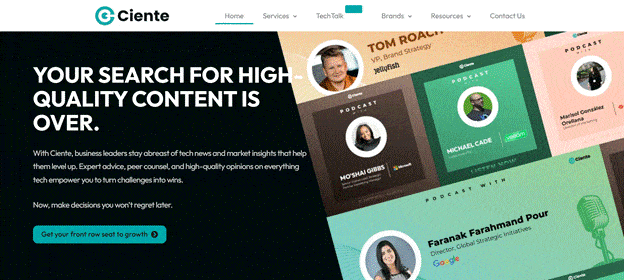
Ciente is a demand gen engine that believes that trust is a fundamental road to growth. Our full-funnel customer-first approach is designed to do just that.

Focus on quality

Our years of on-the-ground experience have taught us that generating demand and translating it into a purchase is all about the right timing and the right content to the right-fitting buying accounts. It’s all about the quality, as opposed to the volume.

Trust building

And the primary step to delivering top-notch quality is about building unwavering trust. At Ciente, we dive deep into audience requirements and preferences. Our primary driver for building trust is our well-researched and up-to-date thought leadership content, from industry insights to the latest tech news.

Market understanding

Demand generation means playing a long game, one that focuses on understanding the market and your buyers, in or out of market. It’s the underlying foundation of our demand gen strategy- to adapt and be proactive, not coercive.

Targeting niche markets

Our focus is crucially on developing awareness and interest that stems from trust, reliability, and authenticity. And the content we publish across our chief and niche publications- Salestech, Infotech, and Martech– lays the groundwork to illustrate our commitment to the same.

Expert insights

Similarly, our expansive library of in-house podcasts, TechTalk, with its vast listenership, is standing proof of our audience-first framework. It’s more of a network, where we focus on decoding market pain points and challenges at the very root.

And delivering expert opinions and insights on the latest market trends from industry thought leaders themselves.

Developing a dialogue: The hidden value

The team at Ciente believes that at the crux of creating valuable content is developing a dialogue that directly correlates to your business hiccups and goals.

Gone are the days of strategies that go nowhere and wrap around the same jargon. Leads that don’t convert and intent that’s just curiosity? We don’t buy into that. Instead, Ciente believes in offering something of real value, something that educates and guides your prospects through the buying journey

Stuck choosing between roads that lead nowhere, we help you uncover a third secret door backed by the latest data insights and in-depth market research.

Services: Full-funnel Demand generation, Lead generation, Data-powered marketing, Content marketing, GTM, Branding and design, and Podcast marketing.

2. Ironpaper

Ironpaper is a B2B growth-centric demand generation agency that focuses primarily on helping clients optimize their sales processes. Its fundamental focus is developing B2B growth engines for marketing and sales success, from strategy to execution. And each facet is supported by data analytics and informed insights.

Demand gen programs at Ironpaper:

The marketing programs developed by the team at Ironpaper are more flexible. It’s technically a learn-and-grow model where they consistently conduct market tests and study buyer needs and opportunities to drive results that are achievable and measurable.

In simple terms, the set goals are realistic. And are preceded by a more adaptive strategic framework that can adapt according to market conditions and client needs.

image 3

Source: Ironpaper.com

Marketing and sales are age-old tactics, but Ironpaper has transformed the generic playbook to attract, engage, and convert ideal customers. From buyer engagement to acquisition, the brand’s mission is to lead with intelligence, maturity, and smartness.

These are the same components Ironpaper applies to the programs it develops.

The additional noteworthy components of Ironpaper’s demand gen:

First, they don’t believe in fluffy marketing or lackluster promises that don’t translate into tangible numbers. That’s their motto- to deliver measurable outcomes and focus on metrics that can be tied to revenue.

Second, Ironpaper’s team ensures that demand generation efforts are improved and iterated to align with sales enablement and qualified lead generation at every step. They don’t treat demand gen as a silo, but as a bridge that connects the right-fit buyer to the right solution.

Third, Ironpaper’s strategies are backed by informed insights and business goals tied together into a disciplined methodology. One that allows them to tackle any marketing or business hiccups, from complex decision-making processes to target account acceleration and sales opportunities development.

Their expertise?

Ironpaper’s objective is simple: “to help remarkable companies grow.” And they deliver on it. The marketing agency understands and highlights the potential you hold, helping you connect with your customers. And ascertain that the customer journey continues to enhance as buyers progress through the funnel.

With Ironpaper, you invest in instilling sustainable growth.

Services: Demand generation, Lead generation, ABM, Sales enablement, and Content marketing.

3. SmartBug Media

One of the leading names in demand generation, SmartBug Media is a full-funnel customer-focused digital marketing agency for businesses to optimize their entire customer lifecycle. Due to its robust capabilities, the company has been recognized as the largest and most decorated HubSpot partner.

It works as an end-to-end partner. And the priority is always consistent communication and keeping pace with clients.

This synergy between the two parties ensures that their values and goals remain streamlined for the duration of the alliance.

image 5

Source: smartbugmedia.com

SmartBug’s strategy is focused on building a resilient course for future growth and success. It doesn’t believe in short-term gains, but helps clients overcome persistent challenges and mitigate potential risks. Basically, it plays the long-term game.

Demand gen program at SmartBug Media:

The marketing agency is recognized for its ability to adapt and tailor solutions for diverse industrial domains and customer preferences. Especially given their expertise across varied verticals and research capabilities.

A misstep that most agencies make is viewing partnerships as one-offs. SmartBug exercises a different motto. For them, each partnership is about maintaining the same momentum at the beginning and after the partnership comes to an end. To ensure this, the team at SmartBug trains teams within the client organization to help them navigate any cracks or punctures in the long term.

Its demand gen approach centers on clients and their needs.

Their expertise?

In other words, its strategy rests on a single philosophy- meeting customers where they are. Before implementing any strategy or building roadmaps, SmartBug takes its sweet time understanding what the client and its audience require.

This tactic positions it as a strategic advisor, not as an implementer.

Services: Customer success and training, Demand generation, PPC and SEO, Revenue operations, E-commerce marketing, and Full customer lifecycle optimization.

4. Walker Sands

The majority of demand gen is about creative insight paired with informed strategies. How else do you instill interest in an audience where none exists?

Walker Sands is adept at this.

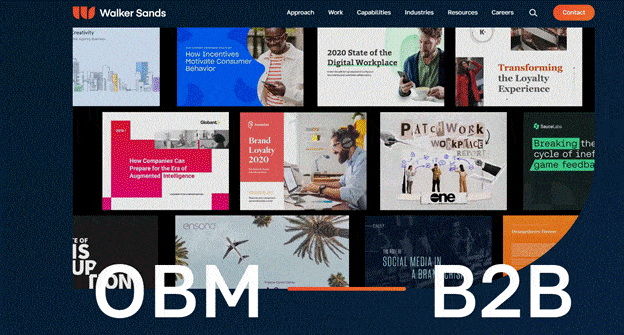
This B2B digital marketing company combines strategies with creative execution. And follow the “outcome-based” marketing philosophy. This means each of their development and brainstorming processes with clients begins with a single question: “How might we achieve your ideal business outcome among your target audience?”

image 6

Source: walkersands.com

Demand gen program at Walker Sands:

For Walker Sands, a truly effective demand gen strategy isn’t about checking steps on a list. It’s about what contributes to real growth- what is the outcome of your campaign? Where are the audience positioned across your overall strategy?

It all boils down to leading with intent and purpose in a way that automatically centers the buyers, not the organization. This way, the digital marketing agency builds its demand gen campaign on your requirements and goals.

You carry the conversation, and they act as consultants. This approach not only builds awareness for your brand or generates leads, but also positions you as a category leader.

Their expertise?

Walker Sands urges you to think bigger and look at the whole picture. Their demand gen strategy doesn’t float upon marketing channel KPIs. But facilitate marketing programs that tie to your brand needs, whether it’s positioning, growth, reputation building, or engagement.

They empower your brand to achieve the most critical goals and inculcate a full-funnel integrated marketing approach. One that is audience-obsessed and revenue-focused.

Services: Digital marketing, GTM, PR, Social media, Graphic and brand design, Copywriting, Campaign development, Content creation, and Digital marketing services.

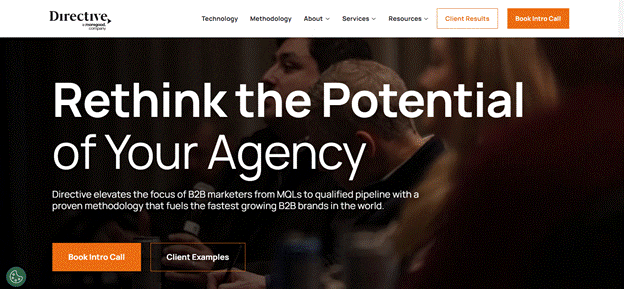
5. Directive Consulting

With marketing expertise across 200+ SaaS and tech organizations, Directive Consulting is recognized as a prominent name in B2B demand generation and performance marketing services. It operates on a single philosophy: campaigns aren’t merely optimized, they’re designed to convert accounts and close deals.

image 7

Source: directiveconsulting.com

In a market where strategies end up in loose threads, Directive ensures that every second of effort and resources spent is tied to the bottom line. In other terms, the agency takes a pipeline-first approach that strategically ties all the assets, channels, and dollars spent to revenue outcomes.

From strategy to execution, every tidbit is attributed the same amount of significance and attention. This ascertains that every campaign, whether GTM or content marketing, is highly impactful. They leverage SEO, paid media, and CRO to deliver the required quality and impact for their clients.

Demand gen program at Directive:

All of Directive’s marketing roadmaps are guided by the concept of “customer generation,” where revenue-centric metrics have precedence over vanity metrics such as impressions and clicks. They report all the tangible outcomes back to you to illustrate any cracks that require tweaking.

It’s about meaningful data, not just a database of noise that leads nowhere.

Their expertise?

Basically, Directive’s model is built for marketing leaders who wish to justify their ROI, reduce acquisition costs, and accelerate their pipeline- technically, whatever goal the client wishes to achieve. All strategies are developed in close consultation with the other party and connect to their broader business objectives.

And the focal point of the demand generation program remains on the entire funnel. It’s not just about attracting prospects, but also converting them with reliability and trust.

Services: Paid Media, Performance design and CRO, GTM, Revenue operations, SEO, and Content Marketing.

Where do brands go wrong with demand generation?

The above demand generation agencies are key market players that have mastered the head and the tail of demand generation. But their approach isn’t limited to hitting the required numbers and then moving on from the campaign. This limited purview only leads to short-term gains.

They know that staying top of mind and lasting success is built on a sturdy knowledge of what you’re doing. And that not all marketing strategies fall into the same basket, irrespective of the shared goal or the same starting point.

Demand gen isn’t another coattail to ride on or a trend to be chased. But this is the mistake B2B demand generation agencies are making- filtering their vitality into just another marketing technique, instead of looking at the whole picture.

Companies need to understand the market a bit better. They create a brand and related products, expecting demand to follow. This isn’t the actual case.

If customers don’t know you and trust your services, their chances of clicking on your ad or even contacting you are nil. This is when brands must tap into problem awareness instead of trying to solve a pain point that the customers aren’t even aware of yet.

If your potential customers don’t realize the problem, how do they know yours is the correct choice?

Demand may already exist in the market in the form of unmet needs. But most of the time, users don’t gauge this need; they remain unaware. Desire or interest (demand) doesn’t exist in this scenario.

So, what demand gen services tend to do is build the demand, i.e., the desire for specific solutions. They don’t merely capture existing demand but create it. But other service providers attempt to do the same.

So, how do you help your clients stand out?

For Ciente, it’s all in the strategy. You must position yourself as the answer to their needs and lacks, and create a demand where none exists in the first place.

In other terms, you create the buzz and position yourself as the solution to your customers’ most pressing needs. But customer needs and expectations fluctuate, which can be frustrating. And end up putting a dent in your strategies and outcome.

The agencies that understand this are the ones worth aligning with.

Mastering Lead Generation for Financial Service & Product Industry

Mastering Lead Generation for Financial Service & Product Industry

Mastering Lead Generation for Financial Service & Product Industry

Marketing for the finance industry is not the same as other sectors. And while the same advice can help you set up it takes something else to win.

Imagine losing a million dollars overnight. If that doesn’t send a chill down your spine, what will?

But for those who do, this mishap is a tragedy.

This is what the buyers of any fintech have to deal with.

The possibility of losing money through no fault of one’s own. To wake up one day with their secured funds empty.

To say trust drives lead generation for the financial and FinTech industry would be quite an understatement. Without trust, the buyers would use their existing solutions till kingdom come. And maybe even then, they’d stick to what works, because our current systems give rise to uncertainty while simultaneously promising its elimination.

Financial buyers are tired of these paradoxical lies and move to organizations that prove they can be trusted or to traditional banking institutions- deeply embedded in the world economy.

If you want to generate leads for your financial or FinTech org, the question is, how do you disrupt the status quo and be considered the safe choice over traditional ones?

There is a leverage here, and it’s called convenience. And the buyers are all about it.

Why do FinTech and Financial services need lead generation?

Lead generation has been getting some bad rep lately. It’s perceived as a way to farm people’s information for data. There’s a reason buyers have become self-directed and choose to engage way later in their buying cycle.

Lead generation has become synonymous with lead lists, which it is not. While high-performing organizations have their own definitions of a lead, lead generation does have a broad definition.

It is the process of gaining the interest and trust of a potential buyer, and turning them (the people) into paying customers.

By this definition, FinTech and the financial services industry don’t just need lead generation but have to sustain themselves through it. Think of this: your SDRs are on-call (cold) and you try to explain what your organization does, and midway, they stop and say, “But our existing solution does this, too. Why do we switch?”

That is a rhetorical question.

They don’t or can’t switch because of the massive changes involved in using a financial service or tech.

There’s a lot of red tape that will hinder it, even if the buyer is genuinely interested in what you have to offer. Lead generation can bypass this by building trust before your SDRs even reach the prospect, as shown in these AI-powered lead generation strategies.

In fact, the buyer will reach you when their need for your solution eventually arises. Your SDRs will have to act as consultants here.

Strategies to Drive Quality Leads for the Financial Industry

Let’s divide this into two parts.

  1. Financial Services
  2. Fintech

Between the two, FinTech has an advantage being the new-age tech, especially after ’08. The crash made people realize just how volatile the banking sector can be and that people needed alternatives. Ever since then, financial services, especially banking, have not yet recovered this trust.

People look to private organizations that mitigate these damages. Instead of lining up in a queue to withdraw their savings, they are secure from the economic downturns in privatized solutions.

For example, Revolut, a tool designed to help you spend and save. But their real promise lies in keeping yourmoney safe.

But the real promise lay in its transparency and becoming a champion of underserved markets.

Something traditional services took a long time to position themselves as.

So, let’s talk about financial services first.

Lead Generation Strategies for Financial Services

Trust is a vital tenet for marketing. Ask any marketer, and they’ll tell you that first and foremost, marketing is all about communicating trust and building a relationship with it as the base.

For financial services, this tenet is magnified. It’s gospel.

The involvement of money means that for people investing in your services, you are a high-risk option. Imagine selling that to a client.

“Hey, you don’t know us, but we’d like to replace your current insurance provider, and maybe we’re not malicious. You can trust us with the livelihood and lives of your employees. We won’t cheat you. Promise!”

If only that were so easy.

1. Building a relationship.

Let’s assume a few things first,

  1. You have a client base, because if you don’t, you need customer acquisition, not lead gen. And customer acquisition requires a sales-led approach first.
  2. You know what you’re doing marketing-wise, i.e., your end goal- X amount of sales. You must have case studies, whitepapers, blogs, email marketing, advertising, and all the basics that need not be outlined because they come before lead generation.

The above two assumptions are also your first steps. But rarely does a financial service start without a client.

While you must have heard about thought-leadership, building relationships is a bit different. It involves inviting your core buyer to check what you have to offer. Many B2B buyers feel their sales calls are transactional.

Here is the opportunity for your brand and solution to try something different. Through sales or through marketing, build a rapport as a problem-solver.

This involves: –

  1. Being active where your buyers are- email, social media, ads, on-calls, etc.
  2. Listening to their problems and asking for market feedback (this is a tough one because it means divesting effort from direct sales and also because the market doesn’t have time to answer).
  3. Asking your sales teams to listen to the problems and using social and email to craft messaging relevant to real-time buyer problems.

This builds credibility. And it is a strategy that is easier said than done. But as you would know, people in finance are cutthroat. And what do cutthroat people like?

A little bit of ROI, honesty, and genuine interest in solving financial problems.

2. Understanding your context.

This is a point that might be universal to all lead generation strategies. To: –

  1. Understand the market’s history with your services
  2. Your context in the current market (which shapes marketing messages).

This step also assumes you have a clear vision of what you’re offering and to whom. If you or the top management don’t know that, then the sharks in finance are going to defeat you.

The reason this step is so important is that it will shape the way your marketing messages sound and your SDRs talk- shaping market perception. For example, let’s say you are a bank selling its salary account to an SME.

The SME has been working with bank XYZ International for a long time. There have been hiccups, yes. But they’re fine with how the bank has helped its employees. But you know the way the SME is growing, the bank XYZ won’t be able to handle the growth.

There aren’t enough insurance plans, and there’s no scope for any 401 (k) or other pension plans beyond government-sanctioned ones.

Your context is this: We safeguard you and your employees while you scale.

This is how context shapes marketing. Won’t you be interested after seeing this message?

3. Leveraging Loyalty.

Why would a buyer change providers? Even in the above example, the SME, now growing, can push the bank to grow, too. After all, loyalty is a major factor in the finance sector. It is a facet of trust.

And while businesses do switch for convenience and growth, they might not give up their existing vendors because they have built relationships. Penetrating new markets is easier, but when competition is at its peak- which it is for financial services- it isn’t.

The conversations you have with your leads will go nowhere.

There’s just too much. You’d have to understand their process, internal money flow, operations, taxes- everything. And let’s not forget the policies the government has imposed on both entities, which are stringent again, because money is involved.

The business has too much to lose in switching. How would you convince them otherwise?

You turn the playbook- you show them the cost of not switching; of loyalty failing when it matters.

Let’s drive this home with an example that does not paint financial services in a good light but also presents an opportunity.

The PPP Loan Disaster

The PPP Loan Disaster must be fresh in many business owners’ minds. COVID-19 struck, and many businesses feared they would go under, but when the Paycheck Protection Program was set in motion, many large banks like Wells Fargo and Bank of America prioritized their bigger clients.

The funding ran out in May, leaving small businesses hanging out to dry.

Tragic.

Loyalty became a cost for SMBs and SMEs who couldn’t survive the harshness of COVID-19 and the apathy of the financial service industry. Many sought refuge in Fintech solutions.

And this is where lead generation transforms from data to a human-human connection. The trick is in loyalty and staying with your customers in turbulent times.

If you make that promise and stand by it, your service would probably dominate the market for years.

For marketing messages, this could take the form of risk-assessment reports, case studies, blogs, outreach, etc. But those are channels and methods of conveying your core message. And the core message for financial services is clear: deliver on the promise of monetary security.

Because FinTech is doing it better.

Lead Generation Strategies for Fintech

For leaders in FinTech, the above section must have made it clear that you have advantages over traditional financial services. So your competition becomes other FinTech solutions, and while you may have trust for the time being, your competition is leveraging something greater: convenience.

Let us preface this part with a little disclaimer: Lead generation is somewhat universal in its methods of omnichannel and multichannel experiences, email marketing, and outreach.

Let’s focus on a real strategy. It has three facets:

  1. Design
  2. Integration
  3. Positioning

a. Design.

In product, design is vital and attention-grabbing (a crucial component of lead-gen!) But beyond that, design informs one thing: Is it easy to use?

Whether it’s the ease with which your client connects to or opens a bank, or the ease with which their finances improve. That’s why Revolut has become such a hot commodity.

Their website on its own screams good design. And if the website is that good, the product can’t be that bad, is what people usually think. And what do you know? Revolut is a great app for personal and business use alike.

The question for differentiation is: Can you build trust through design?

This is what brings leads in. The workflow looks something like this:

Great Idea→ Great Design→ People like Lenny Rachitsky (product people) talk about how great your product and design philosophy is→ organic leads and traffic.

Yes, that is what it looks like for the product ecosystem to thrive. Aesthetics and function are drivers of inbound lead generation.

b. Integration.

Which naturally leads to integration. Great design doesn’t mean the UI is fantastic; it means that the APIs integrate seamlessly with other existing stacks and workflows.

This is a major USP for most organizations, and the one with smooth integration will be the final choice. Whether a business’s AI system, banks, and other workflows can integrate your product will decide how viable your solution is for them.

c. Positioning.

This leads to the final strategy in FinTech lead generation. Positioning your product for the context of the buyer.

Here’s an example for this, too. UPI in India.

The Indian market is a bit different; adoption of tech takes time there. But PayTm, a Venmo-esque app, started gaining traction. And then the Indian government launched the UPI, a universal payment interface, and began the greatest FinTech boom in history.

The main point was to make transactions transparent in a country full of corruption.

Did anyone expect Google Pay to become such a dominant force in the market? But it did, and that’s because Google understood the market and its position. They saw people used PayTM and a native app called PhonePe and conquered the Indian transaction market.

Even now, the two FinTech apps are competitors for a large market. And they show all three facets outlined.

  1. Intuitive Design- they pick up QR codes faster than any app, show bank balances, payment history, spend, etc.
  2. Robust Integration – They are secure and linked to bank accounts.
  3. Positioning- Finding and capturing an emerging market.

This made it so that people flocked to these apps and not vice versa.

This went beyond lead generation and directly into market adoption. This is a clear advantage that products have over services- people can use it and experience the product before adopting it completely.

Lead Generation in finance is complex because it’s abstract.

Yes, there are many abstractions in finance because money is abstract and involves many restrictions, government-mandated regulations, and factors of trust.

It’s red tape everywhere. And lead generation needs to reflect that to gain the buyer for the long term. Without this, financial services become too risky, and FinTech becomes noisy and irrelevant.

It is a lot of work, but you don’t have to do it alone. Ciente has served finance and FinTech since our inception and has understood the principles that drive sales, trust, and growth.

And trust us, without these, a business in the finance industry cannot survive.

The Role of Pricing Strategy in a Successful Go-To-Market Approach

The Role of Pricing Strategy in a Successful Go-To-Market Approach

The Role of Pricing Strategy in a Successful Go-To-Market Approach

Many of the pricing strategies that businesses take for granted today or feel dated were not the norm before 2020.

Let’s look at this article by HBR in 2020: Upgrading your pricing strategy to influence buying behavior.

These are the essential strategies. Frame higher prices as an upgrade or frame benefits in terms of cost or stack discounts.

While industry leaders have known this since the 90s, the public at large has just started to become aware of the subtle pricing cues the industry has set in place to make them buy, and instead of shirking away, people want to see what the tiers have to offer.

Pricing plays a huge part in decision-making, and it’s not because of the cost of the product but the trade-offs required. After all, why does anyone buy but when they have a need? Cross-selling and up-selling require this, too. If the need is not as urgent- why upgrade?

Usually, the answer is: because the price is right (no, not the show).

The trade-off of the price matches the features. And it is this balance that organizations must achieve (btw, this is the tl:dr of the entire blog).

What Is a GTM Pricing Strategy and Why It Matters?

The pricing strategy in GTM is a deliberate choice of positioning your product/service’s cost to better reflect market needs. These market needs are defined by your potential buyers and must reflect their buying habits.

Why does the pricing strategy matter?


People don’t buy because the price is right, they buy because of a desire and need. While B2B buying is logical, buying decisions are based on instinct- a businessperson will trust themselves, the data will just strengthen their case.

The price operates as a data point. When buying and explaining the reason for the buy the price acts as a leverage. A leader can tell their peers “This is their price and here the ROI they can yield us.” A clear comparison that works in the suggesting leader’s favor.

Decision-makers like these are your champions and champions are a core aspect of GTM.

It’s how Slack did it.

Before asking for the price, Slack lets small teams use its app. But once the user knows just how efficient communication through Slack can be- they end up as paying customers. Why? Because their price justifies it.

The pricing strategy in any GTM strategy serves a core purpose: justification.

Why Pricing Is About Trade-Offs, Not Just Cost

The market is full of solutions that look the same. The upgrades they offer are identical, what the tool does is the same, and the distinction between them is negligible.

What remains is the story of the brand and its pricing, often contributing to making the sale.

It’s like a funnel. If the story is good, buyers check the price; if the pricing is optimal, they check the benefits and what it does for them in their context.

In their article, Stoa talks about trade-offs and how each decision has one. It’s a fascinating read for current and aspiring leaders. There’s a particular line that illustrates how professionals think: in trade-offs.

Of course, because neither vendors nor sellers have infinite resources. Money must be mapped, technology must be integrated into existing stacks, and all the hassle of buying a product or service, which includes the scope of failure.

It’s all a web of trade-offs on both sides.

The group of decision-makers has to think about the trade-offs involved before making a decision.

The trade-offs of the buyers that we can think of are:

Market Size

Every organization has a limit to what it can acquire. Let’s look at the TAM of the search engine market, which is estimated to be $185.4 billion in 2024. And around ~80-95% of that market share is held by Google. (which changes depending on whether it’s desktop or mobile)

That’s a lot, but it’s still not 100% because owning any TAM is almost impossible. Even the great AI race, which should have been OpenAI’s, has many competitors.

That’s why decision-makers will think about their SOM first. Will this approach help them capture more of their market or make workflows easier so that it may happen eventually?

And importantly, can they generate enough revenue to integrate your product or service into their stack, and is it worth it?

Tech/Service Integration

One of the most persistent problems with buying and selling any service or product is integration. And it is tough. While many organizations talk about seamless integration, there is a lot of siloed data and tools that make it impossible to do so.

There may be a lot of tools that do integrate seamlessly, but that complexity needs to be managed, and the tool becomes expensive, especially as the prices hit the premium tiers.

But also, if they do need a tool or service like yours, where will they look? At the trade-off #1 and your pricing. Then integration will become secondary. The point would be to choose the best tool based on the safety net it offers.

This is trade-off #2

User Experience

The second is whether the price justifies the user experience. Think of all the cheap alternatives to some tools- everyone uses one in their professional life at some point. These tools are alright at what you want them to do.

But the user experience is not all there. (Of course, there are some exceptions.)

Their customer service may be spotty, or if many users log in, it might start to falter. There’s a host of issues.

Or on the other spectrum, there’s a fantastic tool with everything in place, and the pricing matches that.

That’s trade-off #3.

What is the buyer’s perspective on price?

There are many trade-offs you need to consider in a GTM strategy, but pricing is one that has many strings attached.

The core question will always be: Hey, is this worth it? i.e., worth the hassle, worth the time, worth the effort, and the price decides a lot of that. The buyers want a tool or service that doesn’t add more cost, and if it does, it either returns or multiplies value.

Basic principle; often forgotten.

The price says- This isn’t bad for what it’s worth, or this is too good to pass up, and the price justifies it.

The buyers’ perspective on price will be set by the market you’re addressing. And it goes beyond competitive analysis. When creating or selling a service, organizations undertake complex research to address gaps.

The price must be treated the same way. It must be treated like a gap you’re trying to solve for your core buyers. And the beauty of this approach is that it helps you find the right price.

Popular Pricing Models and How They Fit into the GTM Strategy

  • Value-based pricing
    • Value based pricing is the speculation of what your product/service should be worth.
    • Through research you will identify what the price should be based on number of factors including competition, buyer-problem, market economy, and your product’s role in it.
  • Cost-plus pricing
    • Essentially, setting the price such that it covers overhead costs.
    • For example, if running your organizations costs $100, then your product/service could be priced at $150 to cover the costs. (This is a gross oversimplification.)
  • Competitive pricing
    • This is the one that even the layman knows. Essentially setting a price in response to direct competition.
    • The advantage here is that you can control the narrative and set your price at higher or lower standards than your competitors. I.e., undercutting the competition.
  • Penetrative pricing
    • This one means you undercut to build your brand. A really good strategy if you have a good product, competitive market and funding.
    • For bootstrapped organizations this is a risky move.
    • And raising prices immediately could risk alienation of the audience without clear explanation. (Marketing messages could make it apparent that the pricing is only for a limited time.)
  • Dynamic pricing and Tiers
    • Pricing that changes based on the market and their needs. Tiers fall in dynamic pricing and there is a greater chance of up-selling.
  • Premium pricing
    • Essentially creating an exclusive club through pricing alone. Take ChatGPT’s $200 tier, which outsold and outperformed the rest of the tiers because how good it was. But premium pricing requires a powerful product or service or the buyers won’t be sold on the idea.

While the pricing models are a great start, they miss three crucial elements: TAM, SAM, and SOM.

Your GTM Pricing Strategy is also about the trade-offs.

Now, let’s talk about you: the vendor.

As buyers, people naturally think about trade-offs, but do they do the same when it comes to selling? If that were so, over-promising wouldn’t be a thing.

The Role of Market Size in your GTM Pricing strategy

Essentially, a lot of businesses get their market sizes confused with TAM, forgetting the other two, which actually drive the business.

Let us explain,

So, 1000$ TAM

Maybe out of that, you take your ICP, which are SMBs in say cybersecurity, that goes to $750

And then you niche down to who you can serve, which are SMBs in cybersecurity with a specialization in Kubernetes, then your SOM is actually $450

So that means you will get the chunk of the 450$ pie, not the $1000 one. This matters a lot- because your market size will determine how you can price your product.

Whether you will have to charge a premium or make it cheap will be decided here, based on how much you need to make per customer.

This is your trade-off #1.

The Role of integration in your GTM Pricing Strategy

Second is integration or complexity. SaaS products like SEMrush usually handle complexity well. And well, since most organizations today are built on the SaaS model, handling complexity is done by the servers.

But this can give rise to complexity on the buyers’ side. Integrating existing tools with yours might create silos, and someone needs to work around that. Either the vendor or the buyer has to make compromises.

And for the vendor, these compromises usually mean removing or adding features, especially knowing what the end user might go through. Often, this part is not spoken about in pricing.

It’s all about influencing the buyer, but what about setting a price that matches overhead and maintenance costs?

Or you can leverage this complexity to build tiers- think, the first tier lets your buyers handle the complexity, or tier 2, and so on, you handle it yourself. Now, there’s a reason to upgrade.

The Role of User Experience in your GTM Pricing Strategy

Okay, for this one, you won’t be able to ask for upgrades. You can’t go – you get better service because you’re paying for it.

That will ruin your pricing structure. But user experience matters, and it matters the most.

Everything hinges on how the end users feel and if the buyers see improvement in their teams’ efficiency. Even if your tool is complex and has a harder learning curve, is it learnable and teachable?

And good design requires investment, especially during GTM. Because the window to launch is usually tight. When your sales teams are displaying the tool or getting the buyer to demo it, is it intuitive enough for what it’s doing?

Investing in UX/UI and CX is costly, and the pricing must evaluate this. If it doesn’t, you may lose your customer or revenue. A business cannot run solely on ARR or MRR if it doesn’t break even. And if investors are involved, this is doubly true when pressure to perform starts mounting up.

The Role of CAC and CLV in GTM Pricing Strategy

Which directly leads to your customers. All trade-offs culminate here- everything your organization does yields a dollar price. From electricity to employees and the tools you use.

Your GTM pricing strategy needs to focus heavily on CAC and its CLV, for each customer, how much are you getting back if you charge $X? If the acquisition costs start mounting up and your pricing can’t catch up, that’s going to be a problem.

That means your solution cannot be so cheap that you can’t run your day-to-day. This is why many tools have premium prices and tiers, because running SaaS, AI, Cybersecurity, Data Management, SEO, etc., is not cheap. And, if it is, there is always a hidden cost that the vendors undertake.

Usually, the ones outlined above.

Pricing plays a vital role in making an organization sustainable.

While there is a lot to consider when setting a price for your product and service, it’s a task that many organizational leaders have to undertake.

Funding is good, but balancing the price helps you utilize the cash flow properly.

This is what it means to scale an organization, and that begins with GTM, not after it.