Podcast Marketing Examples: The Best List for All Use Cases

Podcast Marketing Examples: The Best List for All Use Cases

Podcast Marketing Examples: The Best List for All Use Cases

Not all podcasts are created the same. But can there be an objective list? Probably not. But here’s our list of podcasts we love.

Podcasting is having its big moment. It’s like Joe Rogan opened a Pandora’s box that empowered people to be out there, have fun with their friends while making money, and for experts to have conversations with other experts.

It is entertaining and a para-social experience- and if properly produced, almost cinematic. For some reason, people love to listen to others talk – podcasts are the natural evolution of a talk show. However, with less corporate oversight, or at least that was the idea. There are still corporate podcasts that lack the color to be successful.

However, businesses do find niche listeners, and that should never be disregarded; no matter the idea, it should be tried.

No idea, if done with clarity, will fail. And to prove that, here are some podcasting examples that will help you find inspiration, knowledge, and some of what they did to succeed.

There won’t be a boring intro for this one. We won’t be going into what a podcast is, what rules you need to follow to create the best podcast, or how to market it (we’ve already covered that in our podcast marketing strategy piece!).

So here’s the list of the best podcast examples. It’s not ranked and is subjective.

Top Podcasts for Businesses and Business Leaders: Ciente’s Picks

We’ll give you a list of the best podcasts. And you can take these as podcast examples for inspiration, listening, and growing.

TechTalk by Ciente

image 25

This is our show, hosted by Ciente’s CMO Suruchi Bhargava. It is one of the best podcasts for business leaders to be on and listen to.

It’s literally a window into how these leaders work on the ground, something that is missing from podcasts in general. While many podcasts bring in guests, and it’s fantastic, they speak about their industries like a myth. And yes, podcasts are for storytelling, but what about information dissemination?

This is what we have tackled: bringing you insights directly from experts, dealing with similar problems to yours in real-time. It’s a treasure trove for people in marketing, tech, and sales- for tech vendors, this is what your buyers are dealing with, and for tech buyers, this is what your peers are dealing with.

We have an intuitive way of marketing our podcast (there’s more on our blog post on strategies). Essentially, we run simultaneous campaigns and understand that our listeners are people, and since the podcast is very social, we treat it as a piece of human communication, not just another content asset.

Slidebean
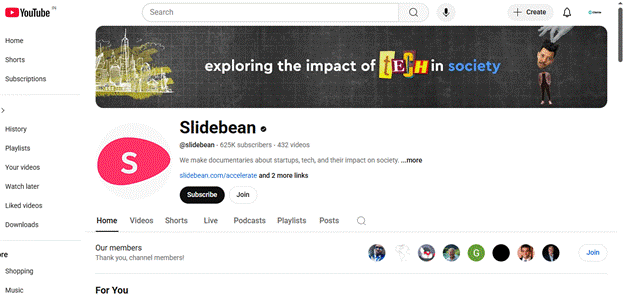
image 19

Slidebean’s YouTube channel is one of the best business podcasts/shows. It’s not a traditional podcast in the sense that two people are talking, but it has the host talking and storytelling aspect. The production quality is top-notch, and the information is relevant.

The show isn’t just for leaders but everyone in SaaS – the videos are short and yet compress so much information, and CEO Jose “Caya” Cayasso is the perfect host- distilling the insights with such an engaging charm.

And the core focus of their channel is the most relevant topic: What is really going on with AI?

They tackle this topic across various domains and perspectives, and it’s perfect for people strapped for time- the videos are no longer than 25 minutes.

The Knowledge Project Podcast

image 24

Shane Parrish has a wild story- he was a cybersecurity expert at an intelligence firm in Canada. He wrote about strategies, deep thinking, and learning on his blog – turns out his readers were from Wall Street.

And if you’ve read content on Farnam Street, his website, you know the information freely available on his website is worth millions of dollars, not that he monetizes it.

But that’s half the story- the knowledge podcast is where the real money is at. He has in-depth conversations with industry experts and stories about them, stories that the public at large is unaware of, like the billionaire who sold blueberries or the deconstruction of Andy Grove, the CEO of Intel.

He shares these lessons of resilience and the value of learning that affects decisions and people on a global scale. While the concept may seem abstract at first, these are tools that transform thinking and shape leaders.

And it is a disservice that it’s only at 333K subscribers on YouTube; it deserves far more. Look at Reed Hastings‘ interview with him and make your own judgment call.

AI in Context by 80,000 hours.
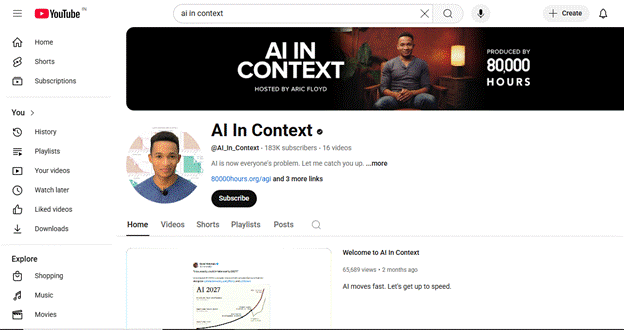
image 20

Okay, hands down one of the best videos on AI we have ever seen. The host, Aric, is charismatic, and the product is on another level. And while it does seem like it is similar to Slidebean’s channel, it is less a podcast and more a docuseries, like Johnny Harris (fair). We’d like to argue that this is a podcast between you and the host.

The information is presented in interview formats with various experts, but the focal point is the storytelling aspect that the viewer and the channel form together. There aren’t many videos, but chances are you have seen the thumbnail of a war room with the words 2027 written on it.

It’s beautiful.

It’s produced by ‘80,000 hours’, a non-profit organization that empowers people to find stability and their life’s calling.

And while you may think, “What does science fiction and speculation have to do with business?” Let’s just stop and consider the effects of AI on our economy- mass lay-offs and techno-oligarchies are already here.

And 80,000 hours has its own podcast, which is quite fascinating if you want to check that out, too. But it’s broader- the topics are varied and can range from biology to geopolitics- and that’s something effective leaders are paying attention to.

This will help you look beyond SaaS.

The Exit Five CMO Podcast (Hosted by Dave Gerhardt)
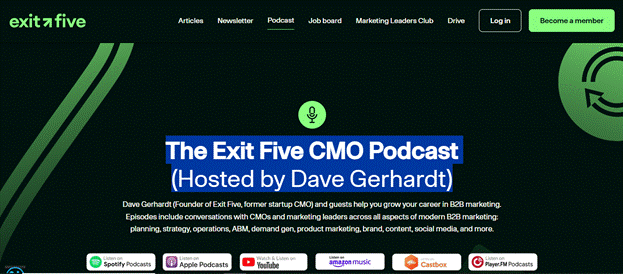
image 22

For a marketing leader, Dave Gerhardt’s podcast is a dream. He has this way of asking the right questions- knowing what is culturally relevant and what is popular in marketing, mixed with timeless principles.

But that’s all technical jargon; Dave’s magnetism as a host lies in his relatable storytelling. Like you imagine industry leaders to be, these corporate giants who speak in an alien tongue, but with Dave, each episode is like two friends having a conversation, and they’re just sharing wisdom over a cup of coffee.

And the crux of the matter is this storytelling. Gerhardt, and basically, Exit 5 is this community for marketers to grow. He transforms marketing from this not-so-accessible field into an approachable subject.

The crucial question marketing leaders have is: what works and why? And Dave has an answer in his podcast.

Scott Galloway’s Prof G Podcast
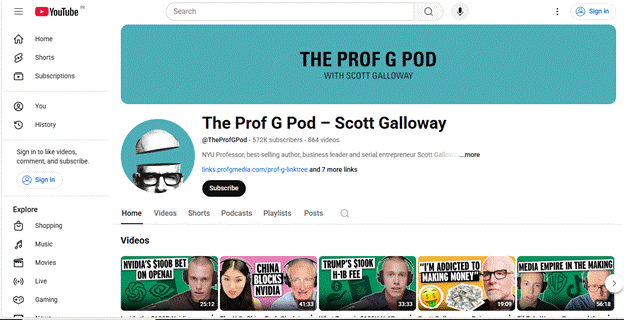
image 23

Scott Galloway. About time the list hits someone “controversial.” And that’s Professor G.

But he isn’t Jordan Peterson, controversial; he’s just that “Hey, no bullshit here” type of person, and that reflects heavily in his podcast. And it is eye-opening for entrepreneurs and young people.

He offers this sage advice that might not always be politically correct by anyone’s standards, but he does have it and won’t shy away from saying it. Again, he does it without being offensive. That’s the NYU professor’s skills at work- he is a teacher through and through.

He has been an entrepreneur himself and has written a lot of books on making money and surviving economic crises- a perfect remedy for today’s times. However, some of his information can seem incomplete; you have to really dig into what he means. He has these Q&As that might answer your question, but with Scott, you don’t know whether you’re getting a thesis or an answer that may not satisfy you until you dig deeper- Scott values brevity.

Lenny’s Podcast
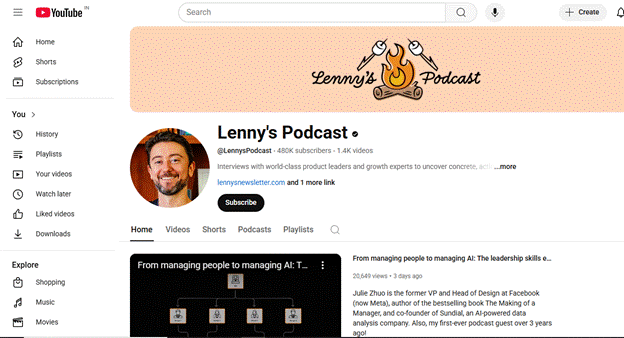
image 21

This is for all the product managers, start-up founders, designers, product marketers, and CEOs. Lenny had his beginnings with his newsletter, which became wildly popular.

And the podcast offers deeper dives into the philosophy of product creation and management- he has this intuitive approach to hosting. He breaks down the principles product people use and dissects these principles to understand his guest’s approach.

And when you listen to him, you’ll understand just how abstract PM is. The podcast transforms all the top-level abstract insights of product management into understandable concepts and actionable pointers that leaders and managers can use to transform their product development cycle.

Why These Podcast Marketing Examples Actually Work

Podcasting isn’t some polished content machine, or rather, it shouldn’t be. It’s raw, alive, and dangerously simple.

People talking, or one person thinking out loud, and suddenly you’ve got an audience leaning in like they’re part of the room. That’s the power.

It isn’t the mic, or the editing, or some secret growth hack.

The best podcasts aren’t afraid of being messy. They don’t hide behind jargon or play safe; they cut through and connect. That’s why they work. Business leaders, founders, or marketers, one thing’s clear: with podcasts, you don’t need perfection. You need clarity, honesty, and the nerve to show up as you are.

Sales Prospecting vs Lead Generation

Sales Prospecting vs Lead Generation: The Distinction Everyone Pretends Doesn’t Matter

Sales Prospecting vs Lead Generation: The Distinction Everyone Pretends Doesn’t Matter

Without prospecting, lead gen is throwing darts with a blindfold on. What can hit the right mark? A reiteration of how prospecting differs from lead gen.

As lead generation efforts remain as linear as ever before, content alone isn’t enough. It sparks interest, but it doesn’t pinpoint if the account is the right fit. Here, even a wholehearted faith in tech adoption cannot hit the nail on the head. This solution is only about cutting corners.

The point isn’t getting a waterfall of leads, but a consistently healthy pipeline of high-quality accounts. Establishing this is where the real effort lies. With teams stretched thin in all directions, what can do the trick?

Well-timed and relevant outreach.

Lead generation without prospecting is an empty shell. 80% of buyers still want to hear from you during their decision-making process, irrespective of any self-research. But it’s only effective with the right timing and context.

Those who come out on top understand prospecting is an integral part of lead generation. Not siloed functions. Others? Their knowledge remains false.

Often used synonymously, prospecting and lead generation are two different funnel functions. And their flawless execution rests on underlining the foundational but vital differences between them.

The Need to Outline the Differences Between Lead Generation and Sales Prospecting

Businesses don’t buy, people do.

A glimpse into and a pivot to a very relational facet of B2B buying has altered a few perspectives. SDRs can’t just tout target accounts about how better, faster, and cheaper the solutions are.

Economic buyers don’t trust such selling.

Your buyers are all too aware of how the market works- they’re sellers and creators themselves. You’re presenting your solutions in an age of saturation, where your competitors can pull one over you and maybe do a better job at penetrating the cold exterior of your target accounts.

This is why taking the path to passive reactivity isn’t effective today. Especially in pursuing complex B2B SaaS sales.

When CEOs feel the business isn’t witnessing any activity on the TOFU, they demand more leads.

Where will the high-quality leads come from? Which team takes the brunt?

In the face of very few high-quality leads, marketing turns to quick peaks from performance metrics. And SDRs are expected to dial numbers for broad outreach. Without any substantial sales performance, these efforts are exhaustive. Siloed functions result in disasters-

Leads that end up going nowhere.

This is why lead generation and sales prospecting must work in tandem. The only stumbling block is amalgamating them as one. The more your business reaches into the account, the better it gets.

So, what can you do?

Implement different means that introduce layers to the lead acquisition and sifting process. There must be synchronicity and alignment to drive pipeline growth. To help your team penetrate the diverse sphere of influence, you should strike a strategic balance between lead generation and prospecting-

By primarily underscoring how they differ from one another.

Learning the Basics: Lead Generation v/s Sales Prospecting

Outreach means identifying and engaging the prospective buyers. That’s the most basic understanding. Whether it’s outbound or inbound, your teams are still researching who your promising accounts are and how you can engage them with the goal of converting them.

But at the bottom, it’s all about getting potential customers into the consideration set, helping them discover your brand at the right time- when they have the “need.” There has to be a rhythm and a process to increasing the receptivity of your messages.

But how?

We move beyond the best practices. The run after best practices has induced a sameness across the market, creating copycats after copycats. It isn’t what you wanted.

This is why it’s crucial to underscore why some businesses implement specific practices over others- where does prospecting reap benefits, and does lead generation ever work?

The methodological differences between lead generation and sales prospecting

1. Who’s Guiding the Processes?

Lead gen efforts are broadly marketing-driven. Because it’s about creating interest and awareness, and attracting new customers based on that. This necessitates a slow build-up and strategic storytelling that tells your brand story and establishes your value proposition.

Customers come to you, but only after you lay the road to your brand. And illustrate that you’re the bigger and better player in the market at the moment.

On the other hand, prospecting is a part of lead generation and sales-driven. Accounts passed on from lead generation efforts are assessed actively by SDRs to determine whether they’re the right fit.

So, you’re identifying those who fit your qualification criteria and then contact them to gauge if they truly are the right fit. And if the comms ascertain this, a meeting is scheduled for further negotiation and then conversion.

2. The End Goal

Lead generation is a one-sided effort by a brand to help relevant accounts take notice of what it can offer them. It all revolves around instilling brand awareness. You have to stand out in the crowded market to show the audience that there’s another player in town, and make an impression.

Meanwhile, prospecting creates a more open line of communication. And proves effective only when the target account is receptive to your interaction.

See, the objective is to schedule meetings, and if the person on the other end of the line isn’t open to hearing you out, it’s the end. Here, you find another pathway or try a hand at warm prospecting (warm follow-ups).

Your sales team researches, finds out the right-fit accounts, and then makes contact with them. Unlike lead generation, it’s more direct and proactive. It offers your team control over lead generation, offering a basis for further nurturing.

3. Communication => Qualification

Lead generation is indirect and a one-to-many strategy. You’re not diving into your TAM to churn out leads and call them right away. Instead, it’s about building multiple bridges to your brand- whether it’s content marketing, SEO ads, lead magnets, or event marketing.

As the accounts interact with these channels, it becomes apparent which ones have purchasing propensity. This is what lead generation is pinpointing- right-fit accounts that require a solution like yours. And then creating awareness like, “Hey, we can help you with your problem!”

Lead gen is about making your brand discoverable.

Whereas sales prospecting dives in deep. This one-to-one strategy works wonders for small businesses, startups, and even B2C customers. Could it navigate the complexities of a diverse B2B buying committee?

It could also prove beneficial to build a connection with at least one POC. Digital transformation can transform prospecting. It’s no longer working with blind folds on. SDRs now hold more information on who they’re calling up or sending emails to. This already gives a sense of whether they’re the right fit.

And helps your sales team avoid intrusive contacting, wasting your and the executive’s time. Because today, people are more strategic about who they give their time to. This is why prospecting cannot be dialing numbers; it must be intuitive.

4. The Approach

Modern lead gen techniques aren’t about generating leads. It includes the nurturing process, i.e., you build deeper and more sustainable relationships with your target accounts. This is why an omnichannel strategy has become a modern B2B marketing prerequisite, especially targeting different stakeholders across a single account.

This way, you’re offering them value that directly relates to their pain points and builds trust for the long term.

But prospecting is about initiating contact with an account you deem the right fit. And further conversation decodes its potential as a prospective buyer-

  1. Who are they?
  2. Do they have the need?
  3. Does this POC have the authority to make the decision?
  4. Do they want to take the conversation further?

Because this is a first contact, prospecting comprises engaging with cold or new accounts, ones with the highest potential for conversion. Your SDRs take a step forward, whereas in lead generation, the interested accounts come to you, and you capture interest.

However-

Prospecting and lead gen, although different, don’t operate in silos.

Almost no marketing campaign or strategy has ever had an immediate effect. But that’s what most marketers trail- immediate, tangible outcomes in a bid to justify their marketing and advertising spend. In this hope, they start prioritizing performance metrics over a sweet balance with brand consistency, which can get them a higher ROI.

The quick peaks have made them delirious. This illusion that numbers drive the business had created a disconnect with sales before. SDRs had one concern- they didn’t trust the leads that marketing sent their way. Often, in an urgency to fill the pipeline, the quality turns out disappointing. This led SDRs to conduct their own set of prospecting. Technically, this is what you do if what marketing gives you is junk.

But that’s not the long-term solution.

Your best quality leads should come from marketing, given that inbound is done correctly. And each lead generated should be followed up by focused prospecting. This is vital to the extremely long sales cycle.

At the first interaction, prospecting offers an overview of market challenges and gaps. Talking to different accounts opens avenues that other channels can’t. You can dive into the mindset of your TAM and address pain points from the nucleus.

Prospecting in lead generation is your most valuable battle card.

That’s how an integrated approach should work. Your leads are already aware of the brand and are serious about a purchase. This allows for little disconnect.

The truth is, you cannot take a one-way ticket to mediocre campaigns. That’s not how modern marketing operates.

When a B2B buyer is searching for solutions, there’s only one scenario here. They come across solutions that sound the same, look the same, and messages that feel the same. In this sea, the B2B buyer’s focus then falls onto the brand’s market positioning and pricing points. None of the brands actually end up making a sale or, for that matter, breakout growth.

Falling into old habits always feels a tad less risky, it’s true, but not sustainable.

This is why a holistic approach is the way forward for all of marketing. No function can operate in a silo. And if they do, you know why your sales pipeline is facing a persistent drought. This sales-marketing misalignment is a rupture for businesses.

And the only way forward is ensuring they align and overlap to build seamless campaigns that focus on the facet that matters most: customers.

Podcast Marketing: Expand Your Influence

Podcast Marketing: Expand Your Influence

Podcast Marketing: Expand Your Influence

Podcast Marketing might be the new frontier. But only if it has a personality; if it doesn’t – you need to rethink.

image 15

Source: An AI image from Stockcake – https://stockcake.com/i/starry-night-storytelling_1201747_1148984

People love storytelling. Even mundane stories remind us of the little joys of life and to observe the different idiosyncrasies of others.

The podcast is the perfect tool for this. It’s this century’s very own sit-around-the-fire storytelling.

There’s always a charismatic host- the fire. Then the wise guest- the elder. And at last, the listeners – a tribe sitting around the fire listening and gaining years’ worth of experiences or the experiences of a storyteller.

For a brief moment, everyone is back to a time when information was passed on verbally. A bit changed and a bit mystical, but still inspiring, hopeful, and informative. This type of communication gave people the courage and mental tools to act.

That’s why the podcast is a cultural milestone; one that has been used to entertain, to diss, and to pass on crucial information.

And this is how you market yours.

Does your business need a podcast?

This is the question you should be asking first. Creating a podcast is a lot of work, a rewarding one, especially monetarily (for brands but also personally for the creator).

It involves: –

  1. Finding a host whom people want to listen to.
  2. Giving your topic a fresh take that hasn’t been done (to the death) before.
  3. Finding and sourcing guests to feature on the podcast, or if it is an internal podcast, having the right people with shareable knowledge.
  4. Marketing the podcast

If you think the podcast may yield a net positive, then go ahead with it. Podcasts are on the rise, but so are concerns of oversaturation. There are a lot of great shows, and attention is scarce. Either you capture it or you don’t; there isn’t much middle ground.

Even engaging shows experience churn, and the listeners move on to newer things.

In short, do it, but it is an investment- time and money, both.

What do you need to start a podcast?

If you do take on the challenge, this is what you will need: –

  1. A mic or two (please invest in a mic, you don’t need a great one, but a good one, and good mics are cheaper than you may think.)
  2. A camera to record (iPhones aren’t bad; neither are smartphone cams, but the podcast will eat storage, so this is something you have to manage)
  3. A host (someone who knows the topic inside out and can speak on it and ask questions)
  4. Editing software (Da Vinci Resolve’s really good, and its free tier is powerful)
  5. Choose a network to host on and an RSS feed link (Spotify is free and offers the least resistance, but there are more. Buzzsprout is a famous one.)

Podcast Marketing strategy

Okay, there is a vital step that should not be skipped: your podcast must be interesting for it to grab people’s attention.

Or else, it is nothing but a marketing gimmick.

That is one of the only prerequisites that will take you far enough- to have something substantial to talk about or in novel ways. Only then will any strategy work long enough to return an investment.

Your podcast will only generate revenue when: –

  1. Your listeners value it.
  2. Your guests (if any) feel like they want to be on it, i.e., if you have high-quality listeners they care about.

The rest is a matter of discovery.

Podcast Marketing Strategy 1 – Embrace the weird

Okay, CEOs and CMOs, strap in. The first marketing strategy we have here is on the presentation, which will set the stage for everything that follows.

The question for the podcast marketing strategy is this: what are you bringing to the table?

However, this idea may seem a bit difficult to grasp. You have products and services you want to sell. Of course, it would be around the topic. But that’s not what podcast listeners need. Look at the trends, and you will see that a podcast is listened to because it speaks to a tribal nature. OR a storytelling hook.

For example, GE launched The Message, one of the most famous B2B Podcasts.

image 16

And that’s in 2016, when podcasts were new and there was increasing traction for them. GE could have leaned into something else, but they didn’t, and that’s why they became one of the most listened to podcasts ever for a while.

Of course, GE had resources, and they could afford a voice cast and effects. But that wasn’t the reason- it was the premise that improved brand-consumer relationships and integrated GE’s offers into the podcast seamlessly.

This means: –

  1. Thinking of new ways of approaching a topic.
  2. Knowing which guests, if any, need to be on the show.
  3. What questions can you ask that haven’t been asked before?

This is the crux of a successful podcast- to investigate what makes a topic interesting.

Podcast Marketing Strategy 2 – Distribution

You cannot depend on the algorithm to make your show discoverable. You must build a distribution channel, and this is where the leaders of your organization jump in.

While the marketing team runs their campaigns on social and owned media like email and advertising, organizational leaders must use their network to disseminate the podcast to their peers.

This is a step that is often forgotten- independent creators have the mammoth task of building an audience and must share and promote heavily on social. What they won’t do for the same resources as a business.

But you do have resources, and one of the best ones is your teams acting as ambassadors. The marketing team can write and craft the message, but your leaders and employees must promote it.

Without this human touch, the podcast won’t grow much. Because, believe it or not, word-of-mouth is vital for a podcast.

Here’s an example of Steven Bartlett, host and creator of the show Diary of a CEO.

image 17

Steve’s show started off simple, in his bedroom with a duvet over his head. But it exploded and continues to bring in big names. How is this possible? He uses content distribution- he atomizes his content and distributes it on YouTube, LinkedIn, TikTok, Instagram, you name it, the guy created content clips for each channel and became one of the most recognized podcasters.

All because of a single method. Now imagine your leaders doing it- the net gain would be insane. But there has to be a cadence set by marketing teams- it cannot be an assault on everyone in the organizational network.

Podcast Marketing Strategy 3- Meta-Storytelling

Content Atomization is the name of the game in this strategy. We are assuming you have done the basics like: –

  1. Researching your ICP
  2. Having an email list and audience to talk to
  3. Handled the technical stuff and recorded the podcast

And they are looking purely for marketing strategies.

In this stage, all you have to do is create meta-narratives for your podcast. These look like blooper reels or something confrontational or wise that comes from behind the scenes.

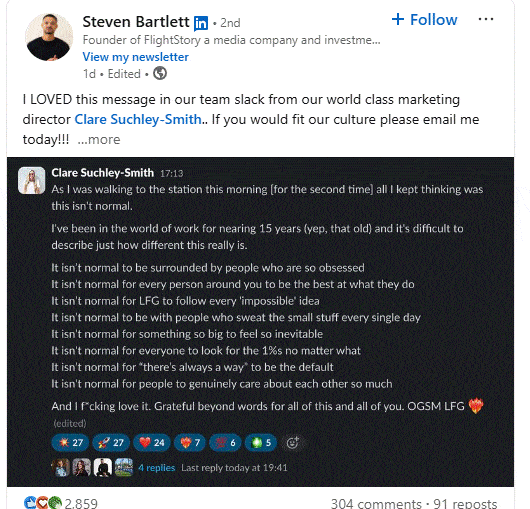
Then, using social media, you show the humans behind the production and their stories. Here’s another example by Bartlett: –

image 18

What does this have to do with his show? Absolutely nothing. It’s engagement. But it leads to storytelling and attracting talent. But that’s not one of the main reasons- the main reason behind this is to show how he runs things, and that attracts people.

The meta-narrative here is that the culture is a goldmine, and the guests are attracted to it.

This is the same playbook Alex Hormozi uses; he breaks his content down to sell or attract crowds to his offers. People talk about meta-narratives more than they talk about the podcast itself.

People love talking about each other’s highs, lows, and entertaining aspects. Whether you use social for this, an influencer, or your owned media, your audience needs to care about the people, especially the host, making the show.

A podcast isn’t just content; it’s a fire you build. And like any fire, it needs care, fuel, and people who believe in gathering around it.

Podcast Marketing about treating it like a show, not an afterthought.

Podcast marketing is tricky. However, the thought leadership and brand relationships it builds are undeniable. Listeners and guests come to enjoy the show and the host- this is a given.

But what do many brands do? They run it like an afterthought with little effort and personality. Is that what your audience or you want?

What about your guests? Are they on the show because they want to sound smart or because there’s actual value they want to share? It’s usually the latter, but it ends with the former happening because the host doesn’t infuse it with personality.

It’s difficult for brands to produce these shows- clear ROI is not visible, especially at the beginning, and then topping it off with distribution? That has got to be tough.

That’s why Ciente helps brands market their podcasts and empowers leaders to become living brands through our own TechTalk. But the central focus is to get your voice out there. Or improve your podcast’s visibility.

In the end, Ciente helps you focus on what you do best: create and speak to your audience, while we amplify what’s already there to the right people.

Traditional vs Predictive Lead Scoring

Traditional vs Predictive Lead Scoring – The right choice for your company?

Traditional vs Predictive Lead Scoring – The right choice for your company?

For many businesses today, the biggest goal to be a success is to generate a lot of leads. However, a lead goes through a long journey from being interested to actually signing up as a customer.

As per recent statistics, the average conversion rate from leads to customers is only 5%.

Does this mean that businesses will always have 95% of their leads unconverted? Not exactly. With advances in technology, marketing tactics have also evolved. From social media publishing software to advanced analytics tools, we have a wide range of options to choose from today. Additionally, managing leads has also moved from the traditional ways of gathering leads, cold calls, and scoring the leads based on outdated, manual techniques to better, more effective ways, including automated lead scoring and lead scoring predictive analytics.

In this article, we’re discussing lead scoring and comparing the traditional method to the predictive method.

But first, what is lead scoring?

Lead scoring is one of the most efficient ways to measure the quality of leads, which allows businesses to reduce the conflicts between the sales and marketing efforts. Specifically, it is a process of assigning a numerical value or rank to a lead based on a set of criteria and their likelihood to convert into a paying customer of the company.

Lead scoring allows companies to use their budget and efforts more efficiently by only focusing on leads that matter and will be highly likely to take action (such as a purchase, a sign-up, etc.). It helps businesses answer questions such as “Which leads should be followed up with immediately?”, “Which lead is showing higher buying signals?” and “How do we know which lead is qualified?”.

It can be done with two methods – traditional and predictive. Let’s talk about them in detail.

What is traditional lead scoring?

Traditional lead scoring, or manual lead scoring, used to be an efficient method of finding the best and most profitable leads for a business before the introduction of machine learning solutions. The method is called “traditional” because it relies on your team’s collective experience, common assumptions, and historical trends that apply to your business.

There’s no single proven or effective method of defining the criteria of traditional lead scoring. The scoring model is designed purely on assumptions. Here’s a simple breakdown of the key steps involved in lead scoring:

1. Identifying Key Characteristics

The sales and/or marketing team of a business first decides the factors that they believe indicate readiness of a lead to convert. It is generally a mix of demographic, firmographic attributes, and behavioural actions. The demographic/firmographic attributes may include anything from the industry that a lead belongs to, the revenue they make in a year, to geographic location and company size.

For example, if you are targeting companies or decision makers of companies belonging to the SaaS industry within the New York area and with a 500+ employee base, the scoring will be high for the leads that specify these details. If the lead’s geographic location is in the LA area, they will have a lower score. Similarly, if they don’t belong to the SaaS field, their score will be low as it makes them less likely to go for your services.

Further on, the behavioural actions typically include criteria such as “clicked the landing page link”, “initiated checkout”, “requested a product demo”, or “opened an email”.

2. Assign Point Values

As specified previously, lead scoring is a numerical method. Therefore, you will manually assign a numeric score to each of the criteria.

Following up on the example above, the score can be:

  • SaaS Industry – +20 Points
  • New York Location – +15 Points
  • 500+ Employee Base – +20 Points
  • Opened An Email – +15 Points
  • Requested a Demo – +30 Points

3. Create The Formula

So, when any new lead enters your database, you’ll have a set formula based on the point values above that will automatically score your leads before they’re contacted. The system will check the criteria they meet, the total points, and the final score based on that.

So if a lead is from the SaaS industry, based in New York, part of a 1000+ employee base, and opened all the emails and even signed up for a demo, they’re the highest-scoring lead and must be regarded with the most attention by the sales team.

4. Set Thresholds

Based on the final score, you may set different thresholds that prioritize the leads. For example, a lead that comes within the 80-100 score must be immediately contacted, and then you can further move to leads that fall under the 50-80 and lower score thresholds.

Pros and Cons of Traditional Lead Scoring

The Pros

  1. Full Control

Your business has full control and the final call when it comes to the qualifying factors, thresholds, and more. You are the decision maker of the final score, and you can adjust it as you wish.

  1. Very Little Setup Needed
    There isn’t any complex software needed for traditional lead scoring. You can choose a good CRM, such as Hubspot predictive lead scoring or Salesforce, that includes scoring features. You don’t need to be too tech-savvy to use the software either. It’s easy and quick.
  1. Transparent

Traditional lead scoring is very transparent, as you know exactly how the leads were scored, and you can edit the scoring factors if you need to. It provides more credibility to the lead score as you decided everything yourself. The sales teams can also find it more reliable as they helped build the model.

The Cons

Despite being a familiar method of lead scoring, traditional lead scoring has several disadvantages.

  1. Subjective

This type of lead scoring is assumption-based and has no definitive proof of effectiveness. Your assumptions may not always match the actual behaviour of the leads and can still be ineffective when trying to convert them into paying customers for your business.

  1. Labor-Intensive

Traditional lead scoring is fully manual. You will always have to assign someone or even a team to manage and maintain the scoring criteria, or it could get outdated and unusable in the long run.

  1. Limited Data

Traditional criteria will always be limited. You can only consider demographic, firmographic, or behavioural data when qualifying your lead, and that may limit your business from finding the most qualified customers. There’s no traditional way to understand subtle patterns.

When is Traditional Lead Scoring the most effective?

Traditional lead scoring can work for you if:

  • Your sales cycles are direct or straightforward
  • You have a limited number of leads coming in (50 or less than 50 in a month)
  • You don’t have the budget or experienced personnel for AI-driven tools
  • You want something easy to explain to your team

Now, let’s move on to predictive lead scoring.

What is predictive lead scoring?

Predictive lead scoring takes the assumptions out of the picture. It is a modern, AI-powered approach that uses up-to-date machine learning capabilities to decide which leads should be prioritized and which ones are less likely to convert.

So, instead of a team deciding on the factors to qualify a lead, predictive scoring pulls data from multiple sources, analyzes your business’s historical data to figure out patterns from past customers, and calculates the score automatically, without human intervention.

Machine learning is used in this method as it can process thousands, and even millions of data points, and identify the clear signs of conversion specific to your business.

The Process of Predictive Lead Scoring

  1. Gathering Data

The first step in predictive lead scoring is pulling together a big dataset that contains past leads and opportunities, the conversion rate of those leads, and how they interacted with your business. This dataset can include anything from demographic data, behavioural data, to engagement data and purchase history.

This is a key step because it is the foundation on which the machine learning techniques will be based.

  1. Training the Machine Learning Model

Once the data is gathered, the system will analyze all the information to look at statistical patterns that help qualify a lead. For example, the patterns can tell what the high-converting leads had in common, which combinations of actions can be predicted, and if there’s any data that was overlooked in the process (such as the timing). 

For example, the model may find out if a lead downloaded more than 3 resources within 15 days, or if they viewed the pricing page twice but didn’t check out, and if there are any specific demographic or firmographic data that makes them more likely to buy.

  1. Score New Leads Automatically

After the past data is analyzed, the machine learning model uses the insights and analytics from it to score a new lead. It will compare the patterns of the past leads with those of the new ones to assign a score.

Now, this score is usually not like the traditional methods (like +10,+20, etc.). It is more likely to be a probability of conversion. For example, Lead A has a 50% chance of conversion based on their patterns, Lead B may not convert as it has only a 5% chance and similarity to highly converting past leads. This will help your sales team decide the priority of contact.

  1. Continuous Learning and Refinement

You may think that the model only takes into account the past data and analyzes new leads based on that. However, predictive lead scoring evolves constantly. It keeps changing its scoring technique based on how the new leads are also performing.

For example, if a product was purchased more in the first week of the month, but now the leads have a higher chance of conversion in the middle of the month, the model will automatically update its criteria. This is also applicable if your product has evolved over time.

The Pros and Cons of Predictive Lead Scoring

The Pros

  1. Objective and data-driven

There’s no guesswork or assumptions in predictive lead scoring. Every criterion is data-based and not based on personal anecdotes or gut feelings. This results in better-qualified leads and a higher likelihood of better conversion rates.

  1. Scalability

There is no limit to the number of leads or data points in predictive lead scoring. Machine learning models can take millions of data points into account before building qualification criteria. From CRM, MAP, ad platforms, to billing systems, product telemetry, predictive lead scoring, AI can analyze everything and put it into context, which would be impossible if done manually.

  1. Higher Accuracy

The average conversion rate of leads with predictive lead scoring is 15% as this method is more accurate and fact-based. Studies also show that predictive models constantly outperform manual scoring as they process dozens of data points in real time. So, if there are any early warning signs that may help you upsell or re-prioritize leads, the model will predict them.

The Cons

  1. Highly Dependent on Data Quality and Quantity

Predictive lead scoring isn’t built for businesses that don’t have proper data in place. Any inaccuracies, such as missing data, duplicate records, or inconsistent tracking codes, can entirely break the system, leading to miscalculations and inaccurate predictions.

  1. Complexity & Cost of Implementation

Since this method involves handling and managing data accurately, only qualified data engineers can stitch the sources together with the additional help from data analysts. Not only will this cost more, but it will be more complex to set up, especially for smaller firms.

  1. Change Management

Not only is the method laborious to set up, but there is also the challenge of building trust. Sales teams may not trust the model and still rely on gut instincts and familiar patterns to predict conversion rates, even if they may be inaccurate. Additionally, if the business changes in any way, such as introducing a new product, new pricing, or situational changes, the model will produce incorrect results that may not be useful.

When does predictive lead scoring work best?

Predictive scoring can be highly beneficial for your business if:

  • You have lots of data about leads and customers
  • You want to automate your lead processes and scale lead qualification to find higher converting leads
  • Your sales cycles are very complex and can be better managed with a machine learning model
  • You have a CRM and marketing stack that is capable of integrating these models

Traditional Lead Scoring vs Predictive Lead Scoring

AspectTraditional Lead ScoringPredictive Lead Scoring
SetupManual rules and assumption-based data pointsML-driven, automated data based on analytics and patterns
DataLimited (explicit fields, behaviors) such as demographic/firmographic and behavioural patternsLarge, multi-source datasets that aren’t limited to demography or behaviour
AccuracyDepends on subjective assumptionsBased on patterns from real outcomes and past lead data
MaintenanceNeeds manual updatesCan auto-adapt as data changes
Use Case Fit  Small teams, simple processesLarger teams, complex funnels, rich data

The Hybrid Lead Scoring Approach

If you want to combine the best elements of traditional lead scoring with those of predictive lead scoring, your business can have a hybrid, unified framework. To elaborate, if you want to blend human expertise with automated lead scoring, a hybrid approach will work best for you. Not only will this reflect the company’s strategic priorities, but it will also have objective data for qualifying leads.

Machine learning, in a hybrid lead scoring approach, is used to identify correlations such as the behaviours that are most predictive of conversion. On the other hand, human teams still hold the ability to adjust, override, or change specific factors according to the changing goals of your business.

This approach is getting more popular now as it provides a middle ground to the companies between the simplicity and transparency of traditional models and the scale and accuracy of predictive systems.

But how will this method work?

Let’s look at a step-by-step functioning of the hybrid lead scoring model:-

  1. Data Preparation and Pattern Discovery

This step will involve using machine learning to look at historical data. This data can still be unlimited, as in predictive lead scoring, as opposed to traditional lead scoring, where you can only look at specific data. With the help of data, machine learning will analyze patterns that tell you the combinations in which a lead had a higher chance of conversion.

  1. Generation of Predictive Scores

The scoring will still be predictive and provide results that tell the probability of conversion of a lead. The score is dynamic and will be updated with any changes in your business.

  1. Application of Business Rules

This is where traditional lead scoring comes into play. Your sales and marketing teams can define any type of rules and adjustments to the model. For example, you wish to strategically focus on businesses belonging to specific industries, or you can eliminate any lead that comes from your competitors’ domains.

  1. Calculation of the Final Hybrid Score

This system will help you blend the predictive components with manual adjustments to come up with a more transparent and accurate scoring formula. This balance helps you ensure that the data is grounded in real data, accurate, and aligned with your strategic objectives.

Why do businesses need lead scoring?

Predictive or traditional, lead scoring does have massive advantages and can prove to be highly useful for a business. Here’s why your business should go for lead scoring:

  1. Focus Limited Resources on the Right Opportunities

Your business may have limited resources and even time to manage leads in a day. Automated lead scoring helps you prioritize and focus your resources on only the leads that matter and have a higher chance of conversion. Cold calling or campaigns are no longer effective and can waste precious resources.

  1. Align Sales and Marketing Teams

Sales teams often complain that the marketing team isn’t providing them with high-quality leads. This changes entirely with lead scoring. Before the sales team contacts a lead, it is already scored with lead scoring tools and prioritized to increase sales efficiency.

  1. Improve Conversion Rates

This goes without saying that conversion rates will certainly increase with any type of lead scoring. You will know what to focus your efforts more on – whether it is on marketing campaigns or on improving sales processes. The leads that score well will be more relevant to your business, and if prioritized properly, will convert more.

  1. Create Consistent, Repeatable Processes

Instead of relying on individual reps’ instincts that can change rapidly, lead scoring builds a standard and consistent process of qualifying leads. This consistency makes your pipeline more accurate and predictable.

  1. Maximize ROI and Marketing Spend

You’re already putting in your resources to gather leads through paid ads, content, and even events. With lead scoring, you can ensure that you extract maximum value and returns out of those investments by focusing only on your most promising prospects.

Conclusion

Lead scoring would have been a “nice to have” marketing exercise a few years ago. But now, it is a standard practice.

Irrespective of the scoring method that you use, the end goal will always be improving brand-to-customer relations and generating ROI.

If lead scoring is done well, your marketing and sales teams can be more aligned, your efforts will be wasted less, and customer acquisition will be more predictable, scalable, and most importantly, profitable.

Lead Generation for Telecommunications

Lead Generation for Telecommunications: Converting Network Anxiety into Revenue

Lead Generation for Telecommunications: Converting Network Anxiety into Revenue

Each industry has its own marketing rules. But every piece online treats it the same- this is misleading. Every industry has it’s own methods- here’s them for telecomm.

Your client’s network goes down for three minutes.

Three minutes.

In those 180 seconds, they lose $47,000 in revenue. Their support tickets explode. Their customers rage on social media. Their CEO gets a panicked call from the board.

And guess who they blame?

You. The telecom provider they trusted with their business-critical infrastructure.

The telecommunications industry is worth $1.8 trillion globally, dwarfing most sectors we obsess over in B2B marketing. Yet telecom marketing remains trapped in technical jargon and feature lists that completely miss what keeps enterprise buyers awake at night.

Your telecom clients’ prospects aren’t shopping for bandwidth or latency specs. They’re buying insurance against career-ending disasters.

Understanding Lead Generation in Telecommunications

Lead generation in telecommunications means positioning your clients to show up before the crisis hits. Before their prospect’s current provider fails them. Before enterprise buyers realize their network can’t handle growth.

Take how Verizon Business approaches healthcare systems. They don’t lead with 5G speeds. They lead with zero-downtime promises for patient monitoring systems. Because a dropped connection in an ICU isn’t a technical glitch for their healthcare prospects. It’s a malpractice lawsuit waiting to happen.

Traditional lead generation focuses on generating interest. Telecom lead generation requires your clients to generate urgency around risks their prospects haven’t even considered yet.

The process involves positioning your telecom clients to:

  1. Identify decision makers across IT, operations, and finance at target enterprises
  2. Understand prospects’ current infrastructure breaking points
  3. Position your client’s solution as risk mitigation, not feature enhancement
  4. Create content that educates prospects on vulnerabilities they didn’t know existed
  5. Build relationships before enterprise buyers desperately need solutions
  6. Convert fear into long-term contracts for your telecom clients

Why Telecommunications Lead Generation Differs from Every Other Industry

SaaS companies worry about churn rates and user adoption. Telecom buyers worry about congressional hearings and regulatory fines.

When AT&T’s network failed during the 2016 presidential election, affecting 911 services across multiple states, it wasn’t just a technical problem. It was a national security issue. Heads rolled. Contracts got terminated.

Your telecom clients’ prospects know this reality intimately.

They’ve watched competitors get destroyed by single points of failure. They’ve seen CEOs resign over data breaches that started with network vulnerabilities. Enterprise buyers understand that choosing the wrong telecom partner doesn’t just impact quarterly results. It can end careers.

This creates buying cycles that stretch 24-36 months for your telecom clients. Not because enterprise buyers are slow, but because they’re terrified of making the wrong choice.

Multiple stakeholders get involved:

  • IT directors who understand technical requirements
  • Finance teams calculating total cost of ownership
  • Legal departments reviewing compliance implications
  • Operations managers planning for business continuity
  • C-suite executives who’ll take the blame if things go wrong

Each stakeholder has different nightmares about what could go wrong. Your marketing must speak to all of them.

Strategies for High-Quality Telecom Lead Generation

Generic B2B marketing advice tells you to “create valuable content” and “nurture leads through the funnel.” Useless platitudes that ignore the unique psychology of telecom buyers.

Telecom buyers don’t want to be nurtured. They want to be protected.

But here’s the messy reality: protection without proof is just another sales pitch. And in telecommunications, proof comes in the form of trust that’s been battle-tested under pressure.

Turn Infrastructure Paranoia into Competitive Advantage (But First, Earn the Right to Their Fears)

Your prospects live in constant fear of infrastructure failure. The smart ones, anyway. The rest will learn the hard way.

But you can’t just walk into their boardroom and start listing everything that could go wrong. They’ve heard disaster scenarios before. From consultants selling expensive audits. From previous vendors who overpromised and underdelivered. From internal teams trying to justify bigger budgets.

The difference between fear-mongering and trust-building lies in specificity and experience.

Don’t create generic “What if your network fails?” content. Create “Here’s how we kept Regional Hospital’s ICU connected during Hurricane Maria when the primary data center flooded” case studies. Show the actual runbooks you executed. Include timestamps from incident reports. Name the stakeholders who can verify your response.

Your marketing should validate their fears through documented competence, not theoretical disasters. Because validation without demonstration is just anxiety amplification. And anxious buyers don’t convert. They freeze.

The messy part? This approach requires admitting when things have gone wrong. When your own systems have failed. When you’ve made mistakes that cost clients money or sleep.

Most telecom marketing avoids this complexity. Perfect uptime statistics. Flawless implementation case studies. Zero mention of problems solved or lessons learned.

But buyers smell this sanitized narrative from miles away. They know network failures happen. They want providers who’ve survived them, not ones claiming they never occur.

Share the 2 AM calls you’ve fielded. The emergency patches you’ve deployed. The client relationships that survived major incidents because you handled the crisis with transparency and competence.

Trust in telecommunications isn’t built on promises. It’s built on performance under pressure.

Master the Multi-Stakeholder Buying Committee (While Understanding They’re All Covering Their Own Jobs)

Telecom purchasing decisions involve 12-15 stakeholders on average. Each with veto power. Each with different priorities.

Each terrified of being the person who chose the wrong vendor.

Your CFO cares about OpEx reduction and predictable costs. But underneath that spreadsheet obsession lies fear of budget overruns that could cost their credibility. Your CISO worries about security certifications and audit compliance. But they’re really worried about being the executive who allowed the breach that made headlines.

Generic marketing messages satisfy nobody because they address surface concerns while ignoring underlying anxieties.

The committee dynamics get even messier when you consider internal politics. The IT director who got burned by the last vendor implementation doesn’t want to stick their neck out again. The operations manager who’s been with the company for fifteen years has seen plenty of “revolutionary” solutions fail spectacularly.

These stakeholders need different types of trust-building:

For Budget Holders: Don’t just show ROI calculations. Show clients who achieved those returns and the specific timeline for payback. Include the unexpected costs that didn’t materialize because your solution handled edge cases properly.

For Technical Teams: Skip the feature comparisons. Provide access to your actual engineers for technical deep-dives. Let them see your internal documentation. Offer paid pilot programs where they can stress-test your claims.

For Legal and Compliance: Provide detailed audit trails from similar implementations. Share the compliance reports from clients who’ve passed inspections using your infrastructure. Connect them with your legal team for direct conversations about liability and indemnification.

For Executives: Give them the phone numbers of other executives who’ve survived crises using your systems. Not marketing references, but genuine peer connections who can discuss both successes and challenges honestly.

The reality is messier than nurture tracks and content personalization. Committee members need to see evidence that choosing you won’t destroy their careers. They need trust that extends beyond your marketing department’s promises.

Leverage Regulatory Pressure as Sales Acceleration (Without Becoming the Compliance Vulture)

Telecommunications operates in a regulatory minefield. HIPAA for healthcare networks. PCI DSS for payment processing. SOX for financial services. GDPR for European operations.

New regulations appear constantly. Existing ones get stricter interpretations. Non-compliance carries seven-figure fines and criminal liability for executives.

But here’s where most telecom marketing gets slimy: they use regulatory fear as a bludgeon instead of a bridge.

“Did you know the new GDPR requirements could cost you millions in fines?”

Yes, they know. They’ve received seventeen similar emails this month from vendors trying to capitalize on compliance anxiety.

Smart regulatory positioning requires understanding the messy implementation reality, not just the headline requirements.

Take HIPAA compliance. It’s not enough to say your solution meets HIPAA requirements. Every vendor claims that. What matters is how you’ve helped similar organizations navigate the actual compliance process.

The endless risk assessments. The staff training requirements. The audit preparation that consumes months of internal resources. The ongoing monitoring that never ends.

Share war stories from actual implementations. The healthcare client who passed their first HIPAA audit with zero findings because your team helped them identify gaps before regulators found them. The financial services firm that avoided SEC penalties because your incident response procedures exceeded minimum requirements.

Regulatory pressure creates urgency, but trust creates action. Without both, you’re just another vendor trying to profit from their compliance headaches.

The messiness comes from timing. Regulatory deadlines don’t align with budget cycles. Procurement processes take longer than compliance windows. Implementations require testing that can’t be rushed even when auditors are breathing down their necks.

Your marketing must acknowledge these realities while positioning your team as the one that makes impossible timelines possible. Not through corner-cutting, but through preparation and experience.

Convert Downtime Horror Stories into Trust Signals (By Owning Your Own Failures)

Your buyers have war stories. Network outages during Black Friday. Security breaches that made headlines. Failed upgrades that took systems offline for days.

These experiences create distrust around vendor selection. Previous providers promised reliability and delivered disasters.

But here’s what most telecom marketing gets wrong: they only share success stories while pretending failures never happen.

Smart trust-building requires acknowledging that things go wrong and showing how you handle them when they do.

Share the client whose primary connection failed during their busiest sales day of the year. But don’t just mention that your backup systems kicked in. Explain the specific response timeline. The communication protocols you followed. The post-incident analysis that prevented similar failures.

Include the mistakes you made during the crisis. The notification delay that caused unnecessary panic. The backup system that didn’t work exactly as planned but got resolved within acceptable parameters. The client relationship management that turned a potential disaster into deeper trust.

This approach separates experienced providers from pretenders. Anyone can claim 99.99% uptime. Only proven providers can explain what happens during the 0.01% and why clients stick with them anyway.

The messy reality is that transparency about failures requires legal approval, client consent, and careful balance between honesty and competitive positioning. Your lawyers will hate this approach. Your sales team will worry about giving ammunition to competitors.

But buyers crave this honesty because they’ve been burned by vendors who disappeared when problems emerged. They want partners who acknowledge reality instead of perpetuating the myth of perfect reliability.

Position Redundancy as Revenue Protection (While Proving You Won’t Overengineer Their Problems)

Redundant systems cost more upfront. But downtime costs more forever.

The challenge is proving this equation without sounding like every other vendor trying to justify premium pricing through fear tactics.

Help prospects calculate the true cost of their current single points of failure. But go beyond generic downtime calculators that every competitor uses. Map out the specific cascade effects for their industry, their customer base, their operational structure.

A retail client’s Black Friday outage costs differently than a healthcare provider’s patient monitoring failure. The calculation includes lost revenue, but also reputation damage, regulatory penalties, customer acquisition costs for replaced business, and internal productivity losses during recovery.

Show them how you’ve helped similar clients model these risks and make informed decisions about appropriate redundancy levels.

The Data-Powered Marketing Framework Your Competitors Don’t Understand

The Data-Powered Marketing Framework Your Competitors Don’t Understand

The Data-Powered Marketing Framework Your Competitors Don’t Understand

Stop worshipping dashboards. This is a human-first, data-powered marketing framework that sharpens marketing intuition, surfaces buyer nuance, and turns analytics into decisions that actually move revenue.

Let’s be blunt: everyone talks about being “data-driven” like it’s a moral badge. Dashboards are worshipped. Attribution models are sanctified. Yet most teams who brag about being driven by data are doing the same thing every agency ever did: tinkering around the edges of the story the buyer is actually telling.

Here’s the thing: data doesn’t buy anything. People do. Data is a tool that helps you understand the people who buy. That’s it. Everything else is posturing.

If you’re a marketing manager, CMO, or a founder with a spreadsheet fetish but a gnawing feeling that something’s missing, you’re in the right place. In this article, we’ll break down a practical, human-first data-powered marketing framework that focuses on the why behind the numbers.

The Lie of “Data-Driven”: Why Numbers Aren’t Enough

“Data-driven” sounds nice because it sounds scientific. But it’s half-baked when the scientific method stops at correlation. Most teams treat dashboards like gospel and confuse what with why. Conversion rate went up; great. But why did it go up? Who did it help? Which buyer did you make feel smarter, faster, or safer?

Aggregates are seductive—they average smooth complexity into tidy numbers. But averages are where buyer nuance goes to die. The “average buyer” is a statistical ghost that rarely, if ever, exists in the messy world of real decisions.

Two problems stand out:

  • The problem of averages. Optimization for the mean often sacrifices the extremes—those who become your best customers or the ones who churn and damage your brand. If you optimize the dashboard, you may be optimizing for the wrong customer.
  • The missing why. Quantitative data shows what happened. Qualitative insights reveal why it happened. Without both, your intuition is flying blind or your data is directionless.

So, if data on its own is incomplete, what’s the alternative? Not anti-data—pro-intellect. Not intuition over analytics—a marriage of both. That’s what having a true data-powered marketing framework means.

The Purpose of a Data-Powered Marketing Framework

A data-powered marketing framework does three things:

  1. It surfaces buyer nuance so your messaging fits a person, not a persona spreadsheet.
  2. It sharpens marketing intuition by turning observations into testable hypotheses.
  3. It confirms buyer logic—testing isn’t about micro-optimizations; it’s about validating the story the buyer is telling you.

This framework is tactical. It’s about re-allocating where you spend your brain cycles: less worshipping of metrics, more interrogation of their meaning.

Below is the practical architecture I use with teams who are already fluent in analytics but starving for insight.

Pillar 1: Gathering the Right Data (Quantitative + Qualitative)

If you only feed your brain quantitative data, you will always be missing half the conversation. Conversely, if you only collect anecdotes, you’ll never scale what works. So you need both, intentionally stitched together.

The Quantitative Toolkit (The Skeleton)

These are the cold signals that show patterns:

  • Website analytics: user flow, time on page, micro-drop points. Not just sessions—where do users hesitate?
  • CRM & product data: time-to-value, cohort behavior, repeat purchase, LTV signals, churn triggers.
  • Sales data: win/loss reasons, deal velocity, objection patterns logged by salespeople.

These tools show where things break and where things stick. But they are silent about motive.

The Qualitative Toolkit (The Texture)

This is where the buyer’s voice is loudest:

  • Short open-ended surveys. Ask one real question after purchase: “What almost stopped you from buying?” That single question will expose a dozen overlooked points of friction.
  • Interviews and sales call transcripts. Nothing beats listening to a person explain their context and constraints in their own words.
  • Social listening & review mining. Public complaints and praises reveal the emotional language customers use when they’re being honest.

Combine both. Use quantitative signals to find the problems; use qualitative methods to understand the pain.

Pillar 2: Building Actionable Marketing Intuition

This is the practical heart of the framework: turning signals into stories and stories into hypotheses.

Build Personas That Reflect Real Customer Nuance

Dump demographic-only personas. Build situational personas: motivations, fears, the “job” they hire your product to do, and the moments they feel most vulnerable. This comes from your qualitative marketing data—not from a demographics dashboard.

For example, the buyer who signs up at 9 PM while juggling family obligations is a different person from the buyer who signs up at 2 PM at work. Same product; different urgency, different triggers, and different copy will move them.

Map the Buyer’s Journey with Emotional Context

Customer journey mapping should be customer state mapping. At each stage, annotate:

  • What question is the buyer really asking?
  • What proof are they looking for?
  • What objection are they likely holding back?

This is the core of a journey map that actually informs messaging. When you know that in Stage 2 buyers worry about vendor lock-in, you don’t test button colors—you test reassurance copy.

From Data Points to Testable Marketing Hypotheses

Every hypothesis should be a clear sentence: “If we do X (based on insight Y), then outcome Z will change.” For example:

  • Insight: 40% drop-off on pricing page; qualitative feedback cites confusion about Feature X.
  • Hypothesis: Clarifying Feature X in the pricing copy will reduce confusion and increase conversions by 10%.

Testing isn’t validation for the ego. It’s the scientific method for falsifying our assumptions quickly and cheaply.

Pillar 3: Validate Intuition with Intentional Testing

Testing should be the final act that validates the intuition you already cultivated. Too many teams treat A/B testing like gambling instead of a tool for discovery.

A/B Testing That Delivers Insights

Design your tests around logic, not randomness.

  • Define primary and secondary metrics tied to the buyer’s logic.
  • Segment by audience state—test on the users who actually experience the friction.
  • Keep changes coherent: don’t change the headline, offer, and CTA in one test. Make it interpretable.

And remember: a “win” isn’t the end. It’s another data point to refine the story.

Personalization Based on Emotional State

Don’t personalize for shallow signals (last product viewed). Personalize for situational signals. If a user is on the pricing page for more than 90 seconds and revisits features, serve a micro-FAQ about common pricing objections or a testimonial that addresses the exact friction point they’re staring at.

Common Data Biases in Marketing and How to Break Them

Data is biased before it’s true. Systems collect what’s easy to collect, not always what’s useful. Here are common biases and how to break them:

Survivorship Bias

You only hear from customers who stayed. Actively seek feedback from those who left. Exit surveys and qualitative outreach to churned customers are gold.

Sampling Bias

If your feedback comes only from NPS respondents or email opt-ins, you’re hearing a skewed chorus. Proactively recruit a representative sample for interviews.

Confirmation Bias

Teams often unconsciously look for data that confirms their pet hypothesis. Make it a rule: every hypothesis session must include a “most likely to disprove” angle.

Algorithmic Bias

If you rely on third-party models (recommendation engines, lookalike audiences), audit them. They often replicate existing biases. Run tests comparing the model’s output to your qualitative signals.

Breaking bias is a habit, not a single action. Bake it into your process with regular audits and hypothesis sessions.

Your 90-Day Playbook to Implement This Framework

Here’s a 90-day action plan you can run with your team.

Weeks 1–2: Conduct a Nuance Audit

  • Pick three signals where you feel confusion (e.g., pricing page drop-off, post-trial churn).
  • For each signal, write down exactly what you don’t know and why it matters.

Weeks 2–4: Open Qualitative Channels

  • Implement one short survey (post-purchase or post-churn) with one open-ended question: “What almost stopped you from buying?”
  • Pull 6–8 sales calls for review and extract verbatim objections.

Weeks 4–6: Run a Hypothesis Marathon

  • Run a 90-minute session. For each signal, generate 3 hypotheses. For each hypothesis, list the evidence, what would disprove it, and the minimal viable test.

Weeks 6–10: Run Two Focused Experiments

  • Keep them tight. One should be copy/positioning. One should be a process tweak (e.g., onboarding).
  • Measure primary and secondary metrics, using behavioral proxies to explain movement.

Weeks 10–12: Scale the Wins into Playbooks

  • If an experiment validates a hypothesis, document the playbook—including the creative change and the contextual trigger (who, when, why).
  • Train sales and CX so the change informs real conversations.

Data-Powered Marketing Examples in Action

Example A: SaaS Pricing Anxiety

  • Signal: 38% drop-off on pricing. Quant data says “price too high.” Qual data says, “I don’t understand if Feature X is included.”
  • Move: Clarify feature inclusion on the pricing page, add a concise one-line explanation of Feature X’s benefit, and place a micro-case-study showing how it reduced time-to-value.
  • Result: Conversion lift +12% for visitors who engaged with the case study.
  • Why it matters: The quantitative data told you where people left. The qualitative data told you what they were thinking.

Example B: E-commerce Abandonment

  • Signal: High cart abandonment at checkout. Quant suggests shipping cost is the suspect. A post-abandon survey reveals: “I wasn’t sure if returns are free, and that scared me.”
  • Move: Instead of a blanket free-shipping offer, add a clear returns policy snippet on the checkout page with an “easy returns” badge.
  • Result: Immediate reduction in abandonment for first-time buyers; average order value remained stable.
  • Why it matters: You solved the real emotional friction—fear of commitment—not just the financial one.

Language That Converts: Write for Buyer Logic

Most B2B copy lists features like a shopping list. That’s lazy. Features explain how your product works; buyers care about how your product solves their problem.

Write copy that completes this sentence for the buyer:

“I want to [job to be done] so that I can [desired outcome] without [primary risk].”

That’s buyer logic. Your job as a marketer is to show them the bridge, not the toolkit.

What to Measure in a Data-Powered Framework

Stop optimizing for vanity. Map your metrics to buyer states:

  • Awareness: Engagement depth, content completion rate, share rate (signals curiosity).
  • Consideration: Repeat site visits, demo booking quality, time on product pages (signals interest).
  • Decision: Time-to-purchase, clicks on proof elements (testimonials, case studies), sales objection frequency (signals readiness and resistance).
  • Onboarding: Time-to-first-value, feature activation, support tickets (signals product fit).

Always pair quantitative metrics with one qualitative check per cohort. Numbers tell you the direction; customer words tell you the motive.

Final Takeaway: Be Brave Enough to Be Wrong

The best marketers are hypothesis machines. They’re comfortable being wrong because being wrong fast gets them to the truth faster. Data-informed decisions reduce the cost of failure by turning it into learning.

If you want a competitive edge, you don’t need more dashboards. You need to:

  • Pull qualitative signals into the same workstream as analytics.
  • Train teams to form and disprove hypotheses.
  • Design tests that answer the why, not just the if.

And always, always remember: the buyer makes the purchase; data only helps explain how and why.

This is the data-powered marketing framework your competitors don’t understand: less worship, more interrogation. Less averages, more nuance. Less random testing, more hypothesis-driven validation.