Social media Branding

Social Media Branding: Clearing a Misconception

Social Media Branding: Clearing a Misconception

There’s a reason your social media page is dying, and there’s no ROI from it. Your social media branding is almost non-existent, directionless, or a combination of the two.

Most brands confuse consistently posting and constant self-promotion as branding, missing the point entirely. And the ones that do it properly outshine the others, but what is the difference between these two approaches?

It isn’t just a matter of strategy but that of intent and a clear understanding of what their business does- they know what they want to say and how they say it. The other organizations are usually following a model using inauthenticity as a base and thus cannot use social media properly- they have nothing to show.

What will you show or connect on if you don’t solve a problem people are dealing with? And even if you do, if you have founders who want you to sell on social media, then that’s good luck to you because the battle has ended before it started.

And that’s where most brands find themselves, in a battle to appease everyone and no one at the same time. Branding for most teams is a performance that they can’t quite grasp.

And it is a performance because it is social media. And the answer lies in the rhythm of your own organization.

  1. What do you want to say?
  2. How do you want to portray it?

That’s easier said than done when you’re at the mercy of an algorithm and low budgets. But there is a way forward, and no, brands, it’s not TikTok.

Social Branding is building a community and influencing culture.

What is Social Media Branding?

Let’s get nerdy for a while. Above is the sigil for House Stark from George RR Martin’s Game of Thrones series. To any watcher, it is clear what the Stark banner stands for – Honor, integrity, honesty, and ferocity. The brand of the Starks- a dire wolf on snow and land is a symbol that represents their ideals and their rule over the North.

This is branding- association with ideas. While many say it’s the logo associated with the ideals, in reality, the ideals are synonymous with the logo. The ideals aggregate and become the form. In this case, the perfect form for honor, integrity, and ferocity is the dire wolf.

There is a harmony of sorts. And this is what people respond to.

So by this, we can infer that social branding is a signal that defines you. And this signal is created through the process of existing and starts to display itself quite naturally. The form and the function of the brand represent the ideals your organization or the individual stands for. And this form is created by identifying the perfect representation of the ideals.

This has been known for quite some time.

Unfortunately, marketing, in a bid to secure itself as a science, has forgotten that it is a social program and people respond to ideas first and then logic. As social creatures, we want to belong to a higher ideal- even if it is an ironic one.

But why do businesses not get social media right?

Since this is in the context of b2b, we will go with examples from brands that sell to other customers. Okay, let’s run an experiment. How many b2b brands– except OpenAI, Palantir, Anthropic, or the ones surrounded by AI hype- can you name?

Take a minute to think.

At least get to five, without googling them.

Maybe your list looks something like this:

  1. Notion
  2. Zoom
  3. Clay
  4. Shopify
  5. SemRush

Are there any overlaps? There might be at least one. Because these brands are the ones that people actually know about. That is excluding your vendors, of course. You would know your vendors. But imagine, there are so many press releases and so many social media accounts- isn’t it weird that many B2B leaders won’t be able to name many?

We bet even your employees who research and work in the trenches don’t know as much as they have been exposed to. And the reason is simple: the problems they solve are generic, the way they solve them is generic, and their approach to social media, surprisingly, is generic.

The result is a failure. You want sales from social media, but you treat your audience like a wolf hunting sheep? Constant self-promotion and no thought given to audience and community building.

Those are the reasons most businesses fail to generate high-quality leads. They are systems first and people second.

What are the b2b brands that are doing it right?

Let us explain with an example that might not date very well and is a low-hanging fruit. But hey, anything to make a point.

OpenAI released an ad campaign at the end of September 2025; it’s the organization’s first campaign. It shows no business deals or AI taking jobs (would they show it even if that is the intention?) But it does show a couple planning a dinner date, a brother and sister on a road trip, and a boy learning pull-ups.

Right now, OpenAI is in a precarious situation. Its tools are being used to automate humans away- when maybe that is not what Sam Altman wants to do (or shows that he doesn’t want to). OpenAI created this ad entirely with people and the creative agency Isle of Any.

Cementing the fact that human connection makes these tools, not the other way around. And guess what? The campaign was a monumental success. And it didn’t talk to business owners; it spoke to the people actually using AI.

The campaign is still being talked about on X and LinkedIn as this piece is being typed.

The brands that do social right aren’t just espousing values, they are infusing their creatives with what the need of the moment is: human values and less transactional interactions. But many leaders and organizations are very late to this party.

How can businesses grow their social media and improve branding?

That’s the question. And if anyone’s giving you a 10-step program to follow. Chances are, either they are fooling you or they don’t know how to do social.

Instead, if you ask an influencer what they do, they’ll give you a whole different story. And that is part of the answer: storytelling.

Business owners and their brands lack any semblance of a story. Go to any about page of a company, and all you will see is their funding rounds or some vague information about the organization. They think social media is a place where they can meet the buyers without any hassle.

But the buyers are not using social media to buy- they are using it to assess and understand the type of company you are. Your website does this, too, by the way.

So what can businesses do?

There are a few answers. But the one that sits at the core is this: It depends on the context.

Your context shapes the story you will tell. Here are some cheat codes: –

  1. Social Media is fun when your culture is.
  2. Social media branding is possible when you solve a real problem and can talk about it.
  3. Social media is a tool to propagate the knowledge your business has encountered and solved.

But what do businesses do? They undermine their own capabilities and relegate little to no creativity to social media. There is no style- something your audience wants.

But can all of this be translated to ROI?

The short answer is yes. But not in the traditional sense. See, MQLs are gone. SQLs, too. They aren’t cutting it anymore.

They don’t capture complexity or emotional nuance. The declining sales are a direct reflection of this. You’re worried that storytelling and context-driven social media marketing are just a gimmick that requires more money.

But why are you in business? Yes, revenue and the creation of jobs are noble. But so is building relationships with an audience who looks to you as increasingly inauthentic.

They aren’t going to think that what you’re doing is that you’re doing to keep your business afloat and avoid mass lay-offs. They will, with their limited perspective, believe you are hoarding money- that’s another effect of the current world economy.

But here is where your business can outpace competition.

With current B2B trends, there’s a high chance that your competition’s social media is not really good. Very few do it right- FatJoe is a strong example of B2B marketing, and it has a complete Gen-Z vibe.

But it got people talking in different circles. Different industry leaders keep commenting on FatJoe’s page because they have a knack for storytelling. Just imagine being one of these leaders and getting a call from fatjoe- even if they are skeptical, they will respond with something like: –

“Hey, yeah. I know you guys.”

They’ll be more receptive to conversations. We can bet money that fatjoe brings high-quality leads from their LinkedIn page, especially when LinkedIn pages are having a weak moment right now.

Social Media Branding is a strategy.

Michael C. Porter defines strategy as unique activities to get a desired outcome and outwit the competition [Paraphrased].

But what is the unique strategy here? Its personality. And most marketing leaders know that personality and differentiation are driving branding forward. But they are hesitant in adopting it because they aren’t quantifiable.

Historically, businesses have always been run on goodwill and communication (ethical ones, that is.) Why would today be any different? Our tools evolved for mass communication, but the needs of the people still remain the same.

They want to align with a strategic partner that helps them grow- and your social media doesn’t show that. How does something grow? Through nurturing, correct?

But if you aren’t nurturing a single component of your own business and use it for thoughtless exercises, people think that’s how you do things.

They will immediately associate you with low effort. Yes, promote your event. Promote your people. Promote your services.

But why don’t you promote your ideas and opinions? Social media branding isn’t promotion. Your buyers are doing the same thing as you; why would they be impressed by your event when theirs is so much better?

What will impress them is the content of the event. What conversations did you have? What did you learn?

What did the presence feel like?

Branding is a story. Make yours something people want to listen to.
Media Buying Process

The Media Buying Process Isn’t What You Think: Why Efficiency Alone Won’t Save Your Campaigns

The Media Buying Process Isn’t What You Think: Why Efficiency Alone Won’t Save Your Campaigns

Media buying process has been painted as a neat funnel. But in reality, it’s messier and fragile than suggested. If you want resilience, here’s what actually matters.

What is the Media Buying Process?

At its simplest, media buying is the process of securing space for your message. A slot on a website, a few seconds in a podcast, a rectangle on a news page, a video that auto-plays before another video. It is where brands purchase access to attention.

But “simple” is deceptive. The textbook definition of media buying includes research, planning, negotiating, executing, and measuring. But this barely scratches the surface.

Media buying is not just logistics. It is about navigating shifting algorithms, negotiating with publishers who guard their premium inventory. And delicately balancing the trade-off between efficiency and brand safety.

This is why the media buying process can’t be thought of as a static checklist. It is more useful to think of it as an adaptive cycle where each step interacts with forces you do not control, from data privacy laws to consumer trust.

Media Planning vs Media Buying: The Twin Processes

Marketers often use “planning” and “buying” as if they were interchangeable. They are not. They are two halves of the same system, but they solve very different problems.

  • Media planning is a strategy. It is about deciding which channels and formats can best carry your story. It is the blueprint for where your message should live and why.
  • Media buying is execution. It is about securing that space in the market, negotiating costs, and ensuring delivery.

When separated, planning looks neat while buying looks tactical. But in reality, the two constantly loop into each other. A change in privacy rules can invalidate a plan. An unexpected opportunity in premium inventory can reshape strategy.

Seeing them as distinct but interdependent is key. Planning without buying is a theory. Buying without planning is a waste. Together, they form the living spine of how media works.

The Illusion of a Linear Media Buying Process

Searching for “media buying process” will recommend the same polished diagrams: define objectives, research your audience, plan channels, negotiate rates, launch, measure, and refine.

It looks like an assembly line. But if you’ve actually managed media spend, you know it rarely plays out in a straight line. The process feels more like steering air traffic in bad weather. Plans collide with competing priorities. Algorithms shift mid-campaign. Regulations change the rules overnight. Publishers and platforms protect their own margins first.

This doesn’t mean the process is broken. It means the way it is usually taught is incomplete. Media buying today is not a checklist. It is a system of moving parts that interact with regulation, human psychology, and technology. The neatness of the diagram hides the actual work.

Why the Standard Playbook Falls Short

Guides from agencies and platforms often frame media buying as a matter of mechanics. Define audience segments, pick the relevant channels, plug in creative, and optimize for the lowest CPM. They miss the friction that actually determines outcomes.

What they rarely emphasize:

  • The subtle negotiations that shape who gets priority inventory and who is left with scraps.
  • The regulatory currents that reshape targeting options mid-campaign.
  • The blind trust many teams place in programmatic dashboards, forgetting that platforms grade their own homework.
  • The obsession with surface-level efficiency hides deeper inefficiency. A cheap click does not equal a qualified buyer.

The media buying process is not only about execution speed. It’s about resilience. The winners are those who design systems that bend without breaking as the market environment shifts.

Step One: Rethinking Research

Traditional playbooks start with audience research. In theory, that means defining who you want to reach and how they behave online. But most marketers stop at what is easy to measure: demographics, intent data, and platform insights.

The flaw is that most of this data looks backward. It shows who the buyer was yesterday, not who they are becoming tomorrow. Buyers move fast. They cross devices, create anonymous identities, and increasingly resist being tracked. In B2B, decision-making rarely belongs to one person. Buying committees often involve ten or more stakeholders, each with different triggers and anxieties.

If you base your buying process on backward-looking data, you will always be half a step behind. The contrarian approach is to mix the obvious with the faint signals. Look not only at what people clicked last week but at what they are starting to talk about in niche forums, how they respond to sentiment shifts in your industry, and how early adopters behave.

That requires weaving first-party data with softer intelligence. For instance, podcast mentions or Reddit chatter are not always precise, but they are directional. They tell you where curiosity is heading. The media buying process becomes less about targeting a frozen identity and more about detecting momentum.

Step Two: Planning as Power Mapping

Most guides equate media planning with choosing channels and allocating budget. That definition is too narrow. Planning is not just tactical. It is strategic power mapping.

Ask yourself:

  • Who actually controls attention in this category? It may not be the big publishers. Sometimes it is smaller communities, niche influencers, or even customer review forums.
  • Which algorithms shape visibility? TikTok rewards creative bias. LinkedIn rewards recency. You need to know the system you are stepping into.
  • Who inside your target account can block the deal? In B2B, procurement, IT security, or legal can slow a deal by months.

It is where planning overlaps with politics. A brilliant creative on the wrong battleground burns money. Planning is about understanding the terrain before you deploy spending.

Step Three: Buying as Curation, Not Just Placement

In most textbooks, buying is the execution phase. You either negotiate directly or run programmatic ads. But in reality, buying is not just a placement decision. It is curation.

Contrarian truths:

  • Lowest CPM is rarely the best value. Cheap impressions often come from made-for-advertising sites that deliver volume but no real audience.
  • Premium placements are not only about scale. They act as a filtering mechanism. When your brand is absent from low-quality spaces, you quietly signal authority and trust.
  • Negotiation still matters. Even in the era of programmatic, private marketplaces and direct deals are the only way to secure inventory that the open exchanges will never offer.

Buying is not just about presence. It is about choosing where not to appear. Absence from the wrong places can protect brand equity as much as presence in the right places can build it.

Step Four: Execution as an Ongoing Sense Check

It’s where most campaigns fall apart. Execution looks simple on a whiteboard. Push go, watch the dashboard, optimize. But the problems creep in fast.

  • Creative fatigue sets in sooner than your testing cycle anticipates.
  • Fraudulent impressions drain budgets invisibly.
  • Cross-device continuity looks seamless in platform reports, but feels broken in real life.

Real execution requires more than watching CTR curves. It requires stepping into the buyer’s experience mid-campaign. If your retargeting follows someone into a sensitive context, you are not only wasting spend but eroding trust. Execution is not just delivery. It is a continuous sense-check against lived reality.

Step Five: Measurement Without Illusion

Measurement is where the media buying process often collapses into vanity. ROAS, CTR, CPM- metrics that look sharp on a report but do not correlate with long-term growth.

The three traps most teams fall into:

  1. Short-termism. Optimizing for immediate conversions can kill long-term brand equity.
  2. Platform bias. Dashboards are not neutral. They are designed to prove the platform’s own value.
  3. Visibility versus attention. An impression that technically “served” may never have been seen.

The better path is to measure not only what is convenient but what is consequential. Incremental lift, audience quality, and brand trust are harder to track, but they divide campaigns that build businesses from campaigns that buy clicks.

Building Resilience into the Media Buying Process

If you step back, the process is no longer just a technical workflow- it is a resilience strategy.

  • Resilience against regulation. Privacy-first design is not optional- Consent layers inside ads, zero-party data collection, and ethical use of first-party data all matter.
  • Resilience against platform volatility. Diversify across formats: display, native, DOOH, audio, AR try-ons

Relying on one channel is fragility disguised as focus.

  • Resilience against audience skepticism. Transparency matters. Label ads clearly. Selects brand-safe placements even if they cost more. Buyers notice the difference.

Treat media buying less like a funnel and more like a living system. Funnels are rigid. Systems adapt.

Why Resilience Is the New ROI

The media buying process is not dying. It is mutating. From clean linearity to adaptive loops. From pure efficiency to resilience. From chasing clicks to earning trust.

The brands that win will not simply be the ones that out-optimize CPM. They will be the ones who see media buying as infrastructure. Infrastructure designed to absorb shocks from new regulations, shifts in algorithms, and sudden swings in audience behavior.

That shift, from efficiency to resilience, is the blind spot in most guides. And it is the reason why media buying, far from being commoditized, is becoming more strategic than ever.

IT Complexity: You Can Never Solve It

IT Complexity: You Can Never Solve It

IT Complexity: You Can Never Solve It

IT admins are always off, hurrying somewhere or the other, putting out fires. It seems that their job has moved from empowering organizations to ensuring systems stay online for efficient work.

All the while managing all compliances. Only for all of it to crash and burn after some error in some system crashes the applications the end user is working on. And then everyone panics, the DevOps team, the CI/CD team, and everyone in between starts blaming IT for not doing the job well.

That should be part of the job description – “Blame the IT guys.”

It’s a meme at this point.

However, these tech teams don’t understand that IT complexity arises because of the layers and layers of applications, services, and systems running in sync with each other.

And the solution to solve this problem is as gargantuan as the problem itself. There are many fixes that IT teams employ, but can there be a definitive one, and do leaders, beyond the CIO, get the severity of it all?

Let’s venture to search for a clear answer.

Why is the IT architecture such a mess?

No, it isn’t because the IT teams love being surrounded by wires and servers, and that’s why they build equally messy systems.

The reason behind it is that there is no clear answer to writing better code, nor can it be handled by a single system. Yes, there have been attempts at improving architecture with methods like modular monolith structures and clean architectures, but these, too, increase complexity instead of decreasing it.

The sole reason is simple: There are too many applications and API calls that muddle up the process. There’s your HR software, then there’s the CRM, then there’s the ERP, the SaaS products, the finance products, so on and so forth, and then there are the native applications.

Then there are internal productions and external tools that need access to these internal tools, and the list goes on. Imagine your IT team is not just taking care of some core business function.

They’re taking care of all of it.

And there’s another layer that goes unnoticed- the humans involved in the process.

Why does IT complexity arise?

There are many layers stacked on top of each other. Systems sending telemetry reports, the APIs calling AI systems and other software, and then there are the failures.

If a single instance crashes, maybe it’s the K8 engineer’s job, but what happens when the entire application node crashes?

That’s the problem of the software engineers, the CI/CD team, and the IT team together. Imagine so many people in one room, waiting patiently for the problem to be solved. There’s going to be tension there and the possibility of: what if we can’t solve this?

There’s the CEO breathing down your neck and the users waiting for applications to go back online. If you’re a SaaS company, these downtimes are a blow to your reputation and lead to losses.

These are the stakes, very human stakes, that give rise to complexity. And it’s an organizational problem- not just the IT department’s.

Can IT complexity be solved?

Okay, this question has no set answer, like at all. Many organizations have tried and failed. Simplification is not possible, and it doesn’t need to be.

Everyone has tried simplifying, and that created limited systems that can’t be scaled. And for start-ups and SaaS companies, well, that’s not going to fare well at all.

Growth is what makes a start-up. And SaaS must be scalable and resilient.

However, the conclusion leaders force on the IT team is to reduce complexity. There are many tools and dashboards designed for it, whether that’s scrum meetings, tools like Atlas, or initiatives that reduce human error. Maybe there’s less chaos on the field when teams collaborate to solve the problem.

Yes, that is the natural choice. However, there is something deeper that operates within this system. And it cannot be solved for.

It is an immutable law of all systems: entropy.

IT complexity can be managed, not solved.

This piece has actually turned into a venture. While researching, we found many disparate solutions. Some pieces suggest using a tool or using a single vendor, but won’t these create newer complexities?

Most leaders take a brute force approach to solving complexity- let the IT guy do it. And while your CIO does cut costs for you and reduce everything universally possible, they will hit limits that aren’t physically scalable.

Yet, leaders want growth. Growth at the price of what exactly?

The answer is clear: operational efficiency.

Companies eliminate operational efficiency to save money and customer uptime, ending up in a loop where this exact thing starts affecting their business negatively. Let’s talk about Larry Tesler’s law, called Tesler’s law (go figure!)

In it, he posits, every application has an inherent complexity that cannot be removed or hidden. Instead, it must be dealt with either in product development or in user interaction.

The simplest example of this is the GUI. Organizations manage complexity while users click buttons and levers. The same is happening to your servers, and while you can use managed services, which is actually the easier option, it moves the complexity to another plate. And then they have to manage complexity.

But the point is to make leaders aware of the variables involved and what they need to do.

So we’ve got down to the awareness of it all. Eliminating complexity won’t actually make your systems smarter; computing gets rigid. It cannot be scaled.

What role does entropy play in IT complexity?

Every system experiences entropy. It reaches a state of equilibrium, i.e., from structure to non-structure, and this non-structure is essential. Balanced entropy in computing actually makes the systems efficient.

But, as applications are stacked, the entropy reaches a tipping point where the information devolves into disorder or the rate of disorder begins to increase. For example, here’s a simulation we ran.

Imagine you have 73 servers, which are 98% resilient, and then you have a 74th server with 95% resilience. The probability that at least one node in the server fails is 78%, which is the baseline. Now, imagine what happens when applications and nodes fail in succession?

It’s chaos.

And that’s why there are days when your systems crash, servers can’t be accessed, or end users experience downtime. And there’s at least one day when this happens.

Remember CrowdStrike? The cascading effect is entropy at work. Since all systems are interdependent, one failure could lead to the next. And it does this to achieve equilibrium.

In short, your systems fail because it’s the path of least resistance.

So what can help you here? As leaders, you need something that has existed before was even a thing.

It’s called Chaos Engineering.

And your CTOs, CIOs, and even Jr. Engineers, probably and hopefully, know about it.

Chaos Engineering- Pioneered by Netflix.

What is the most server-intensive task in the world? AI data centers are obviously number one. And number 2 has to be Netflix (opinion alert).

They completely changed how businesses move to the cloud. Every organization wants to create a resilient system, but how exactly?

This is the answer. It has the makings of a great strategy.

  1. It’s context-based.
  2. It asks questions that are relevant to your problem
  3. It simulates and gives probabilities of failures and weak points.
  4. It has a cool name.

So what does it do? Essentially, engineers at Netflix understood that their servers bring in a lot of people. And failure is imminent – it’s not unavoidable but imminent. A matter of time before something crashes.

What happens when 1.5 million or 10 million people log in to watch Stranger Things? Of course, Netflix being Netflix, that won’t crash them because they will be prepared. How? Using their Simian Army.

No, it’s not like the monkeys Lex Luthor uses in the pocket universe in Superman. But, a method of anticipating failure points and preparing for them. They developed this by imagining a monkey with a wrench wrecking havoc on their systems.

With this, they found vulnerabilities that they could never have anticipated by shutting down instances and entire servers to see what would break and what would remain functional. They knew that IT complexity wouldn’t be a clean solution.

Netflix knew they had to break things (virtually, of course) to see what was affected and what was not. That was 14 years ago in 2011.

Now, Kubernetes, Grafana, and other tools make it easier to handle failures, but the complexity hasn’t gone anywhere. Instead, chaos engineering might become a focal point of future software development.

As AI builds code or users delve into AI-assisted coding, what would matter the most? Identifying failure points as complexity arises.

In short, a person who can anticipate failure, create systems for it, and manage complexity. Which of course will require clear documentation- yes, documentation that cannot be replicated by AI but by someone who sees clear patterns and observes systems as they become more complex.

Maybe, the future of development is not less complexity but more complexity stuffed into efficient packets- that’s worth exploring.

5 B2B Podcasts Emerging Trends for 2025: A Revolutionary Shift or A Temporary Hype?

5 B2B Podcasts Emerging Trends for 2025: A Revolutionary Shift or A Temporary Hype?

5 B2B Podcasts Emerging Trends for 2025: A Revolutionary Shift or A Temporary Hype?

Podcasting is moving towards authentic and data-driven communication. But are these B2B podcasts trends a fad or the future? The verdict’s here.

With a special focus on the future of audio content, James Cridland says that podcasts are a treat for your ears while your eyes are busy. That’s what makes it so unique and popular: it’s audio-first.

And with this, the podcasting world has crossed a huge milestone.

According to Baclinko’s recent survey, 55 percent of US adults listen to at least one podcast episode every month. With the growing customer base, the podcasting industry is all set to mature from a niche channel to a non-negotiable content pillar. Actually, it’s already there.

Over 78% of B2B executives listen to podcasts for up-to-date industry insights and professional growth, spending 54 mins per day on them. This offers marketing a direct line to the target audience. What does this mean?

In 2025, B2B podcasts aren’t ‘nice-to-have’ for your marketing. But imperative to your trust-building arsenal. It’s become non-negotiable for brands. If you aren’t tapping into this goldmine, you’re missing out.

Core B2B Podcast Trends and Statistics to Keep You Informed

If you’re only now getting into the game, you must heed the drastic shift the podcast is currently going through. The current B2B podcasting trends showcase a move away from broad-stroke marketing. And a strategic leap into purpose-driven, intuitive engagement.

This is transforming transactions into a value exchange. The inherent dynamic between buyers and brands turns into a partnership, rather than a bargain.

But according to industry experts, this is just the beginning. It’s worth giving heed to some of the core B2B podcast trends every leader must keep on their radar.

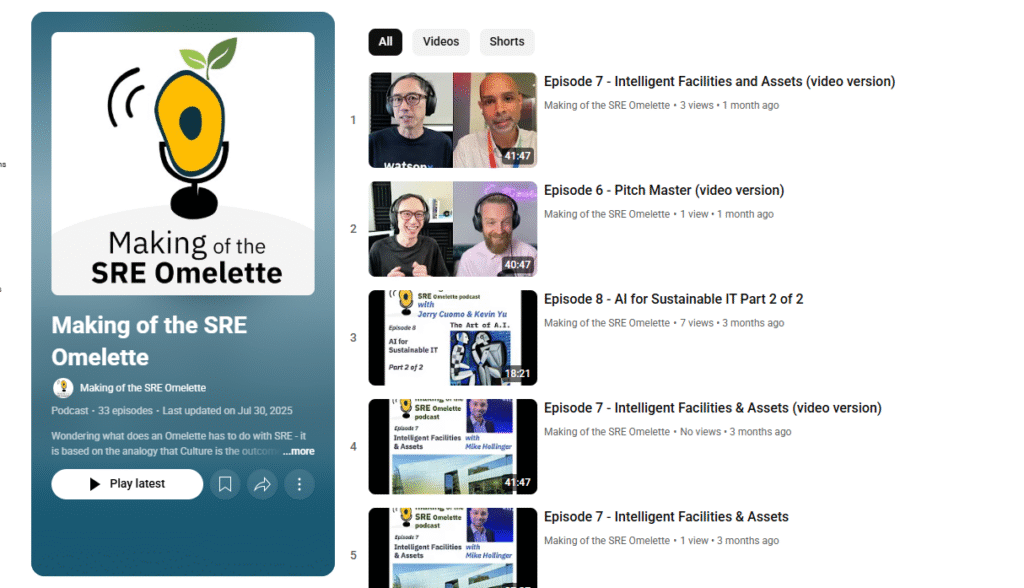
1: Among the Top 150 podcasts, over 61% post a video for each podcast.

Podcasting is facing a format revolution.

From audio-only podcasts, the market is drifting into integrating video cues. The logic behind this shift is quite simple- if audio podcasts became a goldmine for advertisers on such short notice, what could video podcasts bring in? It’s all about vamped experiences. With just listening, the focus is on the conversation- the dialogue. We come to believe the voices and build parasocial connections with them.

Does adding video seem like the next strategic step? With visual cues added to the already advanced listening, marketers unlock higher engagement rates. Because it becomes easier to share among fellow employees as well as on social platforms. Your brand doesn’t just entail a voice, but also humanizes it to instill trust seamlessly.

YouTube and LinkedIn are already locking in. And as of January 2025, YouTube has become the number one platform for podcast discovery.

This strategic inclusion has unlocked a new treasure trove for B2B marketers. With vodcasts, there are now interactive elements such as quizzes, polls, and Q&As that turn passive listeners into active members.

image 3 2

Source: IBM’s Making of the SRE Omelette

The Verdict?

Vodcasts could be a fun little experiment. Even though multi-platform content creation is imperative for discoverability, experts fear that it’s all just hype. Even though there are crucial investments into integrating video, have any podcast publisher stopped to question if that’s what suits their audience? It’ll dilute the entire strength of audio, one that feeds into the listener’s imagination.

So, even if publishers give in, they will scale back. There will be a constant cycle of adoption and then retreat until they develop a treaty, i.e., combine audio with intentional and minimal video cues. But there’s another scenario- two-thirds of US podcast listeners already prefer podcasts with videos.

This could mark a turn because videos cater to different consumption habits. And preferred by algorithms in professional networks. Vodcasts could easily become the next new thing and a revolutionary step in content delivery.

2: Hyper-niche podcasts illustrate 3 times more engagement than broad-topic ones, citing elevated listener trust and action.

If in 2025, you’re attempting to appeal to everyone, you’re likely appealing to no one. You either go niche or your content goes unnoticed.

With 5 million shows held globally, 75 million episodes, and 3.2 million active podcasts, it’s time to break from the bubble. Your brand must tap into niche marketers rather than sticking to traditional gimmicks. But niche doesn’t mean narrowing your reach; it’s about precision targeting. And that’s basically a dream.

Hyper-niche content is an expressway for brands to boost their reach and establish themselves as a credible thought leader. The priority will shift onto highly-focused shows that target specific personas, accounts, and verticals. Additionally, some big names could curate invitation-only podcasts for business leaders and key clients.

This way, your B2B podcasts are shifting from a “selling to” mentality to “solving for.”

image 2 3

Source: Talent Acquisition Leaders

Tight-knit communities have a single vantage point- they’re loyal and easy to convert into customers. According to Cridland, these “micro-communities deliver conversion rates three times more than generic network buys.” The truth is, downloads are easy to track, but any related attributions, whether they are played entirely or at all, remain in question.

So, brands must think beyond these KPIs, i.e., the number of downloads. That’s no longer the true sign of engagement. In modern buying cycles, CPM is going on the back burner. Listening-to-action conversion, listener sentiments, and listener retention will come to drive the steering wheel. The focus is on the listener- how are they engaging with the podcast, not the podcast numbers themselves.

The Verdict?

Hyper-niche podcasts are here to stay. And honestly, it’s a strategic step towards delivering personalized content. The demand for tailored solutions will make niche-driven podcasts a norm, turning them more sophisticated. Because not only will it serve as a direct channel to build connections, but it will also be poised as the audio equivalent of a whitepaper written for a single client company.

3: Podcast marketing has shifted beyond directed advertising. 84% of the total podcast ad revenue is attributed to dynamically-inserted ads.

Ad sponsorships won’t alone power each B2B podcast, especially with shrinking marketing budgets.

There must be alternate streams of revenue to offer the podcast channel long-term stability. You can’t merely measure a podcast’s growth and success through the number of downloads. It must have a tangible impact on the sales pipeline. But how do you measure the influence? You leverage your B2B podcasts as a sales enablement tool.

Apply more lateral thinking to this content model. How else can you drive in leads through your podcasts?

  • AI-driven dynamic ads to offer ads based on who’s listening, where they are, and what they’re listening to.
  • Special sponsorship bundles for particular decision-makers.
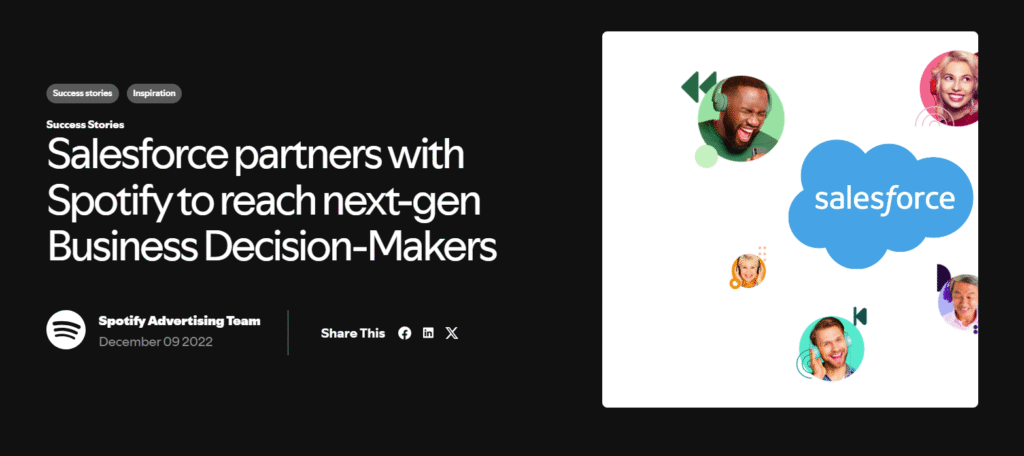
  • Branded segments where the sponsoring brand becomes a part of special segments, such as ‘talk with experts’ or ‘special episodes.’ One such example is Salesforce. They partnered with Spotify to deliver voice-over ads that can amp up brand recall and affinity. The ad campaign’s objective was to reach the next generation of decision-makers. And who would these be? The young, tech-savvy audience- Generation Beta.

And the result was exorbitant.

Spotify’s solution helped Salesforce reach the young decision-makers during their downtime through podcasts. They witnessed an 11% increase in intent to seek information, and a 30% boost in unaided recall, all the while driving traffic to Salesforce’s website.

“We knew our audience was probably interested in podcasts that fall within Business and Tech categories, but Spotify helped us understand how they’re streaming throughout the day—not just for work.”

Salesforce’s Global Brand Marketing Director

image 1 1

Source: Spotify

The Verdict?

Monetization podcast models are gaining momentum.

This comprises subscription-driven premium podcasts for dedicated listeners, sponsorship bundles, and live events. To make the most of their podcasts, agencies have started holding tiered memberships, branded merch, collaborative stages (with other podcasters), and more live experiences in the form of ‘pod perks.’

It’s a broad shift from direct ads to a more focused approach. Free from intrusive and irrelevant ad content, listeners receive more valuable and actionable ads. This move has established podcasts as a business asset more than just a marketing channel. You keep your audience coming back for more (see Apple Podcasts‘ subscription model).

As CFOs demand clearer ROI from marketing functions, it’s become imperative to link your B2B podcasts to tangible business outcomes. Monetization podcasts become your saving grace- a much-needed maturity of traditional podcasts.

4: 76% of B2B brands launch podcasts to drive thought leadership. And 56% of them treat the guest speaker as the thought leader.

Podcasts have made a steadfast shift from being a personal storytelling medium to a B2B marketing tactic.

In the digital-first world, it has become a go-to for time-crunched decision-makers to access meaningful touchpoints. It’s become thought leadership that one can consume on the go. And listeners are 2.7 times more likely to trust a brand if it publishes educational audio content consistently. At least that’s what the stats say. The rising popularity of podcasts in B2B marketing isn’t a media hype. It’s become the staple in tackling the increasingly complex B2B selling processes.

Due to content fatigue, people now spend less time skimming through visual content, whether blogs or videos. And podcasts are an intuitive option to bypass this shortened attention span. This has made podcasting viable for B2B marketers to get into some of the most challenging topics.

Before high-level executives look at pricing charts, they want to hear from trusted professionals with the right expertise. Especially when a high-stakes buy is involved across the SaaS, cybersecurity, and finance industries.

These B2B podcasts don’t merely build trust, but position your own subject-matter experts as the go-to authoritative voice. It shapes the perception of the company’s capabilities, making your leadership voice audible across influential circles.

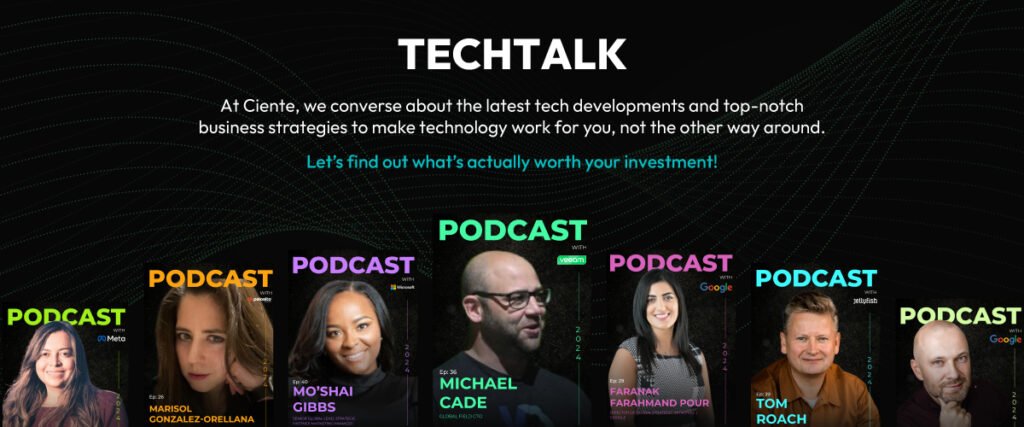
Podcast thumbnail banner Revamp Ref

Source: Ciente’s TechTalk

Ciente’s TechTalk serves as an unfiltered space for thought leaders to share their voices. It positions the guests as thought leaders and offers them a space to provide opinions and insights on trending topics and market innovations.

Hosted by the brand’s CMO, it also positions Ciente as a credible thought leader through insightful dialogues that touch base on modern marketing practices over surface-level jargon.

The Verdict?

Podcasts as a thought leader engine isn’t a far-off dream; it’s already a reality. The average guest-to-customer conversion rate is 10%, more than traditional channels.

Moreover, businesses are leveraging podcasts to establish themselves as market-driving entities. This humanizes them into actual thinking bodies, not as hollow corporate buildings.

This trend is definitely here to stay- as a catalyst for valuable and intuitive business conversations.

5: AI is becoming a significant driver of podcasts as 40% of creators use modern tech to amp up their podcast’s performance, from content planning to reaching the relevant audience.

AI in podcast production is becoming the norm.

With this emerging tech, creating high-quality, engaging podcasts is now easier. It helps with market research and also with decoding the right talking points and post-production processes.

For the listeners, integrating AI will serve as an assistant. And highlight relevant episode recommendations depending on what the user is searching for.

Owing to this, podcasting could become highly data-driven. The use of analytics will uncover niche audiences for your brand and also help the creator craft scripts that resonate with the decision-makers. There are often highly complex topics, especially across SaaS and IT companies. AI will be able to assist with starting points that step into the nuances of market challenges.

Additionally, the emerging technology will help edit the audio, such as removing filler words, eliminating any background, and adjusting the levels. And in the near future, it could also be integrated to translate audio content in real-time across diverse locations.

With AI, B2B podcasts will become even more relevant and actually align with their preferences. This will facilitate more trust and credibility in your B2B podcasts.

One that goes beyond just listening. And centers on in-depth engagement that brings the listeners closer to the podcast.

And inevitably, to the brand.

The Verdict?

There’s no doubt.

AI in marketing isn’t a trend. It’s become a foundational tool for kickstarting specific functions. The level of insights and operational efficiency it can afford is quite difficult to overlook. And the B2B brands that grasp this and implement it with urgency will outpace competitors in quality and quantity.

These B2B Podcast Trends Aren’t Isolated Techniques.

As podcasts become a market favorite, they could easily become a primary sales channel. At least that’s the dream. But its explosive growth is helping marketers and businesses to establish a new equilibrium.

The podcast playbook is actively shaping the future of marketing in real-time.

All that B2B brands must do is align their core strengths with innovation to build a sustainable podcast ecosystem. The B2B podcasts trends for 2025 are proof of this.

The actual impact isn’t hidden in downloads. It comes from diversified podcast models that can penetrate unstable ad markets and retain the magic of audio content.

This is where B2B podcasts are headed- not shouting into a microphone, but really listening to your audience.

The new B2B handshake is not a written contract, but a shared headphone jack.

Strategic Benefits of Using Podcasts: Revisit Your Marketing Frameworks

Strategic Benefits of Using Podcasts: Revisit Your Marketing Frameworks

Strategic Benefits of Using Podcasts: Revisit Your Marketing Frameworks

With a convenient medium like a podcast, listeners can access high-quality content. What can this vantage point afford small businesses? Let’s find out.

Too many content pieces list out ‘how-tos’ when it comes to podcast marketing. But little do they delve into the why.

Yes, podcast marketing has proved effective on various occasions. But why- this should be the fundamental question. Too many businesses are stuck on the same page, replicating the same practices because big names declared them the best.

This isn’t how things work around in next-gen B2B marketing.

Buyers tired of your all-encompassing sameness will flock to competitors. And if you’re starting, doesn’t it prove disadvantageous for your business?

It’s time to rush away from the ‘best practices’ and dig into why something works the way it does. Why are some podcasts a one-time listen, and why have some podcast channels gained such a loyal following?

Underscoring the answers to these is the intuitive way forward, not just a strategic one, especially for podcast marketing.

As millions of users tune into their favorite B2B podcasts, what’s keeping them enticed to listen to the material? Is it the subject matter? The host? Or the entertainment factor? The obvious question is what exactly ticks customers.

Podcasts: An Answer to Marketing’s Prayers?

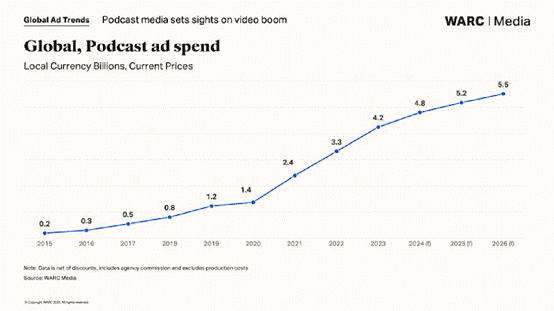
An in-depth inquiry into these questions has made podcasts a treasure trove for advertising. According to a third-party research conducted by WARC, global podcast ad spend is predicted to exceed $5 billion by the end of 2025.

image 26

There’s very little content that customers interact with willingly. We’re talking about a diversity of formats- blog posts, banner ads, social media posts, TV and DOOH ads, and even videos. There’s content everywhere, and not all of it compels us or makes us gravitate towards it. Most of them are untimely ads that seem frustrating (see, Amazon Prime and YouTube).

We’re constantly pleading with brands to understand- we don’t want to watch this minute-long ad. It’s not just intrusive, but straight-up annoying. Who even has the time, even a few seconds of it?

And if they did, users would instead expend those few minutes consuming content they actually wish to, rather than ones they’re forced to. This is something marketers and advertisers still miss. Content is used as shtick, but its application takes the back seat.

Podcast’s creative and technical design helps tackle this hitch.

This marketing channel has been efficient in burning the barrier between consumer demand and desire, and amalgamating them into one. It’s why businesses are flocking to podcast marketing, so much so that there has been a fascinating 6.83% year-over-year increase in podcast listeners. A number that skyrocketed to 584.1 million in 2025. And is expected to hit a whopping 651.7 million by 2027.

It isn’t magic, but a tactic that feeds into the very psychology of why customers listen to podcasts in the first place. It’s convenient- and the sociability, flexibility, and intimacy are high. Across the modern B2B sphere, where buyers seek more relational marketing, podcasts help soften the noise.

It caters to a communication style that B2B buyers desperately vie for, one that instills trust and confidence in a brand rather than selling.

It’s the benefits that podcasts afford businesses that marketers are truly digging into. Let’s plunge into what they are.

A Strategic Edge Amid Market Saturation: Benefits of Podcasts for Modern Marketing

Benefit 1: Demand Generation

Have you heard of Ciente’s TechTalk?

It’s one of the best B2B podcasts out there. Instead of making it a one-sided information dissemination platform, the host, Ciente’s CMO, holds a dialogue. These conversations are a treasure trove for those who are seeking expert insight on the ongoing market hiccups. From Google to Microsoft, TechTalk has hosted multiple guests from some of the industry giants.

This has only played out in the demand gen agency’s favor. Leveraging podcasts across its operations has brought it exposure to some of the big names. You can then use it as a contact to nurture these accounts into customers.

This is the magic that podcasts can afford you, but only if done right.

It all depends on what you’re hoping to achieve with your podcasts- is it awareness or a thought leader tag? Podcasts can do both, but across different timelines. You must play your cards right. Use promotional content to launch your podcast channel and promote episodes based on contextual relevance.

In the short term, this’ll affect your exposure. But for the long term?

Dedicated listeners who can become customers and a concrete thought leader.

Benefit 2: Brand Recognition and Affinity

Do you know what fuels brand recognition? Consistency.

The point is that most marketing strategies operate with loose ends. There’s no set content strategy, whether it’s for your brand’s LinkedIn profile or blog postings. Some day, you post three pieces, and the others none. Do you really believe this is what will truly drive the engagement?

Branding is synonymous with consistency. Infuse this with podcasts? You’re accelerating your brand recognition. There’s a good chance that those appearing as guests on your podcast have never heard the brand’s name.

Podcasts present an opportunity.

You aren’t just tapping into your listeners, but the guests, too. Their loyal followers. This serves as the correct time to illustrate your brand values. And when you do this consistently? It instills your values and brand into the listeners’ minds.

Whether it’s a unique introduction or the material you cover, the audience knows you. It elevates your brand visibility and introduces you to potential news listeners.

For podcasting to be effective, you must publish and deliver content consistently. This’ll help you decide how to embed your podcast publishing into your audience’s listening routine. And then?

Gain valuable mindshare.

Benefit 3: Proof of Credibility

There are too many brands and way too much content out there. Navigating this sea has become exhausting. How do you know which brand to trust and which not to?

From social reviews to case studies, proof of credibility has become a significant need. The credibility and market positioning aren’t instilled through empty slogans, but in what you can deliver.

Podcasts are a major driver of this. It’s a platform that keeps on giving. But with it becoming a significant flare, how do you differentiate a forgettable trend-following channel from a genuine one?

You develop this through your podcasts. You can position your brand’s perception correctly, especially by utilizing long-form formats beyond social media posts and website copy.

Reach out to innovators, industry experts, and other thought leaders for real-world experience and expertise that adds credibility.

When someone from your brand converses with them, it’ll illustrate your own expertise in the field. And help concretize your brand as an emerging thought leader.

Benefit 4: Trustful and Value-Centric Connection

Trust is not created, but something that is earned. And modern marketing is precisely about that.

Amidst a crowded market, it’s challenging to decipher the brands that actually stand on business. Most convey lacklustre promises and fail to deliver on them upfront. Not every brand is out to help you solve your pain points. For some, customers remain numbers and a way to achieve the desired outcomes.

Podcasts cut through the empty promises.

It’s a sure-shot, authentic way to engage with your audiences.

Because listeners aren’t just engaging with your brand, but those behind it: the real people involved. This applies a more human touch to the colors, tagline, mission statement, and logo.

The podcast content itself is not something transactional. Instead, you’re offering your listeners informational value upfront; all they must do is listen. This makes the entire interaction more personal and intimate.

This is why podcast advertising works, you know, especially if the content is a banger.

The listeners themselves end up building a parasocial connection with the listeners. Because each new podcast episode becomes part of the daily routine for dedicated listeners. Your audience starts connecting to the voice involved, which they come to depend on for further information.

Podcasts facilitate brands and audiences to develop authentic and trustworthy client relationships in this way. It’s all about the consistency and tapping into that inherent need for human connection.

Benefit 5: Audience Reach

Podcasts open more avenues.

When you collaborate with other brand leaders, there’s also additional marketing content. These co-branded social posts can help elevate your reach. The interaction is very two-way. It goes beyond traditional media consumers.

Its unique design, i.e., on-demand content, lets business leaders consume the media at their own convenience. Whether it’s between meetings, during their commute, or while exercising, a podcast leverages the moments in between- moments of maximum attention.

This agility in delivery facilitates podcasts to strike when the time’s right, and resonate with a broader audience.

But this isn’t the only way podcasts increase your audience reach.

Podcasts are long-form content pieces that entail repurposing potential. You can transcribe your podcasts and convert them into blog posts, YouTube videos, or LinkedIn posts.

This helps gauge the maximum potential of your content and elevate the podcast’s reach across diverse channels.

Podcast As A Strategic and Intimate Ecosystem

Leveraging podcasts boils down to curating a dialogue. It’s about conversations that are driven willingly, unlike other forms of marketing channels. Engaging podcasts are always a part of conversations, not a one-sided monologue.

Here’s why it works.

Dialogues are invitations that lead listeners towards competence and entice them to desire proficiency, expertise, and mastery. A dialogue informs you- but it’s something that you seek out, not just vaguely come across.

With podcasts, you don’t just listen in or pay attention to. You want to be part of a club.

This component has instilled podcasts at the very nucleus of marketing, turning them from a fun experiment to a marketing staple. And an audience-favorite.