AI turns a 50 year-old-dream of scientists into a reality! A chess genius creates history.
For a groundbreaking discovery, Sir Demis Hassabi was awarded the 2024 Nobel Prize in Chemistry with Google DeepMind Director, Dr. John Jumper. Hassabis, the Co-founder and CEO of Google DeepMind and Isomorphic Labs invented AlphaFold— a unique system that integrates predictive analysis of protein 3D structures from their amino acid sequences.
Over recent years, the world has witnessed impactful transformations introduced by the advent of artificial intelligence in various domains. There is a new addition to this list of applications—protein design.
Protein structure is increasingly complex, involving a series of amino acids in different arrangements/patterns. For several decades, researchers have attempted to decipher proteins’ 3D structures with various experimental techniques that involved extensive procedures. Predicting the structure is cumbersome and intense, but not anymore. The latest AI-integrated innovation has simplified this process and made it possible.
Before pioneering AI to decode protein structures, Demis Hassabi was a chess prodigy. He believes that the strategic thinking he applied in chess was the driving force behind his AI journey. In 2018, when he first competed with the algorithm, it was based on a comparative analysis. However, the updated model added deep learning which is quick to identify patterns and determine protein structures accurately.
There is no doubt that the AI revolution is an asset for not only brands but also scientists. It is paving the way for technological adoption in developing novel solutions for complex processes such as protein sequencing. As the world continues to adopt and integrate AI on a larger scale, we are sure to experience more marvels thanks to this technological advancement.
Weaknesses in your sales pipeline are detrimental. Can the right sales pipeline metrics help elevate the buyer’s journey?
Numbers and data, when isolated from each other, are meaningless. They exist within specific contexts.
We turn them into a quantifiable metric by tracking, analyzing, and comparing them to churn out meaning. This is how metrics help us gauge the effectiveness of a method.
Across the marketing and sales landscape, metrics help us assess and measure performance or production. It quantifies your marketing efforts to measure their effectiveness in boosting conversion rates and lead sales velocity.
Sales pipeline metrics operate in the same manner.
Sales pipeline: The basic understanding.
Sales pipeline is a visual representation of how your prospects move through the different stages in the funnel, i.e., from initial contact to closing a deal. Simply put, it helps analyze the overall buyer journey – what’s causing the drop-offs or why it’s taking so long to close a deal.
Sales pipelines are unique for every business and industry. What it generally looks like depends on the buyer’s journey, depending on their interests, preferences, priorities, and research.
Each buyer moves distinctly to accommodate the pipeline according to their journey, i.e., personalizing and making it effective. More than being sturdy, the pipeline is elastic and adapts to the prospective movements.
It generally includes three processes: lead generation, lead nurturing, and deal closing.
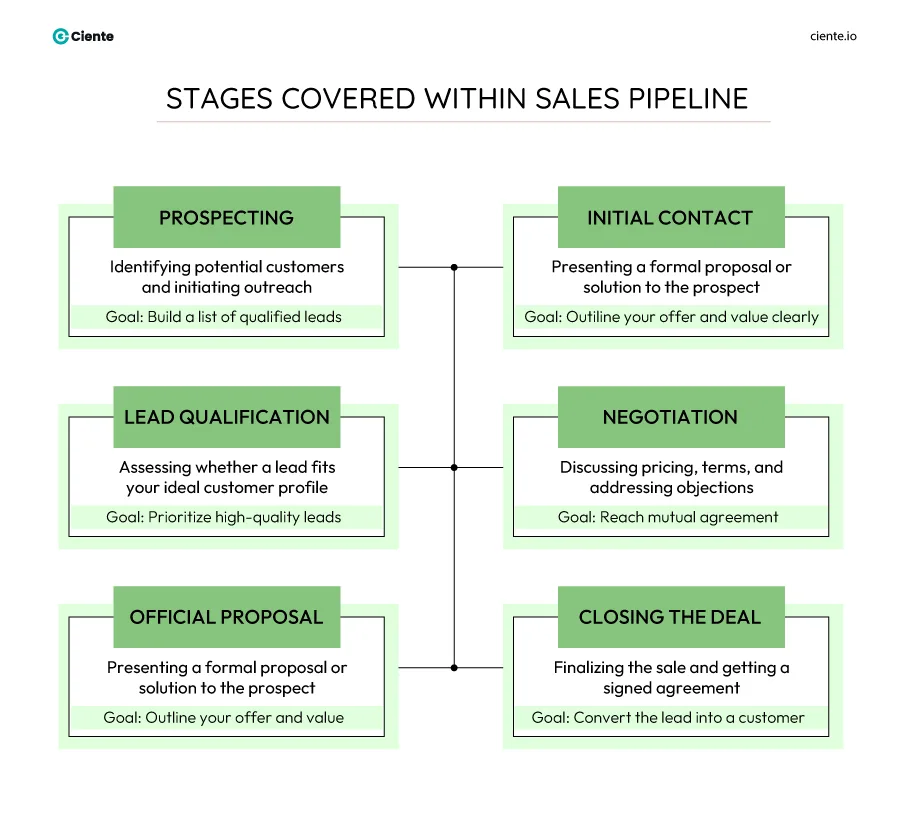
And, these are broader stages covered within the sales pipeline:
Prospecting ⇒ Lead qualification ⇒ Initial contact ⇒ Official proposal ⇒ Negotiation ⇒ Closing the deal
The most crucial objective here is that the pipeline should be able to handle the volume of leads without compromising the engagement quality or performance. If your brand is witnessing low conversion rates, certain challenges within your pipeline should be addressed.
Some of the common challenges your sales and marketing team may encounter include:
Lack of historical data on closed deals
Off-market target audience guiding leads off-base
Absence of measurable targets
Lack of visibility or knowledge regarding the status of the sales pipeline
These are the potential weak spots of your sales pipeline.
So, how do we overcome them?
The Importance of Sales Pipeline Metrics in Driving Success
Certain metrics let us assess how to alleviate these concerns and improve the different stages across the sales journey.
Pipeline metrics are crucial.
Each team member should familiarize themselves with tracking them regularly. Even if the sales pipeline metrics vary for businesses, some general ones should still be tracked by your team.
Understanding what drives your prospects to close a deal in a win or what makes them drop off midway through these metrics also offers significant opportunities for improvement.
This is why choosing the relevant metrics takes precedence.
How can you choose the right sales pipeline metrics that align with your business goals?
1. Align metrics with the business goal you wish to achieve.
Don’t just track numbers; ensure that these numbers boost you closer to your business goals. This data, when siloed, doesn’t mean anything. But within the right context, they mark your progress towards your objectives.
For example, if your goal is to elevate the organization’s market share, then total revenue wouldn’t offer you the nuanced picture. Here, tracking the share of wallet and sales per territory makes more sense.
The crucial factor here is taking a granular approach. If you are dominating the market, how do you ensure that it remains ten years down the line?
2. Leverage a balanced approach.
Identifying bottlenecks is as vital as predicting the success of your sales strategies. To get a more molecular insight into where the lacks and gaps are most prevalent, you can’t just focus on certain metrics while dismissing the rest.
It’s true that the approach must revamp in today’s modern sales landscape. But traditionally relevant metrics take as much precedence as implementing new ones.
This means taking a balanced approach to choosing the right metrics.
Your strategic framework should entail a mix of lagging and leading indicators – one that demonstrates the past performance (closed deals) and ones that forecast (qualified leads).
A balance between them can help your marketing and sales teams to revisit, review, strategize, and analyze accurately.
3. Assess periodically and update your metrics.
One of the most strategic means of selecting the right sales pipeline metrics is assessing what’s working and what isn’t, and updating the list.
It’s crucial to start from somewhere. Each data point can give you the slightest idea into what your sales strategy needs to rework on.
What worked before might not work today. Don’t let the stale metrics prove your efforts ineffective. So, review them periodically to ascertain that they align with the current business challenges and requirements.
4. Get a comprehensive understanding of the entire customer journey.
Numbers wouldn’t always tell you where the rupture is. Most often, sales hit the wall while making a sale or post it.
This is because most only focus on pre-sale metrics and interactions. This damages the customer experience and leads to missed opportunities.
To avoid this, it’s necessary to track the customer experience, too. Metrics, such as sales cycle length, can offer you a 360-degree insight into what’s truly going wrong.
The bottom line?
The sales pipeline metrics you end up choosing must be actionable. If they aren’t, it poses a significant obstacle for you.
These metrics should illustrate a specific behavior – what is happening, what has changed, and what can be done about this.
The right sales metrics don’t merely offer postmortem pipeline analysis. They allow you to proactively make informed decisions and offer clarity into nuggets that often go unnoticed.
Don’t measure everything. Focus on those that align with your goals.
Fundamental sales pipeline metrics to amplify your efforts
Opportunities
The total number of opportunities matters because it portrays the results of your lead generation efforts. Your lead generation efforts should target prospects fitting the ICP, i.e., the ideal customer profile.
What factors qualify prospects as opportunities? There are some criteria that most businesses focus on.
Demographics – age, gender, income, family structure, education, occupation, etc.
Firmographics – company size, ownership, market share, location, sales cycle stage, financial performance, etc.
Psychographics – value proposition, goals, interests, lifestyle choices, etc.
A prospect does not have to follow each criterion, as they vary according to the organization.
To track this, teams must prioritize lead quality because it aptly demonstrates which leads are the most valuable and can easily convert into opportunities.
By analyzing which accounts you count as an opportunity, your team can optimize its marketing efforts and improve lead-nurturing processes to keep them engaged as they move through the pipeline.
How can we assess lead quality?
To simplify this, your sales team can use the BANT or MEDICC lead qualification framework.
The opportunities should be tracked and assessed weekly, monthly, or bimonthly, depending on the preferences of your company. However, it can also be done regularly in case of rapid market fluctuations, multiplying lead volumes, or during push season due to an event.
New Leads
The number of new leads entering your pipeline offers an overview of the success of your marketing campaigns. Additionally, it helps outline your brand’s market reach and offers quantifiable data to back your efforts.
It is necessary to highlight these new leads to establish whether your lead generation strategies are efficient.
Once in a while, we should question whether we are chasing hollow leads with no future potential and wasting our resources.
The end solution follows a comprehensive tracking system and establishes a timeframe depending on the pace and volume of generated leads. Document the number of leads, segment them, analyze the trends, and then compare the different lead-gen efforts to help optimize your strategies.
Overall, lead quality reflects your sales and marketing efforts – how effective they are. But it could largely differ from business size to industry to marketing strategies.
Hence, there’s nothing as simple as “good” or “bad” leads.
By documenting the acquired leads regularly against how many of them actually convert, the results will automatically indicate the performance of your strategies.
MQL to SQL Conversion Rates
This conversion rate calculates the number of marketing-qualified leads who convert into sales-qualified leads. They show interest, sign up, provide their contact info, and subscribe for a demo period to further inspect the solutions offered to them.
These metrics highlight the performance of your lead qualification strategies.
An effective lead-nurturing process will eventually illustrate high engagement results, which may translate to high conversion rates. This indicates a healthy alignment between the sales and marketing teams.
How often do we assess MQL to SQL conversion rates?
Calculate MQL to SQL conversion rates monthly. With this, you will allow the lead qualification processes to work at their own pace, enabling you to make adjustments and understand if they are returning the desired outcomes.
The acceptable range for this conversion rate depends on the industry, business objectives, and past performance – your MQL-SQL conversion rate benchmarks.
Lead Velocity Rate
Velocity measures whether an object is accelerating or decelerating. This applies to a sales pipeline. The lead velocity rate compares the leads generated in the current business period to the previous one.
The velocity rate calculates qualified leads, helping you analyze whether your lead-generation efforts are fruitful and effective. It aids in strategic resource allocation and sales processes, amplifying your efforts.
This metric is crucial to understanding your business revenue growth.
If the number of generated leads for the latest sales cycle remains similar or lower than the previous sales cycle, you know you’re doing something wrong. Thus, it should be assessed monthly or quarterly, depending on your company’s needs.
There is no acceptable velocity rate.
It depends on the industry and your business. Remember, you are your biggest competition.
In every sales cycle, the target should be to generate more leads through improved strategies compared to the previous one.
Average Deal Size
Average deal size is another significant factor that measures the health of your sales pipeline. It represents the monetary value ascribed to a sale.
Tracking the average deal size your business is partaking in helps with sales and demand forecasting.
In the long term, regularly tracking average deal sizes can assist in optimizing and streamlining strategies for marketing and sales initiatives. It is important to reach your brand targets and meet broader market conditions.
Sales Cycle Duration
Analyzing the monetary value of a sale is as significant as calculating the duration of the deal. This metric focuses on the details. It offers an insight into how a deal got stuck and why, with ways to improve it.
Sales cycle duration is the average time a deal spends at every specific stage of the sales cycle. Tracking minute errors resulting in potential delays is easier by calculating the sales cycle duration.
Additionally, this provides crucial insight into the sales cycle length, i.e., the time it takes from the initial contact to the lead being closed. This is also one of the sales pipeline metrics to track.
After all, this also affects the time a deal takes to close.
There are three metrics that we are addressing – average sales cycle duration, sales cycle length, and time taken to close.
These three metrics also help sales forecasting, so your brand can establish practical targets.
A long sales duration can cause a huddle in your pipeline, resulting in relatively high lost deals or drop-offs.
Both these metrics depend on diverse factors, such as the complexity of the product or service. The sales cycles across the B2B landscape are generally longer due to the several decision-makers in the buying committee. And this might delay the purchase as each of them holds their interests and pain points.
You should curate your marketing techniques based on your target market to overcome such hiccups.
Establish priority and build trust regarding the prospects.
Conduct customer research and feedback programs.
Provide social proof through value propositions that align with the prospect’s preferences and pain points.
Time-sensitive offers that urge prospects to take action.
Streamline and integrate your lead nurturing and sales enablement strategies to retarget interested leads and stay on their tail.
These sales pipeline KPIs are mutually dependent on each other to some extent. But their goal remains the same, i.e., measuring how efficiently your sales and marketing efforts convert leads into paying customers.
Number of Deals Won
This pipeline metric tracks the number of successful deals. This is relative to the total number of opportunities during a specific period.
Conversion rates are crucial to drive business growth.
The higher the conversion rates, the faster your business can attain its goals. This is why conversion rates are one of the most crucial sales metrics.
If the conversion rates are low or don’t align with industry benchmarks, you can outline fresher roadmaps by identifying the areas of improvement.
What factors contribute to a successful deal? What have you done differently to win a deal than the one dropped off?
These are the questions you ask your sales and marketing team while analyzing the conversion rates and other trends in your data.
Most often, the opportunities may be high, but the win rates are low, signifying a major lack in the closing stages of the pipeline.
Age of a Deal
This is one of the effective and simple metrics you can use when a deal is taking an unnecessarily long time to move through the pipeline, or the prospect themselves are taking too long to make a decision.
With an increasingly long decision-making period, it is less likely that a prospect converts.
You need to assess why the lead didn’t convert and where they got stuck.
How do you avoid this? – Identify the bottlenecks, remove them, and boost the sales velocity.
To move this forward, your company should equip the sales representatives with the right resources and sales enablement or acceleration tools to drive the purchasing process.
By accelerating the sales processes, the age of the deal will automatically reduce, offering space for more successful closes.
Sales Rep Activity
This metric offers insight into the sales team members’ sales performance. Measuring this helps foster team productivity and takes team accountability.
It outlines how your sales team performs through outreach emails sent, the number of calls made, and the meetings booked by each sales representative. Track the sales and categorize them based on factors such as rep, team, region, product/service(s), etc. using efficient CRM tools.
Through the results, your team can assess whether the sales rep is compensated for their contributions. And once analyzed, underperformers can be equipped with more resources and support from their superiors.
How do you improve the number of top performers, boost sales rep activity, and amplify sales?
The lack of correct skills and knowledge is a huge obstacle. To improve this, offering regular training and coaching sessions to newbies is a way to go.
The training should include actively engaging with prospects and staying updated with industry trends. Actively assessing and improving individual sales per rep will help boost the sales team’s productivity.
Total Pipeline Value
This sales pipeline metric measures the total value of deals in your pipeline. The total pipeline value depends on the value of the sales opportunity, the pipeline stage, and the time taken to close it.
By tracking the value of the current opportunity, it is possible to measure the total forecasted business revenue. Hence, it is a valuable metric for sales forecasting.
If you compare your total pipeline value with your win rates, it can help you forecast how much sales revenue could be generated at the end of the sales cycle. If combined with the sales cycle length, it can help analyze the total revenue potential.
To calculate TPV, each opportunity is provided with a specific monetary value, helping to estimate the total sales amount.
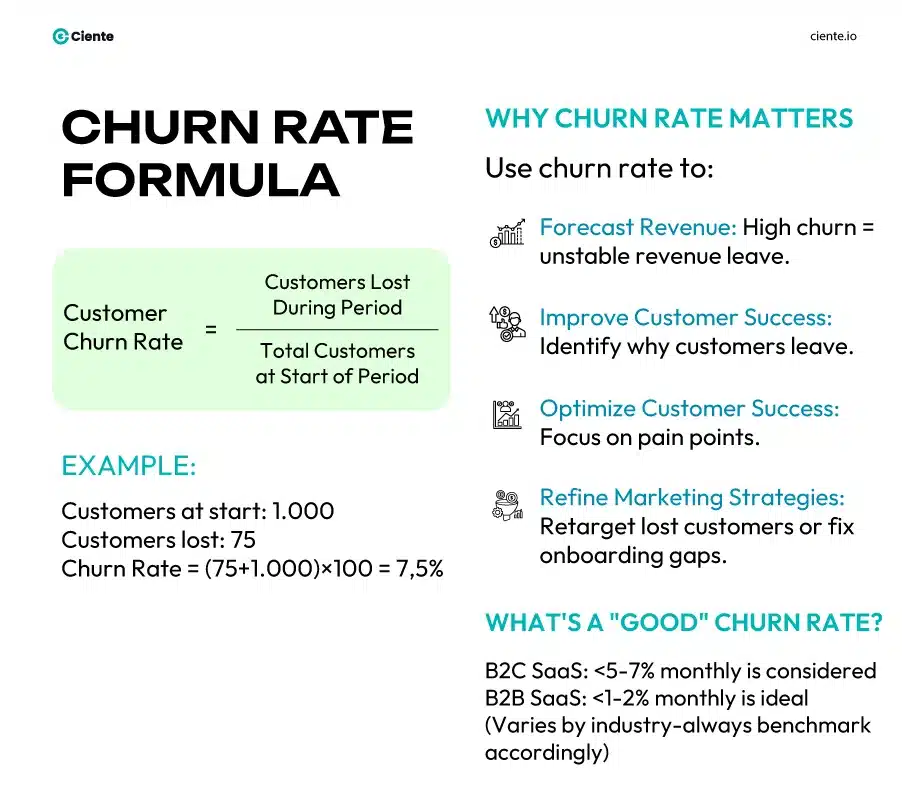
Customer Churn Rate
Also known as the customer turnover rate, it’s the number of customers you’re losing or drop-off from the purchasing journey.
This can be quite a requisite KPI for businesses, as it indicates customers are losing interest in your product or service.
However, this might not be the actual case.
Drop-off rates are as important as win rates. It becomes difficult to identify the improvement areas without highlighting the weak points.
Customer churn rate is a necessary metric in subscription business models.
It calculates the customer percentage that doesn’t renew and cancels their subscription services within a month or a year. Hence, this pipeline metric is significant for companies that rely on a recurring pricing model like SaaS or subscription services.
Implement CRM tools to determine how to boost the workings of your subscription models. And highlight the number of paying customers currently compared to the beginning.
⇒Customer churn rate formula = (the number of customers lost/total customers at the beginning of the period) *100
For the broader picture, the customer churn rate helps highlight the forecasted revenue, improve customer loyalty, prioritize customer success, and enhance marketing strategies.
Average Customer Acquisition Cost (CAC)
Customer acquisition cost signifies the company’s expenditure on acquiring new customers. It includes marketing and sales expenses, salaries, overheads, commissions, bonuses, etc.
The main expenses entail the content, training, software, and other overhead costs. The goal is to prioritize investments that generate regular returns with minimum maintenance costs, such as curating content-specific blog posts.
It helps you assess the profitability, i.e., the amount you spend on a customer compared to the profit you make from selling your services to the customer.
This metric helps with resource allocation, making your customer acquisition process efficient and simpler. Simply put, there is no significant need to focus too long on this process. Sometimes, an expensive customer might not mean that they are equally profitable.
Your sales and marketing teams should incorporate smart and streamlined strategies. An uncommonly high CAC might mean inefficiencies that require vigilance to enable long-term stability.
Remember to research your target audience. Host automated testing regularly to maximize your ROI using the existing customer acquisition efforts.
How can you calculate the customer acquisition cost?
First, add all the sales and marketing expenses. Then, divide this total by the number of new customers.
⇒ CAC = (sales expenses + marketing expenses)/total number of new customers
Customer Lifetime Value (CLV)
After spending an ample amount on your cost acquisition efforts, how do you assess whether it is profitable?
Through customer lifetime value.
This metric calculates the value the customer brings to your business, including the amount they spend on your services, their time as customers, and their purchase frequencies.
By taking individual CLV into account, you can analyze the value of your entire customer base. It will offer insight into how much effort you should spend on customer acquisition.
To enhance CLV, focus on customer retention.
Implement new customer service strategies promptly, addressing their concerns to build a strong professional relationship. When the customers are satisfied and happy, they are likely to remain loyal and purchase your services.
The most significant strategy for driving customer lifetime value is improving customer service, personalized recommendations, discount offers, user-friendly websites, etc.
So, finding a solution based on the metrics can help you improve your sales and marketing strategies. One of which would be to reduce the stages in the sales funnel that are unnecessarily time-consuming.
Now that we have listed the most significant and common sales pipeline KPIs, why is it important to track the right pipeline metrics?
Because even the slightest mistakes can render their efforts ineffective, hampering the ROI, and congesting the pipeline.
Fundamental mistakes teams make while tracking sales pipeline metrics
We’ve established that the right sales pipeline metrics go beyond conversion rates and total revenue. The actual challenge lies in aligning the metrics with business needs and the growth stage.
A majority of teams overlook the nuances, leading to a conundrum. This creates obvious mistakes that fester, especially due to a significant knowledge gap.
What are some of the fundamental ones?
Isolated focus on vanity metrics: Even today, businesses continue to prioritize numbers that look good in theory but don’t represent the actual performance. This could create a false sense of progress, while deeper performance issues remain overlooked. And even mislead or confuse the stakeholders.
Misaligned or irrelevant metrics: Most teams don’t take the time to understand the broader objectives and how they align with sales performance. This can easily derail your focus, not making any significant contributions to your business’s current priorities. And SDRs might end up pushing low-margin deals, delaying crucial shifts.
Overlooking the context: It’s context that takes precedence over raw numbers. Metrics should be segmented by channel type, customer profiles, etc., to spotlight performance gaps. An inaccurate picture can lead to strategies that only work for a specific segment. Marketing and sales must fine-tune their approach accordingly.
Each of the above mistakes can have a compounding effect while tracking your sales pipeline metrics. They distort the overall assessment that impacts how the resources are allocated and how strategies are executed.
But there’s an antidote: intentional, agile, and goal-aligned metrics that align with the evolving sales and growth model.
A healthy sales pipeline is like a cocktail glass.
After passing through this milestone, the opportunity pool should remain approximately the same, and the probability that the opportunity is won is highly likely. This is the make-up of a healthy sales pipeline.
To some extent, we may think about how the shape of the sales pipeline aligns with reality.
The stages and shape of this movement vary according to the buyers, industry, and sales processes.
Why is sales pipeline analysis crucial? To optimize your sales performance, client experience, and drive business growth.
Maintaining a simple and efficient sales pipeline is healthy for your business and sales revenue. But how do we know what “healthy” looks like?
FAQs
1. How can you effectively assess your sales pipeline?
A. Assessing your sales pipeline isn’t about counting closed deals or appointments booked. It’s about deal velocity and step-by-step conversion rate, among others.
To effectively assess its health, your teams must dive into comprehensive reports to spotlight bottlenecks and performance gaps. And segregate the metrics’ analysis by deal type or client profiles, or lead source, etc., to identify hidden ruptures.
2. What are sales pipeline metrics?
A. Sales pipeline metrics are qualitative and quantitative values that track the number and quality of created opportunities. These are crucial to demonstrate the health of your sales pipeline – whether your sales strategies are bearing the desired outcomes.
The common metrics are pipeline value, customer acquisition cost, customer churn rate, deal age, number of deals won, etc. A mix of both lagging and leading metrics provides a curious insight into what’s happening and the revenue potential.
3. How can you track sales pipeline metrics?
A. Generally, sales pipeline metrics can be tracked through your CRM systems through detailed reports and comprehensive dashboards. Your focus should be directed towards updating the deal progression, individual sales rep performance, sales cycle length, etc, ones that actually align with your core business goals.
Regularly tracking these metrics can help you tweak your sales strategies to elevate their effectiveness. And improve revenue forecasting.
4. What benchmarks or industry standards should I compare my sales funnel metrics with?
Industry benchmarks such as a 25-30% win rate and a 3x pipeline coverage ratio can add an advantageous starting point for you. And one of the most relevant benchmarks to compare with is your organization’s historical data.
While focusing on the competitor can help you outline a strategic edge, prioritizing your internal metrics can highlight what needs tweaking, whether it’s cross-departmental alignment or an update in infrastructure.
5. What are the most common pitfalls businesses face in tracking sales funnel metrics?
One of the most common pitfalls is depending on inaccurate data that doesn’t offer any useful insights. They can be misleading for your teams as well as stakeholders. Additionally, most businesses make the mistake of tracking the wrong metrics, overlooking segmentation, or merely focusing on lagging metrics.
With an undefined sales strategy, reaching the critical mile may seem like an endless struggle. These 5 steps map out the route to closing more deals.
The success of your brand relies on a solid sales foundation. Without knowing the critical markers, it is hard to measure sales performance. The lack of a clearly defined sales strategy may be why 45% of surveyed sellers believe their biggest challenge is incomplete data. When your sales team follows a system, it allows them to take the right actions at the right time. The 5-step sales process is a structure to improve the efficiency of your closed deals. It is a guideline to ensure that you are on track and open to tweaking your sales approach.
While the sales approach requires tailoring as per your product or services, the five-step sales process lays a strong foundation to get the pipeline moving. Your sales team can utilize this linear approach to move through each step efficiently. These sales steps allow you to seamlessly monitor the performance and identify gaps that require improvement.
Mastering this framework makes it easier to tweak or modify your sales process strategy in alignment with your goals and the client’s needs.
Step 1: Prospecting
Prospecting involves developing a list of prospects likely to convert into paying accounts. This step has everything to do with researching potential leads and knowing them as much as possible. Understanding the target niche is the stepping stone to drive a sales strategy that yields the results. Focus on your ICP instead of randomly targeting a pool of audience and going nowhere in the journey.
Step 2. Connecting with the customers
Ace the first impression with your target audience. While interacting with the prospects, work toward not making the conversation sales-y. The goal of this step is to transform from a generic call to schedule a first appointment that could potentially close a deal. So, setting the tone right is of utmost importance here. Building a strong relationship with your client can go a long way.
Step 3: Identifying the pain points
Spend enough time figuring out the challenges of your target audience. You can begin by asking relevant questions to draw out the problem and understand how your offering could address the pain points. As you do your research, also find out their preferred solutions and whether they have budget constraints. Communicate your understanding of their problem and how your solution can help. When doing so, emphasize the winning points while at the same time not sounding too sales-centric.
Step 4: Sealing the Deal
Closing a deal involves a series of discussions and reasonings. As you move towards the final step, make sure you walk through the right questions. Talk about the details of your sales flow chart and be open to handling questions and client objections. Have a clear plan in place as to what you will do if the client objects or if they are not ready to commit yet. Such preparation will pave the way for overcoming roadblocks swiftly.
Step 5: Keeping up with the Follow-up
The journey doesn’t stop at signing a deal. Once you have closed a sale, make sure to follow up with the client. You need to make sure that the client receives the product/service as discussed and the whole experience simulates customer satisfaction. This small initiative can work in your favor, promoting brand loyalty. A happy client is likely to be loyal to your brand. At this stage, do not hesitate to ask for referrals to generate new leads.
Wrapping up
Sales are centered around fulfilling milestones. Every aspect of the sales cycle revolves around garnering the right clients, identifying their pain points, strengthening bonds with them, and offering an ideal solution. These 5 steps can be a real game-changer for your business, aligning with your vision and adding structure to an otherwise complex sales process. You gain clarity and can deliver the best solution to address the customer’s pain points.
A product launch is as effective as its Go-to-market strategy. With so many moving parts, cross-departmental collaboration ensures GTM success.
Go-to-Market is a success story waiting to happen. Within the ever-growing product market, businesses have had to compete with each other over the essential resource: the buyer.
Although it seems negative, many organizations have taken this rapid competition as a challenge and pushed the boundaries of innovation: Culminating in GTM.
GTM has allowed businesses to develop strategies and reach their product-fit market in an efficient time, which helped them hit business objectives that aligned with the product’s launch.
Entering the market can be daunting for innovators, traditionalists, and disruptors alike. Who will buy our product, and why will they buy it? The GTM strategy empowers businesses to answer these questions and eliminate the noise that follows it.
From marketing to product, cross-departmental collaboration is necessary for the process, ensuring a smooth and seamless launch. Innovative companies outperform their competition by delivering value through every stage of the buyer journey, whether content creation or sales.
The B2B industry has especially benefitted from Go-to-Market strategies. It has to be evaluated as a game changer in the SaaS market. And it all begins by understanding what it does for you.
Go-to-market innovates the path an organization takes to reach the ideal buyer.
The buyer has become self-directed. Armed with the knowledge, and opinions of many, the B2B buying committee (a.k.a. the buyer) has an array of choices.
Each organization in the B2B sphere releases products that bring an advantage to them. But, the buyer has their own needs and risks to mitigate. How will they choose the best product?
Here is where GTM comes through. It is not just marketing, as some may believe. It is an entire organization working together to make their product launch a fast success.
What is Go-to-Market strategy?
It is an organization creating a GTM strategy to identify and reach its ideal buyer when introducing a new product. Or an old product in a new market.
By bridging the gap of uncertainty between the business and the buyer, Go-to-market demonstrates the unique value an organization brings to the table. And helps the buyer understand what your product does for them.
It provides your teams with a roadmap towards product success. This involves the KPIs your teams have identified and the possible interactions of your ideal customer with your product or services.
The Motions of GTM Strategy.
An important concept of the GTM strategy is the motions. These are the pathways an organization uses to reach its relevant customers.
Some of the motions of GTM are: –
Product-Led
Inbound
Partnership Marketing
Community-Led
Event-led
Outbound
While you research which strategies to use, you will be overwhelmed by all available options. And that is okay.
Most online resources present this picture of using a multi-motion approach for GTM. But that is not possible. Your organization will have to find its unique motion or motions by identifying what your audience feels comfortable with and by understanding your budget.
Let us be real. Many start-ups and emerging SaaS companies do not have the budget to pull every stop. Here, Maja Voje suggests being realistic and choosing one motion that is doable by your organization.
And that is sage wisdom for those experimenting with GTM. And SaaS in general. Be realistic.
Go-to-Market Approaches for SAAS
Understanding your potential buyer is crucial for choosing sub-strategies and complementing motions for your product. They will help you understand the market you are targeting and the approach you must take to penetrate it successfully.
These sub-strategies are: –
The Bottom-up approach or the product-centric approach
It involves building a relationship with the end users and small teams. This approach is perfect for organizations that are starting and do not have a huge budget. It helps early-stage SaaS companies achieve organic growth through word of mouth and referrals. It is a very content marketing-heavy approach.
The Middle-out GTM approach or the sales and product approach
The middle-out GTM approach is ideal for established companies entering new markets or expanding their reach. With this approach, a business may target specific market segments and direct its sales and marketing efforts through outbound and inbound campaigns.
The Top-Down GTM approach or the sales-led approach
The top-down approach is known for its high-revenue potential. It targets organizations with substantial revenues. This is the “traditional” way of SaaS marketing. It has longer sales cycles, enhanced brand recognition, market penetration, and high costs. It is a high-risk high-return strategy.
When implementing your GTM strategy, you must choose between the three approaches. And it depends on the budget of your business.
Approach 1 – GTM Strategies Provide Positive Signals to the buyer
Go-to-market strategies serve more than just a roadmap for the organization. They also provide positive markers for the buyer.
The buyer and vendor relationship is built on trust. SaaS companies need to show their product can solve target market problems. That is the core of Go-to-Market. Show the right market that your product will solve their problems and mitigate risks.
GTM enables an organization to create experiences that reflect these ideals. If your buyers do not perceive you as an expert in your domain through lackluster sales processes or irrelevant marketing messages, they will be put off by your brand and product.
Approach 2 – Go-to-market strategies work best when there is cross-departmental collaboration.
While sales and marketing alignment is becoming the norm, GTM takes it a bit further and involves vital players from: –
Product
Marketing
Sales
Customer Success
and Finance.
These are the core members of the strategic team. They are not limited to these five teams and could have more teams involved, like operations for development. In short, the whole organization must work for GTM’s success.
Each member(s) of the individual teams acts as a point-of-contact between the GTM team and departmental stakeholders, ensuring a smooth workflow and transfer of information between the teams.
The transfer of information provides a vital recipe for GTM success. Every Point-of-Contact should be intimately familiar with the KPIs set by their departments because it will be the driving force of the roadmap.
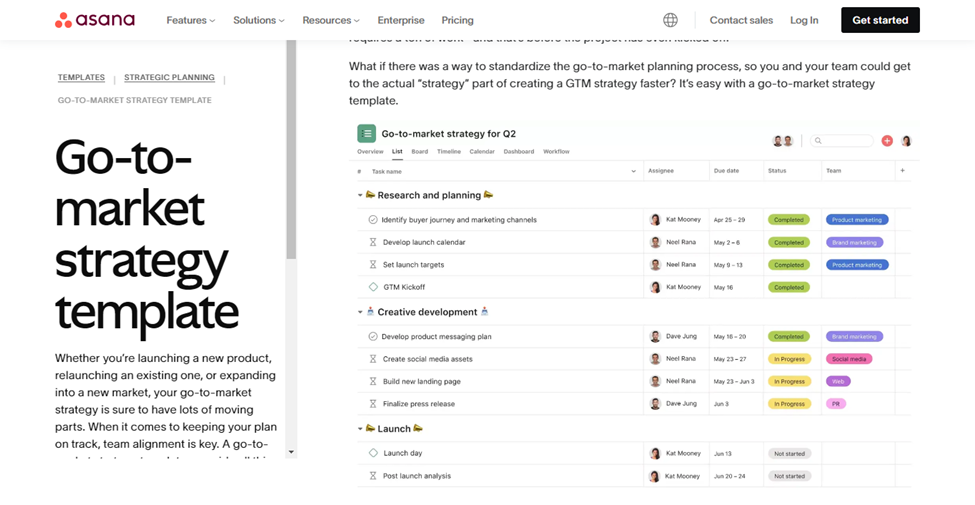
As you can see from their templates, and they agree to it. Go-to-market has a lot of moving parts. It is necessary to understand that a successful GTM strategy comes from visualizing the journey and executing it as close to the original vision as possible.
Approach 3 – Joining the moving parts
What are the moving parts you can identify in your organization? For SaaS companies or typically B2B companies, moving parts consist of Marketing, Product (or service), Finance, Customer Success, and Sales.
1. Marketing
Marketing is seen as the driver of the strategy, which is not false but is not the complete truth either. Marketing is rather in charge of gathering the perspectives and honing them into a single message.
This requires the marketing leaders to collaborate closely with the other teams.
2. Finance
That brings us to finance. GTM strategies hinge on the financial success of the product entering the market. Every ad copy, content marketing strategy, Email campaign, etc., should be seen through a fiscal lens.
What are the metrics of success? ARR, or Annual Recurring Revenue, has been a solid metric for SaaS companies thus far, but it is a long-term metric. Based on your approach and the size of your company, the finance team can create similar short-term leading and lagging metrics of success, which is crucial for your GTM success.
One such metric is the potential buyer’s initial interactions with the product.
That means, after your potential buyer has used the demo, are they satisfied? And who best to answer that but
3. Customer Success
It is up to Customer Success to ensure that your product is solving the pain points of your potential buyer.
What do they like and dislike about the product?
Is it something that can be solved by learning more about the product?
Or is it something fundamental about the function of the product?
And how can we, the developers, solve buyers’ queries?
Customer success, finance, and marketing must evaluate customer lifetime value as a KPI.
They ensure a smooth transition from this phase to the next.
4. Product
Product plays a pivotal role in the GTM strategy and could be called the true driver of your long-term strategies. Today’s marketing is product-led. Marketing has to be heavily involved with product teams to understand the unique proposition of the product and what it does for the user.
Product dev leaders must be involved in the messaging and conveying of the marketing campaigns.
Has the message conveyed the solution of our product in a way that touches on buyer concerns?
Product teams must understand buyer needs. And for that, sales is the only place to go.
5. Sales
The lynchpin of success. Sales has to act as a consultant to the buyer. Before selling
they must understand the product
what it does for the buyer
and what the buyer wants to solve.
The fieldwork that sales do empowers the rest of the teams to create a cohesive vision. It reduces the uncertainty of understanding the buyer and market.
The information that sales gather cannot and must not stay in a silo. Maruch with the ICP.
Salesforce and Slack: The two GTM successes examples of the SaaS era.
Slack or Bottom-Top approach
Slack is the master of PLG or product-led growth. What is their recipe for success?
Their awesome product (And whoever has used Slack knows it)
Community-Led (They have communities in most major cities)
Content (Look at their blog, and you will understand what we mean)
Slack is successful because it understands the vital aspects of work communication. It should be quick, flexible, and connected —allowing for streamlined communication and workflows. And while working on their app, they gave Slack away to teams and understood the successes and failures of their product. Iterating the product as they went.
Slack gave and still gives a freemium model for teams to use. And it is a great product. They invited people to use Slack—end users—to try it out. It was a massive success.
People who used the app became its champions. They entered a market rife with competition and won.
Their only competitor can be said to be Microsoft Teams. Imagine that.
No company signifies a Go-to-Market strategy better than Slack. They made it possible by being consistent with their messages, understanding their limitations, providing the end user rather than big corporations, and iterating their product based on user feedback.
Salesforce or the Top-Down Approach.
Salesforce is synonymous with SaaS. Being a cloud-based software, the original CRM was easy to adopt and set up by big enterprises. And Salesforce knew this.
They made the software free for the first year for teams of up to 10 members. And, like Slack, they had a great product.
But what set them and their GTM apart is the Trailblazer’s community program. The first product community. Salesforce realized that their teams enjoyed solving answers to problems they didn’t know and then shared their knowledge.
The trailblazer community was thus formed as a group of experts who could solve problems and share them with their peers. This helped customers and users by providing real-time value on dynamic problems.
It was revolutionary.
Salesforce’s approach shows that having a product and community is the key to GTM growth. Along with iterating and improving the approach to the strategy.
They understood the need for knowledge workers to share and solve problems, connecting them to like-minded individuals and teams.
It worked because they understood the unique behavior of Salesforce users and created a solution around it.
Go-to-market is about understanding the product’s solution and user behavior.
GTM is a recipe for success. But it is a long-term and iterative process. There has to be room for pivots and flexible changes.
Authoritative and transparent content can instill trust in B2B audiences. Is integrating thought leadership with demand gen the best way to ensure this?
96% of executives assert that thought leadership helps them make insightful and informed business decisions, inspiring them to take action.
Previously, this type of content was generally flagged as a biased opinion rather than an informative insight.
But, with more and more business leaders consuming thought leadership content, organizations have taken further steps to integrate it into their content marketing strategies.
Over 75% of C-suite executives and decision-makers assert that thought leadership led them to learn more about a specific product or service, they were not even considering before.
Thought leadership content is original and valuable. It builds relevance and credibility between different executives, allowing them to collaborate and build recognition with each other.
This shows how important thought leadership is for demand generation. There are barely any requirements for references and citations, this content is evidence-based, making it reliable and authentic. It conveys what the thought leader stands for – who is the face of their brand. Similarly, thought leadership instills other thought leaders’ trust in your brand, establishing it as one of the most advantageous demand-gen strategies.
Demand generation strategy is driving your B2B conversion rates.
It is a marketing tactic that builds brand awareness for your business and generates interest to acquire a maximum number of high-quality leads. Demand gen helps you find, learn more about, and nurture leads by making them realize your services can solve their problem. This is how marketers generate interest and demand.
Most often, your business taps into a niche market and offers solutions to prospective clients. For this to work, the brand awareness strategy should be reliable and optimistic. If the awareness strategy is effective, it helps educate potential clients regarding your business, persuading them that your solutions and offers are genuine.
How can your clients trust you while increasing their reliability on your solutions? By crafting a compelling demand-generation strategy.
It should be authoritative. Your content should establish your industry expertise, i.e., highlight your authority in the chosen field or the subject matter.
This is where thought leadership steps in.
The thought leadership goal is to sound like an expert and establish yourself as one to prospective clients. It is a common but advantageous tactic used by content marketers to prove their credibility and themselves as leaders across the industry. Through thought leadership content that is educational and helpful, your brand shows that it’s an active participant across the chosen industrial domain.
In simpler terms, you have to illustrate that your brand is helpful, i.e., one that a customer turns towards for solutions or expertise in a distinct subject matter. Hence, educating and guiding the customers are the necessary functionalities of thought leadership. You generate new leads, initiate proof of your expertise, and boost engagement across socials through this content type.
Thought leadership content has helped drive demand and revenue – the two asks of the competitive and fast-paced marketing world.
It has assisted in bridging the gap between the expectations of the audiences and those creating the content. Something that traditional marketing tactics have failed to do.
When marketing teams allocate resources to implement their strategies, they should allocate time for mapping approaches that build trust and loyalty. When personal brands of thought leaders overlap with their professional experience, the value of the business also strengthens.
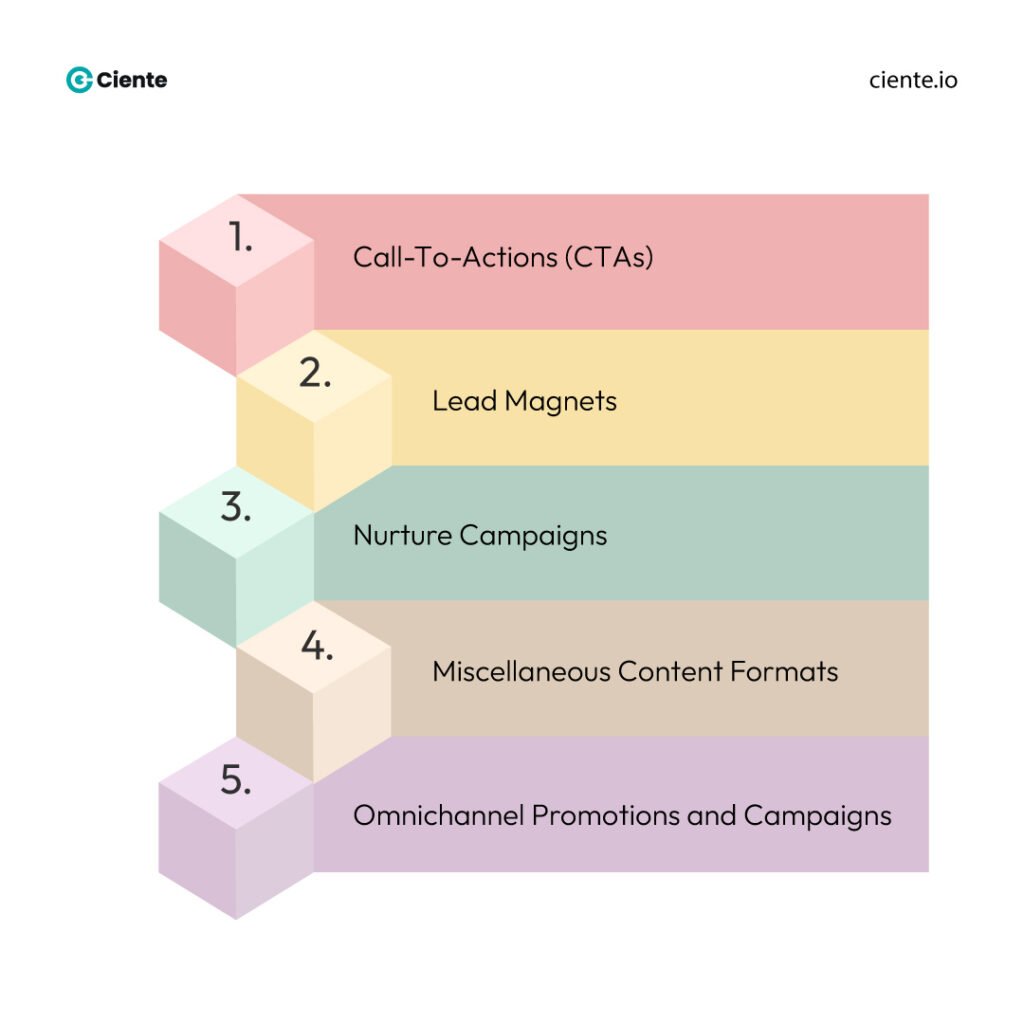
Here are the different ways in which integrating thought leadership with demand gen can prove effective for your brand –
Call-To-Actions (CTAs)
Call-to-actions guide prospects or users in taking the next step across the demand gen funnel, constituting awareness (TOFU), consideration (MOFU), and conversion (BOFU).
Your brand has already established itself as the thought leader. But through carefully placed call-to-actions (in blogs, podcasts, and emails), you urge the prospects towards the problem-solving step by implementing a smart demand gen strategy.
This could include asking them to sign up for weekly newsletters, downloading whitepapers & resources, and registering for webinars.
A strong CTA in a strategic and well-thought-out position convinces the leads to take action by telling them what to do next and guiding them through the decision-making process. When the prospects undergo a less exhaustive and complicated process (by hand holding them through the demand gen funnel), they are more likely to purchase, boosting the conversion rate. The trip through the funnel – from awareness to purchase – becomes hassle-free.
By providing their contact information, the clients have already moved to the next step of the tunnel, meanwhile, for marketers, acquiring leads becomes straightforward.
Lead Magnets
Marketing teams use lead magnets to create SQLs. They offer free resources or trial periods to collect the leads’ contact information.
This is how gated contents also work. Controlled access has become the new axiom of businesses. Remember that this type of content doesn’t contribute towards brand awareness or visibility because hidden content doesn’t drive traffic. It serves a different purpose.
The gated content should be valuable and informative, enabling users to provide their contact information in exchange. These should include topics that specifically resonate with the target audience and address their pain points.
When a prospect clicks on a CTA to avail of gated content, they are redirected to a landing page that has to be strong and provide value, like an eBook or a whitepaper. Meanwhile, the landing page includes a form before you access the content. This form should have clear instructions and be straightforward and user-friendly, allowing a simple user experience.
It is easier to receive the user’s email addresses and contact information, helping segment the accounts for effective email marketing campaigns.
This marketing method eventually helps marketing-qualified leads convert to sales-qualified leads efficiently, boosting the lead nurturing process.
Nurture Campaigns
Content has become one of the most sought-after tools in this fast-paced digital marketing era. It has helped generate demand, nurture leads, and convert them efficiently.
Following this, your brand can offer expertise and valuable insights, boosting engagement and increasing conversion rates through high-quality thought leadership content. The goal is to turn the cold leads into hot ones who will eventually make a purchase.
Thought leadership content can help your brand build this credibility and make it the go-to resource across a niche market. When prospective clients face a marketing challenge, you should be their primary solution provider.
Miscellaneous Content Formats
One of the top goals of integrating a demand gen strategy with thought leadership is to drive engagement. And diversifying your content formats is one way to achieve this. It may range from blogs, landing pages, podcasts, infographics to eBooks, whitepapers, and interviews.
This includes valuable, insightful, informative, and relevant content that taps into a niche market, helping situate your brand as the authority. On a broader scale, it should address complex issues in a specific domain.
Take marketing as an example. The iterated content should establish a correlation between the marketing challenges and your branding solutions. Ensuring subtlety in this regard will emphasize the professionalism that industry experts often exude.
Market your brand instead of selling it!
Take podcasts for example. This form of content has a longer shelf-life. They are easily accessible to visitors and offer an expansive library of valuable content that educates. When you target a niche market, thought leadership through a podcast can offer a deeper insight into complex topics, turning it into memorable and shareable content in solutions.
Sharing snippets from a podcast episode works as an interesting demand-gen strategy. They instill interest and drive the traffic towards the podcast or the associated landing page.
Content such as podcast series makes the target audience receptive to offers, establishing authenticity through expert opinions. This discussion type provides a humanistic tone, making the listeners believe that the speakers speak from years of experience rather than following a script.
Quality thought leadership content is an effective way to attract high-quality leads.
So, thought leadership pieces should focus less on the organization itself and more on the audience meeting their preferences.
Omnichannel Promotions and Campaigns
Promoting through different marketing platforms boosts visibility and drives traffic. When the content is published on these platforms, including social media, new audiences might gravitate towards it, depending on how much it resonates with them.
This strategy is one of the crucial ways the marketing team can use to reach the prospects effectively. It assists in generating leads, allowing you to track the performance of each channel individually.
However, different channels lack consistent and cohesive brand experience. Here, you may pair the thought leadership pieces with the right channel, depending on its format, size, and length.
For example, when you post a small LinkedIn caption interlinking other content published by your brand, those interested might tap on ‘learn more’, taking them to the podcast or the landing page. This boosts your website traffic along with your brand awareness.
However, the bottom line is that regardless of the platform you post your content on, it should carry a consistent expert tone and voice. It should seem like an extension of a brand and not sound like an altogether different brand.
Uniformity remains the key to successful marketing campaigns.
Thought leadership can help market your knowledge to the audience, interest invested prospects, and establish brand value.
Demand gen is educational and informative, benefitting your brand for the long term. It offers you the bigger picture – instituting you as the thought leader and amplifying your brand reach to a bigger audience. Collaborating with other industry experts will allow your brand to create a network driving demand generation.
This unique collaboration between thought leadership and demand gen aims to magnify your impact, broaden your reach, and amplify your brand voice. Lead generation remains crucial, but we often forget the significance of demand generation.
Integrating demand gen with thought leadership has only propelled its importance further. Through compelling content, such as podcast appearances and guest blogs, thought leadership puts forth a unique perspective available on an established platform.
Today, thought leadership makes efficient use of digital marketing platforms to reach fresh audiences, build a loyal following, and drive demand gen while serving the main purpose, i.e., establishing authority.
In the fast-paced digital scape, marketers use thought leadership as a strategic tool to generate revenue, demand, and lead. Therefore, none can argue that thought leadership has elevated demand gen.
Thought leadership with a demand gen program has a transformative impact on your brand and your audience. By embracing this marketing strategy, you allow trust, innovation, and credibility to seep in.
Every content educates your readers but thought leadership content transforms your brand into an indispensable resource.
If, as a developing business, you wish to cultivate a loyal following, aligning thought leadership with demand-gen goals will help solidify trust in your expertise.
Aligning your sales and marketing teams is a crucial propellor for generating high-quality leads. But how do you attain this?
Syncing sales and marketing is an ideal scenario that maintains your growth trajectory. The alignment also delivers a cohesive experience for the target customer base while generating high revenue returns. Although most businesses are aware of this, achieving the unison is easier said than done. Studies indicate that only 8% of brands have successfully aligned their sales and marketing divisions.
Content Marketing Institute found that in cases of misalignment between sales and marketing domains, around 70% of content generated by marketers goes unused because it lacks relevance to the buyer persona. Whereas, HubSpot believes that sales teams struggle to convert around 79% of leads due to a shortcoming to nurture leads. Getting sales and marketing on the same page involves establishing shared goals, strategies, systems, and processes to work unified as a brand. As a result, you can attain better outcomes from marketing activities, such as more closed deals, a higher ROI, and enhanced customer satisfaction.
What happens when Sales & Marketing are misaligned
It is a known fact that sales and marketing diligently work towards the same goal of driving growth and adding to the client network. However, they work in separate silos with different data sets, dealing with metrics, analytics, and so on. When they work as independent streams., it creates a monolithic environment having less capacity to leverage each other’s core competencies. Let’s look at some of the common problems that arise when both sides are working in synergy:
Siloed customer data
The absence of data unification can cause each team to be misinformed about their leads and customers and what they are seeking. For instance, if a sales team is unaware of the marketing strategy being implemented, it may be clueless about client interactions. Alternatively, the marketing team may not receive insights from the sales calls and end up launching campaigns for the wrong audience. This confusion can be avoided by fostering a strong alignment among these two domains.
Under-utilized sales content
Marketing teams strive to create relevant content designed for the target audience, specific to the platforms they frequent. However, if the sales reps do not provide input, all these efforts become futile. When marketers create various forms of content, be it infographics, industry reports, white papers, or some other materials, they need to communicate to the sales team the use of these resources. An alliance among these two sections can help address the sales rep’s needs and deliver result-oriented effective content.
Lead quality
Identifying the target audience is a catalyst to enhance your overall lead quality. Your sales team may focus on adding information-qualified leads, only to be disappointed when the prospects don’t convert into paying accounts. If sales and marketing together identify the lead categories and agree on lead scoring, they can operate more effectively. In this way, the sales team remains updated on the buyer’s journey and the data exchanged during the interactions. It also enables them to prioritize the prospects likely to convert into paying accounts.
The Benefits of Aligning Sales & Marketing
Simply put, misalignment of sales and marketing can hinder customer experience to a large extent. On the contrary, aligning these teams creates a synergistic cross-functional team that can drive your sales pipeline. The partnership between these two teams creates shared objectives and synchronized processes. The marketing branch can help sales generate, qualify, and nurture leads in the sales pipeline. Whereas, sales can promote marketing to bridge any gaps in the funnel. This alignment draws more high-quality leads while shortening the sales cycle. Let’s dive into why it is beneficial to align sales and marketing.
Effective Databank
The current B2B sales and marketing have geared towards a more fragmented solution generating large volumes of data but few insights. Aligning sales and marketing under a common plan results in an integrated tech stack that creates a high-quality data set for both teams.
Highly Motivated Teams
Sales and marketing alignment makes both teams work towards a common goal rather than competing with each other. The outcome is— better performance efficiency and higher revenue growth. Foster better cross-functional collaboration that also contributes to revenue growth. Moreover, aligned teams may be more inclined to stay, contributing to less employee churn.
Improved Resource Utilization
Sales are not involved in content creation. When there is better alignment between these teams, it allows you to deliver more customer-oriented and data-driven messages with input from sales.
Quick and Sustained Growth
Sales and marketing alignment brings them together to collaborate towards a common end goal— higher sales and growth. When everyone heads in the same direction, the friction between the two teams is greatly reduced and the resource utilization goes up. Additionally, the data can become more systematic and lead to streamlined organizational efficiency.
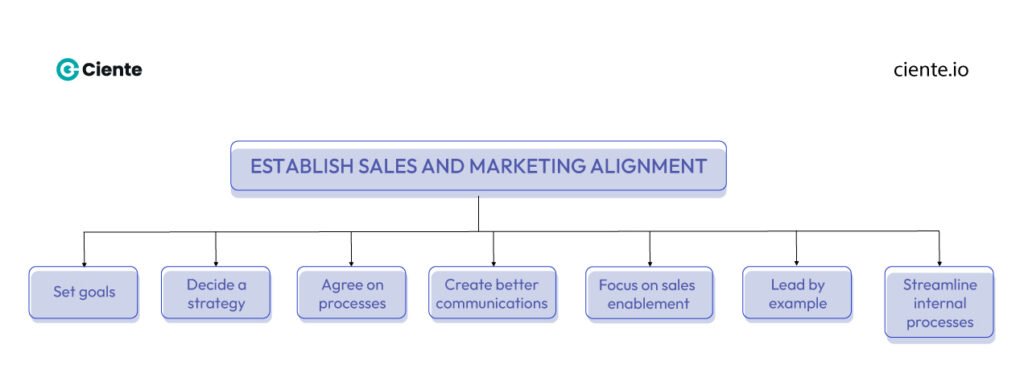
How to establish sales and marketing alignment
These best practices can be your go-to for bringing sales and marketing on the same page.
Set goals
If you may face misalignment, begin by defining objectives and allow both teams to recognize that they are working towards shared goals. This can be anything, from a company’s initiative to a new campaign to adding more clients, both teams must agree on business goals. A stepping stone to uniting sales and marketing is to bring their perspectives on the same page.
Decide a strategy
The next step is for both teams to avoid building independent go-to-market programs. Sales and marketing leaders need to meet regularly to map the buyer’s journey and discuss lead generation, conversion rates, inbound sales tactics, and more. Initiatives such as leadership offsite or regular standing bring clarity and ensure that these divisions work towards the shared goals you discussed previously.
Agree on processes
While executing business objectives, the sales and marketing managers will inevitably interact. If you have a model for promoting cross-functional collaboration, it makes it easy to instill clear communication and eliminate confusion surrounding responsibilities and expectations. Establish the sales and marketing elements upfront to streamline collaborative engagements and amp up the sales funnel.
Create better communications
Poor communication can trigger misalignment of sales and marketing. The best thing to do in such cases is to encourage centralized communication, which ensures that important conversations never go amiss. And transparency in the chain of communication is maintained. You can achieve centralized communication through tools or email campaigns.
Focus on sales enablement
A robust sales enablement framework improves the alignment between these teams. This forms a natural conduit between marketing and sales. For example, there is a sales enablement team to ensure that assets are not presented to sellers without training and guidance on effective application. Investing in a sales enablement team allows you to create reliable information between organizations.
Lead by example
When top leaders in your brand work hard to create the alignments, it works like a ripple effect across the team. Scheduling meetings between the leads of both teams to communicate the explore growth opportunities, offer feedback, and celebrate cross-functional wins can go a long way.
Streamline internal processes
You may be surprised to determine the influence of implementing organizational changes when aligning sales and marketing domains. In this step, introduce niche roles focusing on a specific aspect of the business, like strategy and development, demand generation, and nurturing prospects, for instance. You can also get content marketers on board to develop compelling messages aligned with each stage of the buyer’s journey. This stage is about building a solid framework for each phase of the customer journey, leading to a stronger collaboration between sales and marketing and driving business growth.
For every business that wants to survive the competition and thrive, aligning sales and marketing is no longer a choice. It is necessary to generate B2B leads and grow your brand. Evaluate the current state of these two teams in terms of alignment. The best practices listed here will guide you to build a cohesive relationship between these domains, enabling your teams to achieve the targets and create your mark in the industry.